Artículos
Social media and consumer buying decisions in tourism: The case of Turkey
Las redes sociales y las decisiones de compra de los consumidores en el turismo: el caso de Turquía
Social media and consumer buying decisions in tourism: The case of Turkey
PASOS. Revista de Turismo y Patrimonio Cultural, vol. 16, no. 4, pp. 1051-1066, 2018
Universidad de La Laguna

This work is licensed under Creative Commons Attribution-NonCommercial-NoDerivs 4.0 International.
Received: 08 January 2018
Accepted: 01 March 2018
Abstract: Social media play an important role in the consumer’s decision‑making process in tourism as they do in many other business areas. Tourism and hospitality marketers may reach more potential consumers in a shorter time and at a lower cost through the active use of social media. This study examines the influence of social media on the decision‑making process and online buying trends of tourism consumers and the potential relationships between participant demographics and some of the variables such as information obtained from social media, use of social media for tourism services, the act of buying, influence and intention to share travel experiences. A survey method was used to collect data from various social media users, and Structural Equation Modeling was employed for the data analysis. According to the results; statistically meaningful relationships were found between the variables of knowledge about tourism services in the media and perceptions of use, influence on customers, intention to share experiences and the act of buying tourism and hospitality services.
Keywords: Tourism marketing, Social media, Purchasing decision, Consumer preferences.
Resumen: Las redes sociales tienen un papel importante en el proceso de toma de decisiones del consumidor en el turismo como muchas otras empresas. Los comercializadores de turismo y hotelería pueden llegar a más consumidores potenciales en poco tiempo y a un costo menor a través del uso activo de las redes sociales. Este estudio examina el papel de las redes sociales en el proceso de toma de decisiones y las tendencias de compra en línea de los consumidores de turismo y las relaciones potenciales entre la demografía de los participantes y algunas de las variables, como la información obtenida de las redes sociales, la utilización de las redes sociales para los servicios turísticos, el acto de Compra, influencia e intención de compartir experiencias de viaje. Se utilizó un método de encuesta para recopilar datos de varios usuarios de redes sociales, y se empleó Modelización de ecuaciones estructurales para el análisis de datos. De acuerdo a los resultados; Se encontraron relaciones estadísticamente significativas entre las variables de conocimiento sobre servicios turísticos en los medios y las percepciones de utilización, influencia en los clientes, intención de compartir experiencias y actos de compra de servicios turísticos y de hospitalidad.
Palabras clave: Marketing turístico, Redes sociales, Decisión de compra, Preferencias del consumidor.
1 Introduction
Social Media, as information source for travelers, has revolutionized the lives of people within a decade of its introduction. It has gradually inculcated into our daily routine as a real time source of information (Mukherjee and Nagabhushanam, 2016). This is an interactive platform via which users create, share, communicate and discuss ideas, experiences and opinions (Shan et al., 2017). On the supply side of the markets, today social media is a platform where the firms sell and market their services and products at anytime and anywhere (Llach et al., 2013).
There are several approaches to define this relatively new phenomenon. For instance, Blossom (2009) consider the social media as a tool which creates opportunities for interaction with others ranging from individual to group. Similarly, Kaplan and Haenlein (2010, 61) define the social media as “a group of internet‑based applications that build on the ideological and technological foundations and that allow the creation and exchange of user generated content”. Abrahams et al. (2012, 88) also make a similar definition by saying that “it is online services that allows for social interaction, creating personal contents, non‑centralized applications with free membership”.
Internet usage, as a medium and an integral part of social media, has been developing tremendously since the 1990s through the increasing number of users and web portals. History has seen a wide range of technologies that have facilitated conversation and people have recently begun to use the digital media. Nowadays, there are a great number of websites for sharing photos and sharing videos. People have become accustomed to accessing information at any time and from a multiplicity of electronic devices and a growing quantity of the internet traffic worldwide comes from tablets and mobile phones (Adams, 2015; Mercadal, 2017). The web has opened an opportunity to reach niche buyers directly with targeted information that costs a fraction of what big budget advertising costs (Scott, 2015).
Turkey, as one of the countries where heavy social media users live all over the world, ranks the 5th among the European countries, and 12th in the world with its 46,3 million users in 2016, while there are more than 3 billion social media users worldwide (Ayvaz, 2016). As 42 million people actively use the social media, 36 millions of them access to social media pages via mobile devices. Among the most popular social media platforms, Facebook is the first place with its 32% share, and WhatsApp (24%), Facebook messenger (20%), Twitter (17%) and Instagram (16%) are following it respectively (Ayvaz, 2016). 77% of internet users are being online everyday and 16% of them are connecting to the internet once a week. The share of internet users was 41.6% of total population and the number of total users were 26.6 million in 2010 (Atadil, 2011, 51), so the numbers have approximately doubled in 6 years. The gender distribution of internet users was identified as male 56% and female 44%. The most noticeable increase was seen among the people over 55 years old by 20% which equals to 1.2 million people in total. At the same time, the internet framework covering the mobile communication is widespread in Turkey relative to other emerging economies (Gulbahar and Yildirim, 2015). These data show that the use of internet is very popular in the country and social media can be very effective marketing tool for tourism and hospitality businesses as well, in order to reach very large part of population.
On the other hand, Turkey is a leading tourism country as one of the top ten international tourism destinations for more than 35 million visitors with its rich supply potential. Turkish tourism consists not only of incoming foreigners but also nationals travelling abroad and in‑country visitors. Data show that there are 10 million outgoing citizens annually and, despite the lack of sufficient data about domestic tourism, it is estimated that the number has exceeded 20 million in recent years. These figures seem to be good reasons to examine the effects of social media on the tourism consumer purchasing behaviours in Turkey.
2 Literature Review and Background of the Study
2.1 Social Media and Tourism
Tourism is an information‑intensive industry and hence it is critical to understand the changes in technologies that impact the distribution and accessibility of travel‑related information (Xiang and Gretzel, 2010). Today, with social media, customers have more information sources such as blogs, tweets which can be having positive and negative, leaving an impression of the product in the reader’s mind (Subramani and Rajagopalan, 2003) and research has also suggested that customers believe information that comes from personal sources rather than commercial sources (Hu and Wei, 2013).
The major benefits of the internet as an effective communication channel in the hospitality and tourism industry were emphasized by the authors in the literature (Desai and Eric, 2015; Doolin et al, 2015; Schuckert et al, 2015). The fact that the online tourism and hospitality market is beneficial for both suppliers and travelers may be one of the best explanations for the rapid expansion of online transactions in travel and tourism markets (Yacouel and Fleischer, 2012). Research over the past 15 years shows that there has been a skyrocketing increase in travel and tourism sector in terms of both number of travelers and tourism expenditures (Sigala et al., 2012). During this period, tourism customers have become more active and have concerned about the information shared in social media that considerably reduces their decision making process (Bayram and Sahbaz, 2012). It is clear that the comments in social media definitely influence tourists’ perceptions at a significant level (Lopez et al., 2011). Social media have been widely adopted by travelers to search, organize, share, and annotate their travel stories and experiences through social media in a collaborative way (Leung et al., 2013, Xiang and Gretzel, 2010). Research has also revealed that more than 85% of leisure travelers use the internet as a planning source in recent years (Leung et al., 2013).
Milano et al. (2011) explain that the formation of travel experiences of tourism customers in social media platforms are composed of three stages of experiences as pre‑travel, on the travel and post‑travel. For these stages, before buying holiday services, customers can use the social media, ask questions about the destinations where to visit and stay, reading the previous customers’ comments. Consequently, social media is becoming very effective communication and recommendation tool for tourism customers.
2.2 Social Media and Marketing
Marketing through social media is relatively new medium for all types of businesses and the term social media marketing has been argued in different ways. For example, Weinberg (2009, 3) asserts that “it is a facility that allows firms to tap into wider customer profiles for sharing experiences, promoting the products through electronic social channels and websites in ways which were not possible with the conventional promotion channels”. Gunelius (2011) on the other hand, argues that social media marketing is any kind of direct or indirect marketing practiced through web tools such as social check‑in and content sharing sites, social networks which are used to create awareness among people. Wigmo and Wikström (2012, 20) also describe social media marketing as “an emerging way of promotion aiming for marketing as word‑of‑mouth, establishing relations through discussion with customers as opposed to one‑way communication”. Finally, Tuten and Solomon (2015, 21) argue that social media offer marketers opportunities to reach consumers where they work and live. According to them, social media marketing is “the utilisation of social media technologies, channels and software to create, communicate, deliver and exchange offerings that have value for stakeholders”.
Depending on the definitions mentioned above, recently developed marketing strategies in social media can be categorized into three groups as public relations, marketing the production of the content, and viral marketing (Miletsky, 2010). For the first, public relation staff is obliged to communicate the target groups of customers, as a result of rapid spread of conventional media. In the second category, there are blogs, websites, and other contents that are marketed to internet users. Finally, the contents produced by firms engaging in social media marketing need to be characterized by its virality. In addition to these three strategies, classical word‑of‑mouth (WOM) turned into e‑WOM and ORs (Online Reviews) which allow the users to express their feelings and opinions without any limitation. E‑WOM and ORs are becoming an increasingly important focus of research in marketing, e‑commerce, and e‑tourism studies and now used by customers as one of the most reliable sources to get information (Litvin, et al., 2006; Filieri and McLeay, 2013). Inducing, collecting, and displaying e‑WOM have become priorities of many companies as part of their efforts to stimulate sales, increase brand awareness and brand liking, consumer engagement and loyalty (Rosario et al., 2016; Ashley & Tuten, 2015; Banner, 2017; Read, 2016). Numerous studies in the literature pointed out the major benefits and some unique characteristics of social media such as; low cost, easy participation and free access, global reach, simplicity and flexibility, more publicity, dialogue among participants, community/group access, robust relations with customers, easy connectivity, user‑friendly design, measurability and eternality (Weinberg, 2009; Elley and Tilley, 2009; Adams, 2011; Islek, 2012; Salcido, 2015; Jackson 2015; Banner 2017). Depending on these benefits and characteristics, social media is now becoming an indispensable part of the marketing mix for many businesses. In this context, Tuten and Solomon (2015) argued that a “fifth P” could be added to classical marketing mix as “Participation”.
2.3 Social Media and Marketing in Tourism
The use of internet has been common in tourism industry for a long time and the internet‑based technologies are utilized at every stages of marketing in tourism and hospitality. Intermediaries and principals have been able to establish close relationships with potential customers through web pages (Ekinci, 2004). This industry is inevitably influenced by the new business environment created by the diffusion of ICTs and thus, tourists become co‑marketers, co‑designers, co‑producers and co‑consumers of travel and tourism experiences (Sotiriadis and Zyl, 2013). These new technologies and social media are now key to growth in tourism industry which is characterized as high in experiential qualities that consumers find it more difficult to evaluate attributes before purchase (Ban et al., 2015). The specific nature of services provided by tourism and hospitality firms has been a fertile terrain for the rapid widespread and use of social media by travelers and tourism operations (Minazzi, 2015).
Tourism and hospitality practitioners need to consider how consumers evaluate the information content and booking features through various digital platforms (Murphy et al., 2016). It is argued that tourism firms use social media for the purposes of creating interest to their properties, introducing promotions, drawing the media attention, and creating awareness, recognition and promotion of their brands (Eroz and Dogdubay, 2012). As the messages posted on social media platforms by tourism businesses are the major medium of advertising and promotion, a slightly negative word or tweet, post and comment shared in social media may easily tarnish the reputation and image of the firm (Kim and Ko, 2012; Curkan, 2013; Leung et al., 2017). As a consequence, the growth of social media has created a more level playing field in which tourism businesses have the opportunity to launch marketing campaigns that encompass large populations (Mercadal, 2017). Likewise, tourists on the demand side, plan their all trip details ranging from flight and hotel reservation to car rentals through the internet (Wheeler, 2009). This means that all the parts and elements of tourism industry are open to use social media. Travel and tourism industry is more depended on word‑of‑mouth marketing than any other sectors due to its intangible and perishable service nature. For tourism customers, the only way to get more information about the tourism product is either to try the service (if possible) or from a person who has experience with the service. Therefore, customers rely more on personal sources such as “recommendation by friends” to make purchases.
The word “friends” in social media can be referred as Para‑Social Interaction (PSI) which refers to the illusion face‑to‑face relationship using media as a platform (Hu and Wei, 2013).
2.4 Social Media and Tourist Decision Making
According to Kotler et al. (2003, 218) customers go through five stage of purchasing decision process when making a purchase decision. These are need recognition, information search, evaluation, purchase decision and post‑purchase decision. In this model, “information search” is the most important stage for today’s customers. Customers will decide how much information is needed by searching around via social media as a platform where explicit knowledge flow occurred when someone commented on the piece of information (Angeli et al., 2009).
As an information source, the importance of internet for tourism industry has been documented by various authors and social media research is an emerging field that has received increased attention from tourism scholars of various disciplines in order to understand the consequences on tourists’ behavior, decision making and corporate communication (Minazzi, 2015). A number of studies can be found in the literature about social media and its effects on consumer buying decision. Kaplan and Haenlein (2010) investigated the challenges and opportunities experienced in marketing through social media. The study indicated that the social media could be used as an opportunity in understanding the consumer decisions making process. Milano et.al (2011) studied the impact of online social media on tourism websites. In this study, Italian tourism websites were analyzed in terms of frequency of visits. The study concluded that the websites connected to the social media were more effective and efficient in tourism marketing than classical promotional tools.
Atadil (2011) examined the perceptions of social networks of tourism customers and his study shows that the participants intensively get information about the hotels through social media. It was also found that this set of information gathered through social media plays a critical role on their selection of hotels. Eroz and Dogdubay (2012) investigated the functions of social media in relation to marketing ethics. Their study results explained that social media functioned as a valuable means for the selection of tourism services. Ciftci and Kucukaltan (2012) investigated the use of social media as a marketing tool and they discovered that the hotels were active and productive social media users. Sigala et al. (2012) studied the cases about social media, tourism and hosting. Their study emphasized the potential ways of developing various use of social media in tourism by synthesizing information and knowledge gathered from relevant studies.
As more recently studies, Munar et al. (2013) investigated the transformative power of tourism social me‑ dia in their e‑book. Zivkovic et al. (2014) explained that the tourists are heavily influenced by social media and they transform information obtained from social media into the travel decision making process. Again, Arat (2016) investigated the role of social media on tourism demand using content analysis and tried to explain how hotel services manage their facebook accounts and which features they use. Mkono and Tribe (2017) described the user roles on social media as troll, activist, social critic, information seeker, and socialite using a netnographic approach which can be used by tourism businesses and destination managers.
In the literature, most recent studies have looked at the role of social media on leisure preferences (Aydin and Aslan, 2015), on travel information search (Chung and Koo, 2015), on marketing including destination marketing and destination image (Shengnan et al., 2012; Hays et al, 2013; Mostert, 2015; Minazzi 2015; Roque and Raposo, 2016; Kim et al., 2016), on brand trust and social media brands (Khanlari et al., 2016; Harrigan et al., 2017). Finally, Kavoura and Stavrianea (2014) studied the economic and social aspects of social media in tourism; and Sotiriadis (2017), Lee and Paris (2013) and Okazaki et al. (2017) explained that the importance of sharing tourism experiences and knowledge of travelers in social media.
Similarly, most of the studies show that social media have been widely embraced by travelers in order to search, organize, share, and declare their travel stories and experiences through blogs, online communities, media sharing sites, social bookmarking sites, social knowledge sharing sites, and other tools in a collaborative way (Hays et al., 2013). The studies clearly show that social media is an effective tool for marketing especially in the field of tourism and it can be asserted that the consumers’ decision making process for online tourism purchase is directly linked to the social media marketing.
3 Methodology
3.1 Objective of the Study and Hypotheses
The basic objective of this study is to reveal the social media‑related factors impacting the consumer decision‑making process of buying tourism and hospitality services. More specifically, the study aimed to shed light on the possible variables that promote or reduce the chances of using online platforms to buy hospitality and tourism services. The study differs from the earlier studies in terms of 1) the proposed model and designated variables, 2) target groups (social media users as potential customers for tourism services) and their buying process, 3) Data analysis technique as Structural Equation Modelling (SEM), which is used to analyze the structural relationship between measured variables and latent constructs. SEM is a technique that considers the measuring errors of the relationship into the dependent and independent variables in a given model. SEM has appeared from the point of view of Multiple Regression Analysis, Explanatory Factor Analysis, Confirmatory Factor Analysis and Simultaneous Equations Model and approaches to the relationships between observable and latent variables and examines the structural model of the relationship between latent variables (Bayram, 2010). This method is preferred by the researcher because it estimates the multiple and interrelated dependence in a single analysis.
Figure 1 displays the proposed conceptual model and hypotheses to be tested in the research.

Figure 1
Proposed model and relationships between the variables
Based on the above discussed literature and the conceptual model displayed on the Figure 1, the hypotheses listed below were proposed in order to explain the relationships between previously determined variables. These variables are “knowledge and utilisation” (Lopez et al., 2011), “knowledge and influence” (Kotler et al. 2003; Hu and Wei, 2013; Tuten and Solomon, 2015), “utilisation and purchase” (Ekinci 2004), “influence and purchase” (Zivkovic et al., 2014), “purchase and sharing experiences” (Bayram and Sahbaz, 2012; Hu and Wei, 2013), “information and intention‑as a post purchase behavior” (Kotler et al., 2003; Kim and Ko, 2012; Curkan, 2013; Hays et al., 2013; Zivkovic et al., 2014), “information and purchase action” (Kotler et al., 2003; Litvin et al., 2006; Filieri & McLeay, 2013), and “influence and utilisation” (Kotler et al., 2003; Zivkovic et al., 2014).
The hypotheses from H9 to H15 were proposed in order to explain the mediatory roles of the related variables in the model;
H1: As individuals’ knowledge (information) about tourism service or product increases through social media, their perceptions of utilizing them also increase.
H2: As individuals’ knowledge about tourism service or product increases through social media, they will be more influenced by them as well.
H3: As individuals utilize tourism service or product increasingly in social media, the chance of buying them also increases.
H4: As individuals are influenced more by the tourism service or product in social media, the chance of buying them also increases.
H5: As individuals buy more tourism and hospitality services in social media, the chance of sharing these experiences also increases.
H6: As individuals’ knowledge about tourism and hospitality services increases through social media, their acts of buying them increase too.
H7: As individuals’ knowledge about tourism and hospitality services increases through social media, their intention to share these experiences increases as well.
H8: As individuals are influenced more by the tourism and hospitality services in social media, the chance of utilizing them also increases.
H9: Individuals’ perceptions influenced by the tourism and hospitality services in social media play a mediatory role between being informed by social media and buying them.
H10: Individuals’ perceptions of utilizing the tourism and hospitality services in social media play a mediatory role between beian informed by social media and buying them
H11: Individuals’ perceptions influenced by the tourism and hospitality services in social media play a mediatoryrole between being influenced by social media and buying them.
H12: Individuals’ perceptions influenced by the tourism and hospitality services in social media play a mediatory role between being informed by social media and their utilisation.
H13: Individuals’ acts of buying the tourism and hospitality services in social media play a mediatory role between utilizing social media and intention to share experiences.
H14: Individuals’ acts of buying the tourism and hospitality services in social media play a mediatory role between being informed by social media and buying them.
H15: Individuals’ acts of buying the tourism and hospitality services in social media play a mediatory role between being influenced by social media and intention to share experiences.
In this study, a survey method was employed to investigate the potential impact areas of social media platforms on the decision‑making process of customers for tourism services. To this end, an online self-administrated questionnaire was developed and particular dimensions were created among the items. The questionnaire as data collection instrument, consisting of respondent demographics and the statements under five dimensions of buying process (information, utilisation, influence, purchasing and intention to share), was constructed by the authors on the basis of available literature to address the several relevant issues concerning the decision‑making process. The questionnaire contains 5 point Likert scale items changing the options depending on the degree of participants’ agreement to the statements. The content and structure of data collection instrument (questionnaire) were tested and verified at the pilot study stage. The time frame, nationality and location of target groups, collecting the data through the internet and the rate of responses are the major constraints of this study.
2.2. Universe and Sampling
The target population (universe) of this research consists of the people who are between the ages of 20‑45, accessible via e‑mail or internet, the members of social networking websites, and located (live) in Izmir, Istanbul, Antalya and Ankara as the largest cities of the country. In order to reach them, a web link for online questionnaire was sent out to the potential respondents on the dates between March and June, in 2015. Random Sampling Techniquewithin which the every member of population has equal chance of being included in the sample, was used in order to reach the target group. The questionnaire was delivered to over 700 people in total, and after removing inappropriate and uncompleted questionnaires, 352 of them were processed for data analyses. The chi‑square value was 762,02 as the degree of fitness (df) was 243 and the ratio between two values (x2/df=3) verifies the minimum fit function chi‑square and the acceptability of sample size. The distribution of all participants based on their demographics, social media behaviours and number of holidays spent per year can be seen on Table 1.
2.4 Data Analysis and Findings
The data were analysed through Structural Equation Modelling (SEM) as mentioned above and the items on the questionnaire were analysed by confirmatory factor analysis. After this process, a reliability analysis was carried out again. However, there was no item that would increase the reliability degree when removed. Hoteling T Square was used to investigate whether there were average equalities among all the items in the scale and no question was found whose averages are equal. The consistence scaling was calculated for the structural equation model developed to find out the relationships between the designated variables. The statistical confirmatory scores for the model are as follows;
1:x2=762,02 DF=243: x2/df=3,13, RMSEA=0,078, NFI=0.98, NNFI=0.98, PNFI=0, 86, CFI=0.98, IFI=0.98, RFI=0.97, GFI=0.85, RMR=0.038, SRMR=0.047 AGFI=0.81.
The scales obtained show that the model is above the lowest acceptable level (Figure 2).
| Age distribution | Frequency | Percent | Income | Frequency | Percent | |
| 20‑25 | 76 | 21,6 | Under 1500 | 51 | 14,5 | |
| 26‑30 | 55 | 15,6 | 1500‑2000 | 96 | 27,3 | |
| 31‑35 | 61 | 17,3 | 2001‑2500 | 100 | 28,4 | |
| 36‑40 | 75 | 21,3 | 2501‑4000 | 71 | 20,2 | |
| 41 + | 85 | 24,1 | 4001 + | 34 | 9,7 | |
| Total | 352 | 100,0 | Total | 352 | 100,0 | |
| Education | Social Media Usage(per access‑minutes) | |||||
| Primary | 8 | 2,3 | 10‑30 | 30 | 8,5 | |
| Secondary | 16 | 4,5 | 30‑45 | 29 | 8,2 | |
| High School | 44 | 12,5 | 45‑60 | 89 | 25,3 | |
| Vocational S. | 58 | 16,5 | 60‑120 | 117 | 33,2 | |
| Undergraduate | 166 | 47,2 | 120‑180 | 51 | 14,5 | |
| Masters+ | 60 | 17,0 | 180 + | 36 | 10,2 | |
| Total | 352 | 100,0 | Total | 352 | 100,0 | |
| Gender | N of holidays | |||||
| Female | 187 | 53,1 | 1 | 61 | 17,3 | |
| Male | 165 | 46,9 | 2 | 163 | 46,3 | |
| Total | 352 | 100,0 | 3 | 94 | 26,7 | |
| 4 + | 34 | 9,7 | ||||
| Total | 352 | 100,0 | ||||
| Marital status | ||||||
| Single | 186 | 52,8 | ||||
| Married | 166 | 47,2 | ||||
| Total | 352 | 100,0 |
The reliability of the responses in the scale was calculated by Cronbach’s Alpha statistics, and all the items were found reliable. The results of the reliability analysis and the descriptive statistics of scales are displayed in Table 2.
| Dimensions (D) & Items (statements) | Average | Std. Dev. | Correlation | When omitted Cronbach’s Alpha | Cronbach’sAlpha | Scale average | Scale variance |
| D1 - InformationB1 - Social networking sites provide information about hotels and other tourism services. | 4,27 | ,857 | ,842 | ,899 | ,924 | 4,139 | ,734 |
| B2 - Social networking sites provide information about tourism and hospitality services while making decisions. | 4,18 | ,805 | ,863 | ,896 | |||
| B3 - I subscribe on the social networking sites concerning my favorite hotels and tourism destinations; and I follow their updated notifications. | 3,97 | 1,007 | ,717 | ,930 | |||
| B5 - Social networking sites are informative before trips. | 4,13 | ,810 | ,832 | ,902 | |||
| B6 - Social networking sites contribute to the promotion of tourism and hospitality services. | 4,15 | ,785 | ,798 | ,909 | |||
| D2 - Utilisation (of SM for tourism services) Y1‑I have the chance to access the websites of the tourism services easily via social networking sites. | 4,17 | ,748 | ,788 | ,912 | ,925 | 3,995 | ,769 |
| Y2‑Social networking sites help me to make faster decisions about the tourism and hospitality services, I want to buy. | 4,08 | ,811 | ,800 | ,910 | |||
| Y3 - I make use of the posts and the comments of the people on social networking sites while deciding. | 4,07 | ,883 | ,838 | ,904 | |||
| Y5 - I check the pictures of the hotels on the pages of the social networking sites concerning tourism and hospitality services. | 4,07 | ,857 | ,766 | ,914 | |||
| Y6 - I carefully check all of the special offers on the social networking sites concerning the tourism and hospitality services that I am planning to buy. | 3,96 | ,881 | ,837 | ,904 | |||
| Y7‑ I ask/post questions on social networking sites while I am deciding the tourism and hospitality services that I am planning to buy. | 3,63 | 1,052 | ,720 | ,925 | |||
| D3 ‑Influence (of others)E1 - Positive comments of the users on social networking sites make me trust the tourism and hospitality services I am interested in. | 3,86 | ,863 | ,749 | ,787 | ,850 | 3,730 | ,881 |
| E2 - I think the comments of the experienced tourists on social networking sites are reliable. | 3,59 | ,935 | ,774 | ,772 | |||
| E3 - I am easily affected by the comments on tourism services posted on social networking sites. | 3,38 | 1,095 | ,634 | ,844 | |||
| E5 - I can make better decisions about my tourism activities by the help of social networking sites. | 4,09 | ,840 | ,632 | ,833 | |||
| D4 - BuyingSA1 - I check all of the posts on social networking site about the tourism and hospitality services that I am the stage whether to purchase or not. | 3,98 | ,842 | ,854 | ,915 | ,936 | 4,003 | ,728 |
| SA2 - I might purchase a trip for a tourism destination which is posted on a social networking site. | 3,99 | ,835 | ,886 | ,905 | |||
| SA3 - I might order a tourism and hospitality service that is being advertised via social networking sites. | 3,96 | ,905 | ,879 | ,907 | |||
| SA5 - I might make preferences among destinations according to the comments on social media. | 4,09 | ,829 | ,781 | ,938 | |||
| Dimensions (D) & Items (statements) | Average | Std. Dev. | Correlation | When omitted Cronbach’s Alpha | Cronbach’sAlpha | Scale average | Scale variance |
| D5 - Intention (to share travel experiences as a post purchase behaviour)N1 - I like sharing the pictures of the places I have visited during my trips on social networking sites; and I like posting comments about them. | 4,08 | ,902 | ,826 | ,920 | ,934 | 4,027 | ,724 |
| N2 - I share my holiday experiences on social platforms and consequently I encourage my friends for such trips. | 4,03 | ,872 | ,849 | ,915 | |||
| N3 - I share my opinions regarding to both positive and negative comments I experienced at a hotel on social platforms. | 3,98 | ,867 | ,845 | ,916 | |||
| N4 - I think, day by day, many people are going to arrange trips by making use of social platforms; and then they are going the share their opinions via comments. | 4,08 | ,811 | ,798 | ,925 | |||
| N7 - I am going to encourage my friends in the future to use social media for such purposes. | 3,97 | ,798 | ,814 | ,922 |
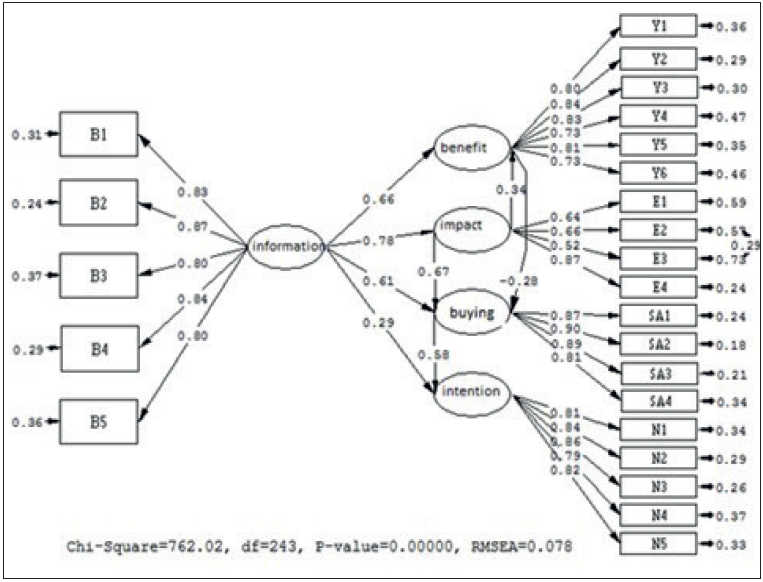
Figure 2
Structural model and full relationships between the variables.
All the relationships between the variables are shown on Figure 2 above. Based on the diagram, the results can be listed as below;
-
A statistically meaningful relationship (0,66) was found between knowledge (information) about tourism and hospitality services in the media and their perceptions of utilizing them. Knowledge about such services is found to be related to the latent variable of utilisation (0,44 units) (t = 10,33; p < 0,01). Therefore H1 is retained.
-
A significant relationship (0,78) between knowledge about tourism and hospitality services in the social media and influence on customers was found with a variance of 0,61 (t = 10,83; p < 0,01). Therefore H2 is retained.
-
Participants’ utilisation of tourism and hospitality services in the media is found insignificantly linked (0,28) with the act of buying in the opposite direction (t = ‑1,59; p > 0,05). Therefore H3 is rejected.
-
A relationship (0,67) between the act of buying tourism and hospitality services in the social media and influence on customers was found with a variance of 0,45 (t = 5,97; p < 0,01). Therefore H4 is retained.
-
A significant relationship (0,67) in the same way between the act of buying tourism and hospitality services in the social media and their intention to share their experience with others was found with a variance of 0,34 (t = 6,88; p < 0,01). Therefore H5 is retained.
-
A relationship (0,61) between the act of buying tourism and hospitality services in the social media and their knowledge about them was found with a variance of 0,37 (t = 4,66; p < 0,01). Therefore H6 is retained.
-
A relationship (0,61) between the knowledge about tourism and hospitality services in the social media and the degree of intention to share their experiences was found with a variance of 0,08 (t = 3,60; p < 0,01). Therefore H7 is retained.
-
A relationship (0,34) between the level of influence and the degree of utilisation was found with a variance of 0,12 (t = 5,48; p < 0,01). Therefore H8is retained but at a relatively low level.
-
Perceptions influenced by tourism and hospitality services in the social media have a mediator role between information and the act of buying. Therefore H9 is retained.
-
Perception of utilisation of tourism and hospitality services in the social media has not a mediator role between information from social media and the act of buying. A negative relationship (‑0,28) between the latent variable (utilisation) and the act of buying was identified and accordingly H10 is rejected.
-
Perception of utilisation of tourism and hospitality services in the social media has not a mediator role between level of influence and the act of buying. Due to the negative relationship (‑0,28) between the latent variable (utilisation) and the act of buying, H11 is rejected.
-
Perceptions influenced tourism and hospitality services in the social media have a mediator role between having information from the social media and their utilisation. Therefore H12 is retained.
-
Act of buying tourism and hospitality services in the social media has not a mediator role between the utilisation of social media and the intention to share experiences. Since, a negative relationship (‑0,28) between the latent variable (the act of buying) and their utilisation was found. Therefore H13 is rejected.
-
Act of buying the tourism and hospitality services in the social media have a mediator role between the information obtained from the social media and intention to share their experiences. Therefore H14 is retained.
-
Act of buying the tourism and hospitality services in the social media have a mediator role between the level of influence and intention to share experiences. Therefore H15 is retained.
The relationships between the latent variables or those variables observed through latent variables are investigated through (t) values. The (t) values higher than 1,96 explain the correlation at significant level. The vast majority of (t) values measured are higher than this coefficient indicate that all values are statistically meaningful, and only one of them measured as smaller than 1,69, reflecting the relationship between the variables as of buying process and benefits sought.
The structural equation regressions that could be established to determine the impact of social media platforms in the decision‑making process while buying products or services from social media are displayed as follows. R2 values in the structural equations are referred to as R2 in the regression analysis.
Structural regression equations of these analyses accompanied by R square values are expressed as the followings;
| utilisation | = 0.34 x influence + 0.66 x information, | R² = 0.90 |
| influence | = 0.78 x information, | R² = 0.60 |
| buying | = ‑ 0.28 x utilisation + 0.67 x influence + 0.61 x information, | R² = 0.87 |
| intention | = 0.58 x buying + 0.29 x information, | R² = 0.72 |
Reduced structural regression equations were determined as,
| utilisation | = 0.93 x information, | R² = 0.86 |
| influence | = 0.78 x information, | R² = 0.60 |
| buying | = 0.86 x information, | R² = 0.74 |
| intention | = 0.79 x information, | R² = 0.63 |
According to the results, as one of the major determinants, the most of the information received from social media for tourism and hospitality services was obtained from B2 variable with a 0,87 coefficient while a lesser amount of information received from B3 and B5 variables with a 0,80 coefficient in the Model (Figure 2). B2 observed variable is related to the latent variable (information) with a value of 0,872. 0,76 or 1 - 0,24 = 0,76, as B3 or B5 variables are slightly related to the same latent variable with a 0,64 value. The other relationships in the figure were measured in the same way.
2.5 Social Media Behaviours of Participants
The research also analysed whether there is a relationship between participants’ demographic profiles as independent variables and their responses to different questions as dependent ones. The averages of responses were calculated to obtain an average value for each scale of units. Parametric statistical analysis was carried out to identify the possible differences among the responses. Major and statistically (Bonferroni as a multiple comparison test, ANOVA‑ with F values between 4,706 ‑ 24,145 and p values between 0,028‑0,001 for all cases) meaningful relationships are listed as follows;
-
Senior participants (41+ years) are having more information about tourism and hospitality services from social media and web pages than youth.
-
Younger participants (36‑40 years) are more influenced by social media than seniors (41+).
-
Participants between 36‑40 years old are buying more tourism and hospitality services through web pages than youths (20‑25 years old)
-
Well‑educated participants (university+) are obtaining more information about tourism and hospitality services from social media than lower educated groups.
-
Lower educated participants utilize the social media less than well‑educated ones.
-
Lower educated participants are influenced by social media less than all other groups.
-
Lower educated participants have intention to share their tourism experiences through social media less than all other groups.
-
Higher income groups (17,500+ USD) are having more information about tourism and hospitality services from social media than lower income groups (less than 8,500 USD).
-
Lower income group participants are less utilizing social media than higher income groups.
-
Lowest income group participants (less than 6,500 USD) are influenced by social media less than higher income group members.
-
Lower income group participants are inclined to buy tourism and hospitality services through social media less than higher income groups.
-
Participants having more holidays (up to 4 times) per year are having more information about tourism and hospitality services from social media than those having fewer holidays (one or two).
-
Participants having more holidays per year utilize the social media more than those having fewer holidays.
-
Participants having more holidays per year are more influenced by social media than those having fewer holidays.
-
Participants having more holidays per year are purchasing more tourism and hospitality services through web pages than those having fewer holidays.
-
Participants having more holidays per year are reflecting more intention to share their tourism experiences through web pages than those having fewer holidays.
3 Conclusion and Comments
This study is basically focused on the effects of social media on the customer decision‑making process in tourism. More specifically the investigation examined how people use social media for their purchases in tourism such as buying services online, and how their purchasing behaviours are influenced by social media. The results of the research are important in that they highlight how people change their purchasing habits for tourism and hospitality services from social media tools.
Based on the results, it was found that information, utilisation, influence, buying and intention (to share their travel experiences) are interlinked stages in consumer decision‑making process. This cyclical process can form the basis of any tourism marketing through social media as Kaplan and Haenlein (2010) investigated in their studies. This also shows how fragile this marketing process is in that when one stage fails, another will also be influenced subsequently. Since the significant relationship between the degree of information and the possibility of utilizing them has been identified in the study as supported by the many other studies (Milano et al. 2011; Sigala et al. 2012; Zivkovic, 2014), it can be claimed that there is a clear need for developing the quality of information published through the social media by the tourism and hospitality services marketers. Similarly, the degree of utilisation of tourism services in social media is directly related to the individual buying behaviour. With respect to the post‑purchase and product utilisation, the social media users are also inclined to share their online experiences to others and willing to future purchases as presented in many studies (Bayram and Sahbaz, 2012; Hays et al. 2013; Paris, 2013; Okazaki, 2017; Sotiriadis, 2017). This could also have a great impact on the potential consumers.
The results of this study indicates that, as individuals’ knowledge about tourism services increases through social media, their acts of buying them also increase. Knowledge about tourism services is also an important determinant for buying services through social media that motivates the intention to share individual experiences. In other words, the more knowledgeable the people, the more inclined to share their experiences online. Any comments shared by these consumers may promptly create positive or negative perceptions among the other users as supported by some other research (Atadil, 2011; Lopez et al. 2011). The level of influence from the tourism and hospitality services in social media is directly linked to utilizing them. In this context, this study differs from other studies by identifying some of the social media related factors effecting purchase decisions for tourism services such as information obtained from social media, utilisation level of social media for tourism services and being influenced by the messages on social media. As post purchase behavior (Kotler et al. 2003), intention to share the travel experiences is found to be a significant dependent variable.
Finally, with respect to the demographics, one of the important findings is the fact that university students between 19‑28 ages do not buy tourism and hospitality services through social media, despite their intensive use of social media. This is an important signal for those companies that target this group as a key market and they can have an opportunity to develop their services with strong long‑term strategic decisions. Another critical finding was the fact that, as the level of education decreases, so does the degree of planning and buying tourism and hospitality services through social media.
4 Managerial Implications
The study argues that consumer buying process for tourism and hospitality services heavily influenced by social media interactions and information obtained from this platform due to its high level of reliability. Hence, the results provide tourism and hospitality marketers with a frame of a reference to determine what they need to know and how to implement actions through social media as an effective marketing tool. Tourism marketers can facilitate the process of information flow through social media and this influence provides a noteworthy contribution to their marketing and sales efforts. As a consequence, it seems that creating any impact on social media is a critical stage that motivates the people to buy tourism and hospitality services, as the buying process for tourism services is not simple and straightforward, but rather a flexible process that involves the interaction among consumers at every stage of the service utilisation particularly in the social media.
The following implications for tourism marketers can be suggested to use social media effectively and gain competitive edge;
-
Marketers should take social media users into consideration as a part of their marketing information system (MIS).
-
Innovative social media strategies, including consumer‑friendly interaction and complaints should be developed for pre‑travel, on‑the‑travel and post‑travel stages of the customers. Instant access will always be open to this community.
-
Accessibility of tourism and hospitality services through social media could increase the number of people who want to buy these services, creating a unique opportunity for marketers to reach more consumer groups than ever before.
-
Integrating tourism and hospitality services into the individual social media accounts by establishing an online feedback system can be designed as an extension of marketing intelligence at a lowest cost.
5 Future Research Directions
This study provides some initial insights, and we are hopeful that the social media can be useful for many tourism businesses and will be an interesting study and research area for the academicians who are involved in the topic. The focal point of this study was discussing the potential effects of social media platforms on the consumer decision process to purchase any tourism and hospitality service, mostly hotel rooms, airline tickets, car rentals etc. The model proposed in this study could be validated by further studies on different societies and/or nationalities in order to compare the behaviours about social media usage and travel decisions.
The implications of social interactions on social media and their influence on consumer purchasing behaviour could be understood by further and more detailed studies as mentioned above. Since, the sample size is relatively small in this study, more studies should be conducted with larger representative samples. It is well known that social media will increasingly continue to affect the every aspects of our life, and this study only provides a small insight into this important phenomenon.
Bibliography
Abrahams, A., Jiao, J., Wang, A. & Fan, W. 2012. Vehicle Defect Discovery from Social Media. Decision Support Systems. 54 (1): 88.
Adams, D. 2015. The History of Social Media. http://www.winnerscience.com/wp‑content/uploads/2012/06/factors‑‑affecting‑price.png, Access: April 20‑2015.
Angeli, F., Grimaldi, R. & Grandi, A. 2009. Directions and paths of knowledge flows through personnel mobility: A social capital perspective.
Arat, T. 2016. The Role of Social Media in Tourism, Proceedings of 25. International Academic Conferences, International Institute of Social and Economic Sciences. 06‑09 September, Paris. 37‑52.
Ashley, C. & Tuten, T. 2015. Creative Strategies in Social Media Marketing: An exploratory study of branded social content on consumer engagement, Psychology and Marketing, Vol. 32: 15‑27. Issue 1, January.
Atadil, H.A. 2011. Otel Isletmelerinde Sosyal Medya Pazarlamasi: Turizm tuketicilerinin sosyal paylasim sitelerine iliskin algilari uzerine bir alan calismasi. Yuksek Lisans Tezi. Dokuz Eylul Universitesi, Sosyal Bilimler Enstitusu, Turizm Isletmeciligi Anabilim Dali.
Aydin, B. & Aslan, E. 2015. The Role of Social Media on Leisure Preferences: A Research on the Participants of Outdoor Recreation Activities, Proceedings of the 5th Multidisciplinary Academic Conference. October, Prague, 1‑9.
Ayvaz, T. 2017. http://www.dijitalajanslar.com/internet‑ve‑sosyal‑medya‑kullanici‑istatistikleri‑2016/ Access, March‑2017.
Ban, O., Ancusa, V., Bogdan, V. & Tara, I. 2015. Empirical social research to identify clusters of characteristics that underlie the online evaluation of accommodation services. Revista De Cercetare Si Interventie Sociala, (50) 293–308.
Banner, M. 2017. “How social media has evolved over the past 12 Years”, http://www.convinceandconvert.com/social‑media‑strategy/how‑social‑media‑has‑evolved/ (Access: 10.11.2017).
Bayram, N. 2010. Yapisal esitlik modellemesine giris AMOS uygulamalari. Bursa: Ezgi Kitabevi.
Bayram, A. & Sahbaz, P. 2012. Turizm İşletmelerinde Sosyal Medya Kullanımına Örnekler. 13. Ulusal Turizm Kongresi Bildiriler Kitabı, 06‑09 Aralık, Antalya: 353‑360.
Blossom, J. 2009. Content Nation‑ Surviving and Thriving as Social Media Changes Our Work, Our Lives and Our Future. Wiley Publishing.
Chung, M. & Koo, C. 2015. The use of social media in travel information search, Telematics and Informatics. May, 32 (2): 215‑229.
Ciftci, G. & Kucukaltan, D. 2012. Sosyal Medyanin Konaklama Isletmelerinin Pazarlamasindaki Rolu ve Ornek Uygulamalari. 13. Ulusal Turizm Kongresi Bildiriler Kitabi, 06‑09 Aralik, Antalya, 1232.
Curkan, S.C. 2013. Sosyal Medya ve Turizm: Türkiye’deki Turistik Destinasyonlarin Degerlendirilmesi. Yüksek Lisans Tezi. Balikesir Üniversitesi Sosyal Bilimler Enstitusu Turizm Isletmeciligi ve Otelcilik Anabilim Dali.
Desai, V. & Eric, P. 2015. Trend and Impact Analysis of the Review Portals on the Travel and Hospitality Industry. Scholedge International Journal of Business Policy & Governance, 2 (3): 23‑27.
Ekinci, H. 2004. Isletmelerin halkla iliskilerinde internetin onemi. Pazarlama Dunyasi Dergisi, Yıl: 14 Sayi: 24.
Elley, B. & Tilley, S. 2009. Online Marketing Inside‑Out, SitePoint Ltd. Canada.
Eroz, S. ve Dogdubay, M. 2012. Turistik Urun Tercihinde Sosyal Medyanin Rolu ve Etik ilişkisi. Dokuz Eylul Universitesi, Iktisadi ve Idari Bilimler Fakultesi Dergisi. Cilt.27, 133‑157.
Filieri, R. & McLeay F. 2013. E‑WOM and Accommodation: An Analysis of the Factors that Influence Travelers’ Adoption of Information from Online Reviews, Journal of Travel Research, 53(1): 44–57.
Gulbahar, M.O. & Yildirim, F. 2015. Marketing Efforts Related to Social Media Channels and Mobile Application Usage in Tourism: Case Study in Istanbul, Procedia ‑ Social and Behavioral Sciences, 195: 453‑462.
Gunelius, S. 2011. 30 Minute Social Media Marketing, McGraw Hill, New York.
Harrigan, P., Evers, U., Miles, M. & Daly, T. 2017. Customer engagement with tourism social media brands, Tourism Management. April, Vol. 59: 597‑610.
Hays, S., Page, S.J. & Buhalis, D. 2013. Social media as a destination marketing tool: its use by national tourism organisations, Current Issues in Tourism, 16 (3): 211‑239.
Hu, F.H. and Wei, G. 2013. The Impact of the Knowledge Sharing in Social Media on Consumer Behaviour, The Thirteenth International Conference on Electronic Business, Singapore, December 1‑4, Conference Proceedings, 71‑85.
Islek, M.S. 2012. Sosyal Medyanin Tuketici Davranislarina Etkileri: Turkiye’deki Sosyal Medya Kullanicilari Uzerine Bir Arastirma. Yuksek Lisans Tezi. Karamanoglu Mehmetbey Universitesi, Sosyal Bilimler Enstitusu, Karaman.
Jackson, G.S. 2015.The Advantages of Social Network Sites, http://smallbusiness.chron.com/advantages‑social‑‑network‑sites‑32069.html. Access: May 19‑2015.
Kaplan, A.M. & Haenlein, M. 2010. Users of the world, unite! The Challenges and opportunities of Social Media. Business Horizons, (53) 61.
Kavoura, A. & Stavrianea, A. 2014. Economic and Social Aspects from Social Media’s Implementation as a Strategic Innovative Marketing Tool in the Tourism Industry, International Conference on Applied Economics, ICOAE, Pro‑ cedia Economics and Finance, (14): 303‑312.
Khanlari, A., Hajiheidari, N. & Farhang, M. 2016. The impact of social media based brand communities on brand trust in tourism industry, Marketing ì Menedžment Innovacìj, Sumy State University, 7 (2): 94‑107.
Kim, A. & Ko, E. 2012. Do Social Media Marketing Activities Enhance Customer Equity? An Empirical Study of Luxury Fashion Brand. Journal of Business Research. 65 (10): 1481.
Kim, S. Lee, K.Y., Shin, S. & Yang, S.B. 2016. Effects of tourism information quality in social media on destination image formation: The case of Sina Weibo, Information and Management, May, Elsevier, http://dx.doi.org/10.1016/j.im.2017.02.009.
Kotler, P., Bowen, J. & Makens J. 2003. Marketing for Hospitality and Tourism, 3rd Ed. Prentice Hall, New Jersey.
Lee, W. & Paris, C.M. 2013. Knowledge sharing and social technology acceptance model: promoting local events and festivals through facebook, Tourism Analysis, 18 (4),457‑469.
Leung, D., Law, R. Hoof, H.v. & Buhalis 2013. Social Media in Tourism and Hospitality: A Literature Review, Journal of Travel & Tourism Marketing, Routledge, 30: 3–22.
Leung, Y., Bai, B. & Erdem, M. 2017. Hotel social media marketing: a study on message strategy and its effectiveness, Journal of Hospitality and Tourism Technology, 8 (2): 239‑255.
Litvin, S., Goldsmith, R. & Pan, B. 2006. Electronic Word of Mouth in Hospitality and Tourism Management. Tourism Management, 29 (3): 458‑468.
Llach, J., Marimon, F., Almeida, M. & Bernardo, M. 2013. Determinants of online booking loyalties for the purchasing of airline tickets. Tourism Manage‑ ment, V., 35: 23‑31.
Lopez, E., Bulchand‑Gidumal, J., Tano, G. & Armas, D. 2011. Intentions to Use Social Media in Organizing and Taking Vacation Trips. Journal of Computers in Human Behavior. 27 (2): 642.
Marketing via Social Media 2015. Access: May 21‑2015, http://extension.ucsd.edu/studyarea/index.cfm?vCourse=BUSA‑40700
Mercadal, T. 2017. Social Media Marketing, Salem Press Encyclopedia, January.
Milano, R., Baggio, R. & Piattelli, R. 2011. The Effects of Online Social Media on Tourism Websites. 18th International Conference on Information, Technology and Travel & Tourism. 26‑28 January, Innsbruck, Austria.
Miletsky, J. 2010. Principles of Internet Marketing. Cengage Learning, Boston.
Minazzi, R. 2015. Social media marketing in tourism and hospitality. Springer International Publishing, Switzerland.
Mkono, M. & Tribe, J. 2017. Beyond Reviewing: Uncovering the Multiple Roles of Tourism Social Media Users, Journal of Travel Research. March, 56 (3): 287‑298.
Mostert, C.L. 2015. A critical assessment of the key success factors of social media as a marketing tool in the South African tourism industry, Ph.D.Thesis, Northwest University, South Africa, http://hdl.handle.net/10394/16257.
Mukherjee, A. & Nagabhushanam M. 2016. Role of Social Media in Tourism Marketing, International Journal of Science and Research. 5 (6): 2026‑2033.
Munar, A.M., Cai, L. & Gyimóthy, S. 2013. Tourism Social Media: Transformations in Identity, e‑book, Community and Culture, Bradford: Emerald Group Publishing Limited.
Murphy, H.C., Chen, M.M. & Cossutta, M. 2016. An investigation of multiple devices and information sources used in the hotel booking process. Tourism Management, 52: 44‑51.
Okazaki, S. Andreu, L. & Campo, S. 2017. Knowledge Sharing Among Tourists via Social Media: A comparison between Facebook and TripAdvisor, International Journal of Tourism Research. Jan‑Feb, 19 (1): 107‑120.
Read, A. 2016. The Future of Social Media: The State of Social Media 2016 Report, https://blog.bufferapp.com/social‑media‑2016.
Roque, V. & Raposo, R. 2016. Social media as a communication and marketing tool in tourism: an analysis of online activities from international key player DMO. Anatolia, 2 January, 27 (1): 58‑70.
Rosario, A, Sotgiu, F, Valck, K. & Bijmolt, T. 2016. “The Effect of Electronic Word of Mouth on Sales: A Meta‑Analytic Review of Platform, Product, and Metric Factors”, Journal of Marketing Research, Vol., 35: 23‑31.
Salcido, M. 2015. Benefits and Advantages of Using Social Media. http://www.organicseoconsultant.com/advantages‑‑of‑using‑social‑media/access: May 19‑2015.
Schuckert, M., Liu, X. & Law, R. 2015. Hospitality and tourism online reviews: Recent trends and future directions. Journal of Travel & Tourism Marketing, 32 (5): 608‑621.
Shan, S., Ren, J. & Li, C. 2017. The dynamic evolution of social ties and user‑generated content: a case study on a Dobuan group, Enterprise Information Systems, 11 (10): 1462‑1480.
Shengnan, Y., Jinxing, H., Xiang, G. & Hongqin, X. 2012. The effect of social media on tourism destination marketing: A media‑synchronicity‑theory based exploration, ICSSSM12 Service Systems and Service Management, 9th International Conference, 473‑476.
Sigala, M., Christou, E. & Gretzel, U. 2012. Social Media in Travel Tourism and Hospitality. Burlington: Ashgate Publishing Company.
Sotiriadis, M.D. 2017. Sharing tourism experiences in social media: A literature review and a set of suggested business strategies, International Journal of Contemporary Hospitality Management. Emerald Group Publishing. 29 (1), 179‑225.
Subramani, M.R. & Rajagopalan, B. 2003. Knowledge Sharing and Influence in Online Social Networks via Viral Marketing. Communications of the ACM, 300–307.
Tuten T.L. & Solomon, M.R. 2015. Social Media Marketing, Sage Publishing London.
Weinberg, T. 2009. The New Community Rules: Marketing on the Social Web. O’Reilly, California.
Wheeler, B. 2009. A Guide to Social Networking and Social Media for Tourism. Access May 25‑2015, http://www.barrywheeler.ca/a‑guide‑to‑social‑networking‑and‑social‑media‑for‑tourism/
Wigmo, J. & Wikström, E. 2010. Social Media Marketing: What Role Can Social Media Plays as a Marketing Tool? Unpublished Bachelor Thesis, Linnaeus University, School of Computer Science, Physics and Mathematics, Sweden.
Xiang, Z. & Gretzel, U. 2010. Role of Social Media in Online, Travel Information Search. Journal of Tourism Management. 31 (2): 179‑188.
Zivkovic, R., Gajic, J. & Brdar, I. 2014. The Impact of Social Media on Tourism, Singidunum Journal of Applied Sciences Supplement. 758‑761.
Author notes