BLOQUE II. GRAMÁTICA
To be, or to unbe - that is the question: exploring the pragmatic nature of the un-verbs
To be, or to unbe - that is the question: exploring the pragmatic nature of the un-verbs
marcoELE. Revista de Didáctica Español Lengua Extranjera, vol. (1), 24, 2017
MarcoELE

This work is licensed under Creative Commons Attribution-NonCommercial-NoDerivs 4.0 International.
Abstract: The following contribution is part of an ongoing investigation (Fruttaldo 2017, forthcoming) and will focus on a particular class of verbs, which in the literature has been defined as the class of the un-verbs. Nowadays, this class of verbs is in continuous evolution as more and more verbs can be preceded by the prefix un- (Cordisco 2011; Zimmer et al. 2011). Therefore, through a corpus-based analysis (McEnery et al. 2006; McEnery and Hardie 2012), we will try to offer some generalisations on the semantic and pragmatic nature of this class of verbs. In order to achieve this purpose, our investigation focuses on the analysis of a corpus of the main sections of Facebook, Google+ and Myspace’s Help Centres. The corpus has been analysed through the online corpus analysis tool Sketch Engine (Kilgarriff et al. 2004; Kilgarriff et al. 2014), which has allowed us to investigate the specific occurrences of the un-verbs found in our corpus and draw given generalisations on their linguistic behaviour.
Keywords: un-verbs, n-verbs, prefix un-, corpus linguistics, social media, pragmatics.
Resumen: En el presente trabajo se presenta un estudio preliminar (Fruttaldo 2017, en prensa) de una clase particular de verbos, que en la literatura se ha definido como la clase de los un-verbs. Hoy en día, esta clase de verbos está en continua evolución, ya que más y más verbos pueden ser precedidos por el prefijo un- (Cordisco 2011; Zimmer et al. 2011). Por lo tanto, a través de un análisis cuantitativo de un corpus (McEnery et al. 2006; McEnery y Hardie 2012), trataremos de ofrecer algunas generalizaciones cualitativas sobre la natura semántica y pragmática de esta clase de verbos. Para lograr este objetivo, nuestra investigación se centra en el análisis de un corpus de las secciones principales de los centros de ayuda en línea de Facebook, Google+ y Myspace. El corpus ha sido analizado a través del instrumento en línea para el análisis de corpora Sketch Engine (Kilgarriff et al. 2004; Kilgarriff et al. 2014), que nos ha permitido investigar las ocurrencias específicas de los un-verbs encontrados en nuestro corpus y sacar generalizaciones sobre su comportamiento lingüístico.
Palabras clave: un-verbs, prefijo un-, lingüística de corpus, medios de comunicación social, pragmática.
BIODATA
Antonio Fruttaldoholds a PhD in English for Special Purposes (ESP) from the University of Naples Federico II. His primary research interests lie in Corpus Linguistics, Discourse Analysis, and (Critical) Genre Analysis, amongst the others. His research has mainly focused on media discourse – in particular, on the genres of TV news discourse. He is a lecturer in English Language and Linguistics and is currently working as a Fixed-term Lecturer in English Language and Linguistics at the University of Naples ‘L’Orientale’. He has published extensively in the field of Media Studies, and among his recent contributions, we can mention Construing transcultural identities. The case of Gomorrah – The Series, The chocolate battle: Media representation of product quality in the British press, and ‘Spilling the tea’ in Academia: A queer representation of the Academic Community through Twitter.
AN INTRODUCTION TO THE UN-WORLD[1]
Most dictionaries provide two entries for the prefix un-. The Random House Dictionary of the English Language (Random House 1983), for instance, defines un-1 as “a prefix meaning ‘not’, freely used as an English formative, giving negation or opposite force in adjectives and their derivative adverbs and nouns”; and it defines un-2 as “a prefix used in English to form verbs expressing a reversal of some action or state, or removal, deprivation, release, etc.”.
The fact that most English dictionaries provide a double entry for the prefix un- (see also Oxford English Dictionary 2012) has an etymological reason. Indeed, according to Skeat’s Etymological Dictionary of the English Language (1882), the un- that precedes adjectives and nouns derives from the German un-, cognate with Latin in- and Greek a(n)-, while the un- that precedes verbs stems from the Old English on(d)-, cognate with German ent- and Greek anti-.
1. THE DYADIC AND UNITARY APPROACH TO THE UN-VERBS
The different etymology of the un- preceding adjectives and nouns, and the un- preceding verbs leads Jespersen (1917) to distinguish between a negative un- (e.g., ‘unfortunate’) and a privative un- (e.g., ‘undress’), arguing that “[t]he two prefixes are now different through stress, the negative words having even and the privative end stress” (Jespersen 1917: 148), a difference that is quite undetectable, since prefixes generally do not change the stress of the word they attach to.
Even though in analysing the prefix un- Marchand (1969) distinguishes between an “un- /ʌn/ (type unfair)” and an “un- /ʌn/ (type unbind)”, he proposes an interesting explanation for the development of the second type of the prefix. Indeed, according to the author, “the [Old English] prefix on- had come to be felt connected with the negative prefix un- […] [as the] idea of negativity is common to both” (Marchand 1969: 153). In this sense, “what distinguishes unbound ‘not bound’ from unbound ‘loosened’ is only the additional idea of an action preceding the state of being loosened, but the state itself is the same” (Marchand 1969: 153). This merger between the two forms, according to Marchand (1969), had begun in the past participles of verbs, which could be either used as an adjective or as the perfective form of verbs. In this fuzzy area of language, due to the idea of negativity common to both prefixes, speakers began to extend the use of the un- in the areas specific to on(d)-.
Marchand’s theory, however, does not resolve the dichotomy between the two uns-. If the two prefixes had merged since they both shared a common negative core, why keep two separate entries for the very same prefix?
Maynor (1979), on the other hand, offers an answer to this question. According to her, it cannot be denied that ‘unlikely’ simply means ‘not likely’, while ‘undress’ denotes something more than ‘not dress’. However, the difference between these two words is not due to phonologically identical but semantically different prefixes: the difference between these two words is due to the semantics of the base. Indeed, Maynor (1979: 311) argues that:
In both of the uns a reversal is involved, whether it is the reversal of a condition (unlikely as opposed to likely) or of an action (undress as opposed to dress). The morpheme un indicates the state of being opposite or contrary to the element to which it is prefixed.
Thus, the morpheme un-, according to Maynor (1979), simply indicates oppositeness either with adjectives and nouns or with verbs. Andrews (1986) shares with Maynor the same unitary approach to the phenomenon.
The problem with Andrews (1986) and Maynor’s (1979) point of view is that, as stated by Horn (2002: 13), “without a semantics of oppositeness or antonymy that generalizes across verbs, adjectives and nouns, their one-un position represents more a promise than an analysis”.
1.1. WHORF’S APPROACH TO THE UN-VERBS
One of the very first linguists or, better, ethnolinguists, who came across the phenomenon of the un-verbs is Whorf (1962). In the various examples of cryptotypes, he includes “[…] transitive verbs of a covering, enclosing, and surface-attaching meaning, the reactance of which is that UN- may be prefixed to denote the opposite” (Whorf 1962: 71).
Horn (1988; 2002), however, does not completely share this view, because according to him “Whorf’s characterization of the relevant cryptotype for un-verbs […] is too restrictive to deal with lexicalized and especially novel un-verbs” (Horn 2002: 18). In fact, many of the un-verbs excluded by Whorf are, indeed, attested, such as the verb ‘unbreak’ in the song by Toni Braxton, Unbreak my Heart (1996).[2] Another example of a verb excluded by Whorf but which is, indeed, attested in the English language is the verb ‘unheat’, which was found in the following example:
(1) The system has to stop while it unheats.[3]
As for the other un-verbs excluded by Whorf and which, nonetheless, are attested, Horn (2002: 18) hypothesises that “the advent of modern technology since 1936 (when Whorf wrote his paper) – in particular the Rewind button and the toggle-erase key on computer keyboards – has widened the net of possible un-bases for the post-Whorfian generations”.
1.2. DOWTY’S APPROACH TO THE SEMANTICS OF THE UN-VERBS
The peculiar behaviour of the un-verbs caught the attention of Dowty (1979), who deals for the first time with the specific classes of verbs that can occur with this prefix.
Indeed, Dowty (1979: 257, emphasis in the original) states that “reversative un- attaches only to (transitive) accomplishment verbs, and all instances of verbs with un- are accomplishment verbs [...]”. Dowty (1979) draws this distinction on Vendler’s (1967) analysis of the categories of verbs, and thus, by accomplishment verbs he refers to Vendler’s (1967) definition of this category of verbs.
The problem with this hypothesis is that there are a number of verbs that can be regarded as non-accomplishment but that, nonetheless, combine with the prefix un-.
One of the exceptions to Dowty’s (1979) hypothesis is, for instance, the verb ‘unknow’, whose “citations typically involve a context in which unknow is directly set off against know” (Horn 1988: 213):
(2) Unless I might unknow what I have come to know.[4]
(3) To awaken the conscious self to the principle of the whole or Tao one needs to forget oneself, so that in knowing one unknows.[5]
1.3. HORN’S LEXICAL HYPOTHESIS ON THE UN-VERBS
While advocating a separate lexical entry for the negative prefix un- and the reversative prefix un-, Horn (1988) does not simply rely on a diachronic assumption for the distinction between these two forms but offers an interesting motivation for this basic distinction.
Indeed, Horn (1988: 212) states that “[o]nly the ‘internal’, state-reversing reading allows a coherent view of the semantics of un-verbs”. Horn (1988), by giving an internal negative structure of the un-verbs, is suggesting that the difference between the negative and the reversative un- can be found in the internal or external nature of the negation. Both negative and reversative un- share a basic meaning of negation. The negative un-, however, realizes this negation externally, and so it does not affect the internal structure of the adjective or noun it attaches to: the only consequence is a negative nuance. The reversative un-, on the other hand, affects the internal structure of the verb, giving that sense of reversal to the states of affairs it describes, whereas it provides nothing but a negation of the result that has been brought about by the base verb.
Horn’s analysis, however, may be seen as unsatisfactory. Indeed, even though he offers a series of counter-examples in order to rebut Dowty (1979) and Whorf’s (1962) analyses of the un-verbs, he does not provide a new aspectual analysis of the predicates that can be preceded by the prefix un-. Additionally, Horn does not offer a valid generalisation that can explain the semantic and pragmatic nature of the un-verbs.
2. CORPUS COLLECTION AND ANALYSIS
The Internet most certainly has accelerated the processes of linguistic change of the English language. This is especially so for the lexicon and word-formation processes, and un-verbs are the most productive phenomena that have been emerging in the language of the Internet (Cordisco 2011; Zimmer et al. 2011).
This particular word-formation process seems to have found its “locus classicus” in the “undo command in computing systems, presaged by a 1976 research report observing that ‘it would be quite useful to permit users to ‘take back’ at least the immediately preceding command (by issuing some special ‘undo’ command)’” (Zimmer et al. 2011: 356). Time has passed, and the family of the ‘undo’ commands has been spreading all over computer systems and, in particular, in the world of social media platforms, which offer users the possibility to undo every single action they have performed. Thus, ‘friending’ on Facebook can be reversed by the ‘unfriend’ button, and if someone tags a friend in a photo, they can be ‘untagged’, whereas on Twitter one may ‘untweet’ a post that has been tweeted or one may ‘unsubscribe’ from users they have been following, thus ‘unfollowing’ them (Cordisco 2011).[6]
Collected in November 2012, our corpus includes the main sections of Facebook, Google+ and Myspace’s Help Centres. The corpus was then uploaded on the online corpus analysis tool Sketch Engine (Kilgarriff et al. 2004;Kilgarriff et al. 2014), which was used as our primary analysis tool for this investigation.
Table 1 below lists all the occurrences of the un-verbs retrieved in our corpus:
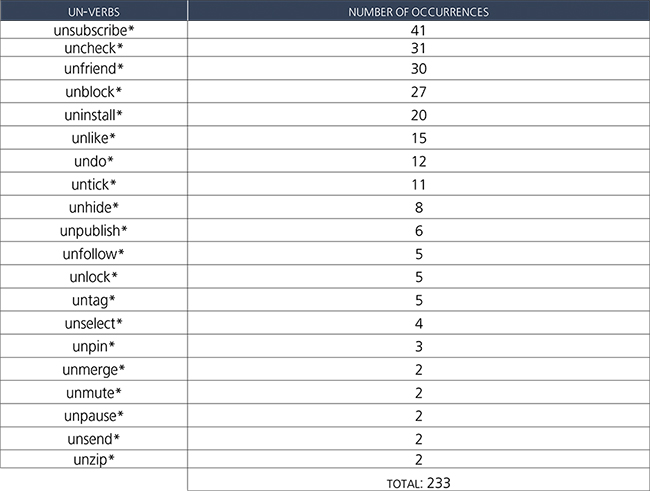
As we can see, one of the most frequent un-verbs is ‘unfriend’ (13% of occurrences), while ‘undo’ seems to rank low (only 5.2%). The low occurrences of the un-verb ‘undo’ can be explained by the simple fact that, due to the increasing number of un-verbs, the hypernymic reversal verb ‘undo’ seems to be put aside in favour of more specific un-verbs.
2.1. LEXICAL REPRESENTATION OF AN UN-VERB
As the literature on the un-verbs has repeatedly underlined, verbs that can be preceded by the prefix un- are generally telic predicates or predicates that contextually visualise an end point. Hence, according to this remark, we can argue that, for the occurrence of a predicate preceded by the prefix un-, the base verb must be a telic predicate, or there must be an end point in the linguistic environment in which it occurs.
This observation is based on the analysis of the following examples found in our corpus, which are logically deconstructed (Van Valin and LaPolla 1997) in Table 2:
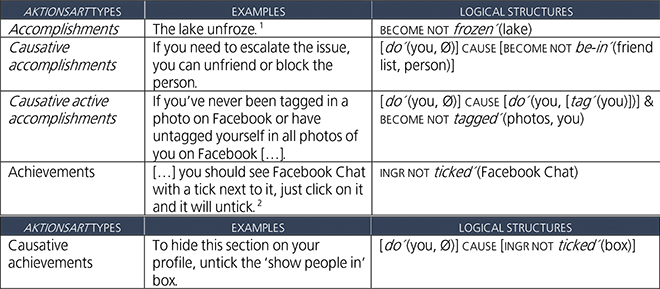
Our observation, however, seems, on the one hand, too inclusive, so to speak, given its potential to encompass all the verbs that belong to the Aktionsart types seen in Table 2. On the other hand, it cannot help us understand why some state verbs, for instance, can be preceded by the prefix un-, given their atelic nature.
The shortcomings of this remark are due to the fact that semantics alone cannot explain the phenomenon of the un-verbs. This is the reason why we must now turn our attention to pragmatics, which will help us better understand the mechanisms that lie at the very basis of the formation of an un-verb.
2.2. EXPLORING THE PRAGMATIC NATURE OF THE UN-VERBS
The pragmatic value of the un-verbs seems to be that it cognitively describes to the recipient a previous state of affairs that is, in turn, negated by the semantics of the prefix un-. In general, negation is in itself a deictic reference to something that was already uttered (Eco and Violi 1987; Fairclough 1992). This previously given piece of information is once again offered to the hearer in order for an element of negation to be added.
Generally speaking, verbs convey new information (Van Valin and LaPolla 1997) and are, therefore, usually regarded as focal elements in the information structure of a sentence. However, when dealing with the un-verbs, we can hypothesise that they can be regarded as focal elements conveying a topical nuance, given their reference to a previous state of affairs (i.e., the topical reference) that is now negated by the speaker (i.e., the focal information).
It can be argued that this pragmatic aspect of the un-verbs may be incompatible with our previous observation, which allows only telic predicates to be preceded by the prefix un-. However, we must underline that this is just an apparent incompatibility. Indeed, as Piaget (in McShane and Whittaker 1983: 416) explains, “a symbolic capacity can be inferred when the action and its ‘stimulus’ are separated in time”. Thus, the fact that telic verbs can be perfectly combined with the prefix un- is due to the fact that the télos, inherent in the predicate or circumstantial (Van Valin and LaPolla 1997), separates the actual happening of the state of affairs from the time when the proposition is uttered by the speaker. This separation in time provides the prefix un- with a previously uttered and/or presupposed piece of information the speaker negates. This is the reason why telicity and the fact that the prefix un- conveys given information are perfectly compatible.
However, we have so far discussed what the necessary pragmatic conditions are for the prefix un- to occur, although no mention was made to the delicate relationship between speaker and recipient.
In the light of the above observations, no restriction was made on the classes of accomplishments, causative accomplishments, causative active accomplishments, achievements and causative achievements, and no explanation on why state verbs can occur with the prefix un- was offered. However, we shall soon see that the key ingredient in this un-recipe is the recipient itself.
In order to understand this, we would like to offer a second observation on the nature of the un-verbs drawn from the analysis of our corpus on the occurrence of a predicate preceded by the prefix un-: enough knowledge must be shared between the speaker and the recipient for the latter to retrieve from the linguistic environment the inferred information negated by the prefix un-.
Drawing on Grice’s (1975) principle of cooperation, this observation is, additionally, a useful constraint on the occurrence of a predicate preceded by the prefix un-. Indeed, only un-verbs that are mutually regarded as referring to a previously given piece of information can be accepted by both the speaker and the recipient. Thus, if the previously given piece of information can be either retrieved by the context or by a non-‘expensive’ process of logical inferencing, the un-verb can be regarded as perfectly grammatical by both the speaker and the recipient. However, if the previously given piece of information cannot be either retrieved by the context or by an ‘economic’ process of logical inferencing, the un-verb can be regarded as ungrammatical. This ungrammaticality is due to the fact that the recipient cannot access the piece of information inferred by the speaker and, thus, communication between the speaker and the recipient fails.
Given our previous observations on the nature of the predicates preceded by the prefix un-, we can now support a unified approach to this prefix, thus, rebutting the distinction between the un- that precedes adjectives and nouns, and the un- that precedes verbs. Indeed, in line with Horn (1988), we can now state that the prefix un- is, in general, a negative prefix. However, when un- precedes an adjective or a noun, their semantic value is negated, while when it precedes a verb, its pragmatic value is negated. In other words, in the case of adjectives and nouns, the negative value of the prefix un- is external, due to the fact that their semantics alone offers all the information that is needed for their interpretation, while their pragmatic value is given by other elements (i.e., definite / indefinite articles, pronouns, etc.). In the case of verbs, on the other hand, the information that they convey is negated and, thus, it is their pragmatic, more internal value that is negated by the prefix un-.
The only exception to this last remark can be represented by state verbs. However, their incompatibility with our observations is only apparent. In fact, in the case of state verbs, due to the fact that they, in general, do not represent actions, but rather lexicalise a state experienced by the subject, the previous information negated by the prefix un- is the state in itself (in this sense, state verbs can be compared to adjectives preceded by the prefix un-, due to the fact that both indicate a property that characterises a given subject, which is in turn negated by the prefix un-).
We can conclude this section by saying that the prefix un-, thus, plays an important role in constructing the information structure of a proposition. Even though this aspect was not openly underlined in the literature, the fact that more and more verbs are inclined to be preceded by this prefix confirms that semantics alone cannot explain the behaviour of the prefix un-, and constraints alone on the kind of verbs that can be preceded by this prefix cannot thoroughly explain all the novel occurrences of un-verbs.
2.3. THE ELEMENT OF VOLITIONALITY IN UN-VERBS
The world of the Internet is a quite peculiar environment, where human beings are capable of performing actions that in the real world would be regarded as impossible. This is especially so in the case of new social networking systems, where each and every kind of action can be restored to its original state. Thus, the prefix un- finds in this environment its most appropriate context, and developers exploit the potential of this prefix in order to inform users that a certain action can be reversed and, thus, its effects annulled.
However, we must also acknowledge that, in the real world, people feel and/or are keen to reverse some actions whose effects are generally considered impossible to reverse. This impossibility does not stop language users from employing the prefix un-. Clark (1981), however, regards verbs like ‘ungrow’ or ‘undie’ as inconceivable, since “[n]o more can one reverse certain other actions once they have been performed”, because “certain actions are by nature irreversible” (Clark 1981: 255). However, we do not completely agree with this restriction concerning the un-verbs, because human beings are not made only of their actions, but they are also capable of conceiving and conceptualizing certain activities that cannot be performed in reality.
In order to respond to the desire of language users to reverse certain actions, and in order to explain the high productivity of un-verbs in the context of new social networking systems, we would like to introduce two-fold observation on the occurrence of a verb preceded by un- drawn from the analysis of our corpus: in the case of un-verbs, (i) the state of affairs must be feasible within its reference framework (be it socio-political, technological, etc.) for the subject to reverse a given predicate and/or (ii) it must be in the capacity of the subject to do so.
As we can see, the previous observation on the nature of un-verbs is divided into two parts. The first and the second part, however, are not mutually exclusive, but they can work together to convey a reversal meaning. This is particularly true in the case of new technologies. For instance, in the case of social networking systems, firstly, the social network itself must offer to its users the material possibility to reverse a certain action. Secondly, once this possibility is offered, users themselves must decide whether to bring back a certain action or not, thus, referring to their commitment to performing a given action.
The element of volitionality, however, seems to be fundamental in the semantics of the un-verbs, especially in those cases (i.e., most of the cases) where an un-verb occurs in a transitive context. When found in a transitive context, the subject that is willing to reverse a given state of affairs is a highly agentive one, whose participant role is that of an agent (Van Valin and LaPolla 1997). Thus, the second part of our observation responds to the very nature of an un-verb that occurs in a transitive context, and whether there may be enough technological development in order to reverse a given action is an additional element that is satisfied especially in new technologies, but it is not a constraint on the very occurrence of an un-verb in itself.
As previously seen, the first part of the previously introduced observation directly refers to the context of new technologies, such as social networking systems, where the prefix un- is being more and more productive. This is mainly because one of the most important features of the language of new technologies is that it has to be immediate. Thus, developers seem to resort to un- given its capability to convey in a simple prefix a meaning that would otherwise be expressed in a full proposition, which would contrast with their priority to share the higher amount of information in the least number of words.
As for the second part of our generalisation, it can be regarded as a contradiction, since it seems to agree with Clark’s (1981) constraint on the occurrence of an un-verb. However, we must promptly specify that no contradiction is found in this second part. In fact, the focus here is on the noun ‘capacity’, which entails a nuance of volition on behalf of the speaker that resorts to the prefix un-. Thus, by using an un-verb that can either convey an actually reversible action or an irreversible one, speakers commit themselves to perform that action to the best of their capabilities, or speakers may simply state their desire to bring back a certain action. To better understand this, we would like to offer example (4):[9]
(4)
Alicia: “You want to keep Jackie in line? Give her something.”
Eliah: “What do you mean?”
Alicia: “Something that makes her feel valued, important, useful.”
Eliah: “But she is none of those things.”
Alicia: “A point you made clear to her. Now... unmake it.”
In example (4), it can be argued that, once a point has been made, it cannot be materially ‘unmade’. Reality does not offer a rewind button (Horn 2002). However, this impossibility to reverse a given state of affairs does not stop the speaker from creating the verb ‘unmake’. This un-verb comprises in itself a commitment the speaker lies upon the recipient for the latter to take back a given state of affairs and restore things as they were. Thus, in this case, the verb ‘unmake’ represents the recipient’s commitment to perform certain actions so as to restore an order that was ‘disturbed’ by his making a point. Hence, the verb ‘unmake’ serves this scope and satisfies both our first observation, as the base verb is an accomplishment; our second generalisation, as the prefix un- refers to a previously given piece of information; and, finally, our third observation on the un-verbs, as it relates to the recipient’s capacity to commit himself to the reversal of a given action.
Before concluding our discussion of the un-verbs, we must underline an aspect on all three generalisations postulated in this work.
Indeed, the three observations so far introduced seem to capture some of the semantic and pragmatic aspects of the prefix un-. However, we must underline that they do not always work together in the realization of an un-verb. Only our second generalisation (i.e., reference to a previously given state of affairs) seems to be fundamental in the creation of an un-verb, whereas our first and third observations appear to be bound to the context where the un-verb is retrieved or created.
We can say that, when all three generalisations are applicable, we are faced with a perfectly lexicalised un-verb, which has entered the mental lexicon of speakers (Clark 1993) and whose meaning is entirely clear to language users.
3. FINAL REMARKS
Given this framework on the occurrence of an un-verb, we must add that it would be worthwhile to devote future research to a diachronic analysis of the prefix un-, in order to understand when and where the reversal meaning conveyed by on(d)- and the negative meaning conveyed by un- merged to form the prefix un-.
Additionally, it would be interesting to study the nature of the object of transitive un-verbs. Indeed, given our second observation (i.e., reference to a previously given state of affairs), the object of a transitive un-verb should always be determined, because un-verbs always seem to presuppose a previously given piece of information. However, the percentages of definite (48.5%) and indefinite (51.5%) direct objects of transitive un-verbs in our corpus are inconclusive.
Thus, future research should be devoted to further exploring this fascinating aspect of English morphology, in order to better define the creative processes behind the discursive construction and interpretation of un-verbs.
REFERENCES
Andrews, E. (1986), “A Synchronic Semantic Analysis of De- and Un- in American English”, American Speech 51 (3): 221-232.
Boons, J.-P. (1984), “Sceller un piton dans le mur; desceller un piton du mur. Pour une syntaxe de la préfixation négative”, Langue Française 52 : 95-128.
Clark, E.V. (1981), “Negative verbs in children’s speech”. In Klein, W. and Levelt, W.J.M. (eds) (1981): Crossing the boundaries in linguistics: Studies Presented to Manfred Bierwisch. Dordrecht: Reidel Publishing Company, 253-264.
Clark, E.V. (1993), The lexicon in acquisition. Cambridge: Cambridge University Press.
Clark, E.V., Carpenter, K.L., and Deutsch, W. (1995), “Reference states and reversals : Undoing actions with verbs”, Journal of Child Language 22 : 633-662.
Colen, A. (1980), “On the distribution of un-, de- and dis- in English verbs expressing reversativity and related concepts”, Studia Germanica Gandensia 21: 127-152.
Cordisco, M. (2011), “Unfriend & Co.: How social networks are affecting the English language”. In Di Sabato, B., and Mazzotta, P. (eds.) (2011): Linguistica e didattica delle lingue e dell'inglese contemporaneo. Studi in onore di Gianfranco Porcelli. Bari: Pensa Multimedia, 387-397.
Cruse, A.D. (1979), “Reversives”, Linguistics 17 (11/12): 957-966.
De La Cruz, J.M. (1975), “Old English pure prefixes: Structure and function”, Linguistics 13 (145): 47-81.
Dowty, D. (1979), Word Meaning and Montague Grammar. Dordrecht: D. Reidel.
Eco, U., and Violi, P. (1987), “Instructional semantics for presuppositions”, Semiotica 64 (1/2): 1-40.
Fairclough, N. (1992), Discourse and Social Change. Cambridge: Polity Press.
Fruttaldo, A. (2017, forthcoming), “What’s done can be undone: Lexical and pragmatic representation of the un-verbs”, Rivista di Psicolinguistica Applicata.
Funk, W.-P. (1990), “On the semantic and morphological status of reversative verbs in English and German”. In Fisiak, J. (ed.) (1990): Further Insights into Contrastive Analysis. Amsterdam: John Benjamins Publishing Company, pp. 441–459.
Grice, P. (1975), “Logic and conversation”. In Cole, P., and Morgan, J.L. (eds.) (1975): Syntax and semantics. Vol. 3: Speech acts. New York, NY: Academic Press, pp. 41-58.
Horn, L.R. (1988), “Morphology, pragmatics, and the un-verb”. In Powers, J., and de Jong, K. (eds) (1988): ESCOL ’88, Proceedings of the Fifth Eastern States Conference on Linguistics. Colombus: Ohio State University Press, pp. 210-233.
Horn, L.R. (2002), “Uncovering the un-word: A study in lexical pragmatics”, Sophia Linguistica 49: 1-64.
Horn, L.R. (2012), “Lexical pragmatics and the un-verbs”, Keynote speech to the LOT summer school. Utrecht, 2012.
Jespersen, O. (1917), Negation in English and Other Languages. København: Høst.
Kastovsky, D. (1982), “Word-Formation: A Functional View”, Folia Linguistica 16: 181–198.
Kastovsky, D. (2002), “The derivation of ornative, locative, ablative, privative and reversative verbs in English: A historical sketch”. In Fanego, T., López-Couso, M.J., and Pérez-Guerra, J. (eds) (2002): English historical syntax and morphology: Selected papers from 11 ICEHL. Amsterdam: John Benjamins, 99-109.
Kilgarriff, A., Rychly, P., Smrz, P., and Tugwell, D. (2004), “The Sketch Engine”. In Williams, G., and Vessier, S. (eds) (2004): Proceedings of the Eleventh EURALEX International Congress: EURALEX 2004. Lorient: Université de Bretagne-Sud, 105-116.
Kilgarriff, A., Baisa, V., Bušta, J., Jakubícek, M., Kovár, V., Michelfeit, J., Rychlý, P., and Suchomel, V. (2014), “The Sketch Engine: ten years on”, Lexicography 1 (1): 7-36.
Kruisinga, E. (1932), A Handbook of Present-Day English. Part II: English Accidence and Syntax. Groningen: Noordhoff.
Lehrer, A. (1995), “Prefixes in English Word Formation”, Folia Linguistica 29 (1/2): 133-148.
Marchand, H. (1963), “On a Question of Contrary Analysis with derivationally connected but morphologically uncharacterized words”, English Studies 44 (1/6): 176-187.
Marchand, H. (1969), The Categories and Types of Present-Day English Word Formation (2nd ed.). München: Beck.
Marchand, H. (1974), “Reversative, Ablative, and Privative Verbs in English, French and German”. In Kastovsky, D. (ed.) (1974): Studies in Syntax and Word-Formation. München: Fink, 405–415.
Maynor, N. (1979), “The Morpheme Un”, American Speech 54 (4): 310–311.
McEnery, T., and Hardie, A. (2012), Corpus linguistics: Method, theory and practice. Cambridge: Cambridge University Press.
McEnery, T., Xiao, R., and Tono, Y. (2006), Corpus-Based Language Studies: An Advanced Resource Book. London / New York: Routledge.
McShane, J., and Whittaker, S. (1983), “The Role of Symbolic Thought in Language Development”. In Rogers, D., and Sloboda, J.A. (eds) (1983): The Acquisition of Symbolic Skills. New York, NY: Plenum Press, 413-422.
Skeat, W.W. (1882), An Etymological Dictionary of the English Language. Oxford: Clarendon Press.
Van Valin, R.D., and LaPolla, R.J. (1997), Syntax: Structure, meaning and function. Cambridge: Cambridge University Press.
Vendler, Z. (1967), Linguistics in Philosophy. Ithaca, NY: Cornell University Press.
Whorf, B.L. (1962), “A linguistic consideration of thinking in primitive communities”. In Carroll, J.B. (ed.) (1962): Language, Thought and Reality: Selected Writings of Benjamin Lee Whorf. New York / London: MIT Press, 65–86.
Zimmer, B., Carson, C.E., and Horn, L.R. (2011), “Among the new words”, American Speech 86 (3): 355–376.
Zimmer, K.E. (1964), “Affixal negation in English and other languages: An investigation of restricted productivity”, Word 20 (2): 1–105.
WEBSITES
Crystal, D. (2001), Twenty-first Century English. Keynote speech to IATEFL Annual Conference. Available online at: http://www.davidcrystal.com/DC_articles/Internet10.pdf (Last accessed: December 24, 2016)
Hoad, T.F. (2012), The Concise Oxford Dictionary of English Etymology. Available online at: http://www.oed.com (accessed through the ULB Library of the Westfälische Wilhelms-Universität of Münster, Germany)
Kwon, H.-S. (1997), “Negative prefixation from 1300 to 1800: A case study in in-/un- variation”, ICAME Journal 21: 21–42. Available online at: http://icame.uib.no/ij21/kwon.pdf (Last accessed: December 24, 2016)
Pullum, G.K. (1999), “Why you can’t unhear this talk”, Lingua Franca, Radio National, Australia. Available online at: http://www.abc.net.au/rn/arts/ling/stories/s51011.html (Last accessed: December 24, 2016)
Stevenson, A. (ed.) (2012), Oxford Dictionary of English (3rd edn.). Available online at: http://www.oed.com (accessed through the ULB Library of the Westfälische Wilhelms-Universität of Münster, Germany)
Zimmer, B. (2009a), “The Age of Undoing”, On the Language column of The New York Times. Available online at: http://www.nytimes.com/2009/09/20/magazine/20FOB-onlanguage-t.html?_r=0 (Last accessed: December 24, 2016).
Zimmer, B. (2009b), “The language of social media: ‘Unlike’ any other”, Visual Thesaurus (blog entry). Available online at: http://www.visualthesaurus.com/cm/wordroutes/the-language-of-social-media-unlike-any-other (Last accessed: December 24, 2016)
Zimmer, B. (2009c), “The Un-Believable Un-Verb”, Visual Thesaurus (blog entry). Available online at: http://www.visualthesaurus.com/cm/wordroutes/the-un-believable-un-verb (Last accessed: December 24, 2016)
Notes