Artículos
Reconciliation Perspectives in Colombia: Characterizing the 2016 Peace Agreement with the FARC*
Perspectivas de reconciliation en Colombia: caracterización del Acuerdo de Paz de 2016 con las FARC
Perspectivas de Reconciliação na Colômbia: Caracterização do Acordo de Paz de 2016 com as Farc
Reconciliation Perspectives in Colombia: Characterizing the 2016 Peace Agreement with the FARC*
Revista de Relaciones Internacionales, Estrategia y Seguridad, vol. 14, no. 1, pp. 31-56, 2019
Universidad Militar Nueva Granada
Received: 07 July 2018
Revised document received: 08 May 2018
Accepted: 17 October 2018
Abstract: Despite ending a 60-year armed conflict with the oldest guerrilla group in Latin America, the 2016 peace agreement with the Revolutionary Armed Forces of Colombia (FARC) has faced growing opposition and resentment from the general population. This resistance has mainly occurred due to the absence of literature clearly providing an explanation of its contents, compromising its implementation and stability. Using the Peace Accords Matrix of the University of Notre Dame, this article explores some of the widespread criticism by comparing this agreement to others in 31 other countries. The key findings suggest that the 2016 Colombian peace agreement is the most extensive and the second most complex signed since 1989, and its crux may be categorized into five different groups of provisions. Statistical analysis suggests that its major criticism -its complexity- is the main impediment to the expected implementation level. Therefore, its stability should be guaranteed by exploring inventive strategies to gain popular support and legitimacy.
Keywords: Colombia, conflict resolution, FARC, implementation, peace agreement, provisions.
Resumen: A pesar de poner fin a un conflicto armado de 60 anos con el grupo guerrillero más antiguo de América Latina, el acuerdo de paz de 2016 con las Fuerzas Armadas Revolucionarias de Colombia (FARC) ha enfrentado una creciente oposición y el resentimiento de la población general. Esta resistencia se ha dado principalmente debido a la ausencia de publicaciones que proporcionen una clara explicación de su contenido, poniendo en riesgo su aplicación y estabilidad. Utilizando la Matriz de los Acuerdos de Paz de la Universidad de Notre Dame, el presente artículo explora algunas de las críticas generalizadas comparando este acuerdo con otros celebrados en otros 31 países. Los principales hallazgos sugieren que el acuerdo de paz del 2016 en Colombia es el más extenso y el segundo más complejo que haya sido firmado desde 1989; y su punto esencial puede clasificarse en cinco grupos diferentes de disposiciones. El análisis estadístico sugiere que una de sus mayores críticas -su complejidad- es el principal impedimento para el nivel de ejecución previsto. Por lo tanto, su estabilidad debe garantizarse mediante la exploración de estrategias ingeniosas para lograr el apoyo popular y la legitimidad.
Palabras clave: Colombia, resolución de conflictos, FARC, ejecución, acuerdo de paz, disposiciones.
Resumo: Apesar de colocar fim no conflito armado de 60 anos com o grupo guerrilheiro mais antigo da América Latina, o acordo de paz de 2016 com as Forças Armadas Revolucionárias da Colômbia (Farc) vem enfrentando uma crescente oposição e o rancor da população em geral. Essa resistência acontece principalmente devido à ausência de publicações que propiciem uma clara explicação de seu conteúdo, o que põe em risco sua aplicação e estabilidade. A partir da Matriz dos Acordos de Paz da Universidad de Notre Dame, este artigo explora algumas das críticas generalizadas que comparam esse acordo com outros celebrados em 31 países. Os principais achados sugerem que o acordo de paz de 2016 na Colômbia seja o mais extenso e o segundo mais complexo assinado desde 1989; seu ponto essencial pode ser classificado em cinco grupos diferentes de disposições. A análise estatística sugere que uma de suas maiores críticas - sua complexidade - seja o obstáculo primordial para o nível de implantação previsto. Portanto, sua estabilidade deve ser garantida mediante a exploração de estratégias engenhosas para conseguir o apoio popular e a legitimidade.
Palavras-chave: Colômbia, resolução de conflitos, Farc, implantação, acordo de paz, disposições.
Introduction
Since the outset of the latest Colombian peace process between the Government and the Revolutionary Armed Forces of Colombia (FARC)1 in September 2012, which ultimately produced the comprehensive peace agreement in November 2016 (hereafter, 2016 CPAF), a growing number of studies and official statements have emphasized the innovative approach used to address the grievances of the armed conflict2, and the numerous benefits that the end of the conflict would represent (Bouvier, 2016; Combita, Delgadillo, & Torres, 2013; Conciliation Resources, 2016; Cristo, 2016; De la Calle, 2016; Jackson, 2016; Herbolzheimer, 2016; Pizarro & Moncayo, 2015; Salvesen & Nylander, 2017)2016; Cristo, 2016; De la Calle, 2016; Herbolzheimer, 2016; Conciliation Resources, 2016; Bouvier, 2016; Salvesen & Nylander, 2017. However, notwithstanding the evidence offered by the Colombian Ministry of Defense (2017, 2018) on the improvement of the degree of security and the reduction of violence as possible results of the 2016 CPAF, several polls have shown a significantly negative perception of socioeconomic, political, security, and justice issues in the country among Colombian citizens (El Tiempo, 2018; Gallup, 2017b; RCN, 2016b; Semana, 2017b; Yanhass Poll, 2017).
A notable uncertainty concerning the 2016 CPAF has been documented, resulting from lack of understanding of its contents, which has already fostered misgivings about its implementation (El Tiempo, 2017a; Gallup, 2017a). In fact, as of February 2018, 39 % of Colombians believed that the 2016 CPAF has been evolving adequately; 15 % had a positive perception of the FARC, and only 38 % of the population believed that the FARC would honor its responsibilities stipulated in the agreement. In addition, some organizations such as the International Commission for the Verification of Human Rights in Colombia (2018) estimate that only 18.5 % of the provisions established have been implemented (El Espectador, 2018; El Pais, 2017; El Tiempo, 2018; Gallup, 2017b).
This sustained pessimism -which has remained unaltered since the signing of the peace agreement (El Colombiano, 2016; El Espectador, 2017, 2018; Gallup, 2017a)- has undermined governability in Colombia and the popular support essential to the implementation of the agreement. For instance, during 2017 only 18 % of the population believed that the situation in Colombia has improved, while only 24 % praised the administration of former Colombian President, Juan Manuel Santos Calderón (Gallup, 2017b); all of the above to uncertainty in the transition to a post-accord environment.
Accordingly, one of the most significant current discussions regarding conflict resolution in Colombia centers on the future of the 2016 CPAF. The concerns lie not only in the outcome of the Disarmament, Demobilization, and Reintegration (DDR) process of the most long-lived insurgent organization in Latin America (Serrano Alvarez, 2018; Torrijos Rivera & Abella Osorio, 2018; Valencia & Daza, 2010;), but also in the vastness of the matters agreed upon and, thus, in the duties of the Colombian government and the FARC to guarantee the full implementation of the agreement, which includes providing the Colombian population and the international community with a full understanding of the agreement to promote its support.
Most studies on the 2016 CPAF have examined its possible future effects on political (Botero & Herrera, 2017; Garay Acevedo & Guecha, 2018; Tesillo, 2016;), social (Cabrera Cabrera, Corcione Nieto, Figueroa Pedreros, & Rodriguez Macea, 2018; Ibanez, 2016; Puerta & Dover, 2017), economic (Medina, Pinzon, & Zuleta, 2017; Rettberg & Quiroga, 2016), and judicial (Bernal et al., 2017; Gomez, 2017) spheres. However, apart from the efforts made by the Colombian high commissioner for peace and some peace-supporting organizations such as Dejusticia (2017), Fundación Ideas para la Paz (2017a), and Común Acuerdo (2017) at the time of writing, little attention has been paid to the 310-page final agreement itself, which requires a full explanation to obtain a clearer picture of the contents of the entire peace process, in light of other international peace agreements.
This article seeks to fill this gap by examining the contents of the 2016 CPAF and drawing on data from the Peace Accord Matrix of the University of Notre Dame and the work of Högbladh (2012) in order to explain its essence and contest some of the criticism concerning it. Moreover, this article aims to determine the extent to which the 2016 CPAF has been a pioneering process regarding the provisions established. To this end, it first gives a brief overview of the traditional approaches used to characterize peace agreements by focusing on their provisions and presents a new five-group model to assess the 2016 CPAF. It then centers on the 2016 CPAF, depicting its similarities and differences with other peace agreements. Lastly, it reviews some of the 2016 CPAF'S major criticisms, as far as its extent and projected implementation level are concerned.
Literature and method: Identifying the essence of peace processes
In recent decades, there has been an intense discussion of the effectiveness of intrastate conflict resolution by means of soft power versus brute force. Although mass media and political discourses tend to praise peace agreements achieved through dialogue, numerous studies have found that these agreements are frequently unstable and likely to result in the recurrence of conflict (DeRouen, Lea, & Wallensteen, 2009; Lounsbery & DeRouen, 2016; Martinez & Diaz, 2005; Paris, 2004; Walter, 2004). These findings received increased attention from policymakers and negotiators, compelling them to use innovative formulas in new peace processes and driving them to include appropriate provisions into peace agreements to encourage successful conflict resolution and, subsequently, achieve effective peacebuilding3.
Academic literature on conflict analysis and resolution has also increased considerably; it closely examines peace agreements, their dynamics, and provisions included to characterize their contents, address grievances and prevent recurrences of violence (Álvarez Calderón & Rodriguez Beltrán, 2018; Cabrera Cabrera & Corcione Nieto, 2018; Fernandez-Osorio, 2017; Gonzalez Martinez, Quintero Cordero, & Ripoll De Castro, 2018). For instance, Bruch, Muffett, and Nichols (2016) discuss grievances originating from natural resources management; Caspersen (2017) explores grievances derived from inter-ethnic/state relations and security sector restructuring (a military and police reform); and Castro-Nunez et al. (2017) examine economic and social development-related grievances and their connection to land seizures.
One of the most widely used methodologies to characterize peace agreements is identifying its provisions. Provisions are understood here as "a goal-oriented reform or stipulation that (...) falls under a relatively discrete policy domain (e.g., executive branch reform, demobilization, minority rights, police reform)" based on Joshi and Quinn (2015, p. 15).
A significant body of literature, including works by Hartzell, Hoddie, and Rothchild (2001); Mattes and Savun (2010); Pettersson and Lotta (2012); Paffenholz (2014); Ansorg, Haass, and Strasheim (2016); Backer, Bhavnani, and Huth (2016); Kovacs and Hatz (2016); DeRouen and Chowdhury (2016); and Jeffery (2017) have examined the essence of peace agreements using their provisions as common themes to establish priorities that should be resolved between parties. However, the disparity in the grouping of provisions has hindered the compilation of these assessments. The UCDP, for instance, organizes these provisions into four groups: military, political, territorial, and judicial (Högbladh, 2012, p. 44), disregarding some important provisions, such as a military reform, reparations, and human rights, which could limit more indepth categorizations. Meanwhile, the PAM organizes them into five groups: institutions, security, rights, external arrangements, and miscellaneous (Joshi & Quinn, 2015, pp. 15-16).
To date, none of the published research on the 2016 CPAF has used either the PAM or UCDP' methodology to categorize its contents. However, in August 2016, the Colombian government and the FARC decided to assign the Kroc Institute for International Peace Studies at the University of Notre Dame with the "principal responsibility for technical verification and monitoring of the implementation of the accord through the Peace Accords Matrix (PAM) Barometer initiative" (LaReau, 2016). With this in mind, we established that the best methodology for this research is the PAM approach to provide some innovative and useful input for present or future studies on the 2016 CPAF that will contribute to the assessment of the agreement implementation.
This article uses the set of peace agreement provisions and the definitions provided by the PAM, which has characterized the peace accords of 31 countries between 1989 and 2012 (Table 1).
| Year | Country | Comprehensive peace agreement | Extent | Provisions | Implementation |
|---|---|---|---|---|---|
| 1989 | Lebanon | Taif accord (10/22/1989) | 11 | 18 | 59 % |
| 1991 | Cambodia | Framework for a comprehensive political settlement of the Cambodia conflict (10/23/1991) | 57 | 21 | 73 % |
| 1992 | El Salvador | Chapultepec peace agreement (01/16/1992) | 106 | 24 | 96 % |
| 1992 | Mali | National pact (04/11/1992) | 15 | 16 | 83 % |
| 1992 | Mozambique | General peace agreement for Mozambique (10/04/1992) | 57 | 24 | 92 % |
| 1993 | India | Memorandum of Settlement (Bodo Accord) (02/20/1993) | 6 | 17 | 24 % |
| 1993 | Rwanda | Arusha accord (08/04/1993) | 101 | 26 | 74 % |
| 1993 | South Africa | Interim constitution accord (11/17//1993) | 196 | 25 | 92 % |
| 1994 | Djibouti | Accord de paix et de la reconciliation nationale (12/26/1994) | 7 | 9 | 89 % |
| 1995 | Bosnia and Herzegovina | General framework agreement for peace in Bosnia and Herzegovina (11/21/1995) | 149 | 24 | 93 % |
| 1995 | Croatia | Erdut agreement (11/12/1995) | 5 | 10 | 73 % |
| 1995 | Niger | Agreement between the Republic Niger government and the ORA (04/15/1995) | 11 | 16 | 65 % |
| 1996 | Guatemala | Accord for a firm and lasting peace (12/29/1996) | 173 | 31 | 69 % |
| 1996 | Philippines | Mindanao final agreement (09/02/1996) | 35 | 23 | 59 % |
| 1997 | Bangladesh | Chittagong hill tracts peace accord (12/02/1997) | 11 | 15 | 49 % |
| 1997 | Tajikistan | General agreement on the establishment of peace and national accord in Tajikistan (06/27/1997) | 45 | 21 | 76 % |
| 1998 | Guinea-Bissau | Abuja peace agreement (11/01/1998) | 3 | 8 | 96 % |
| 1998 | Northern Ireland (UK) | Northern Ireland good friday agreement (04/10/1999) | 35 | 27 | 95 % |
| 1999 | Congo | Agreement on ending hostilities in the Republic of Congo (12/29/1999) | 49 | 16 | 73 % |
| 1999 | East Timor | Agreement between Indonesia and the Portuguese Republic on the question of East Timor (05/05/1999) | 29 | 11 | 94 % |
| 1999 | Sierra Leone | Lome peace agreement (07/07/1999) | 28 | 25 | 83 % |
| 2000 | Burundi | Arusha peace and reconciliation agreement for Burundi (08/28/2000) | 93 | 34 | 78 % |
| 2001 | Macedonia | Ohrid agreement (08/13/2001) | 11 | 22 | 91 % |
| 2001 | Papua New Guinea | Bougainville peace agreement (08/30/2001) | 85 | 25 | 89 % |
| 2002 | Angola | Luena memorandum of understanding (04/04/2002) | 27 | 19 | 88 % |
| 2003 | Liberia | Accra peace agreement (08/18/2003) | 50 | 26 | 88 % |
| 2004 | Senegal | General peace agreement between the government of the Republic of Senegal and mfdc (12/30/2004) | 4 | 9 | 33 % |
| 2005 | Indonesia | MoU between the government of the Republic of Indonesia and the Free Aceh movement (08/15/2005) | 7 | 25 | 87 % |
| 2005 | Sudan | Sudan comprehensive peace agreement (01/09/2005) | 260 | 41 | 73 % |
| 2006 | Nepal | Comprehensive peace agreement (11/21/2006) | 13 | 28 | 72 % |
| 2007 | Ivory Coast | Ouagadougou political agreement (03/04/2007) | 13 | 18 | 83 % |
However, it reorganizes them into a new model, which is explained in Table 2. Provisions are organized into five groups: socioeconomic, political, security and defense, justice, and implementation and verification. These are the provisions that best match the six major topics of the official agenda discussed by the Colombian government and the FARC (2016) during the 2012-2016 peace process, which include: (i) a comprehensive rural reform, (ii) political participation, (iii) ending the conflict, (iv) resolving the illicit drugs issue, (v) victims of the conflict, and (vi) the agreement implementation, verification, and endorsement. A comprehensive rural reform and resolving the drug issues were merged into the first group (socioeconomic provisions) as both topics share most of the provisions established.
| (Comprehensive rural reform and resolving the illicit drug issue) | (Political participation) | (End of conflict) (Victims of the conflict) | (Implementation, verification, and endorsement) | ||
| Children’s rights | Boundary demarcation | Arms embargo | Amnesty | Detailed implementation timeline | |
| Cultural protections | Citizenship reform | Ceasefire | Commission to address damage | Dispute resolution committee | |
| Economic and social development | Civil administration reform | Demobilization | Internally displaced persons | Donor support | |
| Education reform | Constitutional reform | Disarmament | Judiciary reform | International arbitration | |
| Human rights | Decentralization/ federalism | Military reform | Prisoner release | Ratification mechanism | |
| Indigenous minority rights | Electoral/political party reform | Paramilitary groups | Refugees | Regional peacekeeping force | |
| Media reform | Executive branch reform | Police reform | Reparations | Review of agreement | |
| Minority rights | Independence referendum | Reintegration | Truth or reconciliation mechanism | un peacekeeping force | |
| Natural resource management | Legislative branch reform | Withdrawal of troops | un transitional authority | ||
| Right of self- determination | Official Language and Symbol | Verification/monitoring mechanism | |||
| Women’s rights | Power-sharing transitional government | ||||
| Inter-ethnic/state relations | Territorial power sharing | ||||
Characterization of the 2016 comprehensive peace agreement with the FARC
Negotiations towards the 2016 CPAF officially began in September 2012, with a defined six-point framework, and lasted until a final agreement was announced on August 24, 2016. While the peace process had many supporters in Congress, in major social movements, and international organizations, disapproval among the population grew significantly, resulting from the lack of clear information on the peace talks in Havana, Cuba, and the agreement's partial accords. This uncertainty generated trepidation about the future of the country and certain socioeconomic, political, security, and justice aspects. The ratification referendum of the final agreement in October 2016 achieved the highest degree of uncertainty, resulting in 50.2 % of voters rejecting the accord (BBC, 2016). This outcome made it clear to the Colombian government, the FARC and the international community that the majority of the population had misunderstood the whole process and the established provisions.
Despite the strong international support, including the awarding of the 2016 Nobel Peace Prize to former Colombian President Juan Manuel Santos Calderon, the referendum results forced a renegotiation of the accord, which was finally ratified by the Colombian Congress on November 30, 2016. This reviewed version of the final accord added 13 pages to the original 297-page document. These pages included several explanations regarding the definitions and procedures used to reach the established provisions; it also included some modifications thereto required by the opposition and social movements. Some of these key changes contained the protection of private property and legal landowners; the establishment of a statute for political opposition; and the inclusion of guarantees for peaceful protests. The new pages also included regulations regarding the assignment of public funding to FARO'S political party; the inclusion of FARC militias into the DDR process; stipulations obliging the FARC to end its illegal economic activities and provide accurate information on its finances and assets; the funds deemed illegal to be used for victim reparations and address any damages caused; some procedures to guarantee the security of FARC leaders and combatants; guidelines regarding the substitution of illicit crops, including aerial aspersion; actions to ensure the political participation of FARC'S representatives; the creation of dedicated media and radio stations for FARC'S political party; and finally, guidelines and procedures for a transitional justice system (Fundacion Ideas para la Paz, 2017b; High Commissioner for Peace, 2016e; Lopez, 2016).
The 2012-2016 peace process with the FARC yielded an exploratory agreement called The General Agreement for Ending the Conflict and Building Stable and Enduring Peace, five joint reports, 13 drafts of supporting texts, 107 joint declarations, and a final agreement called The Final Agreement to End the Conflict and Build Stable and Durable Peace (the 2016 CPAF), a total of 136 documents. After the final agreement, the exploratory document was perhaps the most important one. It established the agenda and the topics to be discussed, as well as the general guidelines for the peace process. Based on the descriptions by the pam, 38 provisions can be identified to assess the 2016 CPAF final agreement (Table 2) from the five-group model of provisions formulated by this article. These provisions can be organized as follows:
Socioeconomic provisions. This first group, consisting of twelve provisions, establishes the way that the 2016 CPAF deals with socioeconomic grievances and describes its strategy in solving the first and fourth topics of the peace process agenda (i.e., a comprehensive rural reform and resolving the illicit drug issue). These provisions are children's rights, cultural protection, economic and social development, an education reform, human rights, indigenous and minority rights, a media reform, natural resource management, rights of self-determination, women's rights, and inter-ethnic and state relations.
Figure 1 shows that Colombia has the most socioeconomic provisions in its peace agreement, namely, twelve occurrences, while some countries such as Guinea-Bissau and Côte d'lvoire have none. In comparison to other peace agreements, this number is well above the median (3) for this group (Table 3).
| Mean | 3.94 |
| Standard Error | .55 |
| Median | 3 |
| Mode | 2 |
| Standard Deviation | 3.11 |
| Range | 12 |
| Count | 32 |
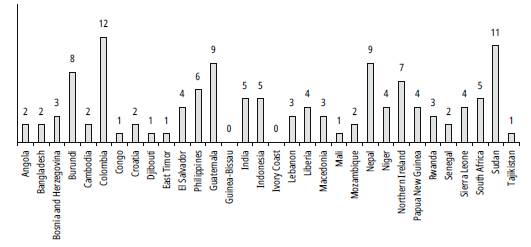
Figure 1
Socioeconomic Provisions Included in Peace Agreements (1989-2016) by Country
Note. Colombia's 2016 CPAF is included. Source: Prepared by the authors based on data from Kroc Institute for International Peace Studies (2015) and Colombian Government & FARC (2016).
To address the required comprehensive rural reform, this group of provisions covers historical problems to be resolved at a national level but with a territorial approach that includes access to and use of land; formalization of rural property for untitled proprietors; improvement of the rural cadaster; protection of special environmental interest areas; rural jurisdiction to resolve conflicts; infrastructure; adequate housing; access to drinking water and sanitation, social security; education; health, food and nutrition; and a solidary and cooperative rural economy (Común Acuerdo, 2017; High Commissioner for Peace, 2016d). Conversely, these provisions related to the illicit drug issue, that is, the eradication and substitution of illicit crops, the prevention and treatment of drug use with a public health approach, and the fight against drug trafficking and organized crime (High Commissioner for Peace, 2016f).
Of the 31 peace agreements analyzed, 94 % include at least one provision from this group, economic and social development (69 %) and human rights (63 %), these are the most employed provisions; the right to self-determination is the least used provision (16 %) (Figure 2). Notably, the provisions less employed internationally were children's rights (19 %), indigenous minority rights (19 %), minority rights (19 %), and rights of self-determination (16 %); all of which are explicitly addressed by the 2016 CPAF. Moreover, the provision on women's rights (25 %) was expanded to cover other gender identities as well, incorporating the rights of the lesbian, gay, bisexual, and transgender community (Colombian Government & FARC, 2016).
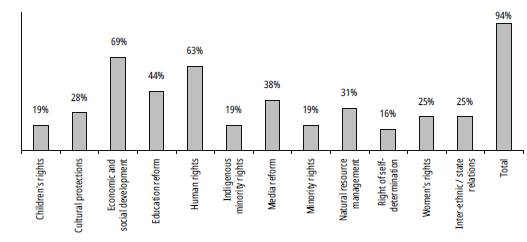
Figure 2
Percentage of Peace Agreements with Socioeconomic Provisions (1989-2016)
Note. Colombia's 2016 CPAF is included. Source: Prepared by the authors based on data from Kroc Institute for International Peace Studies (2018) and Colombian Government & FARC (2016).
The 2016 CPAF'S objective is to boost the rural reform and to reduce rural poverty by 50 % within ten years, through the creation of a land bank to assign rural parcels to farmers, victims, and minorities. Means of production and infrastructure are to be procured through popular participation in regional decisions addressing uneven land distribution to develop local and familiar economies, narrow the rural-urban gap, recover the zones affected by the armed conflict, and protect regional multiculturalism (High Commissioner for Peace, 2016d). The implementation of this group of provisions is possibly one of the most critical challenges of this agreement, as even the most optimistic economic assessments forecast a tough economic future for Colombia (Figure 3).
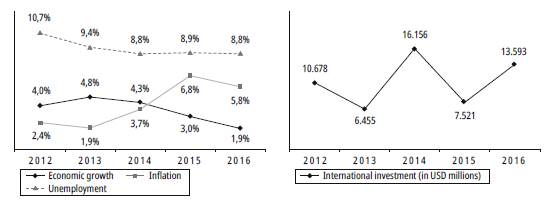
Figure 3
Evolution of Major Economic Indexes in Colombia (2012-2016)
Source: Prepared by the authors based on data from DANE (2016), World Bank (2017), and Banco de la República (2017).
Political provisions. The twelve provisions of this second group involve how the 2016 CPAF addresses equal political participation and administrative issues that have caused or aggravated the armed conflict. It also provides solutions to the second topic of the peace process agenda, that is, political participation. Such provisions consist of boundary demarcation and citizenship, civil administration, a constitutional reform, decentralization/federalism, an electoral/political party reform, and executive branch reforms, as well as an independence referendum, a legislative branch reform, official language and symbols, power sharing during the transitional government, and territorial power sharing.
Figure 4 shows that the 2016 CPAF comprised only four provisions related to this group (a civil administration reform, a constitutional reform, an electoral/political party reform, and a legislative branch reform); this number is the median (4) for this group (Table 4). However, it is low compared to Sudan (ten provisions), Bosnia Herzegovina, the Philippines, and South Africa (eight provisions each).
| Mean | 4.53 |
| Standard Error | .43 |
| Median | 4 |
| Mode | 3 |
| Standard Deviation | 2.44 |
| Range | 10 |
| Count | 32 |
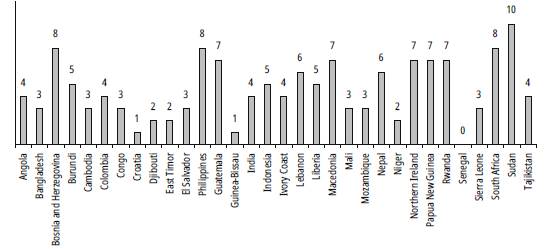
Figure 4
Political Provisions Included in Peace Agreements (1989-2016) by Country
Note. Colombia's 2016 CPAF is included. Source: Prepared by the authors based on data from Kroc Institute for Institute for International Peace Studies (2018) and Colombian Government & FARC (2016).
To resolve grievances related to this group of provisions, the 2016 CPAF encourages forming new political parties, strengthening transparency in electoral processes, increasing the population's democratic involvement, promoting the integration of regions affected by the armed conflict into politics, guaranteeing the political representation of minorities, social movements, victims and stigmatized regions, and establish security protocols aiming to protect FARC members (High Commissioner for Peace, 2016c; Común Acuerdo, 2017).
This agreement was innovative in terms of the measures used to tackle some of the most common challenges in the implementation of peace accords, such as corruption and lack of transparency, violent detractors, and the absence of appropriate conditions for political opposition (Colombian Government & FARC, 2016). Corruption affects the adequate use of resources and precludes the accountability of public organizations and officials, especially when dealing with a post-accord scenario, in which funding is often scarce. To foster transparency, the 2016 CPAF aimed to secure the completion of projects adopted by creating a national council for reconciliation and coexistence and a comprehensive security system for the exercise of politics. The agreement protects opposition leaders, social movements and human rights activists from violent detractors, while promoting a democratic environment for political participation and discussion.
It is possible that other provisions were not included in Colombia's peace agreement because of its reliance on the exploratory document in which strict limits were imposed as conditions for the peace talks. For example, the issues of an executive branch reform, a military/police reform, decentralization/federalism, a power sharing transitional government, and territorial power sharing were excluded, as the government's intention was not to modify the state's structure or administration. Provisions involving areas such as boundary demarcation, a citizenship reform, an independence referendum, and official language and symbols were also excluded in the exploratory document and external to discussion by the parties (Colombian Government & FARC, 2012). In general, 97 % of the peace agreements assessed included at least one provision from this group. An electoral/political party reform (75 %) and a constitutional reform (63 %) were the provisions most used, while territorial power sharing (9 %) was the least used (Figure 5).
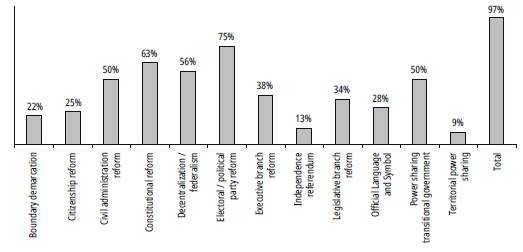
Figure 5
Percentage of Peace Agreements with Political Provisions (1989-2016)
Note. Colombia's 2016 CPAF is included. Source: Prepared by the authors based on data from Kroc Institute for International Peace Studies (2018) and Colombian Government & FARC (2016).
Defense and security provisions. The nine provisions in this third group show how the 2016 CPAF addresses defense and security challenges for the post-accord scenario and provide options for the third topic of the peace process agenda (end of armed conflict). These provisions are arms embargo, ceasefire, demobilization, disarmament, a military reform, paramilitary groups, police reform, reintegration, and withdrawal of troops.
The 2016 CPAF involves only six security and defense provisions (ceasefire, demobilization, disarmament, paramilitary groups, reintegration, and withdrawal of troops). In comparison to other peace agreements, this number is the median for this group (6) (Table 5).
| Mean | 5.59 |
| Standard Error | .33 |
| Median | 6 |
| Mode | 5 |
| Standard Deviation | 1.88 |
| Range | 7 |
| Count | 32 |
According to Figure 6, Sudan had nine occurrences, while Angola, Burundi, Cambodia, and Mozambique had eight, being the countries that included the most provisions of this type. Conversely, Croatia and Guinea-Bissau had the fewest provisions (two occurrences).
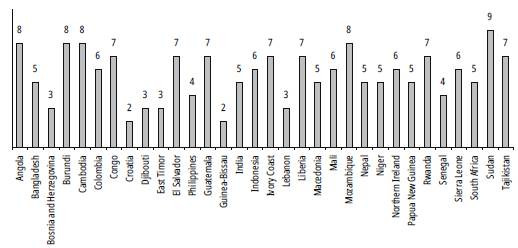
Figure 6
Defense and Security Provisions Included in Peace Agreements (1989-2016) by Country
Note. Colombia's 2016 CPAF is included. Source: Prepared by the authors based on data from Kroc Institute for International Peace Studies (2018) and Colombian Government & FARC (2016).
The implementation of this group is perhaps the most successful. As of July 2017, after a phase of ceasefire and a bilateral end to hostilities, a structure for the monitoring and verification of the DDR mechanism (formed by the United Nations, the Colombian Government and FARC) was established. Approximately 7,000 FARC members were demobilized and distributed among 19 zones (El Tiempo, 2017b). The United Nations mission in Colombia oversaw and verified FARC'S disarmament. FARC'S decommissioned armament, estimated to include 7,132 large and small guns, was stored in containers under the UN'S control (Semana, 2017a). Humanitarian demining programs led by the National Army of Colombia have also been successful (Accion contra minas, 2016), 660 weapon caches in remote areas were collected and destroyed by the un and the National Army of Colombia (United Nations, 2017). The National Army of Colombia and the National Police have provided security to FARC'S demobilized personnel. A new strategy has even been implemented to manage FARC dissidents who chose to ignore the peace agreement and characterized them as armed groups in order to guarantee social, economic, and political reintegration of FARC members (High Commissioner for Peace, 2016a).
Figure 7 shows that all the 31 peace agreements analyzed included at least one security and defense provision. The most used provisions were those related to the DDR process: demobilization (84 %), disarmament (81 %), and reintegration (78 %). The least used was arms embargo (9 %). Two of the key provisions, a military reform (72 %) and a police reform (69 %), were not included in the 2016 CPAF, as they had been deemed prohibited issues by the Colombian government in the exploratory document (Colombian Government & FARC, 2012). Similarly, the arms embargo provision was not discussed by the parties based on FARC'S commitment to voluntarily relinquish its weaponry and refrain from using violent means.
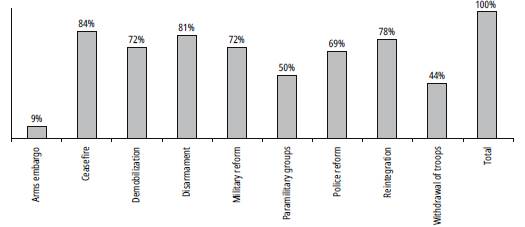
Figure 7
Percentage of Peace Agreements with Defense and Security Provisions (1989-2016)
Note. Colombia's 2016 cpaf is included. Source: Prepared by the authors based on data from Kroc Institute for International Peace Studies (2018) and Colombian Government & FARC (2016).
Justice provisions. This fourth group comprises eight provisions and defines how the 2016 CPAF tackles equality and impartiality while addressing the fifth topic of the peace process agenda (victims of the conflict). These provisions are an amnesty, a commission to addressing damage/loss, internally displaced persons, a judiciary reform, prisoner release, refugees, reparations, and a truth or reconciliation mechanism.
The 2016 CPAF agreement includes all of these justice provisions (eight occurrences), a number that is well above the median (4) for this group (Table 6), in comparison to the other 31 peace agreements analyzed, such as East Timor and Philippines, which include none (Figure 8).
| Mean | 3.69 |
| Standard Error | .31 |
| Median | 4 |
| Mode | 4 |
| Standard Deviation | 1.73 |
| Range | 8 |
| Count | 32 |
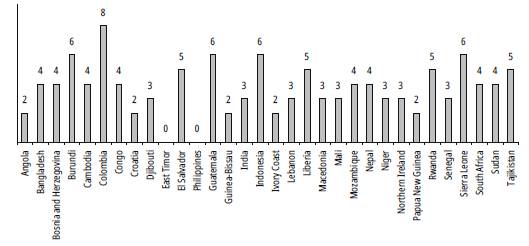
Figure 8
Justice Provisions Included in Peace Agreements (1989-2016) by Country
Note. Colombia's 2016 CPAF is included. Source: Prepared by the authors based on data from Kroc Institute for International Peace Studies (2018) and Colombian Government & FARC (2016).
The 2016 CPAF incorporates a novel scheme to solve justice grievances and victims' rights, through a transitional justice system that is built upon a comprehensive structure of truth, justice, reparation and non-repetition; the creation of a commission for the clarification of truth, coexistence and non-repetition; the formation of a unit for the search of missing persons; the development of comprehensive reparation measures for peacebuilding; a special jurisdiction for peace; non-repetition guarantees; and giving historical memory a central role within the reconciliation process (High Commissioner for Peace, 2016g).
This group of provisions is probably one of the most controversial in Colombia, as the conflict and its complex origins have produced numerous victims, countless damages and a number of human rights violations (Pizarro & Moncayo, 2015). Striking an appropriate balance between justice and peace is the task for the transitional justice system approved by the parties, and endorsed by international political leaders. However, it is still under review of the International Criminal Court and human rights organizations (International Criminal Court, 2016).
Figure 9 depicts how 94 % of the agreements included at least one justice provision. The most used were internally displaced persons (72 %) and refugees (69 %), while the ones used the least involved a commission to addressing damage/loss (6 %) and reparations (25 %).
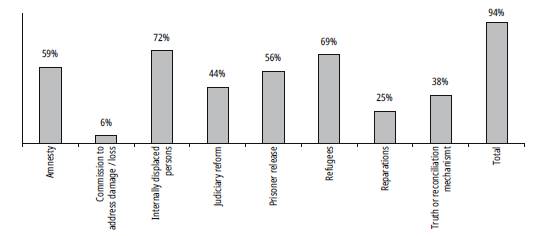
Figure 9
Percentage of Peace Agreements with Justice Provisions (1989-2016)
Note. Colombia's 2016 CPAF is included. Source: Prepared by the authors based on data from Kroc Institute for International Peace Studies (2018) and Colombian Government & FARC (2016).
Implementation and verification provisions. This fifth group, consisting of ten provisions, explains how the 2016 CPAF addresses the sixth topic of the agenda (implementation, verification, and endorsement). These provisions are a detailed implementation timeline, a dispute resolution committee, donor support, international arbitration, a ratification mechanism, regional peacekeeping force, review of agreement, a UN peacekeeping force, a UN transitional authority, and a verification/monitoring mechanism.
The 2016 CPAF includes eight implementation and verification provisions (detailed implementation timeline, a dispute resolution committee, donor support, international arbitration, a ratification mechanism, review of agreement, a UN transitional authority, and a verification/monitoring mechanism), a number well above the median of this group (4) in comparison to the other 31 peace agreements analyzed (Table 7).
| Mean | 4 |
| Standard Error | .39 |
| Median | 4 |
| Mode | 3 |
| Standard Deviation | 2.21 |
| Range | 8 |
| Count | 32 |
This agreement has developed a unique approach to ensure compliance with peace initiatives and strategies through the continous verification of the implementation status to identify delays and adjustments needed. To this end, a follow-up and verification commission for the final peace agreement, as well as a mechanism to verify the agreement, were created (High Commissioner for Peace, 2016b). Similarly, the exploratory agreement of the 2016 CPAF promoted considerably constant assistance during the peace talks, both internationally with Cuba and Norway as guarantors and nationally with Chile and Venezuela. Also included were a citizen participation mechanism, a rapporteur system, and a promulgation mechanism. The agreement created the possibility for multilateral participation by academia, social movements, and citizens, expanding the scope of the topics discussed in Havana. The rapporteur system is led by the Universidad Nacional, and the promulgation mechanism, via a dedicated web page, as well as pedagogical campaigns that fostered transparency and enabled constant and necessary feedback.
The 2016 CPAF does not contain the following two provisions: regional peacekeeping force and un peacekeeping force as the parties agreed not to employ foreign troops in its implementation.
Colombia and Burundi, with eight occurrences, are the countries that have the most provisions of this type, in contrast to Djibouti, India, and Senegal that had no occurrences (Figure 10). Figure 11 depicts that 91 % of the agreements included at least one implementation and verification provision. The most utilized is the verification mechanism (78 %) and the detailed implementation timeline (69 %), while the least employed is international arbitration (6 %) and un transitional authority (13 %).
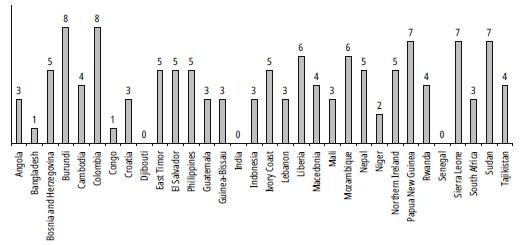
Figure 10
Implementation Provisions Included in Peace Agreements (1989-2016) by Country 8 8
Note. Colombia's 2016 CPAF is included. Source: Prepared by the authors based on data from Kroc Institute for International Peace Studies (2015) and Colombian Government & FARC, 2018.
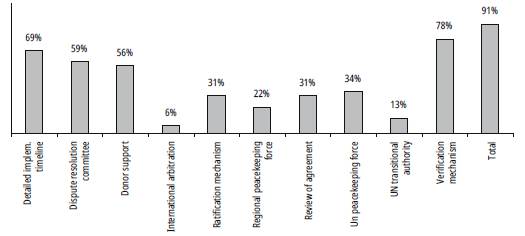
Figure 11
Percentage of Peace Agreements with Implementation Provisions (1989-2016)
Note. Colombia's 2016 CPAF is included. Source: Prepared by the authors based on data from Kroc Institute for International Peace Studies (2018) and Colombian Government & FARC (2016).
Extension as another source of criticism
Another source of criticism for the 2016 CPAF is its extension and complexity, which promote conflicting and sometimes irreconcilable interpretations of its essence and implementation among the government, the opposition, the FARC, social movements, and international organizations. These misunderstandings involve many critical provisions, such as an amnesty (Sanchez, 2016), an electoral/political party reform (El Pais, 2016), human rights (International Committee of the Red Cross, 2017), a judiciary reform (The New York Times, 2016), transitional justice (Brodzinsky, 2016), reintegration (Aidi, 2016), a detailed implementation timeline (The Economist, 2017), economic and social development (Vivanco, 2016b), demobilization (Gomerzano, 2016), an education reform and children's rights (Oppenheimer, 2016), and the truth or reconciliation mechanism (Vivanco, 2016a).
Published studies on peace agreements have previously reported skepticism and grievances resulting from the lack of understanding of its contents. For instance, Spears (2000) demonstrated the instability of peace agreements in Africa due to persisting unfamiliarity with power-sharing provisions. Stanley and Holiday described in Stedman, Rothchild, and Cousens (2002, p. 442) the complications of the un mission in Guatemala (MINU-GUA) because of "a lack of understanding of most Guatemalans regarding the mission's mandate and functions." Mac Ginty, Muldoon, and Ferguson (2007) explained how political and psychological stubbornness destabilized the post-peace accord environment in Northern Ireland. As a result, mass media in Colombia has been instrumental in creating an adverse perception on the part of the accord's main critics, political opponents, and independent groups using the idea that the extensive number of pages of the 2016 CPAF has negatively impacted the reliability of the topics established, and that the high number of topics adversely affected the agreement implementation (CNN, 2016; El Tiempo, 2017c; Negrete, 2017; RCN, 2016a; Rendon, 2017; Semana, 2016).
Given such criticism, could there be a possible correlation between the extent of a peace accord and the number of provisions agreed upon, or between the number of pages or provisions established and the implementation level of the agreement? If such a hypothesis is accurate, in comparison to other countries, Colombia's 2016 CPAF and its implementation may have an uncertain future with agreements covering only 38 provisions within a 310-page document.
Regarding the first part of the question, although some peace agreements have a high number of established provisions vis-a-vis the extent (in pages) of the final accord, such as Indonesia with 25 provisions on seven pages, and India with 17 provisions on six pages, there are also peace agreements such as Mali's, with 16 provisions on 15 pages, and Sierra Leone's with 25 provisions on 28 pages. By running a regression of pam's data, it was possible to determine that there is a significant potential correlation between the extent (in pages) of a peace agreement and the number of provisions agreed upon, according to Pearson's r (30) = .73, p < .001 (Table 8). This suggests that the more pages a peace agreement has, the more provisions it will have.
| Multiple R | .731 |
| P-value | .000 |
| R Square | .535 |
| Adjusted R Square | .520 |
| Standard Error | 5.486 |
| Observations | 32 |
As to the second part of the question, there are also some short peace agreements with a high percentage of implementation level. Guinea-Bissau, for example, has a 96 % implementation level, ten years after the signing of a three-page agreement. Croatia has a 73 % implementation level of a five-page agreement. There are also multifaceted peace agreements, such as El Salvador's, with a 96 % of implementation level ten years after signing a 106-page agreement, and Bosnia and Herzegovina, with a 93 % implementation level of a 149-page agreement. The regression results of PAM'S data did not show any significant correlation between the extent (in pages) of a peace agreement and its implementation level, according to Pearson's r (29) = .20, p > .001 (Table 9). The results suggest that the implementation level of a peace agreement is not directly influenced by its extension; in other words, the success or failure in the implementation of a peace agreement does not depend on the complexity of the vetted documents of a peace process.
| Multiple R | .200 |
| P-value | .280 |
| R Square | .040 |
| Adjusted R Square | .007 |
| Standard Error | 17.695 |
| Observations | 31 |
Similarly, whereas there are some peace agreements with few agreed provisions and a high percentage of implementation level, such as Djibouti's with a 89 % implementation a ten years after the signing of a nine-provision agreement, and East Timor's with a 94 % implementation level of an 11-provision agreement, there are also intricate peace agreements, such as Sudan's, with a 73 % implementation level ten years after the signing of a 41-provision agreement, and Burundi's with a 78 % implementation level of a 34-provision agreement. The regression results of pam's data did not show a significant correlation between the number of agreed provisions and its implementation level, Pearson's r (29) = .17,p > .001 (Table 10). Therefore, it is possible to confirm that the implementation level of a peace agreement is not directly influenced by its complexity, in terms of the number of provisions agreed upon.
| Multiple R | .178 |
| P-value | .337 |
| R Square | .032 |
| Adjusted R Square | -.002 |
| Standard Error | 17.772 |
| Observations | 31 |
Conclusions
The results of the characterization of the 2016 CPAF based on the pam classification helped to identify the essence of the agreement and its future outlook. For instance, the 2016 CPAF is the longest agreement written since 1989 (310 pages) and the second in complexity after Sudan's based on the number of provisions agreed upon (38). Thirty-eight provisions, summarized in Table 11, describe its contents based on international standards and point to a number of aspects that are useful for future peace processes in Colombia with other insurgent organizations such as the ELN.4
| Type of provision and relevant | Provisions | |
|---|---|---|
| topic in the agenda | ||
| Children’s rights | Media reform | |
| 1. Socioeconomic | Cultural protections | Natural resource management |
| Comprehensive rural reform | Economic and social development | Natural resource management |
| Solving the illicit drug issue | Education reform | Right of self-determination |
| Human rights | Women’s rights | |
| Indigenous minority rights | Inter-ethnic/state relations | |
| 2. Political | Civil administration reform | Electoral/political party reform |
| Political participation | Constitutional reform | Legislative branch reform |
| Ceasefire | Paramilitary groups | |
| 3. Defense and security | Demobilization | Reintegration |
| End of conflict | Disarmament | Withdrawal of troops |
| Amnesty | Prisoner release | |
| 4. Justice | Commission to address damage | Refugees |
| Victims of the conflict | Internally displaced persons | Reparations |
| Judiciary reform | Truth or reconciliation mechanism | |
| Detailed implementation timeline | Ratification mechanism | |
| 5. Implementation and verification | Dispute resolution committee | Review of agreement |
| Implementation, verification, and | Donor support | un transitional authority |
| endorsement | International arbitration | Verification/monitoring mechanism |
The agreement is not as innovative as official publicity and mass media have declared; although it did include several pioneering ideas, such as the concepts of historical memory, missing persons, guarantees for political opposition and peaceful protests, victims' reparations, and comprehensive transitional justice, its foundations remain conservative and are close to international practices in conflict resolution. The number of socioeconomic provisions established in the 2016 CPAF (12 occurrences) is well above the median of this group of provisions (three occurrences). Similarly, the number of provisions established concerning justice and implementation and verification grounds is above the median of these groups (eight occurrences in comparison to four occurrences in both cases). Alternatively, the amount of agreed political provisions is equal to the median of the group (four occurrences) and the number of defense and security provisions agreed upon is equal to the median of the group (six occurrences).
International experience is fundamental when planning strategies to improve and stimulate the implementation of a peace agreement and to enhance civil-military relations (Durán, Adé, Martinez, & Calatrava, 2016; Mares & Martinez, 2014; Martinez, 2007; Martinez & Durán, 2017; Martinez, Adé, Durán, & Diaz, 2013; Pion-Berlin & Martinez, 2017). However, every case should be thoughtfully assessed to understand the origins of the conflict and the grievances that have so far hindered effective resolution initiatives, the contents and background of the peace agreement, and the best procedures to guarantee its implementation, and an overall successful reconciliation process.
Criticism on the 2016 CPAF related to its extension, complexity, and possibilities of implementation lacks support. Figure 12 summarizes the statistical results presented in this article, suggesting that, notwithstanding a possible correlation between the extension (in pages) of a peace agreement and the number of provisions agreed upon, there is no reasonable correlation between the extension and its implementation level, or between the number of provisions established in a peace agreement and its implementation level. Therefore, the results of the 2016 CPAF depend principally on the adequacy of the implementation plan, and on gaining popular support and increasing legitimacy.
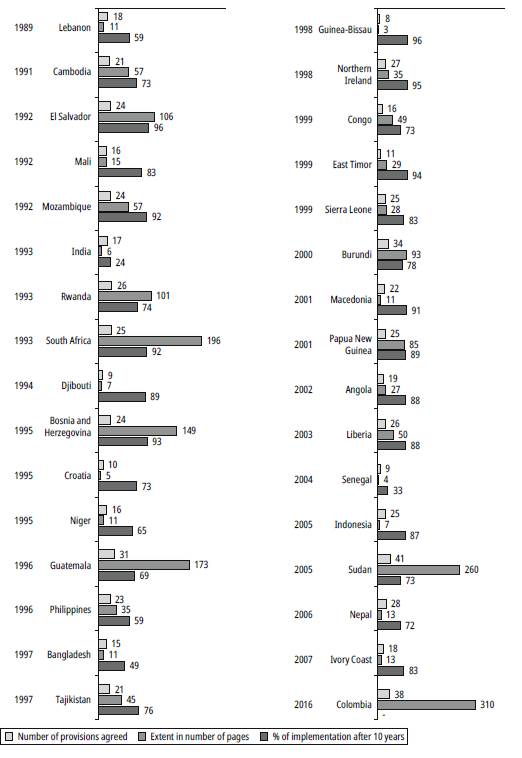
Figure 12
Characteristics of Peace Agreements (1989-2012) in Comparison to Colombia's 2016 CPAF
Source: Prepared by the authors based on data from Kroc Institute for International Peace Studies (2018) and Colombian Government & FARC (2016).
Popular encouragement, transparency and a shared sense of rightfulness are essential when dealing with peace agreements, occurring in the context of an unstable environment. Particularly, when other parties are still focused on armed conflict or illegal enterprises, and while there are limited resources available for the agreement implementation. It is thus necessary for the Colombian government and the FARC to explore context-specific, and at the same time, democratic and participative strategies, so that the stability of the agreement can be ensured for years to come.
References
Accion Contra Minas (2016). Acuerdo sobre limpieza y descontaminación. Retrieved from http://www.accion-contraminas.gov.co/accion/acuerdo/Paginas/Acuerdo-sobre-limpieza-y-descontaminacion.aspx
Aidi, H. (2016). Why Colombians opposed the peace deal with FARC. Al Jazeera. Retrieved from http://www.aljazeera.com/indepth/opinion/2016/10/colombians-opposed-peace-deal-farc-161004064506763.html
Álvarez Calderón, C. & Rodriguez Beltrán, C. (2018). Ecosistemas criminales. Revista Científica General José María Córdova, 16(24), 1-30. https://doi.org/10.21830/19006586.352
Ansorg, N., Haass, F., & Strasheim, J. (2016). Police reforms in peace agreements, 1975-2011: Introducing the prpa dataset. Journal of Peace Research, 53(4), 597-607. https://doi.org/10.1177/0022343316628932
Backer, D., Bhavnani, R., & Huth, P. (2016). Peace and Conflict 2016. London: Routledge.
Banco de la Republica (2017). Estadisticas. Retrieved from http://www.banrep.gov.co/es/-estadisticas
BBC (2016). Colombia referendum: Voters reject Farc peace deal. BBC News. Retrieved from http://www.bbc.com/news/world-latin-america-37537252
Bernal, J., Parra, J., Sierra, H., Ramelli, A., Caldas, L., Andrade, J., & Zambrano, L. (2017). Reflexiones jurídicas sobre el proceso de paz. Bogota D.C.: Universidad Externado de Colombia.
Botero, M. I. & Herrera, R. (2017). Desplazamiento forzado y restitución de tierras en Colombia: una aproximación cualitativa desde la perspectiva de las redes sociales. CIAIQ2017, 3(0), 260-269.
Bouvier, V. (2016). El acuerdo: un compromiso de Colombia para la paz. Portafolio. Retrieved from http://www.portafolio.co/economia/el-acuerdo-un-compromiso-de-colombia-para-la-paz-500566
Brodzinsky, S. (2016). Colombia to sign new peace deal with Farc rebels despite ongoing objections. The Guardian. Retrieved from http://www.theguardian.com/world/2016/nov/23/colombia-farc-sign-new-peace-deal-objections
Bruch, C., Muffett, C., & Nichols, S. S. (2016). Governance, Natural Resources and Post-Conflict Peacebuilding. New York, NY: Taylor & Francis.
Cabrera Cabrera, L. & Corcione Nieto, M. (2018). Aportes y retos en el posacuerdo: Una perspectiva desde las ciencias militares. Bogota D.C.: Sello Editorial ESMIC.
Cabrera Cabrera, L., Corcione Nieto, M., Figueroa Pedreros, E., & Rodriguez Macea, C. (2018). Sobre relatos y memoria. Revista Científica General José María Córdova, 16(24), 177-201. https://doi.org/10.21830/19006586.363
Caspersen, N. (2017). Peace Agreements: Finding Solutions to Intrastate Conflicts. Cambridge, UK: John Wiley & Sons.
Castro-Nunez, A., Mertz, O., Buritica, A., Sosa, C. C., & Lee, S. T. (2017). Land related grievances shape tropical forest-cover in areas affected by armed-conflict. Applied Geography, 85, 39-50. https://doi.org/10.1016/j.apgeog.2017.05.007
Durán, M., Adé, I., Martinez, R. & Calatrava, A. (2016). Experiencias de la participación militar espanola en misiones internacionales: el caso de los oficiales del Ejército de Tierra (1993-2015). Revista espanola de ciencia politica, 42, 125-145.
CNN (2016, November 14). En redes sociales los colombianos siguen divididos frente a nuevo acuerdo de paz con las FARC. CNN. Retrieved from http://cnnespanol.cnn.com/2016/11/14/en-redes-sociales-los-colombianos-siguen-divididos-frente-a-nuevo-acuerdo-de-paz-con-las-farc/
Colombian Government & FARC (2012). Acuerdo general del proceso de paz. Retrieved from https://www.mesadeconversaciones.com.co/sites/default/files/24-1480106030.11-1480106030.2016nuevoacuerdofinal-1480106030.pdf
Colombian Government & FARC (2016). Acuerdo final para la terminacion del conflicto y las construccion de una paz estable y duradera. Retrieved from https://www.mesadeconversaciones.com.co/sites/default/files/24-1480106030.11-1480106030.2016nuevoacuerdofinal-1480106030.pdf
Colombian Ministry of Defense (2017). Logros de la politica de defensa y seguridad todos por un nuevo pais 2017. Retrieved from https://www.mindefensa.gov.co/irj/go/km/docs/Mindefensa/Documentos/descargas/estudios_sectoriales/info_estadistica/Logros_Sector_Defensa.pdf
Colombian Ministry of Defense (2018). Logros de la politica de defensa y seguridad todos por un nuevo pais 2018. Retrieved from https://www.mindefensa.gov.co/irj/go/km/docs/Mindefensa/Documentos/descargas/estudios_sectoriales/info_estadistica/Logros_Sector_Defensa.pdf
Combita, L., Delgadillo, L., & Torres, S. (2013). El posconflicto en Colombia: una mirada hacia los diferentes procesos de paz. Corporación Universitaria Minuto de Dios, Bogotá, D.C., Colombia. Retrieved from http://www.corteidh.or.cr/tablas/usuario/sierra/Posconflicto/El%20posconflicto%20en%20Colombia.pdf
Comisión Internacional de Verificación de Derechos Humanos en Colombia (2018). Presentación del Informe de la Comisión Internacional de Verificación de Derechos Humanos en Colombia - Comisión Internacional de verificación de los Derechos Humanos en Colombia. Retrieved from http://comisioninternacional.org/presentacion-del-informe-de-la-comision-internacional-de-verificacion-de-derechos-humanos-en-colombia/
Común Acuerdo (2017). El nuevo acuerdo de paz. Bogota D.C.: Comun Acuerdo. Retrieved from http://www.al-tocomisionadoparalapaz.gov.co/herramientas/Documents/Nuevo_enterese_version_6_Sep_final_web.pdf
Conciliation Resources (2016). Las innovaciones llevan a la paz en Colombia. Retrieved from http://www.c-r.org/es/news-and-views/news/las-innovaciones-llevan-la-paz-en-colombia
Cristo, J. (2016). Los beneficios de la paz. El Espectador. Retrieved from http://colombia2020.elespectador.com/opinion/los-beneficios-de-la-paz-juan-fernando-cristo
DANE (2016). Mercado laboral. Retrieved from http://www.dane.gov.co/index.php/estadisticas-por-tema/merca-do-laboral
De la Calle, H. (2016). Los beneficios de un país en Paz. Bogota D.C.: Universidad del Rosario. Retrieved from http://www.urosario.edu.co/Home/Principal/Orgullo-Rosarista/Destacados/Los-beneficios-de-un-pais-en-Paz/
Dejusticia (2017). How is the implementation of the Agreement on Victims going? - Dejusticia. Retrieved from https://www.dejusticia.org/en/how-is-the-implementation-of-the-agreement-on-victims-going/
DeRouen, K. & Chowdhury, I. (2016). Mediation, Peacekeeping And Civil War Peace Agreements. Defence and Peace Economics, 29(2), 130-146. https://doi.org/10.1177/0738894209106481
DeRouen, K., Lea, J., & Wallensteen, P. (2009). The Duration of Civil War Peace Agreements. Conflict Management and Peace Science, 26(4), 367-387.
El Colombiano (2016). Y sigue la desconfianza. El Colombiano. Retrieved from http://www.elcolombiano.com/opinion/editoriales/y-sigue-la-descon-fianza-XB5636321
El Espectador (2017). Encuesta Gallup: retrato de un pais pesimista. El Espectador. Retrieved from http://www.elespectador.com/noticias/politica/encuesta-gallup-retrato-de-un-pais-pesimista-articulo-692182
El Espectador. (2018, February 12). Solo se ha cumplido el 18.5 % del acuerdo de paz con las Farc. El Espectador. Retrieved from https://www.elespectador.com/noticias/paz/solo-se-ha-cumplido-el-185-del-acuerdo-de-paz-con-las-farc-articulo-738623
El Pais (2016). Ocho grandes criticas al acuerdo de paz y la respuesta del Gobierno a ellas. El Pais. Retrieved from http://www.elpais.com.co/proceso-de-paz/ocho-grandes-criticas-al-acuerdo-de-paz-y-la-respuesta-del-go-bierno-a-ellas.html
El Pais (2017). Sigue el escepticismo por implementación del acuerdo de paz, según encuesta Gallup. El Tiempo. Retrieved from http://www.elpais.com.co/colombia/sigue-el-escepticismo-por-implementacion-del-acuer-do-de-paz-segun-encuesta-gallup.html
El Tiempo (2017a). 62 % de consultados en encuesta Gallup no creen que las Farc cumplirán. El Tiempo. Retrieved from http://www.eltiempo.com/politica/gobierno/encuesta-bimestral-de-gallup-sobre-percepcion-en-colombia-63114
El Tiempo (2017b). El desarme será simultáneo en los 26 puntos veredales de las Farc. El Tiempo. Retrieved from http://www.eltiempo.com/politica/proceso-de-paz/desarme-de-las-farc-sera-simultaneo-en-los-26-pun-tos-veredales-93814
El Tiempo (2017c). Las intervenciones más polémicas en convención del Centro Democrático. El Tiempo. Retrieved from http://www.eltiempo.com/politica/partidospoliticos/declaraciones-polemicas-en-la-conven-cion-del-centro-democratico-85708
El Tiempo (2018). Corrupción e inseguridad, entre lo que más inquieta a los colombianos. El Tiempo. Retrieved from http://www.eltiempo.com/politica/congreso/resultados-encuesta-bimestral-de-gallup-colombia-188434
Fernandez-Osorio, A.E. (2017). The Participation of Colombia in United Nations' Multidimensional Peace Operations. Journal of International Peacekeeping, 21, 83-124. https://doi.org/10.1163/18754112-02101003
Fundación Ideas para la Paz (2017a). Palabras y disparos. Retrieved from http://www.ideaspaz.org/publications/posts/1537
Fundación Ideas para la Paz, F. (2017b). Radiografia del nuevo acuerdo. Retrieved from http://www.ideaspaz.org/especiales/nuevo-acuerdo/
Gallup (2017a). Gallup Poll 117 (Encuesta Colombia 2017 No. 117). Bogota D.C.: Gallup Colombia. Retrieved from http://www.eltiempo.com/contenido/politica/gobierno/ARCHIVO/ARCHIVO-16832164-0.pdf
Gallup (2017b). Gallup Poll 119 (Encuesta Colombia 2017 No. 119). Bogota D.C.: Gallup Colombia . Retrieved from https://www.dropbox.com/s/lqxepasxg-d90unl/0258-17000010%20GALLUP%20POLL%20%23119.pdf?dl=0
Garay Acevedo, C. & Guecha, A. del P. (2018). Los derechos humanos en Colombia. Revista Científica General José María Córdova, 16(23), 83-105. https://doi.org/10.21830/19006586.307
Gomerzano, D. (2016). Colombia signs new peace deal with FARC while critics cry foul. Retrieved from http://www.france24.com/en/20161124-colombia-farc-rebels-sign-revised-peace-deal-uribe-conservatives-reject
Gómez, G. (2017). Entre el castigo y la reconciliación. Análisis sociojuridico del proceso de paz y la negociación del Acuerdo sobre las Victimas del Conflicto. Estudios Políticos, (50). Retrieved from http://www.redalyc.org/resumen.oa?id=16449788013
González Martinez, M., Quintero Cordero, S., & Ripoll De Castro, A. (2018). La seguridad en la Alianza del Pacifico. Revista Científica General José María Córdova, 16(23), 63-80. https://doi.org/10.21830/19006586.102
Hartzell, C., Hoddie, M., & Rothchild, D. (2001). Stabilizing the Peace After Civil War: An Investigation of Some Key Variables. International Organization, 55(1), 183-208. https://doi:10.1162/002081801551450
Herbolzheimer, K. (2016). Innovations in the Colombian peace process. Oslo: Norwegian Peacebuilding Resource Center. Retrieved from https://noref.no/
High Commissioner for Peace (2016a). Fin del conflicto. Retrieved from http://www.altocomisionadoparala-paz.gov.co/Documents/informes-especiales/abc-del-proceso-de-paz/fin-del-conflicto.html
High Commissioner for Peace (2016b). Implementación, verificación y refrendación del Acuerdo Final. Retrieved from http://www.altocomisionadoparalapaz.gov.co/Documents/informes-especiales/abc-del-proce-so-de-paz/implementacion-refrendacion-verifica-cion-acuerdo-final.html
High Commissioner for Peace (2016c). Participación política. Retrieved from http://www.altocomisionado-paralapaz.gov.co/Documents/informes-especiales/abc-del-proceso-de-paz/participacion-politica.html
High Commissioner for Peace (2016d). Política de desarrollo agrario integral. Retrieved from http://www.altocomisionadoparalapaz.gov.co/Documents/in-formes-especiales/abc-del-proceso-de-paz/politi-ca-de-desarrollo-agrario-integral.html
High Commissioner for Peace (2016e). Sistematizacion de opciones y propuestas voceros del no y lo acordado en el nuevo acuerdo. Retrieved from http://www.altocomisionadoparalapaz.gov.co/procesos-y-conversaciones/Documentos%20com-partidos/21-11-2016-CUADRO-Propuestas-y-Ajustes-definitivo.pdf
High Commissioner for Peace (2016f). Solución al problema de las drogas ilicitas. Retrieved from http://www.altocomisionadoparalapaz.gov.co/Documents/informes-especiales/abc-del-proceso-de-paz/solucion-al-problema-de-las-drogas-ilicitas.html
High Commissioner for Peace, C. (2016g). Victimas. Retrieved from http://www.altocomisionadoparalapaz.gov.co/Documents/informes-especiales/abc-del-proceso-de-paz/victimas.html
Hógbladh, S. (2012). Peace Agreements 1975-2011: Updating the UCDP Peace Agreement Dataset (No. 99) (pp. 39-56). States in armed conflict, 39, 39-56. Retrieved from http://citeseerx.ist.psu.edu/viewdoc/download?- doi=10.1.1.739.1886&rep=rep1&type=pdf
Ibanez, A. M. (2016). El proceso de paz con las Farc: ¿Una oportunidad para reducir la pobreza rural y aumentar la productividad agropecuaria? Revista de Ingeniería, 0(44), 8-13. https://doi.org/10.16924/riua.v0i44.909
International Committee of the Red Cross. (2017). Persisten infracciones al derecho internacional humanitario en Colombia. International Committee of the Red Cross. Retrieved from https://www.icrc.org/es/document/persisten-infracciones-al-derecho-internacio-nal-humanitario-en-colombia
International Criminal Court. (2016). Colombia. Retrieved from https://www.icc-cpi.int/colombia
Jackson, J. (2016). Colombia's Indigenous Peoples and the Peace Accords. Indigenous Policy Journal, 27(3). Retrieved from http://www.indigenouspolicy.org/index.php/ipj/article/view/438
Jeffery, R. (2017). Nepal's comprehensive peace agreement: human rights, compliance and impunity a decade on. International Affairs, 93(2), 343-364. https://doi.org/10.1093/ia/iix007
Joshi, M. & Quinn, J. M. (2015). Is the Sum Greater than the Parts? The Terms of Civil War Peace Agreements and the Commitment Problem Revisited. Negotiation Journal, 31(1), 7-30. https://doi.org/10.1111/nejo.12077
Kovacs, M. S. & Hatz, S. (2016). Rebelto-party transformations in civil war peace processes 1975-2011. Democratization, 23(6), 990-1008. https://doi.org/10.1080/13510347.2016.1159558
Kroc Institute for International Peace Studies (2018). Peace Accords Matrix. Retrieved from https://peaceaccords.nd.edu/about
LaReau, R. (2016). Kroc Institute charged with technical verification and monitoring of historic Colombian peace accord. Retrieved from http://news.nd.edu/news/kroc-institute-charged-with-technical-verification-and-monitoring-of-historic-colombian-peace-accord/
Lopez, N. (2016). El antes y el después del acuerdo de paz de Colombia. El Mundo. Retrieved from http://www.elmundo.es/internacional/2016/11/24/58370c78e2704e47798b4621.html
Lounsbery, M. O. & DeRouen, K. (2016). The viability of civil war peace agreements. Civil Wars, 18(3), 311-337. https://doi.org/10.1080/13698249.2016.1215637
Mac Ginty, R., Muldoon, O. T., & Ferguson, N. (2007). No War, No Peace: Northern Ireland after the Agreement. Political Psychology, 28(1), 1-11. https://doi.org/10.1111/j.1467-9221.2007.00548.x
Mares, D. R., & Martinez, R. (2014). Debating Civil-Military Relations in Latin America. Eastbourne: Sussex Academic Press.
Martinez, R. (2007). Los Mandos de Las Fuerzas Armadas Espanolas del Siglo xxi. Madrid: Centro de Investigaciones Sociologicas.
Martinez, R. & Diaz, A. M. (2005). Spain: an equation with difficult solutions. In G. Kuemmel, & G. Caforio (Eds.), Military Missions and their Implications Reconsidered: The Aftermath of September 11th (pp. 213-247). Bingley: Emerald Group Publishing Limited.
Martinez, R. & Durán, M. (2017). International Missions as a Way to Improve Civil-Military Relations: The Spanish Case (1989-2015). Democracy and Security, 13(1), 1-23.
Martinez, R., Adé, I., Durán, M., & Diaz, A. (2013). Experiencias de la participación militar espanola en misiones internacionales (2000-2012). Revista espanola de ciencia política, 32, 205-223.
Mattes, M. & Savun, B. (2010). Information, Agreement Design, and the Durability of Civil War Settlements. American Journal of Political Science, 54(2), 511-524. https://doi.org/10.1111/j.1540-5907.2010.00444.x
Medina, J., Pinzon, A., & Zuleta, H. (2017). Violencia, procesos de paz e inversión industrial en Colombia (Documentos CEDE No. 33). Bogota D.C.: Universidad de Los Andres. Retrieved from https://economia.uniandes.edu.co/components/com_booklibrary/ebooks/dcede2017-33.pdf
Negrete, E. (2017). Uribismo hará trizas el Acuerdo de Paz si gana el poder en 2018. Confidencial Colombia. Retrieved from http://confidencialcolombia.com/es/1/lo_mas_confidencial/30904/Uribismo-har%C3%A1-trizas-el-Acuerdo-de-Paz-si-gana-el-poder-en-2018-Centro-Democr%C3%A1tico-Acuerdo-de-Paz-Elecciones-2018.htm
Oppenheimer, A. (2016). Colombia peace deal won't solve country's key problem - an outdated economy. Miami Herald. Retrieved from http://www.miamiherald.com/news/local/news-columns-blogs/andres-oppen-heimer/article100406672.html
Paffenholz, T. (2014). Civil Society and Peace Negotiations: Beyond the Inclusion-Exclusion Dichotomy. Negotiation Journal, 30(1), 69-91. https://doi.org/10.1111/nejo.12046
Paris, R. (2004). At War's End: Building Peace After Civil Conflict. Cambridge: Cambridge University Press.
Peacebuilding Support Office (2010). UN Peacebuilding: an Orientation. Retrieved from http://www.un.org/en/peacebuilding/pbso/pdf/peacebuilding_orientation.pdf
Pettersson, T. & Lotta, T. (Eds.) (2012). States in Armed Conflict 2011. Uppsala University: Department of Peace and Conflict Research. Retrieved from http://ucdp.uu.se/downloads/
Pion-Berlin, D. & Martinez, R. (2017). Soldiers, politicians, and civilians: reforming civil-military relations in democratic Latin America. Cambridge: Cambridge University Press .
Pizarro, E. & Moncayo, V. (Eds.). (2015, February). Contribución al entendimiento del conflicto armado en Colombia. Bogotá D.C.: Comisión Histórica del Conflicto y sus Victimas. Retrieved from http://www.alto-comisionadoparalapaz.gov.co/mesadeconversaciones/PDF/Informe%20Comisi_n%20Hist_rica%20del%20Conflicto%20y%20sus%20V_ctimas.%20La%20Habana%2C%20Febrero%20de%202015.pdf
Puerta, C. & Dover, R. (2017). Salud, Recursos Naturales y el Proceso de Paz en Colombia. The Journal of Latin American and Caribbean Anthropology, 22(1), 183-188. https://doi.org/10.1111/jlca.12266
RCN (2016a). El acuerdo de paz de Cuba no existe, asegura el exprocurador Alejandro Ordónez. KCN. Retrieved from http://www.rcnradio.com/nacional/el-acuerdo-de-paz-de-cuba-no-existe-asegura-el-exprocurador-alejandro-ordonez/
RCN (2016b). Gran encuesta: desaprobación de mandato de Santos alcanza un bajo histórico. KCN. Retrieved from http://www.noticiasrcn.com/nacional-pais/gran-encuesta-desaprobacion-mandato-santos-alcan-za-un-bajo-historico
Rendón, O. (2017). Sergio Jaramillo le contestó a Fernando Londono, quien quiere "hacer trizas" el acuerdo de paz. El Colombiano. Retrieved from http://www.elcolombiano.com/colombia/paz-y-derechos-humanos/acuerdo-de-paz-enfrenta-a-fernando-londono-y-sergio-jaramillo-HK6509898
Rettberg, A. & Quiroga, D. (2016). Más allá de la firma: las elecciones legislativas (2014) y locales (2015) y el futuro de la implementación de la Paz en Colombia (SSRN Scholarly Paper No. ID 2718732). Rochester, NY: Social Science Research Network. Retrieved from https://papers.ssrn.com/abstract=2718732
Salvesen, H. & Nylander, D. (2017). Towards an inclusive peace: women and the gender approach in the Colombian peace process. Oslo: Norwegian Peacebuilding Resource Center . Retrieved from https://noref.no/Publications/Regions/Colombia/Towards-an-inclusive-peace-women-and-the-gender-approach-in-the-Colombian-peace-process
Sánchez, O. (2016). Uribe ratificó sus criticas al acuerdo Gobierno-Farc. El Colombiano. Retrieved from http://www.elcolombiano.com/colombia/uribe-ratifico-sus-criticas-al-acuerdo-gobierno-farc-EI4864341
Semana (2016). Declaraciones del exprocurador Alejandro Ordonez. Semana. Retrieved from http://www.semana.com/nacion/articulo/alejandro-ordonez-habla-del-proceso-de-paz-el-gobierno-santos-la-ideologia-de-genero-y-el-plebiscito/495287
Semana (2017a). Después de 53 anos, la guerrilla le entregó 7.132 armas a la ONU. Semana. Retrieved from http://www.semana.com/nacion/articulo/dejacion-de-las-armas-de-las-farc-es-certificado-por-la-onu/530062
Semana (2017b). Popularidad de Santos en diferentes encuestas. Semana. Retrieved from http://www.semana.com/confidenciales/articulo/popularidad-de-santos-en-diferentes-encuestas/532682
Serrano Álvarez, J. M. (2018). El paradigma de la guerra en el siglo XX. Revista Científica General José María Córdova, 16(23), 23-42. https://doi.org/10.21830/19006586.305
Spears, I. S. (2000). Understanding inclusive peace agreements in Africa: The problems of sharing power. Third World Quarterly, 21(1), 105-118. https://doi.org/10.1080/01436590013251
Stedman, S. J., Rothchild, D. S., & Cousens, E. M. (2002). Ending Civil Wars: The Implementation of Peace Agreements. Boulder, CO: Lynne Rienner Publishers.
Tesillo, C. (2016). Importancia de la construcción de paz en un contexto de guerra: caso colombiano en el periodo 2000-2016. Revista Internacional de Cooperación y Desarrollo, 3(2), 130-149. https://doi.org/10.21500/23825014.2782
The Economist (2017). Deadline pressure for Colombia's peace agreement. The Economist. Retrieved from https://www.economist.com/news/americas/21722244-de-lays-implementing-accord-are-worrying-not-fatal-deadline-pressure-colombias
The New York Times (2016). Colombia's Revised Peace Accord. The New York Times. Retrieved from https://www.nytimes.com/2016/11/15/opinion/colombias-revised-peace-accord.html
Transparency International (2017). Transparency International - Colombia. Retrieved from https://www.transparency.org/country/COL
Torrijos Rivera, V. & Abella Osorio, J. (2018). El comportamiento de las FARC tras la firma de los acuerdos de La Habana. Revista Científica General José María Córdova, 16(24), 31-60. https://doi.org/10.21830/19006586.342
United Nations (2017). Octavo informe mensual del mecanismo de monitoreo y verificación. Bogota D.C.: United Nations. Retrieved from https://colombia.unmissions.org/sites/default/files/8o_informe_mecanismo_de_ monitoreo_y_verificacion.pdf
Valencia, O. & Daza, M. (2010). Vinculación a grupos armados: un resultado del conflicto armado en Colombia. Diversitas: Perspectivas en Psicología, 6(2), 429-439. Retrieved from http://www.redalyc.org/resumen.oa?id=67915140015
Vivanco, J. (2016a). Colombia Peace Deal's Promise, and Flaws. Human Rights Watch. Retrieved from https://www.hrw.org/news/2016/09/27/colombia-peace-deals-promise- and-flaws
Vivanco, J. (2016b). Colombia Peace Deal's Unwelcome Critic. Human Rights Watch. Retrieved from https://www.hrw.org/news/2016/08/16/colombia-peace-deals-unwelcome-critic
Wallensteen, P. & Sollenberg, M. (2001). Armed Conflict, 1989-2000. Journal of Peace Research, 38(5), 629-644.
Walter, B. (2004). Does Conflict Beget Conflict? Explaining Recurring Civil War. Journal of Peace Research, 41(3), 371-388.
World Bank (2017). Colombia Data. Retrieved from http://datos.bancomundial.org/pais/colombia
Yanhass Poll. (2017). Desaprobación a gestión Santos sube a 71 %. El Nuevo Siglo. Retrieved from http://www.elnuevosiglo.com.co/articulos/01-2017-desaprobacion-a-gestion-santos-escala-a-71
Notes