Articulos Originales
Study of Enzymes Pre-Treatments in Biomasses Dedicated to Biogas Production
Estudio de pre-tratamientos con enzimas en biomasas destinadas a la producción de biogás
Study of Enzymes Pre-Treatments in Biomasses Dedicated to Biogas Production
Revista Ciencias Técnicas Agropecuarias, vol. 26, núm. 2, 2017
Universidad Agraria de La Habana Fructuoso Rodríguez Pérez
Recepción: 12 Septiembre 2016
Aprobación: 13 Marzo 2017
Abstract: This work presents a study of the influence of an enzyme pre-treatment application to different substrates utilized for biogas production. The substrates studied were biomass of agricultural origin (sorghum-R-132, sunflower JE-94, cornand dasheen) and a tavern residual (white bread). The pre-treatment consisted on the addition of one enzyme (ZY maXX XL 200) in dose of 100 µL/syringes per 350 mg substrates diluted in 30 mL of inoculum. Substrates underwent a biodigestion process and the results were compared with those obtained in absence of the enzyme pre-treatment. Increments were achieved in the maximum specific biogas yield in the substrates. The best results took place with Colocacia esculenta (1918,07 LCH4/kgSV); bread (1792,81 LCH4/kgSV); sunflower JE-94 (1676, 06 LCH4/kgSV); sorghum R-132 (1145,78 LCH4/kgSV) and corn (1139,03 LCH4/kgSV) being obtained more than 100% increment in the maximum specific biogas yield when the treatment is used with enzymes and pig inoculum. On the other hand, it was observed that pH evolves in a similar way in substrates evaluated with enzyme treatment and without pre-treatment.
Keywords: Substrate, Wastes, Agricultural origin, Bovine and swine inoculum.
Resumen: En este trabajo se realiza un estudio de la influencia de la aplicación de un pre tratamiento con enzimas a diferentes sustratos con potencialidades de utilizarse para la producción de metano. Los sustratos estudiados fueron de origen agrícola (sorgo-R-132, girasol JE-94, maíz y malanga) y un residuo de cantina (pan blanco). El pre-tratamiento consistió en la adición de la enzima (ZY maXX XL 200) en dosis de 100 µL/jeringas por 350 mg de sustratos mezclados en 30 mL de inóculo. Se investigó su efecto ante dos inóculos diferentes (inóculo vacuno e inóculo porcino). En cada una de las variantes de experimentación, los sustratos se sometieron a un proceso de digestión anaerobia y los resultados se compararon con los obtenidos en ausencia del pre-tratamiento. Se lograron incrementos favorables en el rendimiento específico máximo de biogás de los sustratos. Los mejores resultados se presentaron con la malanga (Colocacia esculenta), (1918,07 LCH4/kgSV); Pan (1792,81 LCH4/kgSV); Girasol JE-94 (1676, 06 LCH4/kgSV); Sorgo R-132 (1145,78 LCH4/kgSV) y Maíz (1139,03 LCH4/kgSV) donde fueron obtenidos incrementos mayores de 100% en el rendimiento máximo específico de biogás cuando se aplicó este pre-tratamiento con inóculo porcino. Por otra parte, se pudo apreciar que la evolución del pH en los sustratos evaluados, se comportó de forma semejante tanto cuando se utilizó el pre-tratamiento con enzimas que cuando este no fue utilizado.
Palabras clave: sustrato, residuos, origen agrícola, inóculo vacuno y porcino.
INTRODUCTION
The composition of the substrates is one of the main factors in anaerobic digestion to determine methane yield and potential. Most of the bibliographical sources report that the differences in methane kinetics, potential and yield depend on the type of substrates utilized.
The methods of substrate pre-treatments have as object the improvement of their anaerobic digestion qualities, when altering their physical, chemical and biological properties. However, these pre-treatments show certain particularities such as: increase of manipulation costs, increment of legislative requirements for the stabilization and removal of possible pathogens, tendency to handle smaller nitrogen limits, which allows handling these substrates’ age and the decrease of the degradability of activated substrates (Zhong et al., 2011). However, pre-treatments analysis is necessary depending on type, performance and costs (Martínez & García, 2016).
Biological pre-treatments: the objective of biological pre-treatments is to prepare the substrates for the enzymatic degradation and the best method and condition of pre-treatment greatly depends on the substrates type. Among the utilized microorganisms to degrade organic substrates there are several types of mushrooms, such as: brown, white and soft rotten, besides some types of bacteria (Taherzadeh & Karimi, 2008). Kurakake et al. (2007) studied biological treatments in office paper with two chains of bacteria (Sphingomonas paucimobiles and Baccilus circulans), obtaining improvements in the enzymatic hydrolysis, as well as 94% of sugar recovery. Depending on the substrates type (residuals of houses, waters of industries, residuals of still etc), the enzymatic attack can be carried out by different types of mushrooms or combinations of them (Aspergillus niger, Aspergillus awamori, Aspergillus oryzae, Aspergillus terreus, etc). Taniguchi et al. (2005) evaluated biological pre-treatments in rice straw using 4 white-rotten mushrooms (Phanerochaete chrysospurium, Tramete versicolor, Ceriporiopsis subvermispora and Pleurutus ostreatus) and the pre-treatment with Pleurutus ostreatus resulted in a selective degradation of lignin and an increment of rice straw susceptibility to enzymatic hydrolysis. Also, solid fermentation of orange peel with chains of mushrooms types Sporotrichum, Aspergillus, Fusarium and Penicillum, improved the feeding capacity of the constituents and reduced the level of antimicrobial substances. In a similar work, white-soft mushroom cultivations were used to decontaminate residual waters of milled olives, improving their anaerobic digestion. Vintiloui et al. (2009) investigated the influence of temperature and pH of several commercial enzymes on the degradation of corn ears and straw. In accordance with Vintiloui et al. (2009) the best results were obtained at 500 C, they also outline that enzymes produced by mushrooms present their best potentialities to pH values between 4 and 6. However, the methane genesis takes place to values between 6 and 8, therefore, it would be necessary to look for an enzyme that maintains a good activity in these pH ranges.
Low energy requirement, no chemicals usage and gentle environmental condition are the main advantages of biological pre-treatments. However, the efficiency of these pre-treatments is sometimes low. For such a reason, biological pre-treatments need other previous pre-treatments that assure the later enzymatic attack; this alternative can be carried out later to other pre-treatments previous such as physical or chemical pre-treatments. Recently, Martinez et al. (2015) published a work using a chemical–thermal pre-treatment in the same biomasses that are valued in this investigation. Hence, the present work constitutes a continuation of the use of special pre- treatments to be used in the anaerobic biodigestion of agricultural and tavern residuals. Of the analysis of these bibliographical sources it can be appreciated that the application of a pre-treatment with enzymes to organic residuals (lignin type), is very appropriate to favor biodegradability and methane production. This investigation intends to apply a pre-treatment with enzymes to different types of biomasses, studying their effect on the biogas production.
METHODS
This work was carried out in Central University “Marta Abreu” of Las Villas, but the investigation material (Liquid cellulase enzymatic preparation, ZY maXX XL 200) was donated by the Company BIOPRACT GmbH, through investigators of University of Hohenheim, Germany. The experimental results, fruit of an investigation project in execution, were obtained from February 2015 until January 2016. Different effective norms for this type of investigation were taken into consideration, as it is indicated below. The substrates were characterized according to the norm (VDI 4630, 2006) and following the characterization and general classification of substrates, the possibilities of fermentation of organic materials can be considered. The agricultural residuals studied in a Cuban investigation project (Martinez et al., 2014), have been: sorghum (Sorghum R-132), sorghum (Sorghum halepense), sunflower (Helianthus annuus L JE-94), corn (Zea mays), dasheen (Colocasia esculenta L Schott), sweet potato (Ipomoea batata) and potato (Solanum tuberosum Sw). Also, a tavern residual has been studied (white bread). In the case of the agricultural residuals, they were collected by taking their roots, stems, leaves and fruits. Later on they were dried off and fractioned in particles of 1 mm of size. Laboratory analyses of samples were carried out in Germany and field investigations were performed in Cuba.
The investigations in Germany were executed in an investigation stay developed in the University of Hohenheim between September and November, 2013. There enzymes treatment was not applied, neither it was investigated with swine inoculum; it was only investigated with bovine inoculum. In Cuba, a pre-treatment was used with enzymes, which consisted on adding the enzyme ZY maXX XL 200 in dose of 100 µL/syringes for 350 mg of bovine and swine substrates.
Substrates inoculated with the enzyme were allowed reposing during 4 hours, later on the inoculum (30 mL) was added. The next step was to introduce the substrates pre-treated in experimental syringes of 100 mL of capacity. Bovine inoculum was added (caw manure) in some cases, in other cases swine inoculum (pig manure), coming from biodigesters in production. The conditions of the experiments are presented in Table 1.

Experimental syringes were placed in a Hohenheim Bench Test (HBT), two replicas per substrate in each syringe; as well as a replica in a plastic container, in order to investigating the evolution of the pH in the process of anaerobic digestion under field conditions. The following parameters were evaluated:
• Humidity and dry matter content according to norm NC74-22: 1985;
• Ashy content according to norm NC-74-30: 1985;
• Determination of the relationship carbon/nitrogen (VDI4630, 2006),
• pH evolution in the biodigestion
• Evaluation of specific biogas yield Starting from the input data, by means of softwares elaborated for these ends (Gärtest nach VDI 4630) and following the norm (VDI-4630, 2006), the following parameters were calculated:
• Biodegradability rate
• Maximum potential of biogas (LCH4/kgSV) The results of the investigations were processed with the professional statistical package STATISTICA 8.0.
RESULTS AND DISCUSSION
In Figure 1 the behavior of the valued substrates without the use of enzymes pre-treatment and using bovine inoculum are observed. It can be observed that the biggest specific methane yield was obtained with bread (346,12 LCH4/kgSV), while the rest of the biomasses did not reach superior values to 180 LCH4/kgSV, being these values below the obtained by Martínez et al. (2014). That could be due to the mixed use of roots, leaves, and fruits of these agricultural biomasses, which possess bigger quantity of fiber (cellulose and hemicellulose) compared with the studies of these biomasses independent and previously made.
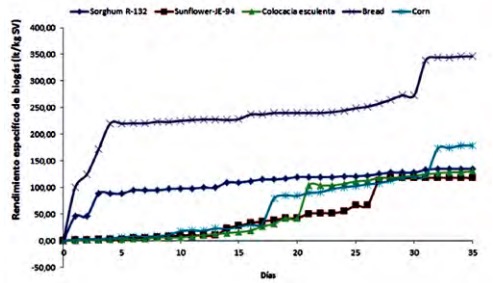
FIGURE 1
Average specific biogas yield of the biomasses using bovine inoculum without pre-treatment in field
Figure 2 shows the results obtained using enzymes pre-treatment with bovine inoculum. It can be appreciated that the biggest specific methane yield was obtained with bread (507,77 LCH4/kgSV), followed by dasheen (Colocacia esculenta) (336,80 LCH4/kgSV), while in sunflower (Helianthus annuus L JE-94) (161,54 LCH4/kgSV) the lowest values were presented. These results are within the range of other investigations developed by Brule et al. (2011), where they did not find significant differences in the biogas yield (m3 /kg oTS) in effluents of the first and second bioreactors of German plants in production that used enzymes with these purposes, compared with the control without their use.
In the Figure 3, the results of the behavior of the different valued substrates are presented with the enzyme ZY maXX XL 200 and pig inoculum.
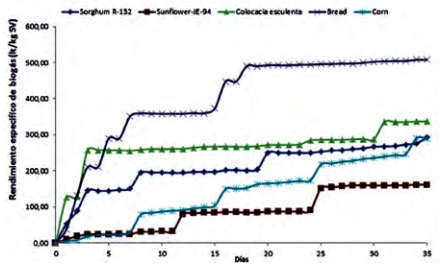
FIGURE 2
Average specific biogas yield of the biomasses using bovine inoculum with enzymes pre-treatment in field experiments in Cuba
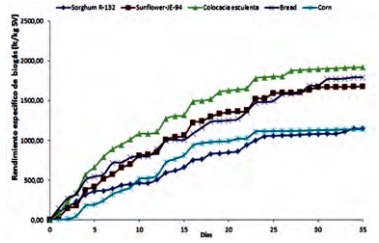
FIGURE 3
Average specific biogas yield of the biomasses using swine inoculum with enzymes pre-treatment in field experiments in Cuba
In this case a different behavior is observed in all substrates. It can be noticed that the biggest specific methane yield was obtained with dasheen (Colocacia esculenta) (1918,07 LCH4/kgSV), meaning an increment of 782,7% regarding the behavior of this substrate without pre-treatment, while the minimum value was obtained with corn (Zea mays) (1139,03 LCH4/kgSV), being an increment of 326,5% (Martínez et al., 2014). According to Brule (2014), the experiments in the stage of enzymatic hydrolysis show a poor efficiency of the enzymes addition to agricultural substrates Brule (2014) concluded that the efficiency of the enzymes can be favored by low content of recalcitrant fibers and lignin, low pH and low temperature. Brule (2014) referred that to achieve a positive effect of enzyme addition in the productive practice, the bioreactor should have a high organic load rate (OLR), a low hydraulic residence time (HRT) and substrates characterized by possessing a mixture of energy cultivations. Therefore, our results are in contradiction with this author’s and until the present there have not been similar references to those in here stated. These results indicate a very positive effect of the enzyme ZY maXX XL 200 in the substrates evaluated, when this type of inoculum is used. It should be emphasized that these results are surprising and they show the potentiality that the enzyme ZY maXX XL 200 possesses to favor biodegradation ability and biogas production.
It is also remarkable that using swine inoculum, the yields achieved in the diverse biomasses are much higher than the ones reached with bovine inoculum. The cost of the enzyme ZY maXX XL 200 is $64,00 €/ kg. Considering the small quantities used for this pre-treatment (100 µL/syringe/ 0,350 mg of substrate evaluated), it can be inferred that the expense is not significant. however, the specific biogas yields per substrates obtained, reach values from a maximum of 782,7% (Colocacia esculenta) until a minimum of 326,5% (Zea mays) of increments, compared these same substrates with those without pre-treatments (Martinez et al., 2014). Therefore, this demonstrates the economic feasibility of its use. In Figure 4, it is shown the yield of obtained biogas (LCH4/ kgSV) in the biomass evaluated in Cuba without the application of the enzyme pre-treatment and using swine inoculum. In this case, it is observed that the best behavior was obtained with corn (Zea mays) (280,13 LCH4/kgSV) and dasheen (Colocacia esculenta) (264,89 LCH4/kgSV), while the rest of the biomasses reached inferior yields to 200 LCH4/kgSV, behaving worse than in the case that bovine inoculum is used.
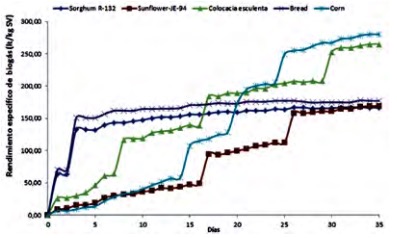
FIGURE 4
Average specific biogas yield of the biomasses using swine inoculum without pre-treatment in field experiments in Cuba
Another important aspect object of valuation was the one related to pH evolution in the samples pre-treated with enzymes. In figure 5 their behavior is presented. There it is possible to observe that, in the first five days of biodigestion process an abrupt fall of the pH is presented, however, as the process went on, these values increased, product of the buffer or tampon effect of the inoculum, and it finished with appropriate values for this type of processes (pH values between 6 and 8), except in the corn basis.

FIGURE 5
pH evolution. Variants analyzed under field conditions with enzymes pre-treatments and bovine inoculum
Something similar is presented in Figure 6. In this case, the same variables are analyzed, but using swine inoculum.
In this case, all substrates finished with pH values above 8. In this case, the enzyme ZY maXX XL 200 fulfilled the requirement of maintaining a good degrading activity of the substrates in these pH ranges between 6 and 8, which agrees with that outlined by Vintiloui et al. (2009). In Figure 7, the obtained results of the statistical comparison of the different substrates evaluated with enzymes using bovine and swine inoculum, respectively, are presented.
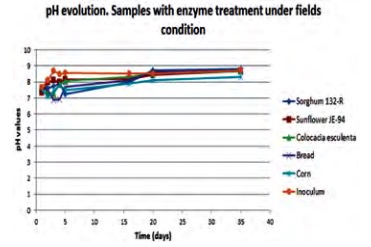
FIGURE 6
pH evolution. Variants analyzed under field conditions with enzymes pre-treatments and swine inoculum.
Analyzing Figure 7, it is possible to appreciate that in all substrates evaluated, the behavior of specific biogas yield, when swine inoculum was used (P.I), presented significant differences with regard to when bovine inoculum (B.I) was used.

FIGURE 7
Whisker Box analysis of substrates evaluated with pre-treatment with enzymes and bovine and swine inoculum, respectively
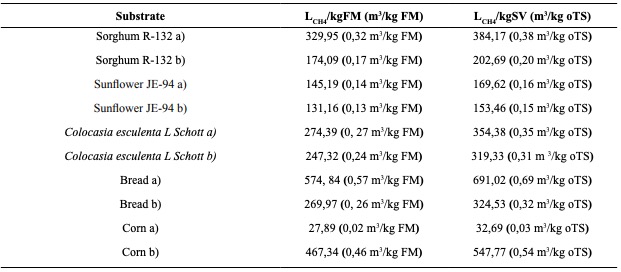
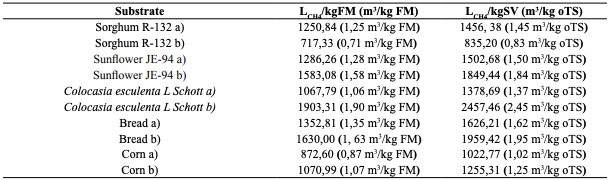
The results obtained at field level, in the process of biodigestion of the substrates pre-treated with enzymes and bovine inoculum, are shown in the Table 2. Analyzing the maximum values obtained, it is evident that in bread substrate the biggest specific biogas yield occurred (574,84 LCH4/kgSV), while in corn, it presented the lowest value (27,89 LCH4/kgSV), differing with the results reached at laboratory level in Germany by Martinez et al. (2014); as well as with other results obtained by Martinez et al. (2015), using chemical-thermal pre-treatment in these same biomasses, which could be given by the utilized pre-treatment. On the other hand, in the analysis of the maximum values obtained in the biogas yields with the same substrates with enzymes pre-treatment and swine inoculum (Table 3), a completely different behavior is observed. Next the values obtained are presented. In dasheen (Colocacia esculenta), the biggest specific biogas yield is manifested (1903,31 LCH4/kgSV), while Sorghum R-132 got the smallest specific biogas yield (717,33 LCH4/kgSV). In this case these results were very good and they show the utility of this type of pre-treatment using swine inoculum.
CONCLUSIONS
• In all substrates evaluated increments above 100% were obtained in their maximum value of specific biogas yield when this pre-treatment is applied with swine inoculum, compared with the case of the same pre-treatment with bovine inoculum application.
•Favorable increases of the specific biogas yield were achieved in the cases of dasheen (1918,07 LCH4/kgSV); bread (1792,81 LCH4/kgSV); sunflower JE-94 (1676, 06 LCH4/kgSV); Sorghum R-132 (1145,78 LCH4/kgSV) and corn (1139,03 LCH4/kgSV), when the treatment is used with enzymes and swine inoculum.
• pH evolution in the biomasses treated with this special pre-treatment behaved in similar way to when the biomasses are not treated. • It is necessary to continue this type of investigation to clarify in which other biomasses that use this special pre-treatment, could report bigger specific biogas yields.
Acknowledgements
To CUBAENERGIA national project. Code. 9917. Studies of basic and special treatments to improve the production and quality of the biogas; To Hohenheim University. Germany.
REFERENCES
BRULE M.: The effect of enzyme additives on the anaerobic digestion of energy crops, University of Hohenheim, Ph.D. Thesis, Germany, 180 p., 2014.
BRULE, M.; VOGTHEER, J.; LEMMER, A.; OECHSNER, H.; JUNGBLUTH, T.: “Effect of enzyme addition on the methane yields of effluents from a full scale biogas plant”, Landtechnik, 66(1): 50-52, 2011, ISSN 0023-8082.
KURAKAKE, M.; IDE, N.; KOMAKI, T.: “Biological Pretreatment with Two Bacterial Strains for Enzymatic Hydrolysis of Office Paper”, Current Microbiology, 54(6): 424-428, 2007, ISSN: 0343-8651, 1432-0991, DOI: http://dx.doi.org/10.1007/s00284-006-0568-6.
MARTÍNEZ, C.; OECHSNER, H.; BRULÉ, M.; MARAÑON, E.: “Estudio de algunas propiedades físico-mecánicas y químicas de residuos orgánicos a utilizar en la producción de biogás en Cuba”. Revista Ciencias Técnicas Agropecuarias, 23(2): 63-69, 2014, ISSN: 1010-2760, 2071-0054.
MARTÍNEZ, C.; OECHSNER, H.; REINHARDT, A.; GARCÍA, Y.; LÓPEZ, L.: “Studies of chemical-thermal pre-treatment in biomass to use for biogas production in Cuba”. Journal of Basic and Applied Research International, 14(3): 215-224, 2015, ISSN: 2395-3438, 2395-3446.
MARTÍNEZ, C.; GARCÍA, Y.: “Utilización de pre-tratamientos básicos y específicos para la producción de biogás. Revisión y análisis”, Revista Ciencias Técnicas Agropecuarias, 25(3): 81-92, 2016, ISSN: 2071-0054, DOI: http://dx.doi.org/10.13140/RG.2.2.34865.99688.
OFICINA NACIONAL DE NORMALIZACIÓN: Determinación de la humedad inicial y de la materia seca, no. NC 74-22, 1985.
OFICINA NACIONAL DE NORMALIZACIÓN: Determinación del contenido de cenizas, no. NC 74-30, 1985.
TAHERZADEH, M.J.; KARIMI, K.: “Pretreatment of lignocellulosic wastes to improve ethanol and biogas production. A review”, International Journal of Molecular Science, 9(9): 1621-1651, 2008, ISSN: 1422-0067, DOI: http://dx.doi.org/10.3390/ijms9091621.
TANIGUCHI, M.; SUSUKI, H.; WATANABE, D.; SAKAI, K.; HOSHINO, K.; TANAKA, T.: “Evaluation of pretreatment with Pleurotus ostreatus for enzymatic hydrolysis of rice straw”, Journal of Bioscience and Bioengineering, 100(6): 637-643, 2005, ISSN: 1389-1723, DOI: http://dx.doi.org/10.1263/jbb.100.637.
VINTILOUI, A.; BRULÉ, M.; LEMMER. A.; OECHSNER, H.; JUNGBLUTH, T.: “Influence of temperature and pH on enzyme activity in the biogas process”, Landtechnik, 64(1): 22-24, 2009, ISSN: 0023-8082.
VDI-RICHTLINIEN-4630: Fermentation of organic material characterization of substrate, sampling collection of material data, fermentation tests. Dusseldorf, 92 p., 2006.
ZHONG, W.; ZHANG, Z.; QIAO, W.; FU, P.; LIU, M.: “RETRACTED: Comparison of chemical and biological pretreatment of corn straw for biogas production by anaerobic digestion”, Renewable Energy, 36(6): 1875-1879, 2011, ISSN: 0960-1481, DOI: http://dx.doi.org/10.1016/j.renene.2010.12.020.
Notes