Artículos originales
Mathematical Models for Flow Estimation in Sutro Weirs Used in Irrigation Systems
Modelos matemáticos para la estimación del caudal en vertedores Sutro utilizados en sistemas de riego
Mathematical Models for Flow Estimation in Sutro Weirs Used in Irrigation Systems
Revista Ciencias Técnicas Agropecuarias, vol. 26, núm. 3, 2017
Universidad Agraria de La Habana Fructuoso Rodríguez Pérez
Recepción: 20 Octubre 2016
Aprobación: 15 Junio 2017
Abstract: The results of the research carried out in Laboratory of Fluid Mechanics and Hydraulics of Carlos de Guatemala University to develop mathematical models necessary in the flow estimation in Sutro weirs are presented in this work. Nine weirs with different values of curvature constant . (5, 10, 20, 30, 40, 50, 60, 70, 90) were produced. The experiment showed that the discharge coefficients . are not constant and vary between 0.6532 and 0.7504. A potential model type μ=7.86x10⁻⁴.-0,0274 was proposed for the correction of the discharge coefficient which greatly improves the accuracy of Sotelo´s equation. To estimate mean water speed in each weir, water depth with values greater than 65% of the maximum water depth should be used, in order to reach minimal speed variations. A mathematical model that relates mean speed and . constant with a correlation coefficient of 0.8961 was found.
Keywords: calibration, discharge coefficient, hydrodynamic canal, flow mensuration.
Resumen: Los resultados de la investigación realizada en el Laboratorio de Mecánica de Fluidos e Hidráulica de la Universidad de San Carlos de Guatemala para el desarrollo de modelos matemáticos necesarios en la estimación del caudal en vertedores Sutro, se presentan en este trabajo. Se fabricaron nueve vertederos con diferentes valores de constante de curvatura a (5,10, 20, 30, 40, 50, 60, 70, 90). El experimento demostró que los coeficientes de descarga . no son constantes y varían entre 0,6532 y 0,7504. Se propuso un modelo potencial del tipo .=7,86x10⁻⁴ .-0,0274 para la corrección del coeficiente de descarga que mejora grandemente la precisión de la ecuación de Sotelo. En la estimación de velocidad media de agua en cada vertedor debe utilizarse los tirantes con valores superiores al 65% del tirante máximo, para que la variación de las velocidades sea mínima. Se encontró un modelo matemático que relaciona la velocidad media y la constante ., con un coeficiente de correlación de 0,8961.
Palabras clave: medición del flujo, calibración, canal hidrodinámico, coeficiente de descarga.
INTRODUCTION
Environmental management is a process directed at identifying, solving and mitigating environmental problems. One of the main tools of this process is the determination of water and energy consumption indicators for effective water management; (Ríos et al., 2010) and to use all the available water with lower costs and without waste from adequate measurement systems (Cadavid, 2009).
Many of the problems of water management lie in the deficiency of flow controls in irrigation systems (Condori, 2005). In this sense, it is important that farmers know the different ways to measure pressure and flow (Bello and Pino, 2000), which allow adopting appropriate measures to reduce vulnerability to risk (González and Ramírez, 2014) and the development of construction projects for control works such as landfills (Santos et al., 2008). Farmer who does not handle the technology well faces several problems to achieve efficiency in the use of water for irrigation (FAO, 2013).
Taking into account the previously mentioned aspects, the objective of the work is to propose mathematical models that allow accurate simulation of flow in Sutro weirs used in irrigation systems to measure small flows.
METHODS
The research was developed in Laboratory of Fluid Mechanics and Hydraulics of San Carlos de Guatemala University that consists of a water supply system by means of pumping and a tank for volumetric sets. To develop the experiments, nine Sutro-type weirs were designed and manufactured with a 3 mm thick sheet of iron and coated with anticorrosive paint to increase the time of material use (Figure 1).
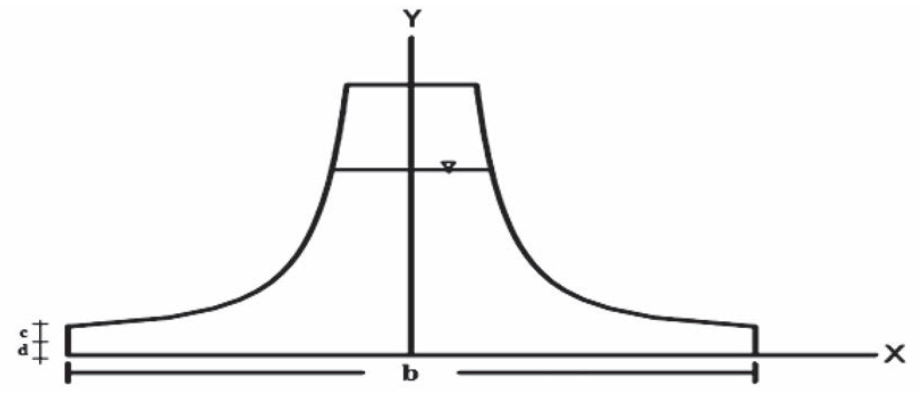
Figure 1
Scheme of the dimensioned Sutro weir
The dimensions of the device were determined according to the general equation corresponding to the symmetrical weir which is written as follows:
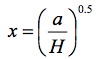 (1)
(1)
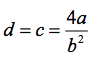 (2)
(2)Where:
x - distance from the center of the weir to the edge of the curvature (cm);
H -height that water level reaches inside the weir (cm);
a -constant of the weir curvature;
b - total width of the weir (cm);
c and d - height components of the rectangular base (cm).
Each weir was designed for a different value of variable a (5, 10, 20, 30, 40, 50, 60, 70, 90) giving a value for x that did not exceed the physical width of the channel.
In order to fix the weirs at the exit of the hydrodynamic canal and to avoid leaks or leaks that could affect the measurements, it was necessary to place rubber strips of 10 mm wide in the perimeter of all weirs.
Height measurements (H) were performed in the hydraulic canal where the supplied flow rate was rigorously controlled to achieve its stabilization; only those that were above the c + d value were considered as valid readings.
The distance (d) for H reading takings was calculated taking into account the condition d ≥ 4H, measured from the weir position in the longitudinal direction. For each reading of load H, three volumetric readings were made to calculate by arithmetic average the flow through the weirs and later to obtain the experimental equation of each of them by means of the following equation:
 (3)
(3)Where:
Qobs - observed flow rate (L s-1);
V -volume captured in the calibrated container (L);
t - time to capture the volume in the container (s).
The simulated flow in the weirs using a linear model was obtained through the following equation:
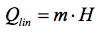 (4)
(4)Where:
Qlin - estimated flow rate using the linear function model (L s-1);
m – line slope obtained by relating the variables Q = f (H);
H - height that water level reaches inside the weir (cm).
The theoretical flow that represents the flow through a Sutro weir was determined from the equation proposed by Sotelo (2002) which is written as:
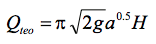 (5)
(5)Where:
Qteo -theoretical flow calculated by Sotelo´s equation (L s-1);
a - constant of weir curvature; g constant of gravity acceleration (m s-2);
H - height that water level reaches inside the weir (cm).
Adjusted flow rate was estimated from the equation proposed by Sotelo (2002), affected by a correction coefficient µ, which constitutes a theoretical contribution in this investigation. The equation used was as follows:
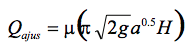 (6)
(6)A coefficient K of the form is determined:
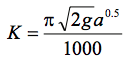 (7)
(7)Equation (6) can be rewritten as:
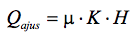 (8)
(8)Where:
Qajus adjusted flow rate (L s-1);
m - coefficient of flow correction;
K - coefficient obtained in equation (7);
H - height that water level reaches inside the weir (cm).
General model for flow rate estimation according to any value of the weir curvature constant was obtained through a potential function generated from the computer statistical program Statistical Package for Social Sciences (SPSS). It is written as follows:
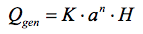 (9)
(9)Where:
Qgen- general flow obtained by SPSS program (L s-1);
a -constant of curvature of the weir;
n -experimentally found exponent the Sutro weir built;
H - height that reaches the water level inside the weir (cm).
The validation and calibration of the proposed models was done using the Average Percentage Error widely used to measure model performance (Zuñiga and Jordán, 2005). The equation used was as follows:
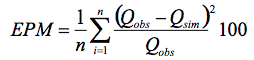 (10)
(10)Where:
EPM -Average Percent Error (%);
Qobs - observed flow rate;
Qsim- simulated flow rate; n number of predicted flows
RESULTS AND DISCUSSION
Analysis of Models for Flow Estimation
Table 1 shows the different equations corresponding to the linear model (Qlin) in Sutro weir for different values of the curvature constant. It can be observed that the models found are adequately fitted to the experimental data. That is verified by the high values of the Coefficient of Determination, which was, in all cases, above 0.99. The slope of the linear adjustment curve (m) increases gradually from 0.2335 to 0.8623.
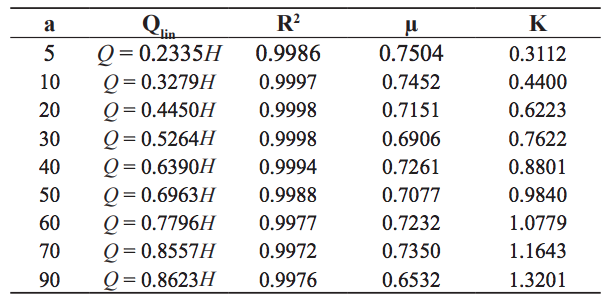
Table 1 shows the values of μ and K. The coefficient μ was calculated in this research for the correction of the equation proposed by Sotelo. It behaved variably in all evaluations performed with values falling from 0.7504 to 0.6532. Coefficient K that groups the weir constant of curvature and gravity in Sotelo’s equation, also varied, but increasingly from 0.3112 to 1.3201.
Analysis of the Parameters μ and m with Respect to Constant of Curvature (a)
Figure 2 shows the results of the functional relationship between coefficient μ and parameter a, in which it is verified that between these two parameters there is no correlation of potential type, with an acceptable coefficient of determination. Consequently, it has no practical importance in accordance with the objectives of the research, however, the relationship between the slope of the linear adjustment curve (m) and the curvature constant satisfactorily responded to a potential function of type m = αaβ, with a high determination coefficient of 0.9945 as shown in Figure 3.
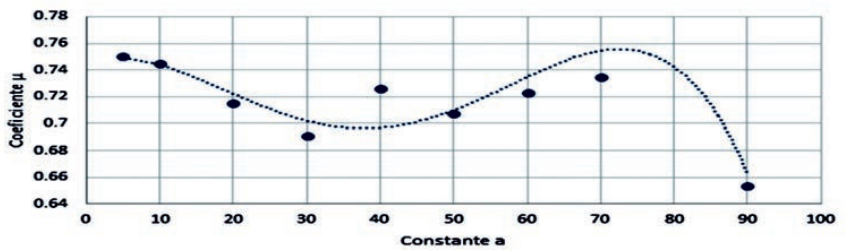
Figure 2
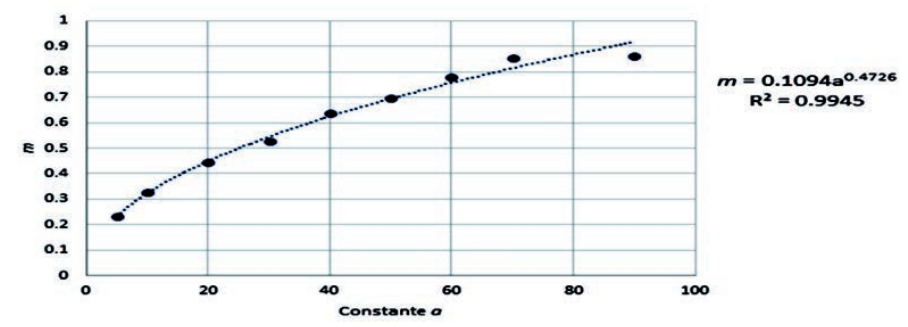
Figure 3
Relationship between Coefficient m and Constant of Curvature
From the results obtained in the previous figure the mathematical deductions were made and they are shown next:
If a comparison is made between equation (4), which estimates the flow rate of the weir using a linear model (Qlin), and equation (6), for the determination of the flow rate from the equation proposed by Sotelo, affected by the correction coefficient m, it can be written that, by analogy, the coefficient m can be calculated as:
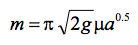 (11)
(11)According to graph 3, the slope m can also be calculated by the following equation:
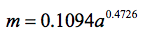 (12)
(12)If both coefficients m are equalized and then μ is cleared, a new value of this coefficient is obtained as a function of the weir constant of curvature; this is:
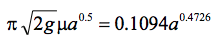 (13)
(13)Clearing gives the value of μ:
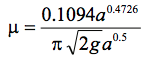 (14)
(14)If the value of gravity acceleration (g = 981 cm s-2) is introduced in Eq. (14) then:
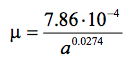 (15)
(15)This new value of μ has a better functional relation with the weir constant of curvature (a) and responds correctly to a potential function as it is observed in Figure 4; therefore, it adapts to the characteristics of Sutro weir operation.
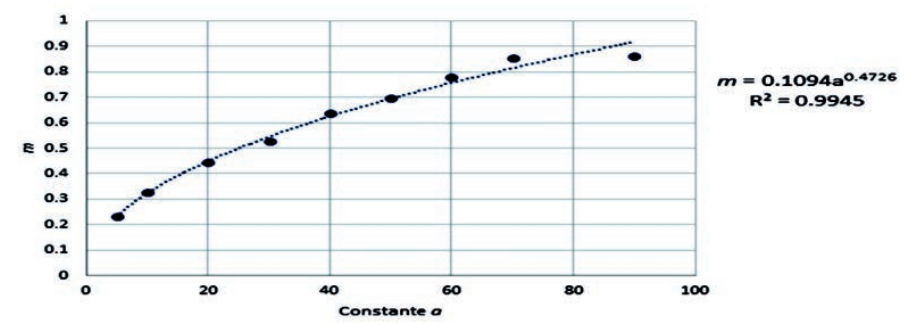
Figure 4
Relationship between the New Value of µ and the Constant of Curvature
The model for estimating Sutro weir flow obtained by the SPSS program (Qgen) is as follows:
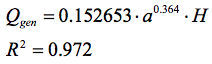 (16)
(16)This model has a high coefficient of determination and allows estimating the value of the flow rate that a Sutro weir discharges for any value of the curvature constant (a) from the water height measurement (H). The comparison of this model with the equation proposed by Sotelo shows that the coefficient a ≠ 0.5. Therefore, the arbitrary use of the constant value of 0,5 leads to an error in flow rate estimation.
Analysis of the Errors Made by the Models in the Estimation of the Flow
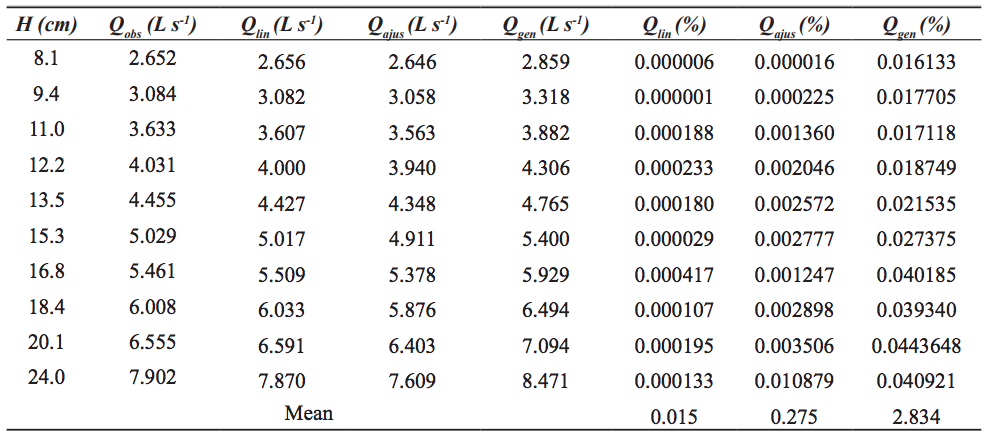
Errors in the experimental process are shown in Table 2, where it can be seen that the models to determine Qlin, Qajus and Qgen flow rates have values lower than 3%, consequently, they can be used reliably in flow measurement in open conduits. That is because the errors are below the allowable maximum limit of 5%. The most accurate results were found in Qlinand Qajusmodels with an error lower than 0.3%. Qgen produced the greatest error with a value of 2.834%.
The results of the research confirm the need to calibrate weirs to achieve accurate flow estimates. In this sense, Crookston and Tullis (2013) affirm that the drainage capacity of weirs is determined by the discharge coefficient that is specific for each geometry of the weir (San Mauro et al., 2016); but it should be obtained by testing to achieve the required accuracy (Boss et al., 1986, Aguilar 2001, Santos et al., 2010).
Knowledge the amount of water available is an indispensable requirement to manage this resource with different purposes in an efficient way (Rázuri et al., 2009; Ayala and Albóniga, 2015). In the specific case of irrigation systems, it is necessary to effectively manage water metering and control devices to regulate the amount of water used by the consumer and to contribute to reduce overexploitation of aquifers and energy savings due to lower needs (García and Pérez, 2004; IDAE, 2005; Tarjuelo, 2005; Fernández et al, 2009).
Analysis of Water Speed at the Weir Outlet
The results of the tests performed for estimating Sutro weir flow, allowed the determination of water speed at the weir outlet from the continuity equation and the definition of a procedure to find the mean speed in this type of weir.
 (17)
(17)Where:
Q - flow rate (cm3 s-1);
V -speed (cm s-1);
a – area under the curve for a proportional symmetrical weir (cm2)
In order to determine the mean speed for each weir, the speeds are taken into account where its length is at least 65% of the maximum water depth.
The results of the investigation allowed finding a correct relation between the water speed at the outlet of the weir and the curvature constant with a determination coefficient R2 of 0.8961, as shown in Figure 5. The model found is of the simple linear type, where the slope represents the weir constant of curvature.
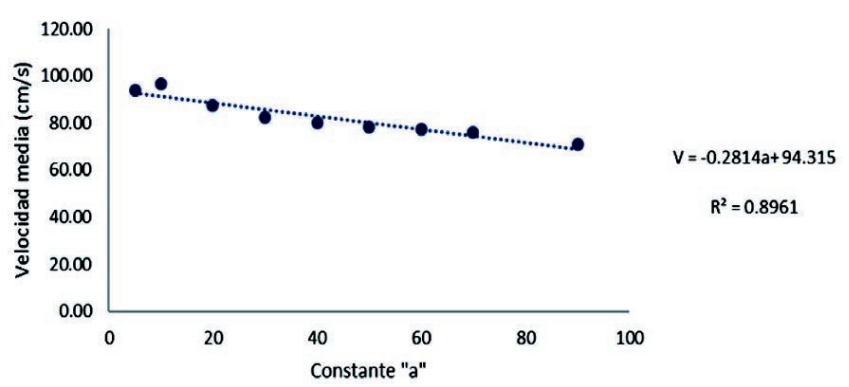
Figure 5
Relationship between the New Value of vm and the Constant of Curvature
CONCLUSIONS
-
Discharge coefficients μ experimentally obtained are not constant and vary between 0.6532 and 0.7504.
-
A potential model type μ = 7.86∙10-4a-0.0274 was proposed for the correction of the discharge coefficient which greatly improves the accuracy of Sotelo’s equation. A mathematical model that relates mean speed and constant of curvature, with a correlation coefficient of 0.8961, was found.
-
The results of the investigation allowed finding a correct relation between water speed at the weir outlet and the curvature constant with a determination coefficient R2 of 0.8961.
-
For estimating mean water speed in each weir, water depth with values greater than 65% of the maximum water depth should be used in order to reach minimal speed variation.
REFERENCES
AGUILAR, A.; RIVAS, I.: Vertedores, [en línea], Ed. Instituto Mexicano de Tecnología del Agua, México, 2001, ISBN: 968-5536-02-3, Disponible en: http://repositorio.imta.mx/bitstream/20.500.12013/1115/1/IMTA_097.pdf, [Consulta: 22 de junio de 2016].
AYALA, L.J.C.; ALBÓNIGA, G.R.: “Dispositivo electrónico de medición del caudal de agua para canales abiertos”, Revista Ciencias Técnicas Agropecuarias, 24(Suppl.): 91-99, 2015, ISSN: 2071-0054.
BELLO, M.; PINO, M.: “Medición de presión y caudal”, Boletín INIA, (28): 21, 2000, ISSN: 0717-4829.
BOS, M.G.; REPLOGLE, J.A.; CLEMMENS, A.J.: Aforadores de caudal para canales abiertos, ser. ILRI publication, no. ser. 38, Ed. International Institute for Land Reclamation and Improvement, Wageningen, 293 p., 1986, ISBN: 978-90-70260-92-7.
CADAVID, J.H.: Hidráulica de canales: fundamentos, Ed. Fondo Editorial Universidad EAFIT, Medellín, Colombia, 369 p., 2006, ISBN: 978-958-8281-28-5.
CROOKSTON, B.M.; TULLIS, B.P.: “Hydraulic Design and Analysis of Labyrinth Weirs. I: Discharge Relationships”, Journal of Irrigation and Drainage Engineering, 139(5): 363-370, 2013, ISSN: 0733-9437, DOI: 10.1061/(ASCE)IR.1943-4774.0000558.
FAO: Captación y almacenamiento de agua de lluvia. Opciones técnicas para la agricultura familiar en América Latina y el Caribe, [en línea], Ed. FAO - FIDA, Chile, 270 p., 2013, ISBN: 978-92-5-307581-2, Disponible en: http://www.fao.org/docrep/019/i3247s/i3247s.pdf, [Consulta: 23 de junio de 2016].
FERNÁNDEZ, C.A.; HOLZAPFEL, E.; DEL CALLEJO, I.; BILLIB, M.: Manejo sostenible del agua para riego en sudamérica, Inst. Instituto Argentino de Investigaciones de las Zonas Aridas - Universidad de Buenos Aires, Buenos Aires, Argentina, 183 p., 2009, ISBN: 978-987-25074-1-1.
GARCÍA, G.S.; PÉREZ, L.J.R.: “Resultados de la introducción del riego por goteo en la cooperativa de producción agropecuaria cañera «Primer Soviet de America»”, Revista Ciencias Técnicas Agropecuarias, 13(1): 47–51, 2004, ISSN: 2071-0054.
GONZÁLEZ, A.; RAMÍREZ, J.D.: Manual piragüero. 3-Medición del caudal, Ed. Comunicaciones Corantioquia, 1.. ed., Colombia, 2014, ISBN: 978-958-57280-7-3.
IDAE (INSTITUTO PARA LA DIVERSIFICACIÓN Y AHORRO DE LA ENERGÍA): Ahorro y eficiencia energética en agricultura de regadío., ser. Ahorro y eficiencia energética en la agricultura, no. ser. 2, Ed. Instituto para la Diversificación y Ahorro de Energía, Madrid, España, 36 p., 2005, ISBN: 978-84-86850-94-4.
RÁZURI, L.R.; ROSALES, J.G.; HERNÁNDEZ, J.D.: “Formulación de alternativas de uso del agua con base en el balance disponibilidad–demanda en la zona de Santa Rosa, sector La Hechicera del estado Mérida”, Academia, 8(16): 46–64, 2009, ISSN: 1690-3226.
RÍOS, J.A.; ESCOBAR, J.F.; PALACIO, I.: Guía metodológica para determinar módulos de consumo y factores de vertimiento de agua, Ed. Área Metropolitana del Valle de Aburrá, 1.. ed., Medellín, Colombia, 76 p., 2010, ISBN: 978-958-44-7731-6.
SAN MAURO, J.; SALAZAR, F.; TOLEDO MUNICIO, M.A.; CABALLERO, F.J.; PONCE-FARFÁN, C.; RAMOS, T.: “Modelación física y numérica de aliviaderos en laberinto con fondo poliédrico”, Ingeniería del Agua, 20(3): 127–138, 2016, ISSN: 1886-4996, 1134-2196.
SANTOS, A.C.; CUBILLOS, C.E.; VARGAS, A.: “Modelación hidráulica de un sector de río caudaloso con derivaciones empleando HEC-RAS”, Avances en Recursos Hidráulicos, (17), 2008, ISSN: 0121-5701, Disponible en: http://revistas.unal.edu.co/index.php/arh/article/view/9288, [Consulta: 23 de junio de 2016].
SANTOS, L.; DE JUAN, J.A.; PICORNELL, M.R.; TARJUELO, J.M.: El riego y sus tecnologías, [en línea], Ed. Centro Regional de Estudios del Agua (CREA)- Universidad de Castilla- La Mancha (UCLM), España, 296 p., 2010, ISBN: 978-84-692-9979-1, Disponible en: https://es.slideshare.net/GuillermoSarah/el-riego-ysustecnologias, [Consulta: 23 de junio de 2016].
SOTELO, G.: Hidraulica general, Ed. Limusa, México, 2002, ISBN: 978-968-18-0503-6.
TARJUELO, J.M.: El riego por aspersión y su tecnología, [en línea], Ed. Mundi-Prensa, 581 p., 2005, ISBN: 978-84-8476-225-6, Disponible en: https://books.google.com.cu/books?id=wMJzLxduGjsC, [Consulta: 23 de junio de 2016].
ZÚÑIGA, A.; JORDÁN, C.: “Pronóstico de caudales medios mensuales empleando Sistemas Neurofuzzy”, Revista Tecnológica - ESPOL, 18(1): 17-23, 2005, ISSN: 1390-3659.
Notes