Artículos originales
Identification of the Services in Four Integral Managerial Base Units of Technical Services
Identificación de los servicios prestados en cuatro Unidades Empresariales de Base Integrales de Servicios Técnicos
Identification of the Services in Four Integral Managerial Base Units of Technical Services
Revista Ciencias Técnicas Agropecuarias, vol. 26, núm. 3, 2017
Universidad Agraria de La Habana Fructuoso Rodríguez Pérez
Recepción: 28 Enero 2017
Aprobación: 15 Junio 2017
Abstract: Integral Managerial Base Units of Technical Services (UEBIST) were created with the purpose of lending a wide range of services to the units of production of agricultural companies, to individual farmers and to the different agricultural entities existing in the municipalities. However, all necessary conditions that allow them to fulfill this purpose, have not been created yet due to different causes. Starting from this problem, the present work has as objective to identify the main services lent by four UEBIST located in the counties Artemisa, Pinar del Rio, Holguín and Granma and the limitations that prevent them, at present time, to enlarge the range of services. As a result, it was determined that services of soil farming constitute today the main activity and source of revenues in these UEBIST. They show levels of execution of the 74.44, 58.46 and 52.38%, respectively, except the UEBIST of the Agricultural Company Manuel Sanguily, where 40.13% was reached, due to the insufficient availability of agricultural machines to carry out these activities and its faulty state of work capacity. Other important services as machine maintenance and repair represented 5.26, 18.67, 13.50 and 10.22% in the units studied and that indicates a low level, due to the faulty state of the production resources, to technical and organizational problems and to the shortage of material resources.
Keywords: agricultural companies, production, organization, esources.
Resumen: Las Unidades Empresariales de Base Integrales de Servicios Técnicos (UEBIST) fueron creadas con el fin de prestar una amplia gama de servicios a las unidades de producción de las empresas agropecuarias, a los productores individuales y los diferentes organismos existentes a nivel municipal. Sin embargo, hasta el presente, aún no han sido creadas todas las condiciones necesarias que les permitan cumplir con este propósito debido a diferentes causas. A partir de esta problemática, el presente trabajo tiene como objetivo identificar los principales servicios prestados por cuatro UEBIST ubicadas en las provincias Artemisa, Pinar del Rio, Holguín y Granma y las limitaciones que les impiden en la actualidad ampliar la gama de servicios. Como resultado, se determinó que los servicios de preparación de tierras, constituyen hoy en día la principal actividad y fuente de ingresos en estas UEBIST con niveles de ejecución del 74,44, 58,46 y 52,38% respectivamente, excepto en la UEBIST de la Empresa Agropecuaria Manuel Sanguily donde se alcanzó el 40,13%, debido a la insuficiente disponibilidad de medios mecanizados para realizar estas actividades y su deficiente estado de capacidad de trabajo. Con relación a otros servicios importantes como son el mantenimiento y la reparación de las máquinas estos representaron en las cuatro unidades estudiadas el 5,26; 18,67; 13,5 y 10,22% lo indica un bajo nivel de ejecución, debido al deficiente estado de los recursos de producción, a problemas técnico-organizativos y la escasez de recursos materiales.
Palabras clave: empresas agrícolas, producción, organización, recursos.
INTRODUCTION
Nowadays, the externalization of tasks has been shown in many sectors, mainly in the small and medium companies. There it, has not only become in a factor of competitiveness, but also, in a growing way, in an important element in their future perspectives, since it allows them to elevate their competitiveness, effectiveness, levels of professionalization and to enlarge their performance environment (Langreo, 2010; Bono, 2010).
In current agriculture, there is a tendency to reduce the costs of operation and to avoid the expensive amortizations of machinery that, in some cases, it would be impossible to redeem during all their useful life. There are many farmers that carry out, with their own means, the most habitual works in their cultivations, like plant cares, irrigation and fertilization; but they hire with companies of agricultural services some works that they cannot carry out as the soil farming, harvesting, packing, forage chopping, pruning, etc. (Bernat, 1998; Guidotti, 1994). These companies do not only work in the provision of agricultural services to producers, but also in technical consultancy and training, being important that the trainer have an appropriate formation and continually develop abilities, knowledge and enterprising abilities to guarantee the correct provision of services in the rural zones (Figueroa et al, 2010).
In Cuba, this form of organization took a new impulse since 2009 when the first Integral Managerial Base Unit of Technical Services was created, process that was later generalized to the rest of the country (Linares et al., 2010; Fernandez, 2015; Suarez, 2011). However, these units were located, since the beginning; in the same facilities of old, central workshops belonging to agricultural companies and they have not experienced significant changes, neither structural nor technological in the last 20 years. Because of that their low level of development, if it is compared with the standards of quality, design and construction of the new agricultural machines, tractors and agricultural implements introduced in the agricultural sector through different programs and some international projects to develop mechanization in Cuba.
Many of these new means acquired started to be operated in the productive units of the different agricultural companies, although the majority has passed to be part of the machinery stock of the Integral Managerial Base Units of Technical Services and that has allowed increasing mechanization services to farmers. For example, according to official figures1 , the increment of service benefits to food producers, as result of use ordered of the new acquired agricultural machines since late 2014 until the present has had some benefits. It has facilitated to service units in Holguín province, to participate in activities linked to soil farming, sowing, plants care and harvest in more than 70 000 hectares, which demonstrates the notable impact of this organizational system.
Considering the problems linked with the low level of technological development of the Managerial Base Units, Cuban Ministry of Agriculture has carried out several studies to rehabilitate and to modernize these units 2, 3. However, the incidence of different factors, especially those of economic type, have not allowed materializing the results of those studies. Due to that, these units continue working under difficult conditions to guarantee, to short and medium term, the durability and the good state of work capacity of all agricultural machines newly acquired and to guarantee all the types of services which they were conceived for at the beginning4 (Fernandez, 2011a).
Based on that previously expressed, an identification of the services lent by UEBIST located in Artemisa, Pinar del Rio, Holguín and Granma provinces, is carried out in this work. Main types of services offered are quantified by these units and the main limitations that prevent them to guarantee the machines’ work capacity and to enlarge the range of services to be offered to the farmers are determined.
METHODS
The study was carried out in four Integral Managerial Base Units of Technical Services belonging to Agricultural Companies of Artemisa, Manuel Sanguily, Mayabe and Tabaco Torcido, located in the counties of Artemisa, Pinar del Rio, Holguín and Granma, respectively. The period of observation comprised the year 2014. Information related with the different types of services offered by these units to the productive units was gathered from invoices emitted by them during the period studied. To enter the gathered information two models were designed in Excel format (Tables 1 and 2), which facilitated to organize, process and chart the data.


An internal diagnosis was carried out in the four UEBIST by means of the methodology for characterizing the workshops (Fernandez and Shkiliova, 2011, 2013; Rosales, 2016; Castell et al., 2015) focused to the evaluation of current state of the production resources and the determination of the real potentialities of these units to fulfill the different technical activities.
RESULTS AND DISCUSSION
In this part, the results of processing the information related with the different types of services performed by the Integral Managerial Base Units of Technical Services selected are presented.
Figure 1 shows how the benefits from the services provided in these units (by type), fluctuate during the year 2014. As it is appreciated, in the UEBIST of Güira de Melena, Manuel Sanguly, Tabaco Torcido and Mayabe, the type of services of mechanization prevailed (2407; 147; 441 and 1407 activities respectively), with 79.20; 62.55; 57.72 and 83.70% in relation to the total of the services provided, what demonstrates that this type of service is the main activity in these units.
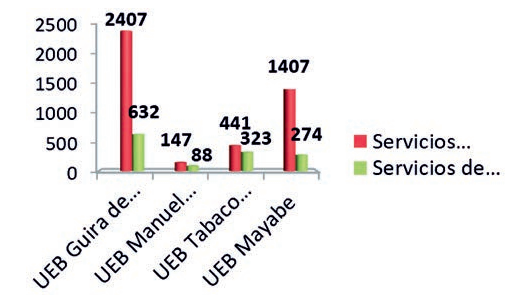
Figure 1
Types of Services
Most of these services corresponds to agricultural works related to soil farming (plowing, tier, subsoiling, tiller, etc) in the UEBIST of Güira de Melena, Tabaco Torcido and Mayabe with percentages of execution of 74.44, 58.46 and 52.38%, respectively, and increasing incomes to the end of the year 2014 of 468 794.7; 24 960.4 and 51 820.83 pesos.
To guarantee performing these activities they have a set of agricultural machines organized in platoons, as it is illustrated in Table 3. In the UEBIST of the Agricultural Company Manuel Sanguily this correlation behaved in a different way, with 40.13% for the services of soil tillage and the rest to other works, fundamentally the transportation of animals, with 59.87% (Figure 2). The insufficient availability of machinery and its faulty state of work capacity preventing to fulfill the demand of this type of service (of the eight tractors, only three Belarus tractors 800 are capable to carry out the activities of soil plowing).

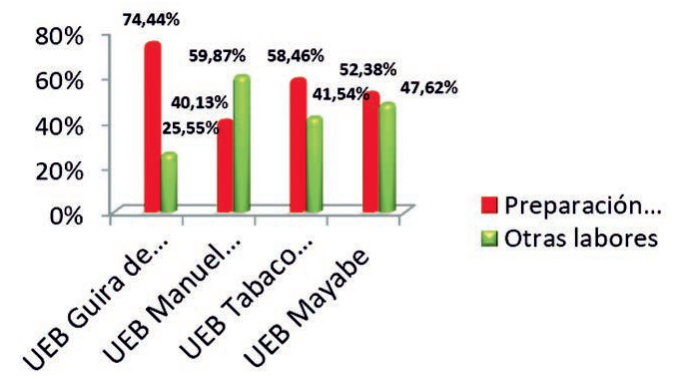
Figure 2
Distribution of Services
In relation to workshop services, Figure 3 illustrates their annual distribution in the four analyzed UEBIST.
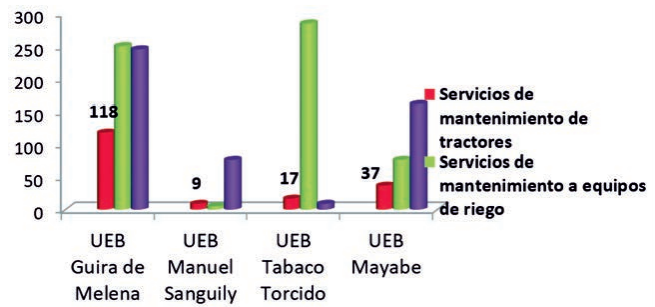
Figure 3
Distribution of Workshop Services
As it is appreciated, the services of maintenance and repair of tractors and agricultural implements were the least performed when being compared with the rest of the services (maintenance to the irrigation equipment and other services). In the UEBIST of the companies Tabaco Torcido, Güira de Melena, Manuel Sanguily and Mayabe, the services of maintenance and repair represented the 5,46; 19.24; 10 and 13.50%, respectively, with regard to the total of the workshop services, what is considered very low.
When analyzing the different factors that affect in a direct way on the level of carrying out the maintenance and repair services of the machines in the units, production resources were determined as decisive factors, given that the time and quality of the services offered to users greatly depend on them. Among the elements to be considered as production resources are means of work (technological equipment, tool machines, hand tools, measuring instruments), and constructive infrastructure, workers, technical and normative documentation, organization of the works, etc.
The results reached in the diagnosis of these resources in the units studied, are shown in Tables from 4 to 9.

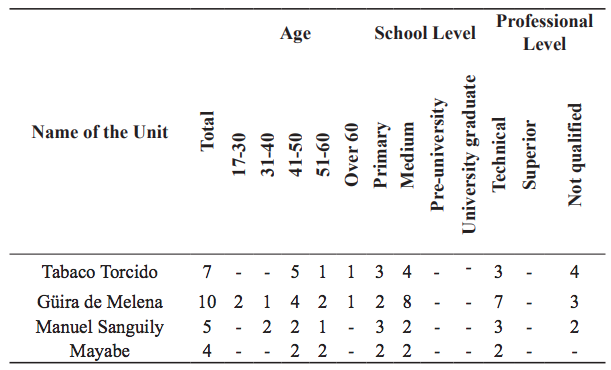
As it is appreciated in the previous table, there is a low potential of personnel dedicated to maintenance and repair of tractors and agricultural machines, mainly in the UEBIST of the Companies Tabaco Torcido and Manuel Sanguily, what constitutes an obstacle to offer this type of service to clients that demand them. This, jointly with the low availability of material resources, lead to the fact that in general clients do not request this service and carry out maintenances and repairs of their agricultural machines with their own resources and under conditions not always suitable for their performing. In the case of the stock of tractors and existent agricultural machines in these units, these activities are carried out fundamentally by the own operators without a strict control over their work.
As for the personnel dedicated to maintenance and repair of irrigation equipment, the potential is higher in the four units, which is in correspondence with the level reached in performing this type of service, as it is appreciated in Figure 3.
When characterizing the maintenance personnel, it was determined that in all the cases, the greater percentage concentrates on the ranges of ages among 41 to 50 years old (50.0%) and the 51 to 60 years old (22.72%), what is considered high. With regard to their school and professional level, 36.7% reached primary and 63.7% medium level. A 59.9% reached the level of technician and 41% does not have qualification.
Tables 6 and 7 show the information related to the existent workspaces in those units, the general constructive state and the main problems of this nature.
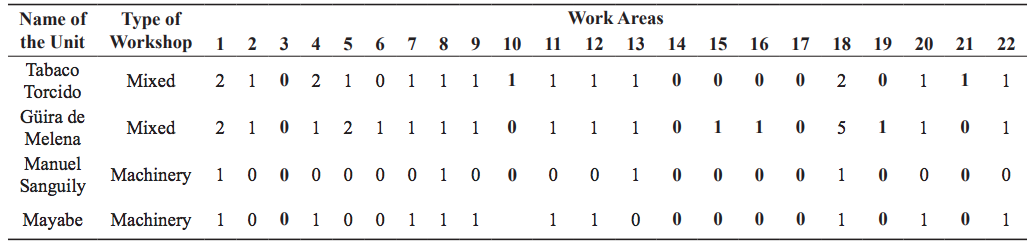
Legend. 1. Maintenance and repair of tractors, 2. Maintenance and repair of implements, 3. Maintenance and repair of means of transport, 4. Maintenance and repair of irrigation equipment, 5. Machinery pool, 6. Washing area, 7. Vulcanization, 8. Workshop machinery, 9. Welding, 10. Electricity, 11. Warehouse of pieces, 12. Warehouse and serving of lubricants, 13. Hand tools, 14. Repair of radiators, 15. Repair of pieces, 16. Technical diagnose, 17. Blacksmithing, 18. Offices, 19. Kitchen-dining room, 20. Bathrooms, 21. Lockers, 22. Entrance control room.
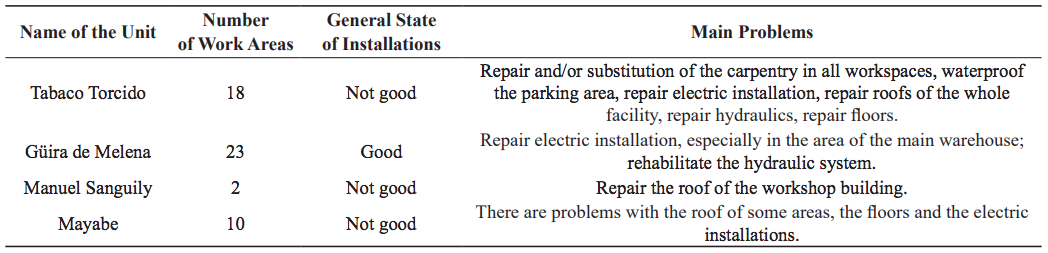
The main areas for maintenance and repair of agricultural technique exist, however, the lack of some important areas is observed as they are those dedicated to maintenance and repair of means of transportation, repair of electric components, repair of radiators, repair of complex components, technical diagnosis, smithy, kitchen-dining room and lockers for the workers. In the peculiar case of the Agricultural Company Manuel Sanguily the rehabilitation of the local currently occupied by the UEBIST should be undertook, since it does not have neither the necessary minimum conditions to carry out the works of technical assistance to the machinery nor to guarantee its correct state of work capacity.
The general state of the facilities occupied by the UEBIST of the Companies Tabaco Torcido, Manuel Sanguily and Mayabe is classified as not good due to the identified constructive problems.
In Table 8, the information related with the readiness of the mensuration instruments is shown, hand tools, technological equipment and scheme them tools and their state of the work capacity.
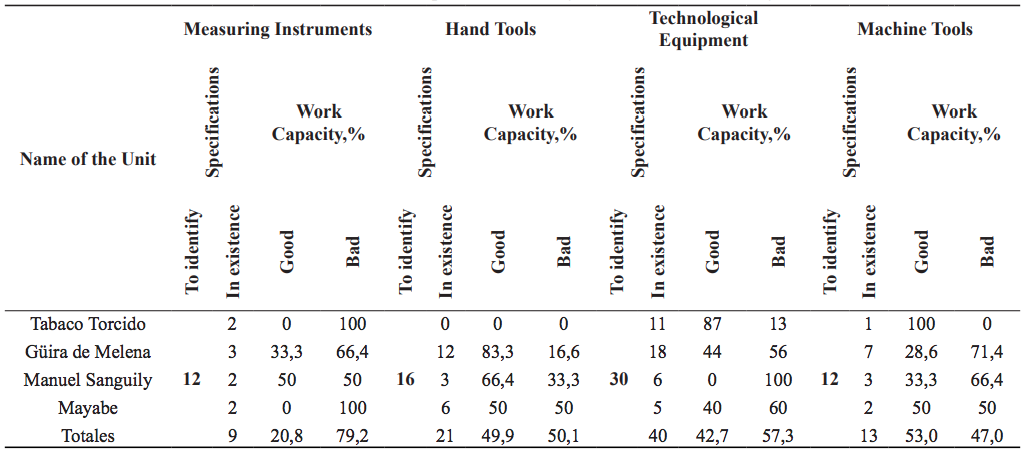
By means of the analysis of the information, it is determined:
The 79.2% of measuring instruments have a failing work capacity. The existent denominations are notably scarce. It was also determined that they do not have high levels of precision due to that they have not been gauged.
Around 50% of the reported hand tools are in good state of work capacity, although their quantities and sorts are very scarce, specifically in Unit Manuel Sanguily. In Unit Tabaco Torcido, their existence is not reported. In these two places, the works are carried out with tools belonging to machinery operators.
The 57.3% of the existent technological equipment in the four units possesses a state of work capacity that is classified as bad and in general the existent specifications are scarce and of obsolete technology. In the peculiar case of the Unit Manuel Sanguily, the existence of these means is very scarce and they have a state of work capacity classified as bad.
Although 53.0% of the machine tools have a good state of work capacity, their levels of precision are low due to the high number of years of operation and to their faulty maintenance. There is a lack of devices and of cutting tools, what does not allow executing every type of works.
Table 9 shows the information obtained in the four units regarding technical documentation, means for the machinery work control and planning and organization of the maintenance works. Starting from this information the following was observed:
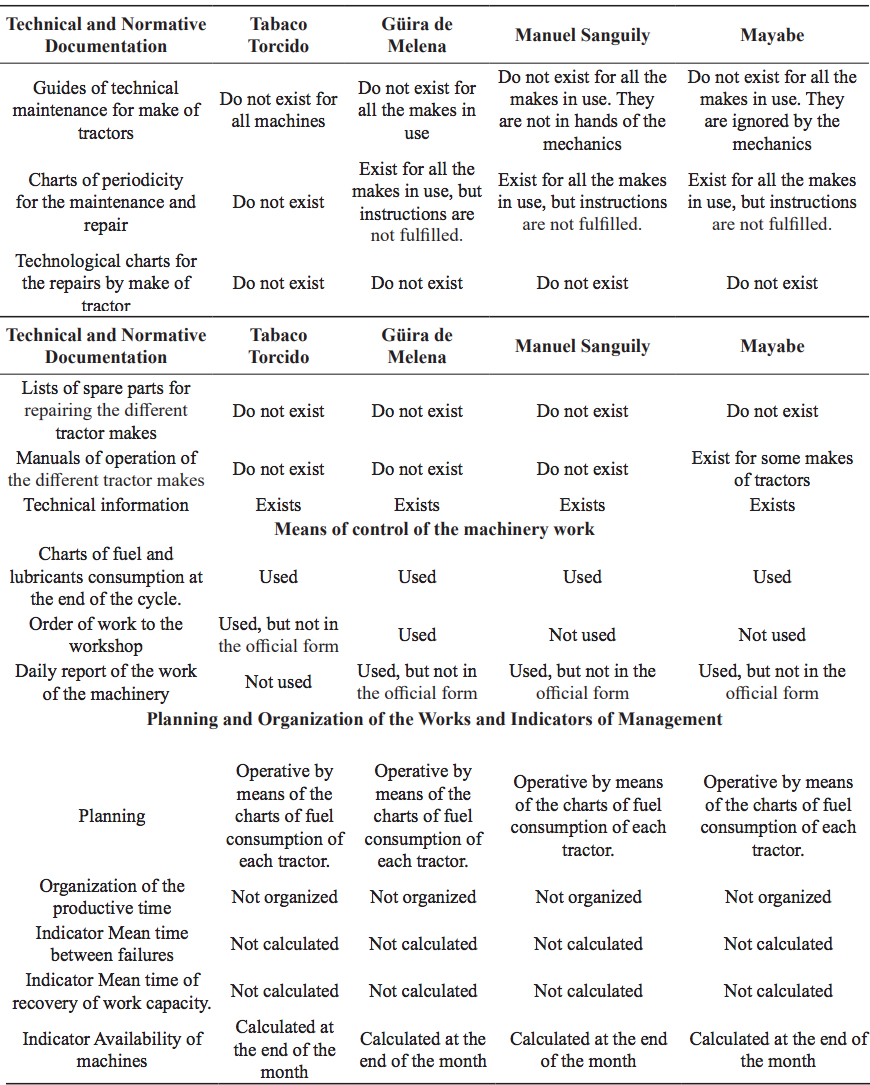
Technical documentation is scarce and, in general, maintenance workers do not know it.
The main means of control used is the card of fuel consumption at the closing of the cycle. The rest of the means does not obey the official forms. Gathered information does not have use value.
Planning of maintenances is eminently operative, and does not allow organizing the productive process.
There are not indicators that facilitate to evaluate maintenance and repair activity. Only at the end of every month the indicative coefficient of technical readiness is calculate by means of a method of momentary observation.
CONCLUSIONS
-
As result of annual evaluation of the services lent by the four Integral Base Units of Technical Services studied, it was determined that the services of agricultural mechanization constitute the main activity and source of revenues in these organizations in the current moment. Most of these services correspond to agricultural works related with soil tillage.
-
There is a low level of execution of technical maintenance and repair services to tractors, machines and agricultural implements if they are compared with the total of the services offered.
-
One of the restrictions that prevents diversifying and increasing services to producers in those units is the current state of their production resources. Because of that, they are not prepared enough to assume all types of services, especially for which they were created, like those related with maintenance and repair of machines as key elements to guarantee the good state of their capacity and the sustainability and quality of agricultural mechanization services.
REFERENCES
BERNAT, J.C.: “Las empresas de servicios de maquinaria agrícola”, Vida rural, (78): 52-54, 1998, ISSN: 1133-8938.
BONO, J.R.G.: “La agricultura a tiempo parcial y la externalización de servicios agrarios como vehículo del cambio estructural”, Revista Española de Estudios Agrosociales y Pesqueros, (225): 13–45, 2010, ISSN: 1575-1198.
CASTELL, S.; MIRANDA, A.; DÍAZ, G.; PÉREZ, N.: “Análisis de los servicios de mecanización en la Empresa Agroindustrial de Granos «Los Palacios»”, Revista Ciencias Técnicas Agropecuarias, 24(4): 45-51, 2015, ISSN: 2071-0054.
FERNÁNDEZ, M.; LORA, D.; SHKILIOVA, L.: “Análisis de las potencialidades de una unidad prestadora de servicios de mecanización y de asistencia técnica”, Revista Ciencias Técnicas Agropecuarias, 22(Suppl.): 77-80, 2013, ISSN: 2071-0054.
FERNÁNDEZ, M.; SHKILIOVA, L.; NORES, Y.; RÍOS, A.: “Estudio para la implementación de acciones estratégicas en la Unidad Empresarial de Base Integral de Servicios Técnicos de la Empresa Agropecuaria Güira de Melena”, Revista Ciencias Técnicas Agropecuarias, 20(1): 66-71, 2011, ISSN: 2071-0054.
FERNÁNDEZ, M.; SHKILIOVA, L.; SUÁREZ, J.: Tracción animal y labores manuales, Ed. Instituto de Mecanización Agrícola (INFOIIMA), La Habana, Cuba, 2012, ISBN: 978-959-285-014-9.
FERNÁNDEZ, S.M.; SHKILIOVA, L.; LORA, D.: “La gestión en los talleres de mantenimiento y reparación de la maquinaria agrícola de Cuba”, Revista Ingeniería Agrícola, 5(3): 53-56, 2015, ISSN: 2227-8761.
FIGUEROA, B.; FIGUEROA, K.A.; CARMENADO, I. de los R.; SANDOVA, B.F.; HERNÁNDEZ, F.: “La empresarialidad en prestadores de servicios profesionales agropecuarios del estado de Campeche, México”, Ra Ximhai: revista científica de sociedad, cultura y desarrollo sostenible, 6(3): 355-364, 2010, ISSN: 1665-0441.
GUIDOTTI, R.: “Empresas de servicios de maquinaria agrícola”, Vida rural, (1): 48-49, 1994, ISSN: 1133-8938.
LANGREO, N.A.: “La externalización del trabajo agrario y las empresas de servicios a la agricultura”, Economía Agraria y Recursos Naturales, 2(1): 45–67, 2002, ISSN: 1578-0732.
LINARES, E.; FERNÁNDEZ, M.; LORA, D.; SUÁREZ, J.; SALVÁ, R.; REY, R.: Procedimientos para la creación de las unidades empresariales de base de servicios técnicos, Ed. Instituto de Mecanización Agrícola (INFOIIMA), La Habana, Cuba, 2010, ISBN: 978-959-285-007-1.
ROSALES, N.L.; TORRES, F.; SHKILIOVA, L.; FERNÁNDEZ, M.; CUN, R.: “Diagnóstico de los recursos de producción en un taller de atención a productores agropecuarios”, Revista Ingeniería Agrícola, 6(1): 3-8, 2016, ISSN: 2227-8761.
SUÁREZ, J.; RÍOS, A.; LINARES, E.: “Unidades integrales de servicios técnicos de maquinaria agrícola”, Revista Ciencias Técnicas Agropecuarias, 20(2): 15-19, 2011, ISSN: 2071-0054.
Notes