Artículos originales
Operation Indicators in Milk Collection Trucks in Jimaguayu, Sibanicu and Vertientes
Indicadores de explotación en el acopio de leche por camiones en Jimaguayú, Sibanicú y Vertientes
Operation Indicators in Milk Collection Trucks in Jimaguayu, Sibanicu and Vertientes
Revista Ciencias Técnicas Agropecuarias, vol. 26, núm. 4, 2017
Universidad Agraria de La Habana Fructuoso Rodríguez Pérez
Recepción: 27 Noviembre 2016
Aprobación: 11 Septiembre 2017
Abstract: The research carried out is part of the project: Rational Organization of Milk Collection Process and Distribution by Means of Automotive Transport in Camagüey Province. Its objective is to evaluate operation indicators in the process of bovine milk collection with the use of means of transport in Agricultural Companies of Sibanicú, Jimaguayú and Vertientes of Camagüey Province in Cuba. The operation indicators are determined, taking into account the time balance with the use of the workday photo - timing method, the coefficients of utilization of static load capacity of trucks, travel and time, productivity, yield and fuel consumption, as well as economic indicators. The results obtained show the work efficiency limitation of means of transport due to the low coefficient of utilization of static load capacity in milk collection, with values between 0.2134 and 0.4555 (21.34 and 45.55 %) in the municipalities studied. That is due to the low availability of milk at the collection points and the inadequate organizational management of the car fleet capacity. Likewise, this coefficient influences the productivity of the trucks, that transport between 934,88 and 2 004,28 L, which is below their design capacity. In fuel consumption, values between 2.97 and 4.30 km/L are obtained, which means that there is an over consumption of 0.2 and 1.53 km/L compared to those recommended by the manufacturer (4,5 and 5 km/L), due to the deterioration of roads and the distances traveled. Also, the cost of the ton-kilometer is 0.049 and 0.07 pesos/t-km and the cost of each ton of milk transported is between 33.65 and 34.64 pesos/t, according to the calculated distances.
Keywords: coefficients, fuel consumption, transportation cost.
Resumen: El presente trabajo se realizó en las Empresas Agropecuarias de Sibanicú, Jimaguayú y Vertientes de la provincia Camagüey de Cuba. Se plantea como objetivo evaluar los indicadores de explotación en el proceso de acopio de leche vacuna con el uso de medios de transporte automotriz. Se determinan los indicadores de explotación, contemplando el balance de tiempo, los coeficientes de aprovechamiento de capacidad de carga estática de los camiones, recorrido y tiempo, productividad, rendimiento y consumo de combustible, así como, los costos de operación en la transportación. Los resultados obtenidos muestran los factores técnico – organizativos que limitan la eficiencia del trabajo de los medios de transporte, debido al bajo coeficiente de aprovechamiento de la capacidad de carga estática en el acopio de leche, con valores entre 0,2134 y 0,4555 (21,34 y 45,55%) en los municipios estudiados; esto se debe a la baja disponibilidad de leche en los puntos de recogida y al inadecuado manejo organizativo de las capacidades del parque automotor. Asimismo dicho coeficiente influye en la productividad de los camiones, que transportan entre 934,88 y 2 004,28 L, lo que está por debajo de su capacidad de diseño. En el consumo de combustible, se obtienen valores entre 2,97 – 4,30 km/L, por lo que existe un sobreconsumo de 0,2 y 1,53 km/L comparados con los recomendados por el fabricante (4,5 y 5 km/L), debido al deterioro de las condiciones de los caminos y las distancias recorridas. Además el costo de la tonelada – kilómetro es 0,049 y 0,07 pesos/t-km y el costo de cada tonelada de leche transportada entre 33,65 y 34,64 pesos/t, de acuerdo con las distancias calculadas.
Palabras clave: coeficientes, consumo de combustible, costo de transportación.
INTRODUCTION
World production of cow milk in 2014 was 735 100 000 tons, even though all the countries recognized by the ONU on the planet produce it, the top ten producers represent 50.57% of the total production, contributing a little more than 337.93 million tons. Currently, India is the largest producer of bovine milk in the world, which accounts for 17.8 8 % of world production, delivering more than 130 000 000 tons in 2014, according to USDA, (2015)1.
In Cuba, there are 16 provinces producing bovine milk, among them Camagüey, which is the main Cuban cattle province. The national production in 2014 was 497 100 000 million liters of bovine milk, the five major producing provinces contribute 54.69 % of the national production, delivering 252 000 000 liters. Camagüey is the one with the highest production of livestock in Cuba, delivering 90 200 000 liters for 18.15% of the total (ONEI, 2015). This has led to the introduction of technologies for the transportation and collection of milk, which require an analysis of the operation indicators to contribute to the improvement of the organization and efficiency of the transportation process, in which there have been international works, but less nationwide.
At international level, several investigations have been carried out by Kalra & Singh (1988), Butler et al. (2005), Dooley et al. (2005) and Gyulai et al. (2013) the trucks and tankers taken together were travelling about 1014 km per day in the existing milk pick-up system. The efficient routes formulated reduced the daily travel distance to 954 km, a saving through rationalised routes of about 6% (60 km per day, guided at planning of routes in the milk collection process, in order to minimize the costs of th e process. They determine how to transport all the milk available with the least number of trucks and traveling the shortest distance.
In Cuba, there are studies related to the evaluation of operation parameters in different agricultural groups, which allow an increase in the organizational efficiency of the technological process of agricultural activities Miranda et al. (2002, 2013) y Morejón et al. (2012). They evaluate the performance indicators of New Holland L-520, CLAAS DOMINATOR rice croppers and of the means of transportation used in the crop-transport process of rice in the Agroindustry Complex“ Los Palacios”, respectively. Matos et al. (2010), Matos y García (2012) and de las Cuevas et al. (2014) carry out similar studies, but for Case-7000 and CAMECO sugar cane harvesters and for the trucks in sugar cane transportation, respectively. In addition, Ortiz et al. (2011) and Olivet et al. (2012) perform the technological and operation evaluation for sets of machines in the work of soil breaking up and furrowing for the cultivation of sweet potato, respectively.
In the aforementioned investigations, there are not studies aimed at evaluating the indicators for the operation of bovine milk collection process with motor transport. Consequently, this research is conducted with the objective of evaluating operating indicators in the process of bovine milk collection using automotive means of transportation in Sibanicú Jimaguayú and Vertientes agribusinesses companies. It is part of the research project entitled: Rational Organization of Bovine Milk Collection and Distribution Process by Means of Automotive Transportation in the Province of Camagüey.
METHODS
Experimental investigations were conducted during automotive transportation of milk collection in production units of the Ministry of Agriculture, located in the municipalities of Sibanicú, Jimaguayú and Vertientes, Camagüey Province, from January 2011 to December 2013. The fieldwork and characterization of the experimental area was performed under milk collection conditions. It presents 32 dairy routes each with one truck and 16 of them were evaluated, representing 50% of the total. The trucks evaluated are sho n in Figure 1. They are ZIL 13 0 and Z IL 13 1 models of more than 25 y ears of operation, remodeled with Chinese motors Yuchai brand and having a capacity in the collection tank between 3 800 and 4 200 L, respectively.
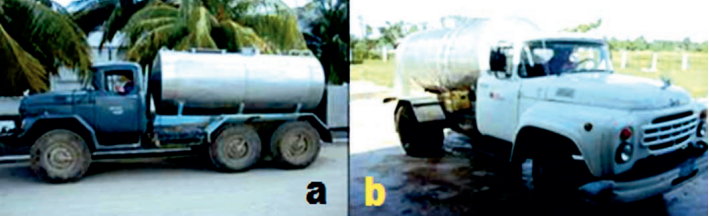
Figure 1
Trucks Evaluated. Models a) ZIL 130 and b) ZIL 131.
The structure of th e working day in the automobile transport is defined by the methodological program for the study of transport organization and labor regulations in milk transportation to the reception center. Those regulations are ad equate to the conditions of operation and characterization of the process object of study. Different operating times according to NC 34-37: 03, adapted to the conditions of the process under study, are determined, such as:
 (1)
(1)Where:
TTO - Total observation time: it includes the time of the working day deployed by the driver, as well as the time used to have some food, h;
TPC - Conclusive preparatory time: it is the time used to receive the task to be fulfilled, besides the time to prepare the equipment for the work, as well as those ones of transfer from the parking to the field and of returning to the parking, h;
TP - Main time: it is the most important in the working day, where the time of loading of the transport takes place, the time to leave the field, as well as the time of travel with load, h;
TA - auxiliary time: it includes the document formulation, time of discharge measurement, among others, h;
TS - time of service: it is the time that the driver needs for the attention and the daily maintenance of the vehicle, h;
TDNP - rest time and personal needs, h;
TIA - time to eat f ood: the time the driver uses to eat food, it includes breakfast, snack, lunch and dinner, h;
TI - time of interruptions: it includes all the times that cause interruptions in the accomplishment of the main task , h
Operating Coefficients
Efficiency in operation is given by a set of transport vehicle utilization coefficients according to Camargo and Hernández, (1989)2 and Díaz et al. (1980).
Coefficient of utilization of operating time:
 (2)
(2)Where:
 (3)
(3)Utilization coefficient of static load:
The coefficient of utilization of the static load capacity (γest), expresses the degree of efficiency with which the load capacity is operated in “Nc” number of trips with load. This is determined by the following expression:
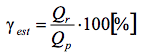 (4)
(4)Where:
Qr - total amount of actual load (liters of milk) transported, L;
Qp - maximum possible load to be transported by the means according to manufacturer, L .
Where:
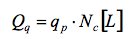 (5)
(5)Qp - possible quantity of liters of milk to be transported according to the desiof the truck, L;
Nc- number of trips w ith l oad of the trucks eval uated
Determination of the coefficient of utilization of travel (β)
The coefficient of utilization of the route is obtained according to:
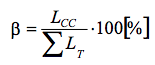 (6)
(6)Where:
LCC - travel done by the trucks in the load transportation, km ,
ΣLT - total travel of the means of transportation, km;
The route (LT) that carries out the automobile transport belonging to a base, by which a set of parameters of operation and maintenance are defined, is the reason why it is necessary to have a good definition of the routes and distances that the means of transportation will make either cargo or passengers, under different working conditions. It is determined by :
 (7)
(7)Where:
Lsc - travel by unloaded trucks, between one or more loading points, km;
Lo - total distance traveled by empty trucks for fuel and lubricant supply, km.
Determining the production of means of transportation
Production of trucks (quantity of liters of milk transported):
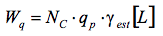 (8)
(8)Performance (WA) of existing trucks is expressed as the ratio of liters transported between liters according to the capacity of trucks according to manufacturer, by the following expression:
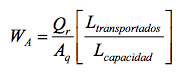 (9)
(9)Where:
Aq - existing storage capacity in the truck fleet, L;
Where:
 (10)
(10)Where:
Cc- number of exi sting trucks .
Determination of production costs
The different economic indicators were obtained according to Díaz et al. (1980) and NC 34-38: 2003. The cost of the ton-kilometer (CTK M) is determined by the following expression:
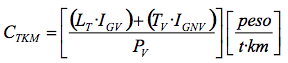 (11)
(11)Where:
LT - total travel distance, km;
IGV - variable costs index, peso/ km
TV- time of a trip; h
IGnV- non-variable costs index; peso/h
Pv- traffic of a trip,
Where:
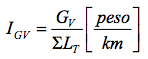 (12)
(12)Where: GV- costs variables that fluctuate depending on production levels of traffic, peso, according to monthly closing report3.
 (13)
(13)Where:
S- salary costs of drivers who a relinked to the production, peso;
A- amortization expense for capital repairs of vehicles in one year, peso;
R- maintenance costs and l ight repairs (costs of materials, spare parts, mechanic’s wages, tire wear and replacement), peso;
C- expenditures for fuel, lubricants (greases and oils), peso;
O- other variable costs, peso.
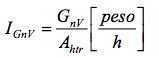 (14)
(14)Where:
Ahtr- number of hours worked by trucks, h;
GnV- no variable costs, peso; according to monthly closing report, which remain constant regardless of the production level of traffic, they are determined as:
 (15)
(15)Where:
DV - costs for depreciation of vehicles, this item is from existing depreciation rates regarding an hour of work of the vehicle, h;
SF - costs for fixed salary of drivers, when they are paid by the selection of common occupations rather than performance, h;
GI - indirect costs that include administrative salaries, general costs such as electricity, subsistence allow ances, costs for repairs to basic means other than milk transportation vehicles, among others, h
Cost of a ton (CT)
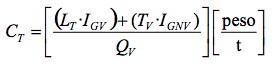 (16)
(16)Where:
Qv - number of tons transported per trip, t.
The average milk price of 2.42 peso/L in the territory is considered according to its quality
RESULTS AND DISCUSSION
Behavior of Time Elements Corresponding to a Working Day of the Means of Transport Participating in Milk Collection
In Figure 2, it is shown the behavior of operating time percentages with respect to the total time of observation composing the working day, during the operation of the trucks in bovine milk collection, in Jimaguayú, Sibanicú and Vertientes Municipalities.The values of total observation time in the municipalities of Jimaguayú, Sibanicú and Vertientes were 109.63, 125.73 and 1 70.22 hours, respectively.
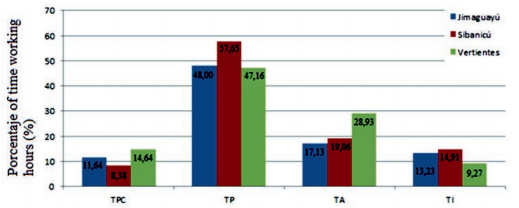
Figure 2
Behavior of the Percentage of the Working Times that Compose the Working Day during Milk Transportation in the Municipalities of Jimaguayú, Sibanicú and Vertientes
The final preparatory time (TPC) reached values between 8 ,3 8 % (10.63 h) and 14.64% (24.9 2 h) as an average of the w orking time in the municipalities studied. The municipality of Vertientes reached the highest value with 14.64% (24.9 2 h), that is considered too high, which affects labor productivity, mainly due to the poor organization of the means of transportation at the base and it facilitates they are used in other activities not related to its corporate purpose.
In the case of the main time (TP), it ranged from 47.16 (80.27 h) to 57.65% (72.48 h) of the total time observed during the working day. The highest value was obtained for the municipality of Sibanicú, this indicator is considered low, which indicates th at the truck’ s main activity is not taken fully, mainly due to the low volumes of milk collection, the inadequate location of the collection points, the bad conditions of the roads and organizational causes in the process.
The auxiliary time (TA) behaved with 17.13 (18.78 h); 19.06 (23.97 h) and 28.93% (49.25 h) in Jimaguayú, Sibanicú and Vertientes, respectively. It is mainly used in the loss of time during the preparation of documents (billing and reconciliation between hauler, producer and receiving point) and the losses in the discharge operations, due to the poor technical condition of the milk reception facilities and the low availability in the simultaneous discharge, which causes queuing.
One aspect that limits the work efficiency of the means of transport in milk collection was the high index of interruption time (IT). It reached values between 9.27 (15.78 h) and 14, 91% (18.75 h) of the working day in the three territories, respectively and that is the main technical and organizational reserve of the transport in this activity. Within the causes that affect this result is waiting time to load in the field (Tepc), due to the late arrival of the haulers to the point of collection, inadequate location of the milk containers or away from the point of loading, among other organizational factors along the route.
Performance of the Main Indices Transport Operation in Collecting Cow’s Milk
Figure 3 shows a comparison of the different coefficients: the utilization of the static load capacity, the route and the time of operation of the means of transport, evaluated in the municipalities of Jimaguayú, Sibanicú and Vertientes. The evaluation of these indices in an entity facilitates understanding the work efficiency of them and their economic impact.
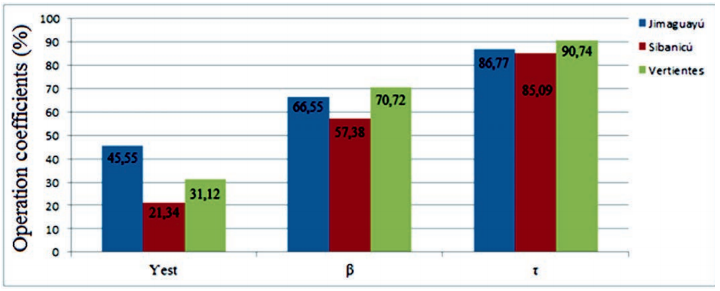
Figure 3
Behavior of Transport Operation Rates in the Municipalities of Jimaguayu, Sibanicu and Vertientes.
The result obtained in the three municipalities evaluated Jimaguayú, Sibanicú and Vertientes, is considered unfavorable, occupying only 45.55, 21.34 and 31.12% of static load capacity utilization (γest) respectively, mainly because of the poor availability of milk collection points and inadequate organization of the fleet capacities considering the historical collecting volumes by route.
The determination of the route coefficient of utilization (β) is considered of maximum relevance in the operation of the automotive transport. The results of this indicator are in correspondence with the type of route the loads describe. In the case of milk collection, the routes that the automotive means describe are distribution, circular or collection, mainly. The truck is filled as it carries out a determined path between one and several points of collection. In that sense, the path with load Lcc, must be greater than the others must, if the no-load travel Lsc and the total distance th at the empty trucks travel (Lo) exceed the established values, the coefficient is severely affected. This happens with the trucks used in the collection of milk to the point of cooling in the case of Jimaguayú, which reaches values of 66.55% (76.9 km), mainly because the distance occupies 11.9 9 % of total kilometers traveled on average (13.86 km).
The trucks used in the collection of milk to the cheese factory in Sibanicú, reach a coefficient of utilization of the route of approx imatel y 58 %, mainly due to the fact that the distance Lo occupies 18 % of th e average kilometers traveled (17.63 k m).
In freight transportations, it is important to evaluate the correspondence between the times the vehicle transits under load and the total time. This indicator directly affects the economy and the energy efficiency of the environment, since it affects the direct costs of means of transport.
In the investigation, the value obtained from the use of time reach es (τ) values between 85 and 91%. These values, in spite of being above 85%, show that there are technical - organizational reserves in the process under study, mainly due to the organizational problems of transportation abovementioned; so it is vitally important to reduce the no-load travel and the stationary times (reduce the loss of time to load in the field).
Analysis of the Production of Means of Transport
The performance of trucks production, in quantity of liters transported on average, showed values of 2004.28 L, 934.88 L and 1176.28 L in the localities studied. These are well below the transport design capacity used in th e milk collection process, in accordance with the results of the utilization coefficient of the static load capacity obtained in Jimaguayú, Sibanicú and Vertientes Municipalities.
Similar results are obtained for the performance in liters transported per liters of capacity of the trucks under study, obtaining that a vehicle transports during the working day 5.1, 4.27 and 6.2% of the fleet capacity in use in Jimaguayu, Sibanicu and V ertientes, respectively. In the evaluation of the fuel consumption index, values are obtained averaging 2.97, 3.62 and 4.30 km / L in Jimaguayú, Sibanicú and Vertientes, respectively. These values are low compared to the values obtained by Gonzalez (2008) and Marimón et al. (2013), who obtained an average consumption index of 5 and 6 km/ L for Yuchai engines in Omnibus Giron V and Zil 130, respectively. That responds to the inadeq ate conditions of the roads that lead to excessive speed changes affecting the speed of travel of vehicles and the unnecessary distances of traveling with out loads, which can be seen more clearly in the municipalities of Jimaguayú and Sibanicú.
Technical - Economic Analysis of the Milk Collection and Distribution Process
Taking into consideration the average milk price of 2.42 peso/ L in the territory according to their quality, in the case of Jimaguayu, the quantity of acidic milk arrived at the reception center due to transportation problems amounted to 18,302 L for a total of 44 290.84 pesos. In the case of Sibanicú, the volume amounted to 26 154 L, for an amount of 63 29 2.68 pesos. Likewise, in Vertientes, the volume of acidic milk due to transportation problems amounted to 8 8 224 L, for a total of 213 502.08 pesos. These values represent a total of 132 680 L of acidic milk due to transport problems, for a value of 221 085 pesos.
From the analysis of the cost of milk transportation operation in Jimaguayú, Sibanicú and Vertientes, the results obtained were 0.59, 0.49 and 0.7 peso/ t-k m, respectively. The cost of one ton was 34.22, 33.56 and 34.64 peso/ t. These values are influenced by the low rates of load capacity utilization of the vehicles, the high rate of total distance traveled with out load and the time losses to load in the field.
CONCLUSIONS
• The result of the evaluation of the technical - economic indicators of the trucks labor in milk collection in Jimaguayu, Sibanicu and Vertientes showed the inefficient operation of the means of transport in the process, motivated by low volumes of collection, inadequate location of collection points, bad conditions of the roads, as well as organizational problems, obtaining:
• The main time with average values between 47.16 and 57.65% of the working day; The total time of interruptions, that yielded average values between 9.27 and 14.91%, constituted the main technical and organizational reserve of the transport in this activity.
• The coefficient of static utilization of the load was between 21.34 and 45.55% as an average for the three municipalities studied .
• The fuel consumption index reached values averaging 2.97, 3.62 and 4.30 km/L in Jimaguayu, Sibanicu and Vertientes respectively;
• The quantity of acidic milk arriving at reception centers due to transportation problems in the evaluated municipalities amounted to 132 680 L, for an amount of 221 085.60, pesos;
• The cost of the ton-kilometer reached average values between 0.59, 0.49 and 0.7 and the cost of each ton increased by transportation in 34.22, 33.56 and 34.64 pesos in Jimaguayu, Sibanicu and Vertientes, respectively.
REFERENCES
BUTLER, M.; HERLIHY, P.; KEENAN, P.B.: “Integrating information technology and operational research in the management of milk collection”, Journal of Food Engineering, ser. Operational Research and Food Logistics, 70(3): 341-349, 1 de octubre de 2005, ISSN: 0260-8774, DOI: 10.1016/j.jfoodeng.2004.02.046.
DE LAS CUEVAS, M.H.R.; DÍAZ, M.; GÓMEZ, I.; PANEQUE, P.: “Evaluación tecnológica y de explotación de la combinada de caña CAMECO”, Revista Ingeniería Agrícola, 4(4): 35–38, 2014, ISSN: 2326-1545.
DÍAZ, P.F.; GALVAÑI, P.E.M.; CASTAÑER, H.J.A.: Planificación del transporte de carga y pasajeros, Ed. Pueblo y Educación, La Habana, 257 p., 1980.
DOOLEY, A.E.; PARKER, W.J.; BLAIR, H.T.: “Modelling of transport costs and logistics for on-farm milk segregation in New Zealand dairying”, Computers and Electronics in Agriculture, 48(2): 75-91, 1 de agosto de 2005, ISSN: 0168-1699, DOI: 10.1016/j.compag.2004.12.007.
GONZÁLEZ, M.: Evaluación de la efectividad técnico – económico de la sustitución de motores Yuchai en los camiones Zil 130 de la empresa cárnica de Pinar del Río, Universidad de Pinar del Río, Trabajo de Diploma, Pinar del Río, Cuba, 2008.
GYULAI, D.; PFEIFFER, A.; SOBOTTKA, T.; VÁNCZA, J.: “Milkrun Vehicle Routing Approach for Shop-floor Logistics”, Procedia CIRP, ser. Forty Sixth CIRP Conference on Manufacturing Systems 2013, 7: 127-132, 1 de enero de 2013, ISSN: 2212-8271, DOI: 10.1016/j.procir.2013.05.022.
KALRA, K.K.; SINGH, R.V.: “Milk transportation routes management”, Agricultural Systems, 28(4): 259-271, 1 de enero de 1988, ISSN: 0308-521X, DOI: 10.1016/0308-521X(88)90070-4.
MARIMÓN, M.; HERNÁNDEZ, L.R.; AGUIAR, L.; SERRADET, Y.: “Contaminación del medio ambiente y remotorización”, Avances, 15(2): 207-214, 2013, ISSN: 1562-3297.
MATOS, R.N.; GARCÍA, C.E.: “Evaluación técnica y de explotación de los camiones en la transportación de la caña”, Revista Ciencias Técnicas Agropecuarias, 21(2): 30-33, junio de 2012, ISSN: 2071-0054.
MATOS, R.N.; GARCÍA, C.E.; GONZÁLEZ, G.J.R.: “Evaluación técnica y de explotación de las cosechadoras de caña Case-7 000”, Revista Ciencias Técnicas Agropecuarias, 19(4): 6-9, diciembre de 2010, ISSN: 2071-0054.
MIRANDA, C.A.; CASTELLS, H.S.; FERNÁNDEZ, A.O.; SANTOS, G.F.; IGLESIAS, C.C.: “Análisis de la utilización del tiempo de turno por las cosechadoras arroz CLAAS DOMINATOR”, Revista Ciencias Técnicas Agropecuarias, 22(4): 27-31, diciembre de 2013, ISSN: 2071-0054.
MIRANDA, C.A.; IGLESIAS, C.C.; ANILLO, J.; FALCÓN, L.; RIVERO, F.R.; RIVERO, M.R.; RUIZ, L.M.; CRUZ, B.A.: “Evaluación tecnológica y explotación de las cosechadoras de arroz New Holland L-520”, Revista Ciencias Técnicas Agropecuarias, 11(4): 13–15, 2002, ISSN: 2071-0054.
MOREJÓN, M.Y.; IGLESIAS, C.C.E.; DOMÍNGUEZ, C.G.: “Evaluación de los medios de transporte utilizados en el proceso cosecha-transporte del arroz en el Complejo Agroindustrial “Los Palacios””, Revista Ciencias Técnicas Agropecuarias, 21(3): 45-48, septiembre de 2012, ISSN: 2071-0054.
OFICINA NACIONAL DE NORMALIZACIÓN: Máquinas agrícolas y forestales. Metodología para la evaluación económica, no. 34-38, La Habana, Cuba, 2003a.
OFICINA NACIONAL DE NORMALIZACIÓN: Máquinas agrícolas y forestales. Metodología para la evaluación tecnológica - explotativa, no. 34-37, La Habana, Cuba, 2003b.
OLIVET, Y.E.; ORTIZ, A.; COBAS, D.; BLANCO, A.; HERRERA, E.: “Evaluación de la labor de rotura con dos aperos de labranza para el cultivo del boniato (Ipomoea batatas Lam) en un Fluvisol”, Revista Ciencias Técnicas Agropecuarias, 21(4): 24-29, diciembre de 2012, ISSN: 2071-0054.
ONEI (OFICINA NACIONAL DE ESTADÍSTICA E INFORMACIÓN): Panorama Territorial. Cuba 2014, [en línea], Ed. ONEI, La Habana, Cuba, 2015, Disponible en: http://www.one.cu/panoramaterritorial2014.htm, [Consulta: 5 de septiembre de 2016].
ORTIZ, A.E.; GASKINS, B.G.; PARRA, L.R.; VÁZQUEZ, H.B.: “Evaluación tecnológica y de explotación de conjuntos de máquinas en la labor de surcado para el cultivo del boniato (Ipomoea batatas (Lam) Poir)”, Revista Ciencias Técnicas Agropecuarias, 20(2): 11-14, junio de 2011, ISSN: 2071-0054.
Notes