ORIGINAL ARTICLE
Hydraulic Design of Irrigation Systems for Gardens in Cuba
Diseño hidráulico de sistemas de riego para jardines en Cuba
Hydraulic Design of Irrigation Systems for Gardens in Cuba
Revista Ciencias Técnicas Agropecuarias, vol. 29, no. 4, 2020
Universidad Agraria de La Habana
Received: 15 December 2019
Accepted: 25 September 2020
ABSTRACT: This research shows the results obtained, during the conformation of design criteria, to ensure the built and management of irrigation systems in gardens efficiently. Aspects related to the determination of irrigation requirements, water use and supply sources; according to climate conditions, were included. Design tools are addressed to rationalize the system, guarantee water efficiency, facilitate its building according to available resources, specifying irrigation frameworks, spacing between sprinklers and laterals, as well as network schemes. Elements are detailed on sizing of sprinkler circuits, main distribution network, automatic control system and pumping station. These design criteria were applied in tourist centers in Cayo Santa María, Cayo Coco and Cayo Cruz, Cuba.
Keywords: Design Criteria, Water Use, Irrigation Frameworks Spacing between Sprinklers.
RESUMEN: En la presente investigación se muestran los resultados obtenidos, durante la conformación de criterios de diseño, para garantizar la ejecución y explotación de sistemas de riego en jardines de forma eficiente. Se incluyeron aspectos relacionados con la determinación de las necesidades de riego, uso del agua, fuentes de abasto, según condiciones climatológicas regionales. Se abordan herramientas para racionalizar el sistema, garantizar eficiencia hídrica, facilitar su ejecución según recursos disponibles, especificando marco de riego, espaciamiento entre aspersores y laterales, así como esquemas de redes. Se detallan elementos sobre dimensionado de circuitos porta aspersores, red principal de distribución, sistema de control automático y estación de bombeo. Estos criterios de diseño fueron aplicados en centros turísticos de Cayo Santa María, Cayo Coco y Cayo Cruz, Cuba.
Palabras clave: criterios de diseño, uso del agua, marco de riego, espaciamiento entre aspersores.
INTRODUCTION
During the design, construction, management and exploitation of Gardens, various factors intervene, being of maximum interest, the landscaping, plants, climate conditions, earth movement, rainwater drainage and irrigation system, among others. The acceleration of climate change, along with its effects, have a negative influence on the optimal development of plants in ecosystems and it is important to have a high efficient irrigation system that adapts to the conditions of exploitation facilities. The preservation of native vegetation, selection of plants, the use of water and alternative sources of reuse, will play an important role to complement with hydraulic design of the rational irrigation network.
In the design process, water requirements and supply sources, together with the hydraulic network scheme, must be defined, including the type of irrigation (drip, spray or rotating sprinklers), selection and location of sprinklers, irrigation framework, lateral pipe sizing, sprinkler circuit and main irrigation network, using computer tools that streamline the system. There is not a method in Cuba that, allows the creation of a rational design for high efficiency of irrigation systems in gardens, integrated into the constructive dynamics. Therefore, that is the objective of this research, and the solution to this problem, its main scientific contribution.
MATERIALS AND METHODS
Irrigation Requirements and Supply Water SourcesT
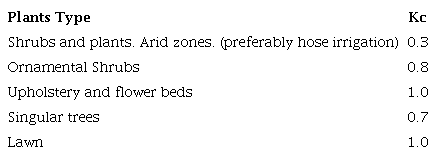
The reference evapotranspiration (ETo) is determine using Penman-Monteith (Solano et al., 2003), applied by Pino & Mujica (2007) and widely used with good results (Da Silva, 2016). For the climate of Cuba, ETo ranges from 5.0 to 6.3 mm/day. The usable precipitation is defined using the expressions given by Pacheco et al. (2004), the actual evapotranspiration is required by taking as values of the crop coefficient, those referred by Lamote (2002). The crop evapotranspiration rate or calculated (ETc) will be expressed by: .
Net irrigation requirements (Hn) are determined according to the general equation for the water balance: Hn = ETc - Pa (usable precipitation) and gross sheet: Hb = Hn/Efficiency (85% sprinkler - 95% drip). Regarding the type of water to be used, the reuse of rainwater, in combination with treated wastewater (including nutrients), is fundamentally recommended to decrease exploitation costs and integrating with drainage systems, to guarantee sustainability in the management and use of irrigation water.
Rational Irrigation Layout, New Hydraulic Design. Sprinklers Circuits
In uniform areas of grass, sprinkler irrigation is applied, in shrubs, pots and trees, drip irrigation is applied and for upholstery and flowerbeds, spray with retracted height is applied. Underground hoses with bubblers can be an option, in large garden areas to reduce costs and water consumption. In coastal ecosystems, drip irrigation or bubblers is not the best option, due to the environmental salinity and saltiness of capillary water.
Pressurized water distribution, stationary irrigation, automated sectors, always have quick couplers for hoses are proposed to cover all the garden areas. The range radius of sprinklers, spray or micro-spray, will depend on the winding road and architectural extensions of the garden. It is recommended to use spray nozzles with a radius of 1.5 to 5.2 m for small areas. For large gardens, it is proposed to use spray or rotating sprinklers with radius of 8 to 14 m, and up to 18 m of radius in big parks. Drip irrigation sectors (exposed or underground), increase water efficiency, therefore its use is favorable, if the recommended criteria are fulfilled.
The sprinkler spacing patterns advised are triangular or square, and the expressions proposed for determining the spacing between lateral and sprinklers are:
Triangular sprinkler spacing pattern:
Where, Ea: sprinkler spacing (m), A: nominal range diameter of the sprinkler (m), and EL: lateral spacing.
Square sprinkler spacing pattern:
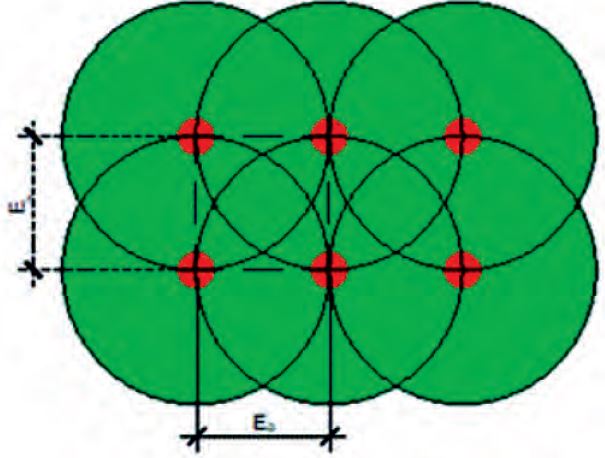
FIGURE 1
Square sprinkler spacing.

FIGURE 2
Triangular sprinkler spacing
Other recommendations are not to irrigate with winds over 25 km/h and extend sprinkler spacing up to 85% A, if necessary. In addition, it is indicated always to use square sprinkler spacing pattern to minimize the effect of the wind (Figures 3 and 4), selecting sprinklers and spray with more than 2 or 4 types of nozzles and high uniformity, including reducible radio up to 25% (Rain, 2018; Torres, 2019).
For the hydraulic lateral sizing and sprinkler circuits, it is proposed to apply the head loss equation of Hazen-Williams, together with the typical factor F of Christiansen, which takes into account that the flow is not uniformly distributed through the multiple outlets (sprinklers). These expressions are referred in several studies (Sadeghi et al., 2011; Sadeghi y Peters, 2011; Zerihun et al., 2014).
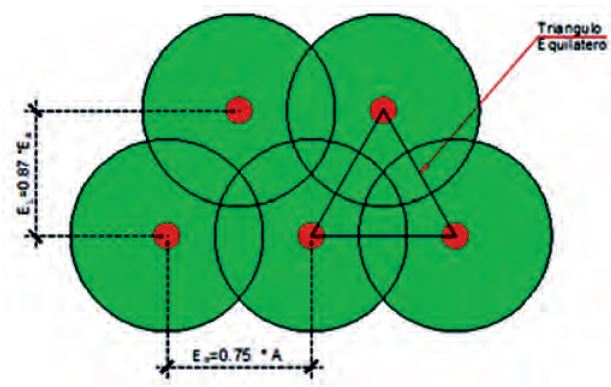
FIGURE 3
Intermediate rational provision.
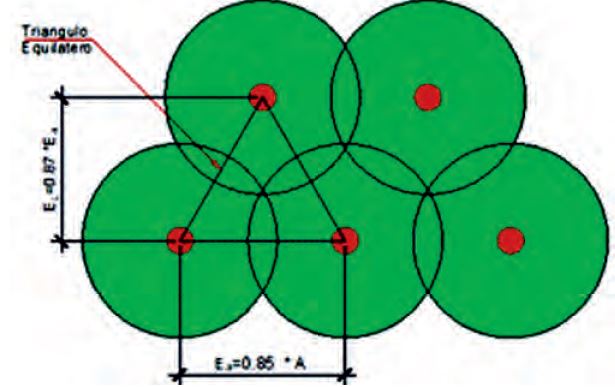
FIGURE 4
Limit rational provision.
The head loss pressure in lateral or branch (hf) is obtained by the equation:
Where L is the length of the lateral or branch (m); I head loss per length unit (m / m); Hf total head loss pressure in the lateral or branch (m); F Christiansen factor (length correction) and (1.15) 15% of local head loss.
It is recommended that the pressure variation at the inlet of the lateral sprinkler circuit ∆ Pa, must not be greater than 20% of the nominal working pressure of the sprinkler (Pn∙Asp), in order to achieve a uniform distribution in lateral. Using tables make the design faster, just like well-founded programs or spreadsheets in Excel
Determine:
Check:
(ΔZ) is topographic difference.
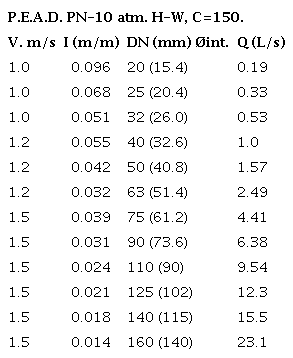
In Table 2, Q represents the total flow in L/sec of the branch or lateral, the design speeds should never exceed 1.0 m/s for Ø ≤ 32 mm, for Ø > 32 mm maximum speed 1.2-1.5 m/s, guaranteeing less head loss pressure and greater uniformity.
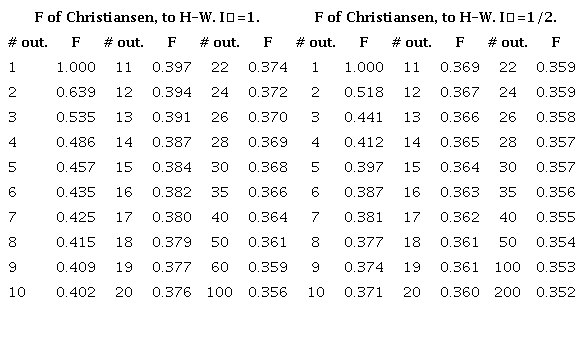
Select F according to Table 3, when the first branch is at a distance from the beginning of the pipe (lo), equal to the equidistance (l) between the branches, that is, l=lo, or when (lo = l/2).
The ratio of Iₒ/I can occur in many variants, even the lateral can have different diameters, so for greater precision use the general equation F of Cristiansen, together with the corrective factor G of Anwars's (multiple outlet) or GAVG (multiple outflow) to H-W, according to Sadeghi and Peter. (2011).
The flow (Q) of each irrigation sector corresponds to the ∑Q of the sprinklers in the circuit, spray or drippers (as appropriate), the drip irrigation sectors will have a smaller total flow. The number of sprinklers or spray per circuit must be similar, to guarantee homogeneous flows, equal characteristics for each irrigation sector separately and similar for the entire system (pressures, intensity and flow).
Drip irrigation can increase efficiency above 95%, so water losses are minimal, presenting great advantages, although it requires a high investment, control and maintenance for its proper operation (Martin., et.al). Its use can be online or between lines, exposed or underground, with a wide range of assortments according to manufacturer (Rain Bird., 2018), and the criteria established in the Karmelli-Keller table, which relates, flow rate, separation between emitters or bubbler, and soil type, with humidity percentages.
Simulated Main Hydraulic Network and Pumping Station
The main hydraulic distribution network, will be made up of a mesh system, the pre-dimensioning of which is carried out by transforming it into an equivalent branch network. Being able to divide the Qm/2, where Qm represents the maximum flow rate of the most unfavorable irrigation sector (sprinklers circuit); starting from the maximum admissible velocity in the pipeline (1.2 to 1.5 m/s), the minimum internal diameter of the sections is obtained. Initially, it should be considered that: each sector is watered from a single knout of the mesh, that the flow rate is continuous, and that the pre-sizing of the network is carried out when the maximum flow circulates in only one direction of the sections (Figure 5).
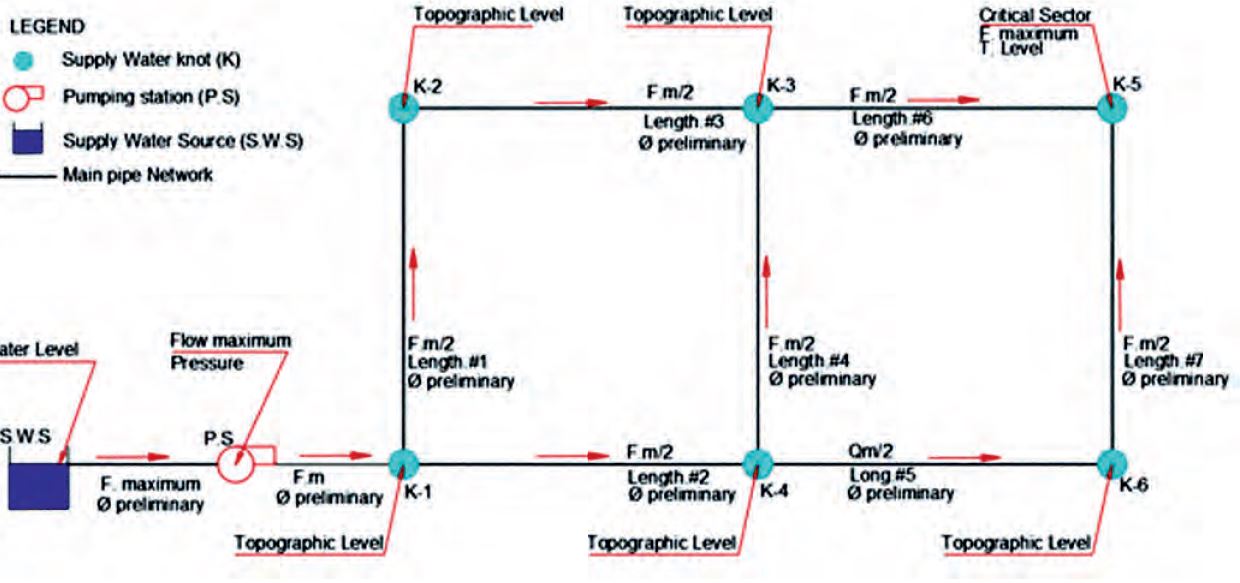
FIGURE 5
Pre-dimensioning of the Main network.
Once the layout has been made in plan, the lengths and topographical dimensions have been defined, the network is modelled in EPANET, and can be combined with EpaCAD (Palomino & Quintana, 2017) to facilitate the transport of data, defining the pressure requirement at the knout, definitive diameters, head losses, and pipe speeds from branch by branch, for extraordinary case. The pressures at the inlet of each sprinkler circuit (irrigation sector) are defined by specific simulated model (Fernandes et al., 2012). The total flow to discharge by the hydro pressure system will be the corresponding to the critical or most unfavorable sector, as well as the total hydraulic pressure, including a coefficient of local head losses of 1.15. The pumping booster set system must have a minimum of two to three pumps couple in parallel, including one of reserve, pressure switch or variable speed driver (preferably).
Supply Sources, Water Reservoir, Automatic System and Irrigation Control
Rainwater collect and reuse of treated water are sustainability premises to define supply sources (Díaz, 2018; Torres, 2019). The water collection for irrigation should be independent from that for potable water, with the construction of two separate cisterns, with a minimum recommended capacity of 1 day of reserve, maximum two each. One reservoir to storage rainwater and other to storage the treated or reuse water. A central controller from which all sprinklers circuits and automatic solenoid valves are activated carries out control management of the irrigation system. The automat should be located in a garden area preferably (there are multiple options), with a direct on / off connection to the hydro pressure system. Incorporate sensors of soil moisture, solar sync, rain and evapotranspiration meters to perform daily water balance through software, even a computerized system may be the option if resources are available.
RESULTS AND DISCUSSION
Irrigation Requirements and Reservoir Volumes. Coco Caribe Hotel, Cayo Cruz, Camagüey, Cuba. 528 Rooms
The resulting water balance for the month with the highest deficit (April) shows an irrigation requirement of 5.10 mm/day. Taking into account 85% efficiency in the sprinkler irrigation system, a real water requirement of 6 mm/day should be applied, in an area of 1.80 ha, which represents a maximum daily consumption of 108 m3/day. A concrete cistern for the reservoir of rainwater will be built, with an automatic overflow to the reuse water cistern, each with a 1 day reserve capacity (Volume=108 m3).
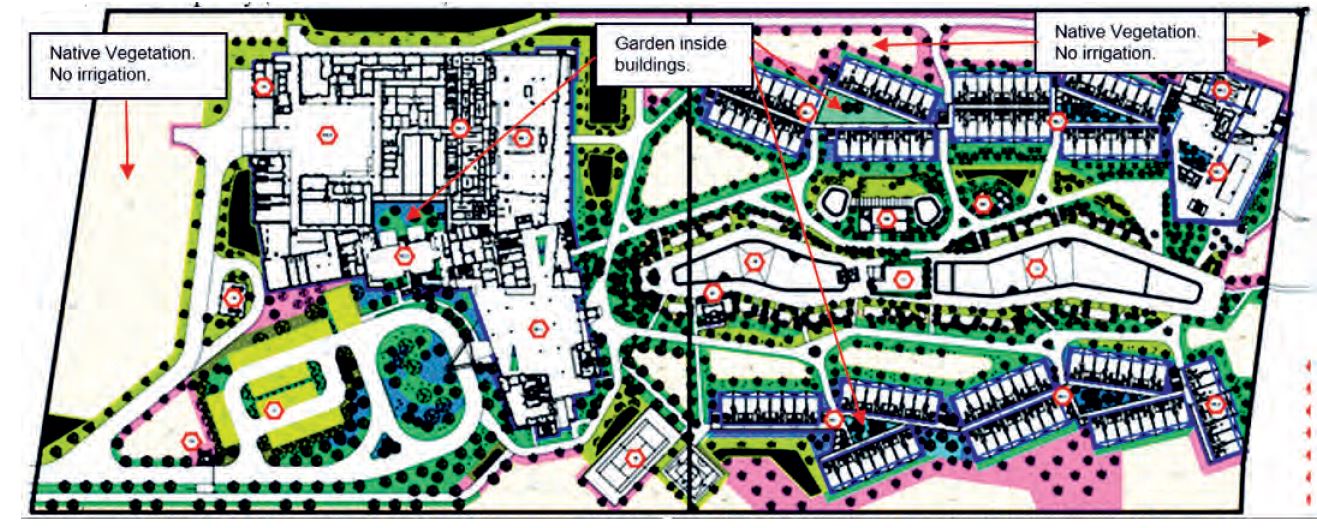
FIGURE 6
General plan of green areas. Coco Caribe Hotel.
Selection of the Irrigation System, Sprinklers Circuits and Lateral Layout. Coco Caribe Hotel
The design and execution, opt for the Breeam certification, which accredits the Hotel with criteria of environmental sustainability, the use of water with reuse alternatives (rain and treatment water) provide credits. The total area built covered is 7.19 ha, which is located in a fragile coastal zone, with ground water levels up to 0.60 m above mid sea level. It has been decided to carry out sprinkler irrigation to garden area of 1.80 ha, which represents 25% of the total built, with coverage for irrigation with quick couplers and hoses. Areas of preserved native vegetation will not be watered.
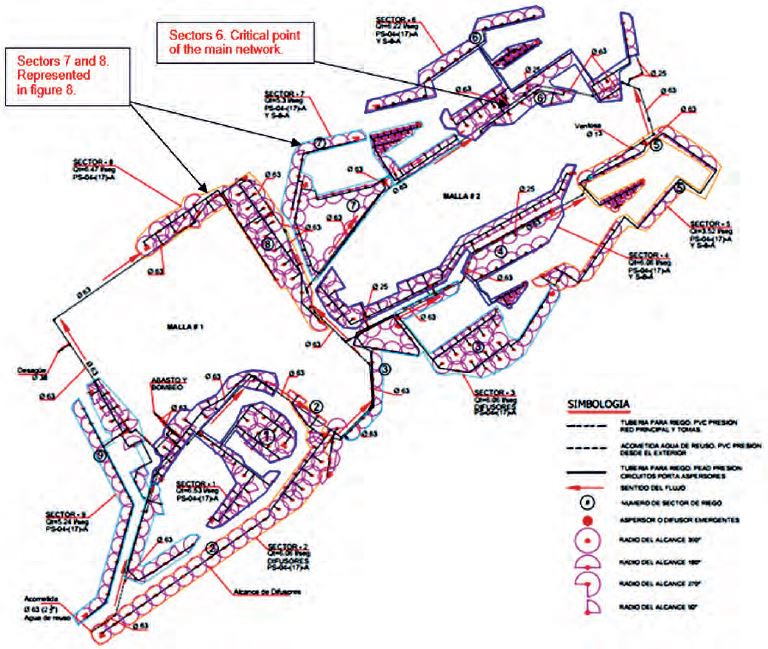
FIGURE 7
Main and secondary irrigation network (Sprinkler Circuit).
It is analyzed (Figure 6), together with topography, roadways, drainage, and multi networks, to select pup-up spray sprinklers Hunter, with radius of 5.2 m, working pressure of 1.7 kg/cm2 and flow of 0.98 m3/h, adjustable between 0º-360º. In small internal building garden it is proposed to use pup-up spray sprinklers, with radius of 2.1 m, working pressure of 1.4 kg/cm2, flow of 0.25 m3/h, retracted height to 0.6-1.0 m, depending on the height of the flowerbed. Quick couplers of bronze for the use with hoses are included, covering all the irrigation areas (1.80 ha), in vulnerable points (swimming pools), the quick couplers are connected to the drinking water network. For triangular sprinkler spacing pattern, the expression (1) is applied, adjusted for a spacing between sprinklers of 0.85 of scope, then (2) is applied for the distance between laterals.
The spray sprinklers must be located, in such a way that the appropriate branch and lateral structure can be maintained, according to the defined triangular sprinkler spacing pattern, and then the pipeline layout is carried out within the sprinkler circuit, as shown in Figure 7. In this way, it is possible the sizing usage of the sprinkler circuits, applying the expressions (4), (5), Tables 2 and 3, together with Excel spreadsheets, software, or complete tables that meet the established speed criteria. The results are represented in Figure 8.
When applying Table 2 of rapid sizing with the established speeds, the criterion of ∆ Pa ≤ 0.20 Pn. Asp. (5) is always met. To calculate (6) and check (7), to demonstrate that the pressure delivery to the sprinklers is uniform, guaranteeing efficiency and rationality in the system. Using small low flow spray or sprinklers is favorable, since costs decrease, the insertion of new technologies is essential. The technical data tables of manufacturers Hunter and Rain Bird should always be consulted, because the use of sprinklers or spray with range nozzle is a real option, as it is dual-jet sprinklers, and adjustable radio nozzle (Hunter, 2018; Rain, 2018).
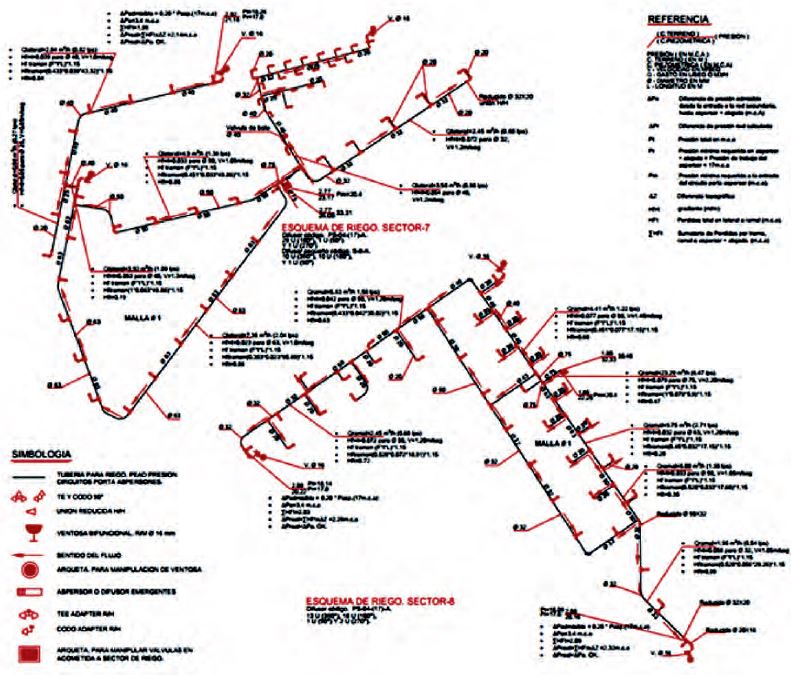
FIGURE 8
Hydraulic schemes. Sprinkler circuit. Irrigation sectors 7 and 8.
Main Network of Irrigation Supply Water System. Coco Caribe Hotel
The critical sector flow is 6.22 L/s, the maximum pressure required is 27.5 m.c.a. The simulation in EPANET model, demonstrates that it is feasible to build a system with a meshed main network with a uniform diameter of DN 2 1/2 “in the ASTM standard, Øint. 66.92 mm, PVC, PN-11, SDR-26. The main pipe outlet from the hydro pressure equipment has DN 3”, Øint. 81.54 mm, PN-11. The meshed network is recommended to favor pressure, head losses, energy consumption, and maintenance and repair work, drawn up next to the multi network excavation.
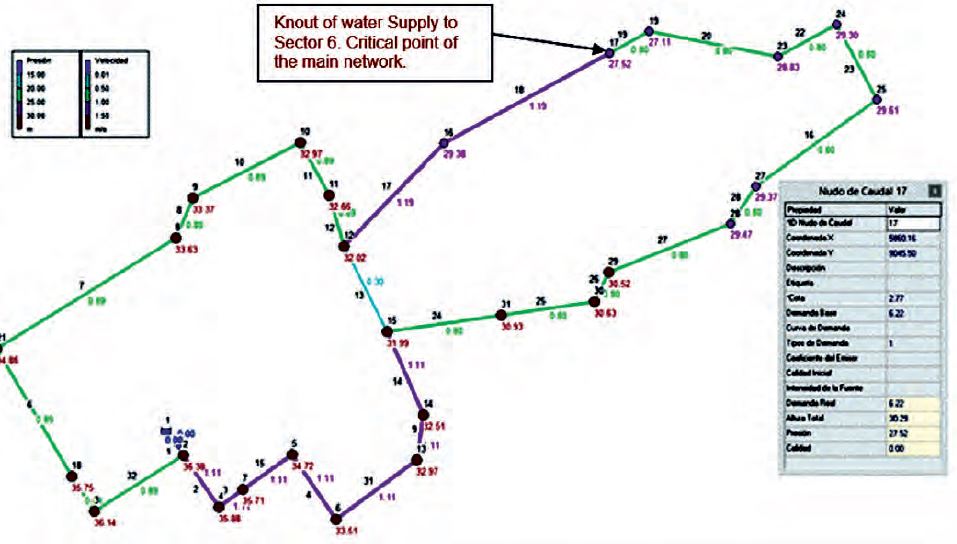
FIGURE 9
Model in EPANET. Sector No 6. Critical point. Main network.
Pumping Station and Automatic Control. Coco Caribe Hotel
The maximum flow to circulate will be 6.53 L/s, together with an estimated total hydraulic load of 35 m.c.a,.The result of simulated in EPANET model allows specifying the power of the pumps to be installed. It is recommended 2 in parallel+1 reserve (Pot=6.6 kW total, working 4.4 kW).
The hydro pressure system will present on/off drive from the automatic irrigation controller. The operation point of the system has been determined, along with characteristic curve, during multiple simulation, for all irrigation sectors (sprinklers circuits). The proposed automatic irrigation control system guarantees simultaneous program operation, connection with sensors, location in external /internal built areas, support on the wall or on a pedestal, manual start and advance by keys, among other advantages. Model ACC-1200-SS with capacity of up to 12 irrigation sectors.
Valuation of Resources, Rationality of the System and Efficiency
It is recommended to quantify initially the available resources for the investment, to make a rational adaptation and viable design, sustainable project that also adapts to local climate conditions. The results presented below demonstrate significant savings in import costs, reducing the resources to use by 55%, covering 100% of the planned irrigation garden area.
Table 4 shows a saving for pipes, accessories, spray sprinklers, quick couplers, and hydro pressure system of $ 15,335, for a rational (efficient, novel) garden irrigation system.
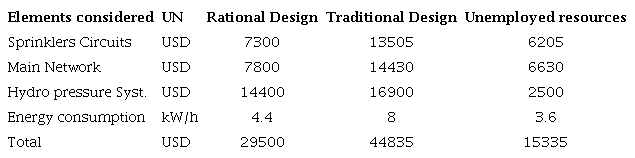
Power consumption is lower, saving 3.6 kw/h daily, for an expected 4 hour run time of 14.5 kW/day∙300 days=4350 kW/year. If it is considered that 0.25 L of oil in Cuba is equivalent to 1 kW/h of generation, 1090 L of oil would be saved every 1.8 ha of garden irrigation (460 USD/year).
CONCLUSIONS
-
Criteria, expressions, diagrams, summary tables have been provided, which guarantee a hydraulic design for an irrigation system for gardens, that is rational, new and of high efficiency.
-
The established criteria have been applied to tourist centers in cays in northern of Cuba, presenting the results obtained at Hotel Coco Caribe, Cayo Cruz, with 1.80 ha of garden irrigation.
-
Environmental sustainability criteria, alternative sources for water reuse and water efficiency are introduced.
REFERENCES
DA SILVA, G.M.: “Estimativa da evapotranspiração de referência padrão (Penman-Monteith FAO 56): Uma abordagem com dados meteorológicos limitados”, Pesquisas Agrárias e Ambientais, 4(4): 253-260, 2016, ISSN: 2318-767.
DÍAZ, D.A.J.: “El agua en Cuba: un desafío a la sostenibilidad”, Ingeniería Hidráulica y Ambiental, 39(2): 46-59, 2018, ISSN: 1815-591X.
FERNANDES, S.F.L.; PINTO, A.; SILVA, R.; MOURA, J.P.: “Modelling High Pressure flow and replacement of pipes in water supply systems in north Portugal”, Journal Iran. J. Sci. Tech, Transactions of Civil Engineering, 36(C1): 53-65, 2012, ISSN: 1815-591X.
HUNTER, R.G.: “Catálogo de Productos Residencial, Institucional y Golf”, Built on Innovation, ser. Spanish RC 001, 37(10): 234, 2018.
LAMOTE, M.A.: Metodología para el diseño, construcción, y mantenimiento de sistemas de riego para jardinerías, Universidad de Ciego de Ávila (UNICA), Tesis de Maestría en Ciencia del Riego y Drenaje, Ciego de Ávila, Cuba, 72 p., 2002.
MARTIN, A.: Manual de Riego de Jardines, Consejería de Agricultura y Pesca, Junta de Andalucía, Andalucía, España, 262 p., 2018.
PACHECO, J.; PACHECO, E.; VELIZ, L.: “Determinación de la lluvia aprovechable en los proyectos de regadío para campos de golf”, En: Sextaconferencia científica Internacional UNICA, Ed. UNICA, Ciego de Ávila, Cuba, p. 12, 2004.
PALOMINO, C.A.; QUINTANA, D.: Diseño del sistema de Riego por aspersión para el campus de la Universidad Cesar Vallejo en la sede Lima Norte, Inst. Universidad Nacional Agraria La Molina, Especialización y Profesionalización en Gestión de Calidad y Auditoría Ambiental, Lima, Perú, 160 p., 2017.
PINO, P.Y.; MUJICA, C.A.: “Diseño Hidráulico de sistemas de riego para campos de golf”, Ingeniería Hidráulica y Ambiental , 28(1): 41-46, 2007, ISSN: 1815-591X.
RAIN, B.: El Riego automático de espacios verdes, The Intelligent Use of Water, Catálogo General 09 (17), 2018.
SADEGHI, S.H.; MOUSAVI, S.F.; GHEYSARI, M.; SADEGHI, S.H.R.: “Evaluation of the Christiansen method for calculation of Friction Head Loss in horizontal sprinkler laterals: Effect of variable outflow in outlets”, Journal Iran. J. Sci. Tech, Transactions of Civil Engineering , 35(2): 233-245, 2011, ISSN: 2228-6160.
SADEGHI, S.H.; PETERS, T.: “Modified G and GAVG Correction Factors for Laterals with Multiple Outlets and Outflow”, Journal of Irrigation and Drainage, Engineering, ASCE, 137(11): 697-704, 2011, ISSN: 1943-4774.
SOLANO, O.J.; VÁZQUEZ, M.J.; MENÉNDEZ, G.A.; MENÉNDEZ, G.J.: “Estudio de la evapotranspiración de referencia en Cuba”, Revista Cubana de Meteorología, 10(1): 33-38, 2003, ISSN: 2664-0880.
TORRES, H.R.: “La captación del agua de lluvia como solución en el pasado y el presente”, Ingeniería Hidráulica y Ambiental , 40(2): 125-139, 2019, ISSN: 1815-591X.
ZERIHUN, D.; SÁNCHEZ, C.A.; NOLTE, K.: “Field-Scale Sprinkler Irrigation System Hydraulic Model. I: Hydraulic Characterization”, Journal of Irrigation and Drainage Engineering, ASCE, 140(3): 1-14, 2014, ISSN: 0733-9437.
Notes
Author notes
*Author for correspondence: Yemir Pino Puebla, e-mail: yemir@epiaonce.cu
Conflict of interest declaration