SOFTWARE
Model and Software for the Parameters Calculation in Centrifugal Disk of Fertilizer Spreaders
Modelo y software para el cálculo de parámetros en discos centrífugos esparcidores de fertilizante
Model and Software for the Parameters Calculation in Centrifugal Disk of Fertilizer Spreaders
Revista Ciencias Técnicas Agropecuarias, vol. 30, no. 1, e08, 2021
Universidad Agraria de La Habana
Received: 20 June 2020
Accepted: 04 December 2020
ABSTRACT: On an international scale, the broadcast distribution of mineral fertilizers is carried out fundamentally with the use of centrifugal disk spreaders with blades, due to their high distribution capacity and their constructional and operational simplicity. In spite of these advantages, a high demand in the correct selection of the parameters of the working process of these organs is required, to guarantee a high uniformity of fertilizer distribution in the field and consequently, the corresponding productive requisites. A model to determine the characteristics of the movement of the fertilizer particles on the spreading disk with inclined blades in relation to the radial direction is presented in this work. The analysis was carried out by obtaining the differential equation of the dynamics of a particle’s motion by applying the laws of classical Newtonian mechanics. The equations obtained from the solution of the differential equation of motion were programmed using the Mathcad software, version 2000 Professional. It allowed evaluating the model with specific data and obtaining the output speed and angle of the fertilizer based on parameters of input such as: inclination angle of blades, coefficient of friction between the fertilizer and the disk and blades material, dimensions and rotation speed of the disk and coordinates of the zone of the fertilizer fall from the mouth of the hopper.
Keywords: Inclined blades, Distribution Uniformity, Mathcad Software.
Resumen: A escala internacional, la distribución a voleo de fertilizantes minerales se efectúa fundamentalmente con el empleo de esparcidores centrífugos de disco con paletas, debido a su alta capacidad de distribución, acompañado de simplicidad constructiva y de operación. No obstante, estas ventajas, se requiere una alta exigencia en la correcta selección de los parámetros que intervienen en el proceso de trabajo de estos órganos, como requisito fundamental para garantizar una alta uniformidad de distribución del fertilizante en el campo, que garantice los requerimientos productivos correspondientes. En el presente trabajo se presenta un modelo que ha sido elaborado con vistas a determinar la característica del movimiento de las partículas de fertilizante sobre el disco esparcidor dotado de paletas inclinadas con relación a la dirección radial. El análisis se realiza obteniendo la ecuación diferencial de la dinámica del movimiento de una partícula mediante la aplicación de las leyes de la mecánica clásica newtoniana. Las ecuaciones obtenidas de la solución de la ecuación diferencial del movimiento son programadas empleando el software Mathcad, versión 2000 Professional, lo cual posibilita evaluar el modelo con datos concretos y obtener como salida, la velocidad y ángulo de salida del fertilizante en función de parámetros de entrada tales como: el ángulo de inclinación de las paletas, el coeficiente de fricción entre el fertilizante y el material del disco y las paletas, las dimensiones y velocidad de rotación del disco y las coordenadas de la zona de caída del fertilizante desde la boca de la tolva
Palabras clave: Paletas inclinadas, uniformidad de distribución, software Mathcad.
INTRODUCTION
On an international scale, the broadcast distribution of mineral fertilizers is carried out fundamentally with the use of centrifugal disc spreaders with blades (Fig. 1), due to their high distribution capacity and their constructional and operational simplicity. In spite of these advantages, a high demand in the correct selection of the parameters of the working process of these organs is required, to guarantee a high uniformity of fertilizer distribution in the field and consequently, the corresponding productive requisites
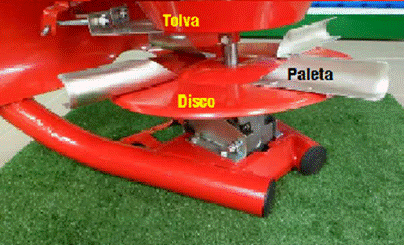
FIGURE 1
Centrifugal spreader of mineral fertilizers.
In this sense, the modeling of the movement of fertilizer particles on the spreader disc has been object of study at different times by different authors (Turbin et al., 1967; Villette et al., 2005; Cerović et al.,2018), to determine the interrelation between the parameters involved in this process, such as: the diameter and angular velocity of the spreading disk, the position of the blades and the place of fall or feeding of the fertilizer on the disk, among others. The operation of a centrifugal fertilizer spreader has three phases or stages. In the first, the fertilizer is dropped by gravity from a mouth or gate located at the bottom of the hopper towards an area near the center of the disk (Figure 1). During the second stage, the material to be distributed is transported towards the edge of the disk, under the action of a system of forces, led by the centrifugal force and subjected to the action of friction forces with the surfaces of the disk itself and the paddles. In the third phase, the material is launched into the field, its trajectory being determined by a ballistic flight under the action of the density and speed of the surrounding air.
It is obvious that an adequate prediction and control of the movement of the particles in the second phase, starting from an adequate definition of the fertilizer drop point from the hopper gate, will allow adjusting both the outlet speed and the dispersion angle in the field of scattered particles. The modeling of the second phase has been approached by different authors. Villette et al. (2005) develop an analytical model to describe the movement of particles on a concave disk equipped with flat blades. The model allows establishing the relationship between the horizontal radial and tangential components of the output velocity, although it is not directly applicable to flat discs. Cerović et al. (2018) analyze the movement of an ideal, spherical and homogeneous fertilizer particle along a straight blade fixed to a rotating flat disc used in centrifugal mineral fertilizer spreaders. The analysis is carried out on a non-inertial reference system, applying the laws of classical mechanics. As a result, they propose a system of homogeneous ordinary differential equations of second order, the solution of which represents an approximation to the real relative motion of a fertilizer particle along a straight blade fixed radially to the disk rotating at constant angular velocity. The model is useful for the optimization of the parameters of this type of fertilizer distributor, although it is not applicable exactly in the case of pallets with an inclined disposition in relation to the radial direction. For this analysis Cerović et al. (2018), build on earlier studies by Aphale et al. (2003); Dintwa et al. (2004); Villette et al. (2005), although studies in this regard carried out in the 20th century reached a high level of development, such as those carried out by Mennel and Reece (1962); Turbin et al. (1967); Griffis et al. (1983); Olieslagers et al. (1996) . The latter enables the calculation of the movement of the particles when the disk is provided with inclined blades in relation to the radial direction, having served as the basis for the realization of the model and software that are exposed in this work, being completed until the determination of the fan of dispersion of the fertilizer particles at the outlet of the spreading disk. The third phase corresponding to the flight of the particle once it is propelled by the disk, has been approached by different authors like Walker et al. (1997); Van Liedekerke et al. (2009) and Cool et al. (2014, 2016), not constituting the object of study in this work, whose objective is to present a mathematical mechanical model that describes the dynamics of the movement of particles on a fertilizer distributor disk with inclined blades, as well as a software that, based on the application of the model, makes it possible to calculate the geometric and kinematic parameters that determine the output speed and the dispersion angle of the fertilizer at the outlet of the disks.
MATERIALS AND METHODS
The model presented is developed to determine the characteristic of the movement of the fertilizer particles on the spreading disk and in contact with the blades, which will allow determining the magnitude and direction of the speed with which they leave the disc depending on its geometric and kinematic parameters. For the elaboration of the model, the flat disk is considered, although conical disks are also used. As for the blades, they can be oriented in the radial direction, as well as with an inclination contrary to the rotation of the disk (rearward blades) and with an inclination in favor of the rotation of the disk. The latter case was selected for the elaboration of the model, as it is considered the most efficient in achieving a higher speed of particles launch with the same rotation speed of the disk. The analysis was carried out by obtaining the differential equation of the dynamics of the motion of a particle by applying the laws of classical mechanics (Newton´s Second Law). The analysis was carried out on a non-inertial reference system that rotates together with the disk, so it was necessary to take into account the “fictitious” forces (centrifugal force and Coriolis force) that act on the particle in this mobile system. The solution of the differential equation of motion was carried out by classical methods of mathematical analysis. The equations obtained from the solution of the differential equation of motion were programmed using the Mathcad software, version 2000 Professional, which made it possible to evaluate the model with specific data and obtain the output speed and angle of the fertilizer based on parameters of input such as: : inclination angle of blades, coefficient of friction between the fertilizer and the disk and blades material, dimensions and rotation speed of the disk and coordinates of the zone of the fertilizer fall from the mouth of the hopper.
DEVELOPMENT
In Figure 2, the forces acting on a fertilizer particle in its interaction with the disk and bladeof the centrifugal distributor are shown.
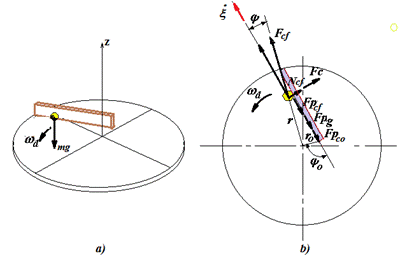
FIGURE 2
Forces acting on a particle in the centrifugal blade disk spreader.
As it can be seen in the figure, the following forces act on the particle: mg - Weight of the particle, acting perpendicular to the surface of the disk (Figure 5.6a), equal to the product of the particle mass (m) by the acceleration of gravity (g);
Fcf - Centrifugal force, which is directed in the direction and sense of the radius-vector r ⃗ that locates the radial position of the particle with respect to the center of the disk. This force is expressed as:
Being its magnitude:
Fco - Coriolis force, given by:
being its direction perpendicular to the vectors (relative velocity of the particle with respect to the blade) and (angular velocity of the disk), its direction is opposite to the rotation speed of the disk, while its magnitude is given by:
Fpcf - Friction force between the blade and the particle product of the centrifugal force:
where is the coefficient of friction due to friction between the particle and the material of the blade; ψ is the angle between the direction of the centrifugal force and the direction of relative motion of the particle with respect to the blade; Fpco - Friction force between the blade and the particle product of the Coriolis force:
Fpg - Friction force between disk and particle:
In general, the material of the disk is the same as the blades, in which case the coefficient of friction between the disc and the particle =. Stating the Newton's Second Law in the non-inertial system the differential equation of the motion of the particle in the direction of the blade is obtained:
From Figure 2 b) it can be seen that:
where: ξ - path traveled by the particle along the blade, measured from the beginning of the blade;
ro - initial radius vector, directed from the center of the disk to the beginning of the blade;
ψo - initial value of the angle ψ between the radio vector and the blade. It is also possible to state that:
On the other hand, the friction coefficient μf can be expressed indistinctly as friction angle ϕf through the relation:
Substituting 9, 10 and 11 in 8 and carrying out some transformations, the following expression is obtained for the differential equation of the relative motion of the particle on the disk:
which is an ordinary linear and non-homogeneous 2nd order differential equation with constant coefficients, whose general solution can be determined as the sum of the solution of the homogeneous equation and the particular solution of the non-homogeneous equation.
The homogeneous part of this equation is expressed as:
having the general solution of the form:
where C1 and C2 are the integration constants, while λ1 and λ2 are the roots of the characteristic equation:
A particular solution for the non-homogeneous Equation 12 can be determined by applying the indeterminate constant method:
Differentiating 19 and substituting in Equation 12, the following particular solution of the non-homogeneous differential equation is obtained:
Substituting 15 and 20 into 13, the solution of the differential equation 12 takes the following form:
Finally, Equation 5.25 is evaluated for the initial conditions, corresponding to the starting position of the blades, where for t = 0; ξ = 0 and the velocity of the particles dξ/dt = 0. In this way, the solution of the differential equation of the motion of the particle is finally obtained:
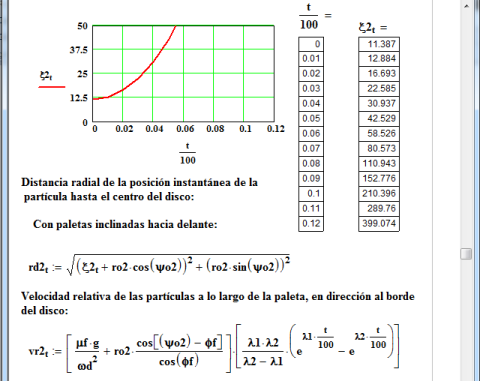
A graph of this expression, evaluated for certain conditions, is shown in Figure 5.7, showing that the residence time of the particles on the disk is of the order of hundredths of a second.
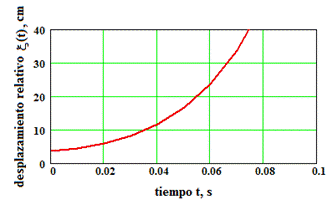
FIGURE 3
Variation as a function of time of the relative displacement of the particles along a disk with advanced blades rotating at 800 r.p.m
Deriving expression 22 with respect to time, the relative velocity of the particles along the distributor blades is obtained:
The magnitude of the radio vector that joins the center of the disk with the instantaneous position of the particles is determined as follows:
Substituting expression 22 for ξ = f(t) in expression 24 and evaluating for the maximum magnitude of the radio vector re (outer radius of the disk), it is possible to obtain the residence time (tp) of the particles in the disk, since it is fed (position ro, ψo) until it reaches the outer edge of the disk (position re, ψe). In that time, the disk will have rotated an angle and also the particle will have traveled an angle in its relative motion: in such a way that the outlet angle of the particles will be given by:
By evaluating these expressions for the feeding points 1 and 2 (Figure 4) that form a strip bf at the beginning of the blade , it is possible to obtain the angles (θs1 and θs2) that define the fertilizer outlet points at the edge of the disk , the outlet angle being delimited by the vectors that correspond to the absolute fertilizer outlet velocities, which are determined by the vector sum of the drag velocity (tangent to the outer edge of the disk) and the relative velocity of the particles, whose direction is collinear with the direction of the blades.
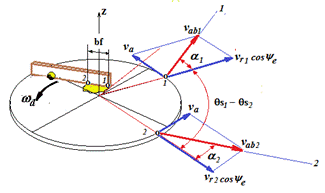
FIGURE 4
Fertilizer outlet conditions in the centrifugal disk.
The modulus of the ground speed is determined by the expression:
The drag speed while the relative speed is determined by expression 23. The fertilizer dispersion angle (θs), will be limited by the directions of and (Figure 4), being determined by the expression:
where:
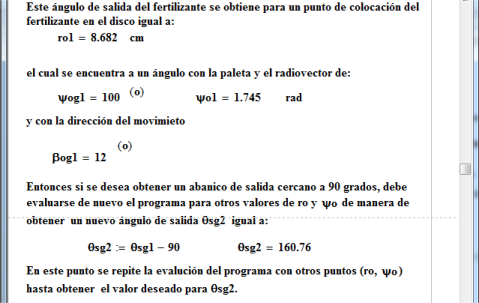
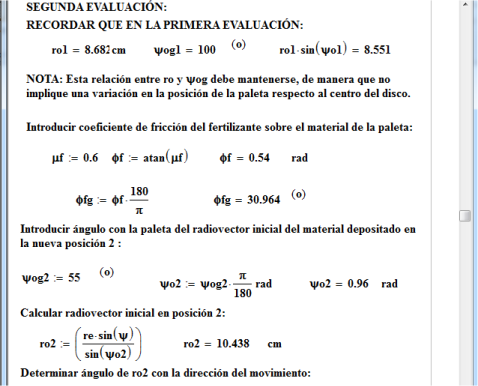
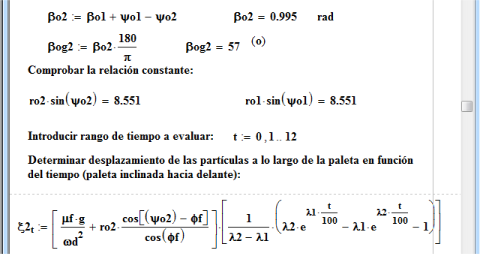
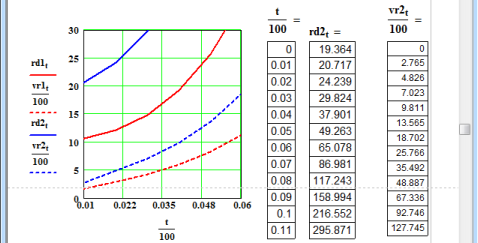
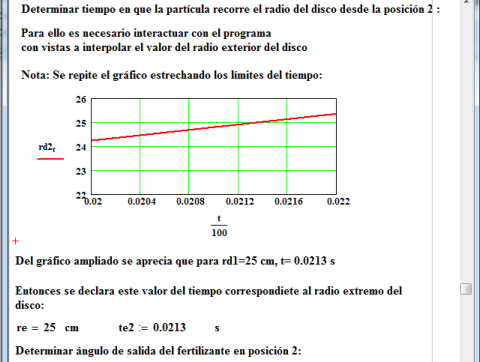
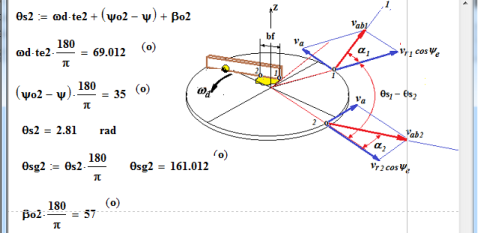
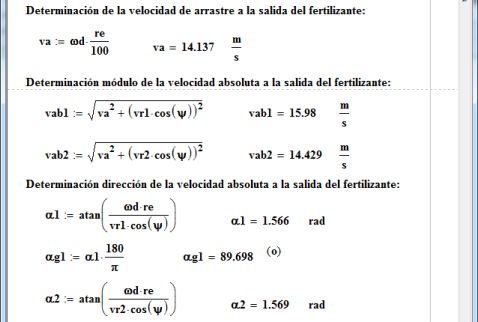
The programming in Mathcad of the equations obtained is shown through an exercise that is exposed below, showing the screenshots of the run of the program that has been called "CENTRIFERT”:
Demonstration Exercise
Determine the zone (bf) for placing the fertilizer on a centrifugal disk with advanced blades, in order to obtain a dispersion angle of 90o ± 2o in the opposite direction to the advance of the machine. The following data are known:
-
Disk rotation speed: nd = 540 r.p.m.;
-
External radius of the disk: re = 25 cm;
-
Angle of the blade with the final radius-vector: ψe = 20o;
-
Coefficient of friction of the fertilizer on the disk and the blade's material: mf = 0.6
Solution of the Exercise using the Program "CENTRIFERT"
-
Coefficient of friction of the fertilizer on the paddle and disc material: µf = 0.6 Exercise solution using the "CENTRIFERT" program: the "CENTRIFERT" program:
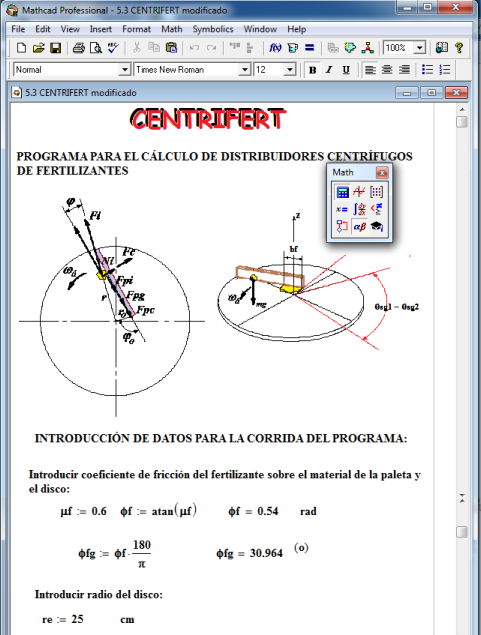
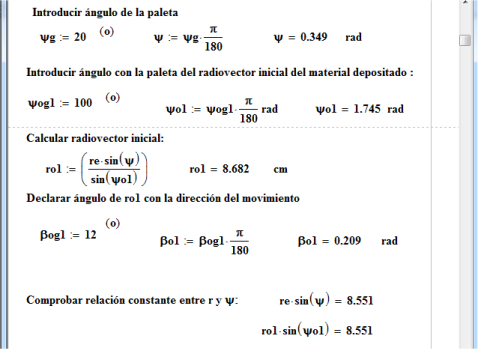
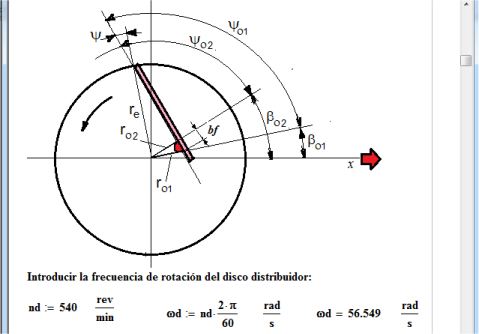
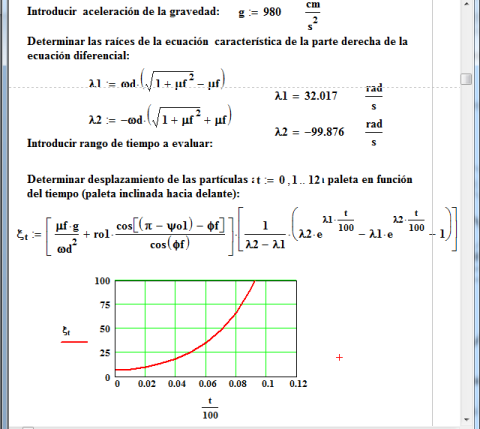
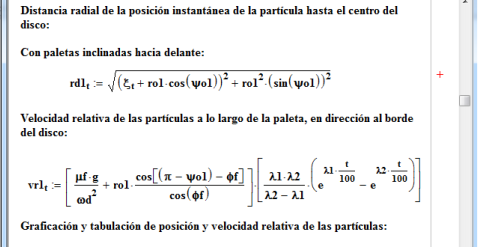
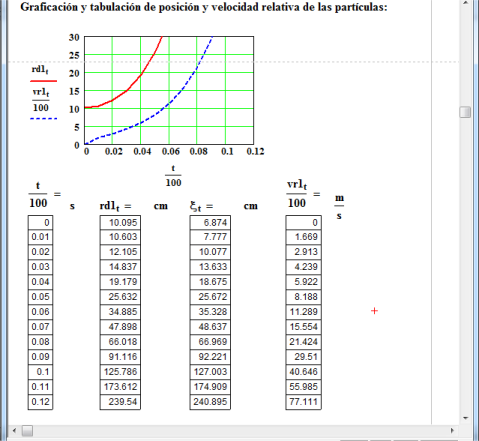
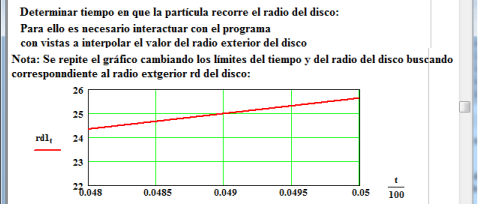
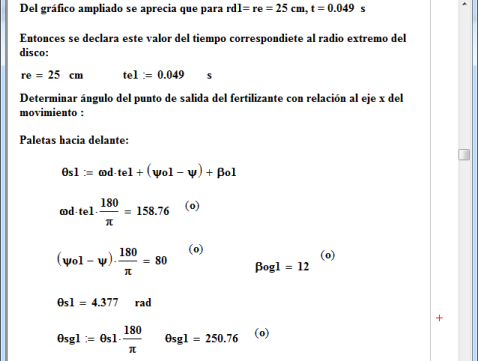

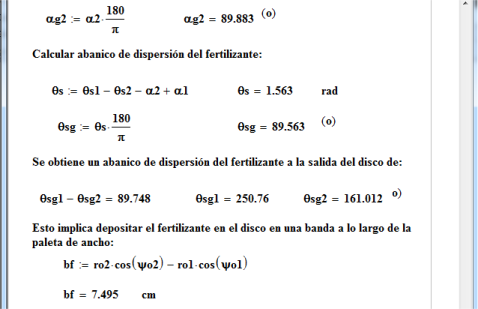
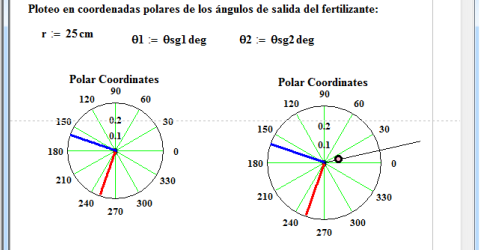
COMMENT ON THE PROGRAM RUN
As it can be seen from the program run, the angles corresponding to the fertilizer outlet points in extreme positions 1 and 2 corresponding to the fertilizer positioning band bf = 7.945 cm are obtained in graphical form (graphs in polar coordinates). Now, as explained, the fertilizer application or launch band (shaded area in Figure 5) will be framed by the directions of the absolute velocities (Vab1 and Vab2), which have been determined on the basis of the values of the relative speeds (Vr1 and Vr2) and the drag speed Va. In Figure 5, the angle βo1 has been retracted 90o approximately, to achieve that the fertilizer launching fan is located in the opposite direction to that of the movement of the machine.
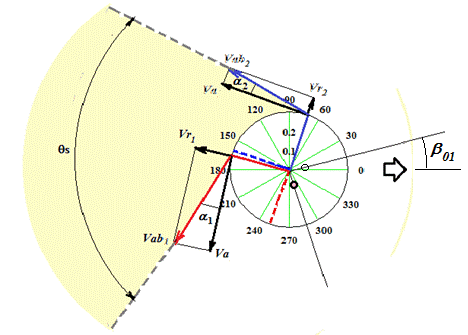
FIGURE 5
Construction of the fertilizer release finger
CONCLUSIONS
-
An analytical model was obtained that describes the movement of particles on a spreader disk for fertilizers of the centrifugal type with straight blades inclined in relation to the radial direction.
-
As a result of programming the model in Mathcad, the calculation of the fertilizer output parameters (output speed and dispersion angle) was possible based on input parameters such as: the angle of inclination of the blades, the coefficient of friction between the fertilizer and the material of the disc and the blades, the dimensions and speed of rotation of the disk and the coordinates of the area where the fertilizer falls from the hopper mouth.
-
As a result of the execution of a demonstrating exercise, applying the program "CENTRIFERT", a dispersion angle of the particles θs ≈ 90° was obtained. The width of the fertilizer feeding band on the disk was bf≈7.5 cm.
REFERENCES
APHALE, A.; BOLANDER, N.; PARK, J.; SHAW, L.; SVEC, J.; WASSGREN, C.: “Granular fertilizer particle dynamics on and off a spinner spreader”, Biosystem Engineering, 85: 319-329, 2003, ISSN: 1537-5110, e-ISSN: 1537-5129.
CEROVIĆ, V.B.; DRAGAN, V.P.; RADE, L.R.; SAŠA, R.B.; VUKOVIĆ, A.: “On the Fertilizer Particle Motion Along the Vane of a Centrifugal Spreader Disc Assuming Pure Sliding of the Particle”, Journal of Agricultural Sciences, 63(1): 83-97, 2018, ISSN: 0021-8596, DOI: https://dx.doi.org/10.2298/JAS1801083C. UDC: 631.33.022.
COOL, R.S.; PIETERS, G.J.; ACKER, V.J.; VAN DEN, B.J.; MERTENS, C.K.; NUYTTENS, R.E.D.; VAN DE GUCHT, C.T.; VANGEYTE, J.: “Determining the effect of wind on the ballistic flight of fertilizer particles”, Biosystems Engineering, 151: 425-434, 2016, ISSN: 1537-5110, e-ISSN: 1537-5129.
COOL, R.S.; PIETERS, J.; MERTENS, C.K.; HIJAZI, B.; VANGEYTE, J.: “A simulation of the influence of spinning on the Ballistic flight of spherical fertilizer grains”, Computers and Electronics in Agriculture, 105: 121-131, 2014, ISSN: 0168-1699.
DINTWA, E.; TIJSKENS, E.; OLIESLAGERS, R.; DE BAERDEMAEKER, J.; RAMON, H.: “Calibration of a spinning disc spreader simulation model for accurate site specific fertilizer application”, Biosystem Engineering, 88: 49-62, 2004, ISSN: 1537-5110, e-ISSN: 1537-5129.
GRIFFIS, C.L.; RITTER, D.W.; MATTHEWS, E.J.: “Simulation of rotary spreader distribution patterns”, Transactions of the ASAE, 26(1): 33-37, 1983, ISSN: 2151-0032.
MENNEL, F.I.; REECE, A.R.: “The theory of the centrifugal distributor: II. Motion on the disc, off-center feed”, Journal of Agricultural Engineering Reearch, 7(4): 345-353, 1962.
OLIESLAGERS, R.; RAMON, H.; DE BAERDEMAEKER, J.: “Calculation of fertilizer distribution patterns from a spinning discspreader by means of a simulation model”, . Journal of Agricultural Engineering Reearch, 63: 137-152., 1996.
TURBIN, B.G.; LURIÉ, A.B.; GRIGORIEV, C.M.; IVANOVICH, Z.M.; MELNIKOV, C.B.: Máquinas Agrícolas. Teoría y Cálculo Tecnológico, Ed. Machinostroienie, En idioma ruso ed., Leningrado, Rusia, 1967.
VAN LIEDEKERKE, P.; THIJSKENS, E.; DINTWA, E.; RIOUAL, F.; VANGEYTE, J.; RAMON, H.: “DEM simulations of the particle flow on a centrifugal fertilizer spreader”, Powder Technology, 190: 346-360, 2009, ISSN: 0032-5910.
VILLETTE, S.; COINTAULT, F.; PIRON, E.; CHOPINET, B.: “Centrifugal Spreading, an Analytical Model for the Motion of Fertiliser Particles on a Spinning Disc”, Biosystem Engineering, 92(2): 157-165, 2005, ISSN: 1537-5110, e-ISSN: 1537-5129.
WALKER, J.T.; GRIFT, T.E.; HOFSTEE, J.W.: “Determining effects of fertiliser particle shape on aerodynamic properties”, Transactions of the ASAE, 40: 21-27, 1997, ISSN: 2151-0032.
Notes
Author notes
*Author for correspondence: Arturo Martínez-Rodríguez, e-mail: armaro466@gmail.com