ORIGINAL ARTICLE
Received: 15 September 2020
Accepted: 01 March 2021
ABSTRACT: The present work has the objective to applied programming model linear to optimize the transport process, for increase the organic eggs commercialization in the AVIORGANIC farm. Using economic and mathematics methods through linear programming and analysis of the questionnaires by FODA matrix. The results show that is necessary transporting 240 eggs per week and increase at least one client to optimize transportation costs, representing a decrease in the order of 24,9 USD. Proposing a strategic to allow eggs organic sales incentive.
Keywords: Linear Programming, FODA Matrix, Transportation.
Resumen: El presente estudio tiene como objetivo aplicar un modelo de programación lineal que optimice el proceso de transporte, para incrementar la comercialización de huevos orgánicos en la finca AVIORGANIC. Se aplican métodos económicos matemáticos empleando la programación lineal y el análisis de los cuestionarios a través de la matriz FODA. Los resultados muestran que para optimizar los costos de transportación se deben transportar 240 huevos semanales y aumentar en al menos un cliente la comercialización, lo que representa una disminución del orden de los 24,9 USD. Se propone una estrategia que permite incentivar la venta de huevo orgánico.
Palabras clave: programación lineal, matriz FODA, transportación.
INTRODUCTION
According to Hernández (2009), commercialization is a discipline, with a recent scientific development, characterized by multiple attempts to define and determine its nature and scope. Four components are involved in the marketing decision: when (time), where (geographic location), to (markets, goal) and (marketing strategy). Due to the economic situation that Ecuador faces, it is necessary for producers to undertake agribusiness to achieve a better quality of life, facing obstacles in the production and marketing process.
Among the alternatives is the production of eggs, a basic ingredient in food. It has a high content of nutrients such as proteins, vitamins, minerals and essential amino acids, which are those that our body does not have a factory on its own and therefore must be provided in the diet (Instituto de Estudios del Huevo -IEH-, 2009).
For the production of organic eggs, the provisions of the organic and conventional poultry manuals must be taken into account (Mercur, 201d. C.; Clara et al., 2015; Fundación Origen, 2016). Among the most important aspects are the adequacy of the facilities, the handling, the diet and the breed. According to CONAVE (2019), during the year 3,904 million eggs were produced in Ecuador, which means that 10.7 million average, are produced per day. On average, an Ecuadorian consumes 226 eggs per year, equivalent to 0.62 eggs per day.
The production and commercialization has evolved in such a way that the efficiency in the productive results has increased the competitiveness, being nowadays a crucial factor for the survival of the producers. The difference will be marked among the companies that analyze each link in the value chain, optimizing their processes and maximizing the use of resources.
At present, mathematical programming is widely used in the poultry industry, seeking to improve production techniques in different areas and trying to find new ways to solve problems. Winston & Goldberg (2005) mentions that linear programming (PL) is a tool to solve optimization problems.
López et al. (2017), citing Arsham (2002), suggest that optimization is used to find the answer that provides the best result, among which profit, production value, among others, stands out; therefore, its use can be worked in different variants, associated with the optimization of different indicators of the company's management, such as production costs, transportation and the use of productive capacity. Other applications, at the discretion of Gazmuri y Arrate (1995), maximize the benefit in consideration of the endowment of labor as a determining factor of the production capacity, a known demand is also assumed for each period and product. Other researchers, including Gomes et al. (2006), also refer to different economic indicators to optimize and propose the application of the model with multiple criteria.
For all these, this research is carried out in La Libertad Parish, Las Lajas Canton, El Oro Municipality. As a strategy to contribute to the improvement of the economic level of organic egg producers, aiming to apply a programming model that optimizes the transport process, to increase the commercialization of organic eggs in the unit under study.
MATERIALS AND METHODS
Study area and sampling Characterization
The work was carried out in La Libertad Parish, belonging to the Las Lajas canton, in the El Oro province, Ecuador. Its population is 802 inhabitants, (INEC-Ecuador, 2020).
AVIORGANIC is a family production farm that has a total area of 2 ha, dedicated to 1 ha poultry production. Using free grazing organic production (corn, onion, garlic, chilli, carrot, raw rice, pumpkin, tomato), with a contribution of 110gr distributed in three daily servings. There are a total of 300 hens, of the Araucana breed, which are located in a backyard, with manually filled plastic feeders and troughs. Weekly egg production amounts to 420 eggs. The production cost of one egg pail (30 units) is $ 3.90, with a unit selling price of 0.25 ct.
The owner of the farm has technical experience in raising and handling birds. Establishing defined goals with future perspectives to business expansion, maintaining environmentally friendly products. production line.
To determine the number of samples to be used in the surveys of current and potential clients, they are considered the references reported by Yirat et al. (2009; Monzón et al. (2019), through the expression 1, by means of the statistical program STATGRAPHICS Plus 5.1.
Where:
nsize of the sample;t2Student approach;σ2quadratic half deviation;Δ2prospective error for the stocking with a significance level.Empirical method used:
-
Interview with key informants: important referents in the egg production and commercialization process in the unit under study were interviewed.
Current and potential clients in the egg production and marketing process in the area under study were surveyed.
Qualitative method used:
The SWOT analysis was carried out according to the methodology set out by Thompson et al. (1998). Consisted of the application of two questionnaires to current and potential clients, with the results obtained the SWOT matrix is elaborated.
Mathematical method used
Linear programming has been used by other authors in the optimization of different processes such as Montero (2011); Ortega (2017); Quintero et al. (2020). The research in question uses a linear programming model as an optimization method to increase commercialization of organic eggs, focusing on one of the most important links, transportation. It consists of determining the quantities of organic eggs that must be transported from the production area to the different destinations, minimizing the total cost of transportation and that the demands of each destination are satisfied and the offers of the origin are fulfilled.
For the resolution of the model, the computer package called "System for quantitative analysis of businesses on the Windows environment" (WinQSB) version 2.0 was used.
Elements and components of the Linear Programming (PL) model
Xj- Decision variables
Z = C1X1 + C2X2 +… + CiXi- the objective function that expresses the optimization criterion that will be used in the problem (which can be maximize or minimize).
where: Cj is the economic coefficient.
Ai1Xi1 + Ai2Xi2 +… + .AijXij {≤ = ≥} bi the system of linear constraints or limitations, i = 1,…., m. (They represent limitations that oppose the objective to be achieved).
where: Aij norm of unit consumption of resource i for activity j and bi is the availability of resource type i.
Condition of non-negativity of the variables (CNN):
Quantification of the economic effect
-
Cost level calculation of the current transportation variant (Ncvta):
where: Xjva- Represents the value of egg units with the current transportation variant.
-
Calculation of the cost level of the optimal transportation variant (Ncvto).
As in this version the optimality criterion is to minimize transportation costs, the value is obtained directly from the output report of the WinQSB program package and is the value of the objective function. Being able to determine the significant economic effect (EEc):
RESULTS AND DISCUSSION
Table 1 shows the results obtained from the elaboration of the SWOT matrix, after analyzing the surveys of potential clients (13) and current clients (12); establishing development strategies for the AVIORGANIC farm.
SWOT matrix obtained for the AVIORGANIC farm
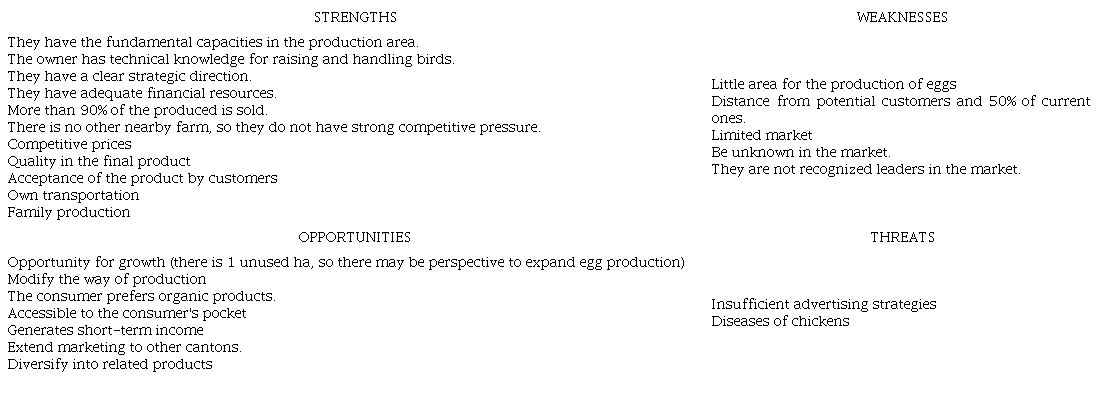
Development strategies for the AVIORGANIC farm
- 1. Encourage the sale of organic eggs, even though there is knowledge of the product;
- 2. Promote an advertising campaign incorporating local shops and markets;
- 3. Disseminate in the population of the municipality what an organic egg is and what benefits they can obtain for their health;
- 4. Promote advertising strategies, through the preparation of posters, flyers, slogans, image and brand of the farm, so that it can be recognized by potential customers, and in this way increase the sale of organic eggs.
Formulation of the linear programming model to be used to achieve the optimization of the commercialization of eggs through transportation
For the formulation of the model, it is taken into account that the farm has 9 current clients, with two destinations, distributed in a local market and 8 families, deliveries are once a week. The commercialization is direct and the transportation is carried out in a private truck that consumes a gallon of gasoline at a cost of 1.25 USD per 30 km.
The market is located at a distance of 60 km from the farm and demands a total of five buckets of eggs per week for a total of 150 eggs.
The family nuclei are located 10 km from the entity in the same settlement and require a bucket of 30 eggs per nucleus, for a total of 240 eggs per week.
So they are declared as decision variables:
-
X1: units of eggs to be transported from AVIORGANIC to the local market.
-
X2: units of eggs to be transported from AVIORGANIC to the settlement.
Objective function:
Origin restriction:
X1 + X2 = 420 week eggs
Destination restriction:
X1≥150 eggs
X2≥240 eggs
CNN
XJ≥0 j = 1, 2
Results obtained for the model with the use of the WinQSB software package
Once the data had been entered in the WinQSB package and the essential variables of the integer type were considered, the outputs were obtained in the report (Figure 1). The problem being addressed requires by its nature the mathematical treatment of a linear programming problem in integers, since it does not make sense for this case to obtain fractional values.
As can be seen, the solution is non-degenerate, the two essential variables were basic, so for the optimization of costs 150 eggs must be transported to the local market and 270 eggs to the family nuclei of the settlement at a cost of 450.9 USD (Figure 1).
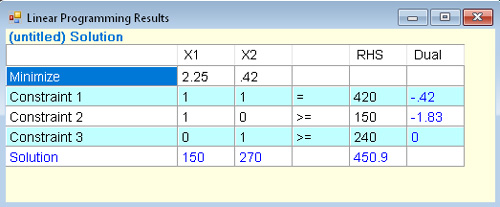
FIGURE 1
Results of the linear programming model for transport.
It is proposed, according to what is obtained in the model, that in the settlement it is necessary to increase the sale of eggs in a bucket to optimize the commercialization based on the cost of transportation. Recommending to attract at least one more client.
If the production of 420 eggs per week is not achieved in AVIORGANIC, there will be a loss of 0.42 USD and if the 150 eggs transported to the local market are not sold, the loss would be 1.83 USD.
Several authors such as Yesin & Sevostyanov (2014); Lopez et al. (2015) and Rodríguez et al. (2015), have worked on transport optimization in different spheres with satisfactory results.
Economic effect quantification
Table 2 shows that the optimal variant reports a significant economic effect, which represents a decrease of the order of 24.9 USD, with respect to the cost level of the current transportation variant. Similar results obtained López et al. (2017) in terms of the economic effect on the cost of production of a company.
Summary of the economic effect

CONCLUSIONS
-
The development strategies for the AVIORGANIC farm should focus on encouraging the sale of organic eggs, through an advertising campaign incorporating local stores and markets.
-
To optimize transportation costs, 150 eggs should be transported to the local market and 270 eggs to the family nuclei of the settlement at a cost of 450.9 USD.
-
The good variant, reports a significant economic effect that represents a decrease of the order of the 24.9 USD, with regard to the level of cost of the variant of current transportation.
REFERENCES
ARSHAM, H.: Modelos deterministas: Optimización lineal, [en línea], Ubalt, 2002, Disponible en:http://home.ubalt.edu/ntsbarsh/business-stat/opre/SpanishD.htm., [Consulta: 7 de septiembre de 2020].
CLARA, I.N.; ALTIERI, M.A.; VÁZQUEZ, L.L.: Agroecología: principios para la conversión agroecológica y el rediseño de sistemas agrícolas, Ed. Sociedad Científica Latinoamericana de Agroecología, Ecuador, 61-72 p., 2015.
CONAVE: Consumo per cápita de huevo al año kg/persona/año, Corporación Nacional de Avicultores del Ecuador, Quito, Ecuador, 2019.
FUNDACIÓN ORIGEN: Manual avícola, [en línea], Ed. Escuela Agroecológica de Pirque, Pirque, Santiago de Chile, Chile, 2016, Disponible en:http://fundacionorigen.cl/manuales/ManualAvicola.pdf, [Consulta: 7 de septiembre de 2020].
GAZMURI, P.J.; ARRATE, I.: “Modeling and visualization for a production planning decision support system”, International Transactions in Operational Research, 2(3): 249-258, 1995, ISSN: 0969-6016, e-ISSN: 1465-3995.
GOMES, C.; FIGUEIRA, J.; LISBOA, J.; BARMAN, S.: “An interactive decision support system for an aggregate production planning model based on multiple criteria mixed integer linear programming””, Omega, The International Journal of Management Science, 34(2): 167-177, 2006, ISSN: 0305-0483.
HERNÁNDEZ, G.Á.R.: Planeación de mercadotecnia en las empresas cubanas, Ed. Ediciones Logos, La Habana, Cuba, 2009, ISBN: 978-959-7159-13-1.
INEC-ECUADOR: Instituto Nacional de Estadística de Ecuador (INEC), [en línea], Instituto Nacional de Estadística de Ecuador (INEC, INEC-Ecuador, 2020, Disponible en:www.ecuadorencifras.com/www.inec.gov.ec, [Consulta: 5 de septiembre de 2020].
INSTITUTO DE ESTUDIOS DEL HUEVO -IEH-: El Gran Libro del Huevo, Ed. Editorial Everest, S.A, España., 173 p., 2009.
LÓPEZ, C.G.A.; CASTRO, P.N.A.; GUERRA, O.: “Optimización del plan de producción: estudio de caso carpintería de aluminio”, Revista Universidad y Sociedad, 9(1): 178-186, 2017, ISSN: 2218-3620.
LOPEZ, Y.R.; MESA, Y.M.; GUERRA, D.M.S.; BAO, O.M.: “Modelación matemática del complejo cosecha-transporte de la caña de azúcar para su racionalización”, Revista Ciencias Técnicas Agropecuarias, 24: 42-48, 2015, ISSN: 1010-2760.
MERCUR, P.: Manual de Avicultura, Ed. Ministerio de Agroindustria, Buenos Aires, Argentina, 201d. C.
MONTERO, W.E.: Optimización de la Cadena de Producción de Pollo utilizando Programación Matemática, [en línea], Universidad de Guayaquil, Tesis en opción al título de magister en control de operaciones y gestión logística, Guayaquil, Ecuador, 2011, Disponible en:https://pdfs.semanticscholar.org/d861/b940c5e2645f5897f92fe42d8776c1de413e.pdf, [Consulta: 9 de septiembre de 2020].
MONZÓN, M.L.L.; GARCÍA, P.A.; PLATA, C.A.; MARTÍNEZ, R.A.; RANGEL, M. de O.L.; HERNÁNDEZ, G.A.A.: “Simulación de la Respuesta al impacto de la guayaba mediante el Método de Elementos Finitos”, Revista Ciencias Técnicas Agropecuarias, 28(4): 5-18, 2019, ISSN: 1010-2760, e-ISSN: 2071-0054.
ORTEGA, M.R.F.: Las restricciones de recursos utilizados en el proceso productivo para lograr la optimización operativa de una empresa Avícola Cajamarquina, año 2017, Tesis en opción al grado de maestro en Ciencias en: Dirección de Operaciones y Cadena de Abastecimiento, Perú, 2017.
QUINTERO, L.M.; TORRES, A.A.; PÉREZ, H.B.; ZALDÍVAR, M.Á.; VIZCAY, V.D.: “Optimización de la producción de recursos para el aprendizaje electrónico a través de herramientas matemáticas”, Revista Ingeniería Agrícola, 10(3): 55-61, 2020, ISSN: 2306-1545, e-ISSN: 2227-8761.
RODRÍGUEZ, L.Y.; MOREJÓN, M.Y.; SOSA, G.D.; MARTÍNEZ, B.O.: “Modelación matemática del complejo cosecha-transporte de la caña de azúcar para su racionalización”, Revista de Ciencias Técnicas Agropecuarias, 24(Esp.): 42-48, 2015, ISSN: 1010-2760, e-ISSN: 2071-0054.
THOMPSON, A.A.; STRICKLAND, A.J.; COLADO, I.P.; CARREÓN, S.M.A. : Dirección y administración estratégicas: conceptos, casos y lecturas, Ed. Mac Graw-Hill Interamericana, México, DF, 1998, ISBN: 970-10-1693-9.
WINSTON, W.L.; GOLDBERG, J.B.: Investigación de operaciones: aplicaciones y algoritmos, Ed. Thomson, vol. 4, 2005.
YESIN, K.S.; SEVOSTYANOV, A.L.: “Logistics of Grain Transportation: Program Exploitation for Calculation of Optimum Number of Vehicles.”, Bulletin of PNU, 32(1), 2014, ISSN: 1996-3440, Disponible en:http://pnu.edu.ru/ media/vestnik/articles-2014/117-124.
YIRAT, B.M.; GARCÍA, P.A.; HERNÁNDEZ, G.A.A.; CALDERÍN, G.A.; CAMACHO, N.A.: “Evaluación de la calidad de la guayaba, variedad enana roja EEA-1-23, durante el almacenamiento a temperatura ambiente”, Revista Ciencias Técnicas Agropecuarias, 18(2): 70-73, 2009.
Notes
Author notes
*Author for correspondence: Segress García Hevia, e-mail: segressgirl@gmail.com
Conflict of interest declaration
