ORIGINAL ARTICLE
Effect of Three Tillage Systems on Soil and Crop Properties
>Efecto de tres sistemas de labranza sobre propiedades del suelo y cultivo
 Jhonatan Rodríguez-Parra Alfaro
Héctor Medina-Dávila
Guido Sarmiento-Sarmiento
Jhonatan Rodríguez-Parra Alfaro
Héctor Medina-Dávila
Guido Sarmiento-Sarmiento
Effect of Three Tillage Systems on Soil and Crop Properties
Revista Ciencias Técnicas Agropecuarias, vol. 30, no. 3, e08, 2021
Universidad Agraria de La Habana
Received: 10 January 2020
Accepted: 18 June 2021
ABSTRACT: Knowing the effect of various tillage systems on the properties of the soil allows optimizing agronomic management. For this reason, the effect of 3 tillage systems on 3 properties of a sandy loam soil was investigated during 4 agricultural campaigns in Majes irrigation area, Arequipa, Peru. The treatments were horizontal tillage (LH): disc plow, disc harrow and tine harrow; Vertical Tillage (LV): chisel plow, disc harrow and tine harrow, and no tillage (NL). Volumetric soil water content (percentage), soil temperature (°C), water stress measured on the leaf (percentage) and crop yield (t∙ha-1) in a sandy loam soil were evaluated. The results show that for volumetric content of soil water (percentage) the treatments of NL (19.73%) and LV (17.16%) were statistically superior to the treatment of LH (13.80%), for water stress measured on the leaf, the treatment of NL (16.52%) was superior compared to the treatments of LV (18.92%) and LH (20.57%), which were statistically similar. The soil temperature values in ºC, measured in the 20 cm stratum and the crop yield in t∙ha-1 did not show significant differences between the tillage system treatments. It is concluded that the use of No Tillage is recommended in sandy textured soils.
Keywords: Sandy, Temperature, Stress, Humidity.
RESUMEN: El conocimiento del efecto de diversos sistemas de labranza, sobre las propiedades del suelo, permite optimizar el manejo agronómico. Por ello, se investigó en el efecto de tres sistemas de labranza, sobre tres propiedades de un suelo franco arenoso, durante cuatro campañas agrícolas en la irrigación Majes, Arequipa, Perú. Los tratamientos fueron Labranza horizontal (LH): arado de discos, grada y rastra; Labranza Vertical (LV): arado de cinceles, grada y rastra, y no labranza (NL). Se evaluó contenido volumétrico de agua del suelo (porcentaje), temperatura del suelo (°C), estrés hídrico medido en la hoja (porcentaje) y rendimiento del cultivo (t∙ha-1) en un suelo franco arenoso. Los resultados muestran que para contenido volumétrico de agua del suelo (porcentaje) los tratamientos de NL (19,73%) y LV (17,16%) fueron superiores estadísticamente al tratamiento de LH (13,80%), para el estrés hídrico medido en la hoja el tratamiento de NL (16,52%) fue superior en comparación a los tratamientos de LV (18,92%) y LH (20,57%) que fueron similares estadísticamente. Los valores temperatura en ºC medido en estrato a 20 cm y rendimiento del cultivo en t∙ha-1, no mostraron diferencias significativas entre los tratamientos de sistemas de labranza. Se concluye que es recomendable el empleo de No Labranza en suelos de textura arenosa.
Palabras clave: arenoso, temperatura, estrés, humedad.
INTRODUCTION
Soil degradation affects 33% of agricultural soils worldwide (FAO and ITPS, 2015). In 2006, the European Commission, concerned about the magnitude of the problem, identified a series of threats related to agriculture (erosion, compaction, loss of organic matter, pollution, salinization and acidification) that are favoring this process of soil degradation (Louwagie, 2011). Some of these threats such as erosion, infiltration, compaction and loss of organic matter are directly related to soil tillage practices (Jones et al., 2012).
Crop residues in conservation systems can minimize the potential loss of yield according to Pittelkow et al (2015) & Lundy et al. (2015); reduce the loss of moisture, by evaporation and runoff, improve the quality of the soil in accordance to Lopez et al. (2012); Palm et al. (2014), limit weed growth according to Nichols et al. (2015) and reduce erosion risks (Boulal et al., 2011).
The effect of tillage on soil moisture depends on the implement used, thus the chisel plow reduces water losses from the soil, compared to the disc harrow according to Olivet et al (2019); No Tillage further reduces the water loss of the ground compared with conventional tillage or vertical tillage according Molina et al. (2012), and the chisel plow increases infiltration in comparison to discking according to Herrera et al (2017). However, some authors report that there is no difference between tillage treatments on soil moisture (Bogužas et al, 2018).
In relation to soil aggregates, conservation tillage can significantly increase the content of stable macroaggregates in water, the Mean Weight Diameter (MWD ) and the Soil Organic Carbon content (Zheng et al, 2018 ) .
Soil bulk density is reduced and the pore space is increased, with minimal tillage or no tillage compared to conventional tillage, (García et al., 2018 ; Martínez et al ., 2018) .
MATERIAL AND METHODS
The research was carried out on the grounds of CIEPA-UNSA, Irrigation Majes Arequipa- Peru (16º19 'S, 72º13' W) during the 2017-2018 agricultural seasons. The soil was a sandy loam in texture, with 0.18% organic matter content.
A randomized complete block design (RCBD) was applied for three treatments with three repetitions for each one. The treatment factors evaluated were:
-
Horizontal Tillage (HT), disc plow, disc harrow and tine harrow
-
Vertical Tillage (VT), chisel plow, disc harrow and tine harrow
-
No Tillage (NT).
The experimental unit was 20 m long by 6 m wide, with an area of 120 m 2 .
The experimental plot had been under alfalfa from 1998 to the 2016 campaign. The crops grown in 2017 and 2018 were fodder corn and Green beans, in rotation.
The alfalfa was plowed and, on 24/7/ 2017, a cover crop (beans) was sown to have a layer of organic matter. When the cover crop developed, glyphosate was applied (1/10/2017). Tillage was carried out on 6/10/2017, using disc plow, disc harrow and tine harrow (HT), as well as chisel plow, disc harrow and tine harrow (VT), and glyphosate (NT).
The sowing of the first fodder corn campaign (10/8/2017), was carried out manually (0.75 m between rows and 0.20 between plants). The variety used was Opaco Mal Paso, with a density of 133,000 plants ha -1 . 120-60-40 kg ha -1 of NPK were applied through fertirrigation. Drip irrigation was applied in water volumes of 5 000 m 3 / campaign.
Soil temperature was measured in centigrade degrees, volumetric soil water content was measured in m 3 / m 3 (then it was taken to % ), both with a GS3 model FDR soil moisture sensor ( Decagon Devices brand , USA) installed at a depth of 20 cm and at a single point for each experimental unit. Readings were taken weekly. Water stress in the plant was measured in percentage with a leaf sensor (Leaf Sensor) that measures turgor (thickness of the leaf), connected to a multimeter with input voltage 2.0 V. It was used in a single plant for each experimental unit. Readings were taken once a week on the same leaf, and during all the development of the crop. Yield was measured in weight per unit area (t ha -1 ), for this, 05 random samples were taken for each experimental unit, starting from the center, and weighed to obtain the yield of the fresh culture.
With the exception of yield, all variables were measured in-situ. An analysis of variance, a Tukey test and a Levene's test of 95% confidence (α = 0.05) were performed on all variables, using the Real Statistics complement for excel.
The first crop of fodder corn was harvested on 12/27/2017. After that, green beans were sown manually on 01/30/2018, keeping 0,75 m between rows and 0,20 m between plants, density of 133,000 plants ha -1 . They were applied 20-60-40 kg ha -1 of NPK through fertirrigation. Drip irrigation was applied, water volumes of 3 000 m 3 / campaign. The first green bean crop was harvested on 04/03/2018. Then the second crop of fodder corn was sown on 04/26/2018, which was harvested on 8/8/2018. After that, the second crop of green beans was planted, on 08/15/2018, which was harvested on 10/27/2018.
RESULTS AND DISCUSSION
The results of volumetric water content of the soil measured at a depth of 20 cm, indicate that there are significant differences between tillage systems for this parameter. Figure 1 shows the results of Tukey significance test ( α = 0.05 ) which clearly shows the superiority of treatments no tillage (NT) and vertical tillage (VT) with 19.73 % and 17 16 %, respectively. They were statistically similar, but different to the horizontal tillage treatment (HT ) with 13.80 % , with which it is concluded that these conservation tillage systems have a positive effect on soil moisture retention.
The averages of soil water storage capacity in the present investigation are different from those reported by Olivet et al. (2019), who concluded that water storage capacity is greater in soils with LV.
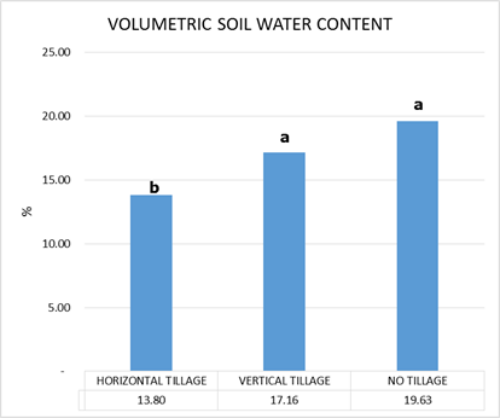
FIGURE 1
Effect of tillage system in volumetric soil water content
Results of soil temperature measured at a depth of 20 cm, show that there are no statistically significant differences ( α = 0.05), between the tillage systems.
However, the average soil temperature for the no-tillage treatment (20.23 °C) was slightly lower, followed by vertical tillage (21.05 ° C) and horizontal tillage (21.35 ° C), Figure 2.
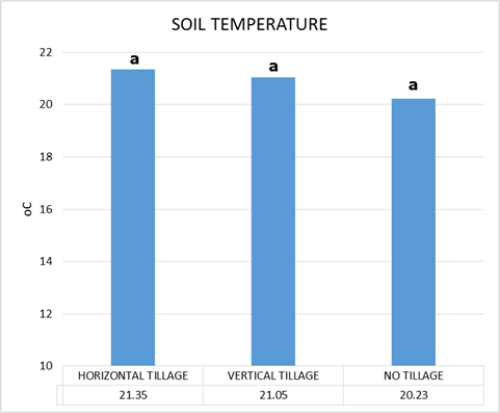
FIGURE 2
Effect of the tillage system on soil temperature
For the no-tillage treatment, the presence of residues on the surface and the higher proportion of water in the soil apparently contributed to the regulation and reduction of the edaphic temperature in the last seasons (2nd Fodder corn season and 2nd Green bean season, respectively). These elements reduce water losses caused by evaporation, as the residues function as a protective cover (mulch) to water and external factors such as solar radiation, wind, humidity and temperature, according to Yoo et al. (2006). It proved NT with management of residues on the soil and crop rotation is promising in terms of reduction and regulation of soil temperature in a 20 cm stratum, with better results from the second year.
Water stress results show that there are significant differences (α = 0.05), between the tillage systems. The superiority of the no-tillage treatment (NT) with 16.52 % is clearly shown, compared to the vertical tillage (VT) treatments with 18.92 % and horizontal tillage (HT) with 20.57 %, respectively, which were statistically the same. It allows concluding that the no-tillage treatment (NT) has a positive effect in terms of reducing water stress or increasing the turgor of plant leaves, Figure 3 .
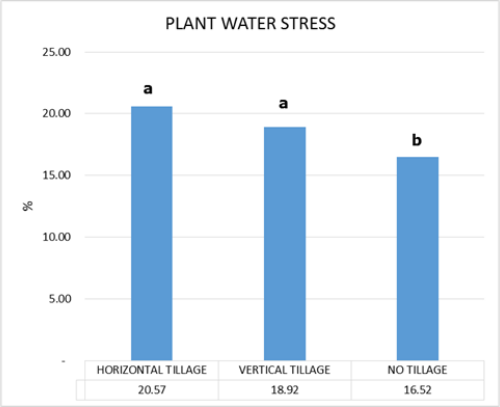
FIGURE 3
Effect of tillage system on plant water stress.
Results obtained in this research agree with those reported by Navarro (2000), who, when investigating the effect of tillage on soil structure, germination and development of corn and beans, reports that soils maintain a better structural state in undisturbed sites or with little soil movement, which reduces soil moisture losses and, therefore, reduces water stress in plants.
Crop yield data indicate that there are no statistically significant differences between tillage systems; neither for the cultivation of fodder corn nor for the cultivation of green beans, Figures 4 and 5.
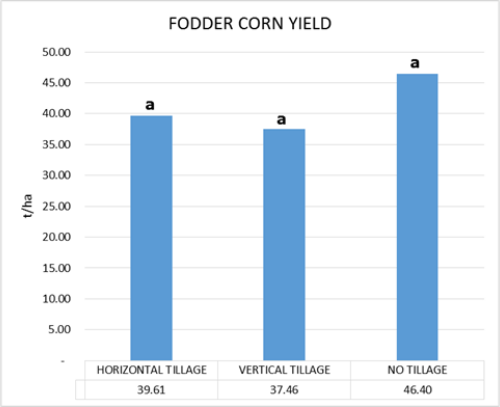
FIGURE 4
Effect of tillage system on fodder corn yield.
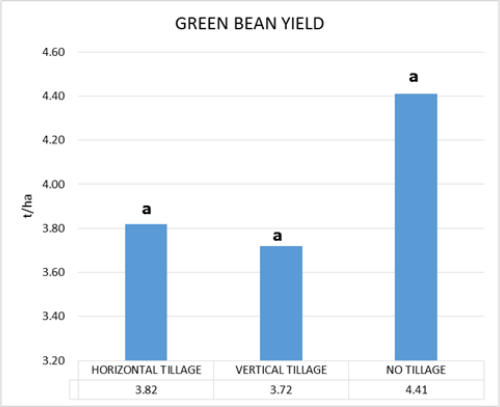
FIGURE 5
Effect of the tillage system on green bean yield
Results obtained during this work were similar to those found by Prieto et al. (2010) who did not find significant differences on the yields of corn and cotton crops for three tillage systems, concluding that two years of soil management were not enough to achieve significant improvements.
CONCLUSIONS
-
The volumetric water content of soil, to 0,20 m is significantly reduced when Horizontal Tillage is used.
-
There are no differences in soil temperature, to 0,20 m, between the 3 tillage treatments.
-
Water stress in plants is significantly reduced when No Tillage is used.
-
There are no differences in the yield of the crop of fodder corn or green beans, between the three tillage treatments.
-
No Tillage is the recommended treatment to optimize the three parameters of the soil investigated in this work.
REFERENCES
BOGUŽAS, V., SINKEVIČIENĖ, A., ROMANECKAS, K., STEPONAVIČIENĖ, V., SKINULIENĖ, L., BUTKEVIČIENĖ, L. M.: "The impact of tillage intensity and meteorological conditions on soil temperature, moisture content and CO2 effluxin maize and spring barley cultivationŽemės dirbimo intensyvumo ir meteorologinių sąlygų įtaka dirvožemio temperatūrai, drėgmei ir CO2 emisij". Zemdirbyste-Agriculture, 105(4): 307-314, 2018, https://dx.doi.org/10.13080/z-a.2018.105.039
BOULAL, H., GÓMEZ-MACPHERSON, H., GÓMEZ, J. A., MATEOS, L.: "Effect of soil management and traffic on soil erosion in irrigated annual crops". Soil and Tillage Research, 115-116, 62-70, 2011, https://dx.doi.org/10.1016/j.still.2011.07.003
FAO AND ITPS: Status of the World’s Soil Resources. Intergovernmental Technical Panel on Soils. Retrieved from www.fao.org/publications%0Ahttp://www.fao.org/3/a-i5199e.pdf, 2015.
GARCÍA R., D. Y., CÁRDENAS H., J. F., SILVA PARRA, A.: "Evaluación de sistemas de labranza sobre propiedades físico-químicas y microbiológicas en un Inceptisol". Revista de Ciencias Agrícolas, 35(1):, 16, 2018, https://dx.doi.org/10.22267/rcia.183501.79.
HERRERA, P. J., MARTÍNEZ, S. J. A., RODRÍGUEZ, M. S. A.: "Efecto de dos sistemas de labranza sobre la infiltración en suelos Ferralíticos Rojos", Revista Ingeniería Agrícola, 7(4): 3-10, 2017, ISSN: 2306-1545, e-ISSN: 2227-8761.
JONES, A., PANAGOS, P., BARCELO, S., BOURAOUI, F., BOSCO, C., DEWITTE, O., VIESTOVA, E.: "State of Soil in Europe". JRC Reference Reports, 78, 2012. https://dx.doi.org/10.2788/77361
LÓPEZ, M. V., BLANCO, N., LIMÓN, M. ÁNGELES, GRACIA, R.: "No tillage in rainfed Aragon (NE Spain): Effect on organic carbon in the soil surface horizon". Soil and Tillage Research, 118: 61-65, 2012, https://dx.doi.org/10.1016/j.still.2011.10.012
LOUWAGIE, G., GAY, S. H., SAMMETH, F., RATINGER, T.: "The potential of European Union policies to address soil degradation in agriculture". Land Degradation and Development, 22(1): 5-17, 2011, https://dx.doi.org/10.1002/ldr.1028
LUNDY, M. E., PITTELKOW, C. M., LINQUIST, B. A., LIANG, X., VAN GROENIGEN, K. J., LEE, J., VAN KESSEL, C.: "Nitrogen fertilization reduces yield declines following no-till adoption". Field Crops Research, 183(August), 204-210, 2015, https://dx.doi.org/10.1016/j.fcr.2015.07.023
MARTÍNEZ, S. J. A., RODRÍGUEZ, M. S. A., WONG, M. S. M.: "Influencia de dos sistemas de labranza sobre las propiedades físicas de un suelo Ferralítico rojo", Revista Ingeniería Agrícola, 8(1): 41-46, 2018. ISSN: 2306-1545, e-ISSN: 2227-8761.
MOLINA, D., CADENA, M., CAMPOS, S., ZERMEÑO, A.: "Efectos de tres sistemas de labranza y mejoradores de suelo en la disponibilidad de humedad y volumen de exploración de raíces". Revista Mexicana de Ciencias Agrícolas, 4(2007-0934), 719-727, 2012.
NICHOLS, V., VERHULST, N., COX, R., GOVAERTS, B.: "Weed dynamics and conservation agriculture principles: A review". Field Crops Research, 183, 56-68, 2015, https://dx.doi.org/10.1016/j.fcr.2015.07.012
OLIVET, R, Y., ORTIZ, R, A., COBAS, H, D.: "Efecto de dos sistemas de labranza mínima sobre la humedad de un suelo Fluvisol para cultivo del frijol ( Phaseolus vulgaris L .)", Revista Granmense De Desarrollo Local, 46(1), 18-23, 2019.
PALM, C., BLANCO, H., DECLERCK, F., GATERE, L., GRACE, P.: "Conservation agriculture and ecosystem services: An overview". Agriculture, Ecosystems and Environment, 187: 87-105, 2014, https://dx.doi.org/10.1016/j.agee.2013.10.010
PITTELKOW, C. M., LIANG, X., LINQUIST, B. A., VAN GROENIGEN, L. J., LEE, J., LUNDY, M. E., VAN KESSEL, C.: "Productivity limits and potentials of the principles of conservation agriculture". Nature, 517(7534): 365-368, 2015, https://dx.doi.org/10.1038/nature13809
PRIETO B; PEROZA, J; GRANDET, G.: "Efecto de labranza y manejo de materiales organicos sobre algunas propiedades fisicas y químicas de un Vertic endoaquept del valle del Sinu, Cordoba Colombia". Temas Agrarios, 15(2), 27-36, 2010.
YOO, G., NISSEN, T. M., WANDER, M. M.: "Use of Physical Properties to Predict the Effects of Tillage Practices on Organic Matter Dynamics in Three Illinois Soils". Journal of Environmental Quality, 35(4), 1576-158, 2006, https://dx.doi.org/10.2134/jeq2005.0225
ZHENG, H., LIU, W., ZHENG, J., LUO, Y., LI, R., WANG, H., QI, H.: "Effect of long-term tillage on soil aggregates and aggregate-associated carbon in black soil of northeast China". PLoS ONE, 13(6), 1-19, 2018, https://dx.doi.org/10.1371/journal.pone.0199523
Author notes
*Author for correspondence: Godofredo Peña-Dávila, e-mail: gpena@unsa.edu.pe
Conflict of interest declaration