VIEW POINTS
Preparation of Animal Food in Germany
Preparación de alimento animal en Alemania
 Hans Oechsner hans.oechsner@uni-hohenheim.de
Adianni González Freire adianni.gonzalez@gmail.com
Hans Oechsner hans.oechsner@uni-hohenheim.de
Adianni González Freire adianni.gonzalez@gmail.com
Preparation of Animal Food in Germany
Revista Ciencias Técnicas Agropecuarias, vol. 31, no. 2, pp. 1-6, 2022
Universidad Agraria de La Habana
Received: 19 August 2021
Accepted: 14 March 2022
ABSTRACT:
The work is presented in three parts. The first part approaches the German methodology for the preparation of food animal going to the biggest bovine livestock (bovine branch), the methods of preparation of allowances are exposed based on the German norms and its wide use in Germany for the feeding of the livestock bovine facilities in small, medium and big facilities. The second part exposes the technologies used in Cuba. In third part it leaves the possibility it discusses of introducing some of the German technologies in Cuba. Emphasis is made in the possibility of introduction of these technologies in any investigation or development institution in Cuba that is in charge of from the bovine production to private or state scale. For their importance and applicability, the fundamental steps of the haymaking methodologies and silage are described to different scale, in dependence of the size of the installation, of the purpose of the breeding (meat or milk) and of the number of livestock heads, being the objective of this work to discuss these methodologies in our country. By means of these methodologies it is possible to produce animal food using endogenous resources that allow achieving a sovereignty and economic independence when not having to care great quantity of agricultural ingredients that urge the production of animal food (animal concentrated food), saving material resources, humans and money. Finally, it is emphasized in the importance of to value the results reached with these methodologies due to their possibility of being transferred to productive scale and to potentializes this activity to national scale.
Keyword: Animal Food, German Methodologies, Necessary Inputs.
RESUMEN:
El trabajo se presenta en tres partes. La primera parte aborda la metodología alemana para la preparación de alimento animal con destino al ganado vacuno mayor (rama vacuna), se exponen los métodos de preparación de alimentos basados en las normas alemanas y su amplia utilización en Alemania para la alimentación del ganado vacuno estabulado en pequeñas, medianas y grandes instalaciones. La segunda parte expone las tecnologías utilizadas en Cuba. En la tercera parte se discute la posibilidad de introducir algunas de las tecnologías alemanas en Cuba. Se hace énfasis en la posibilidad de introducción de estas tecnologías en cualquier institución de investigación o desarrollo en Cuba que se ocupe de la producción vacuna a escala privada o estatal. Por su importancia y aplicabilidad, se describen los pasos fundamentales de las metodologías de henaje y ensilaje a diferentes escalas, en dependencia del tamaño de la instalación, del propósito de la cría (carne o leche) y del número de cabezas de ganado, siendo el objetivo de este trabajo discutir estas metodologías en nuestro país. Mediante estas metodologías es posible producir alimento animal utilizando recursos endógenos que permitan lograr una soberanía e independencia económica al no tener que importar gran cantidad de ingredientes agrícolas que encarecen la producción de alimento animal (piensos), ahorrando recursos materiales, humanos y dinero. Finalmente se enfatiza en la importancia de valorar los resultados alcanzados con estas metodologías debido a su posibilidad de ser transferidos a escala productiva y potenciar esta actividad a escala nacional.
Palabras clave: alimento animal, metodologías alemanas, insumos necesarios.
INTRODUCTION
Some years ago, Martínez et al. (2009) treated some aspects of improving bovine facilities in Germany and their possible introduction in countries of the south, like Cuba; in that occasion, the facilities and their productive infrastructure were analyzed. In this work, the technologies that exist in Germany to satisfy the feeding demands of this type of livestock will be approached.
According to Martínez (2015), in Cuba, the feeding of bovine livestock is carried out in grasslands and hills in intensive (rotation for small land extensions) and extensive (in big land extensions) ways in areas destined to these ends. Also, by means of using diets that contain concentrated food called fodder. These foods denominated fodder are quite expensive because most of the inputs have to be imported and their preparation takes place at industrial scale in factories specialized in these operations. The fundamental inputs for the preparation of these concentrated foods are grains, protein supplements, mineral salts, medications and antibiotics among others.
Other forms of feeding bovine livestock in Cuba are by means of green forage and hay makers, however, the technology of preparation of hay in ballers and the technology of the silage is quite depressed at the present time, due to different factors such as great deterioration of the machinery used in this works and a low capacity and quality of grasses and forages for this operations. For such a reason, this work has as objective to present some variants of animal food preparation in Germany that can be valued and pondered by decision-makers to make it be possible their introduction in Cuba. It could be of maximum relevance in the current moments where the country bets to give a total overturn to animal feeding with endogenous resources and with the participation of state and private producers, in the two fundamental branches of the bovine production (milk and meat).
DEVELOPMENT OF THE TOPIC
German case
In Germany, the technology and the machinery used for the production of food with animal destination (silage and hay making) are those established or standard at international level. Some of them can be appreciated in the works of Martínez (2015 and Martínez & Cruz (2019). In the case of the silage technology, silo croppers or integral reaping machines of forage of different types and models are used depending on the size of the exploitation (small, medium or big companies). Moreover, integral tows, tractors of different powers and weight for forage compaction, special canvases for covering the silo, preservatives (special inoculum) to accelerate the process of lactic fermentation of the forages, pH and temperature sensors to control the whole process of silage, are utilized. Two types of silo are used (bunker type and silo on the soil). It depends on the type and size of the cattle exploitation (number of livestock heads) as well as on the use of the silage like animal food or bioenergy (methane production). For the silage production, the plant of corn (Zea mays) is used as fundamental raw material which is harvested and cut into pieces smaller than 15 mm in the silo cropper for their deposit in the silos. They also use a tuber called "Sellerie", (Apium graveolens). In both cases, a silo on the soil is used, where the conditions are created defining the area of its construction, adding straw or hay baller to define their dimensions (long, wide and height) and preparing them for their filling. This is a non-permanent silo, since when it is harvested, the silo comes undone. It is also common to use above the soil a plastic bag case where the material to make silage is incorporated, being closed tightly until its opening for the use. In the case of bunker type silos, they are constructive facilities made up with concrete which fulfill German norms, they are permanent and they are used repeatedly every year. Between both types, their differences are remarkable and the cost is a fundamental element. Detail of these types of facilities can be observed in Handbuch (2001) and Pieper (2002)) as well as in the website: www.silage.de. For the great diversity of the agricultural machinery used in these technologies, it is possible to show only some of them (See Figures 1, 2, 3, 4 and 5).
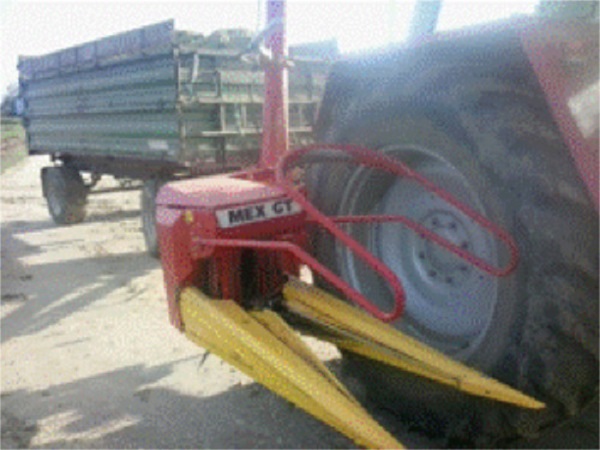
FIGURE 1
Silo cropper of small format working. Source: Author´s file.
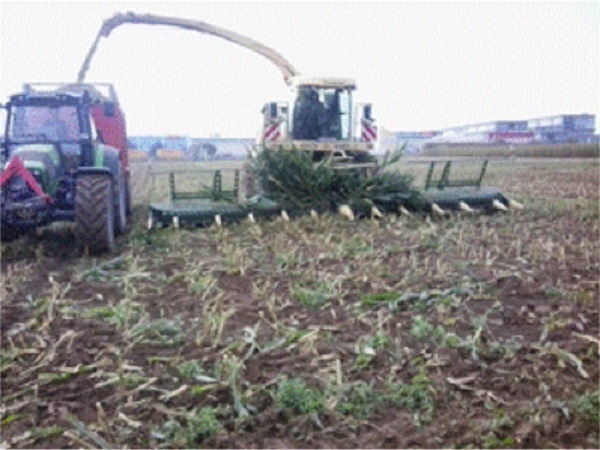
FIGURE 2
Silo cropper of great format working. Source: Author´s file.
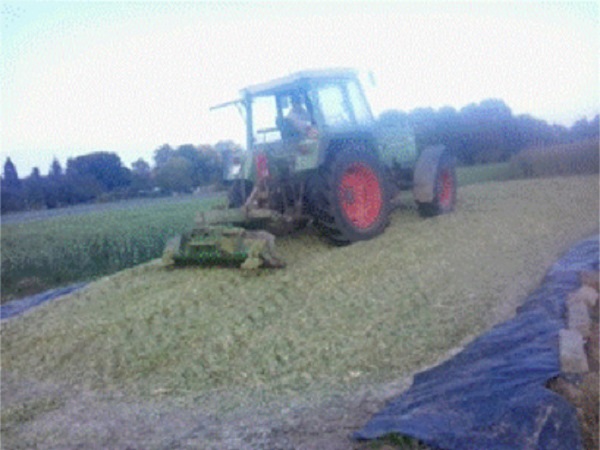
FIGURE 3
Compacting of the forage in soil silo of small format. Source: Author´s file.
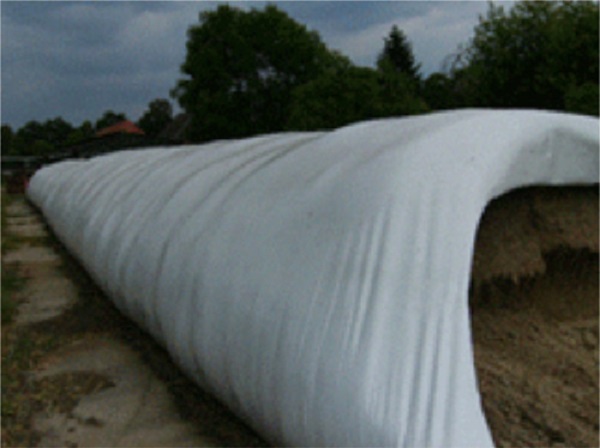
FIGURE 4
Forage in hermetic plastic silo on soil. Source: Author´s file.
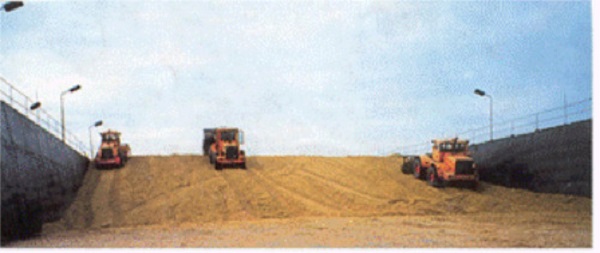
FIGURE 5
Compacting of the forage in silo of great format (bunker type). Source Martínez (2015).
Hay Technology
In the hay technology, different croppers of forages are used and in successive phases of processing they carry out the technological operations of veering, surrounding and drying of the forage in the land, packing it with packer-rollers (with or without lining of a plastic cover), transport and placement of the rollers in the warehouse.
For the hay making different integral or haulage agricultural machines are used, which can belong to different trademarks and models, some of the utilized ones are presented in Figures 6, 7, 8 and 9.
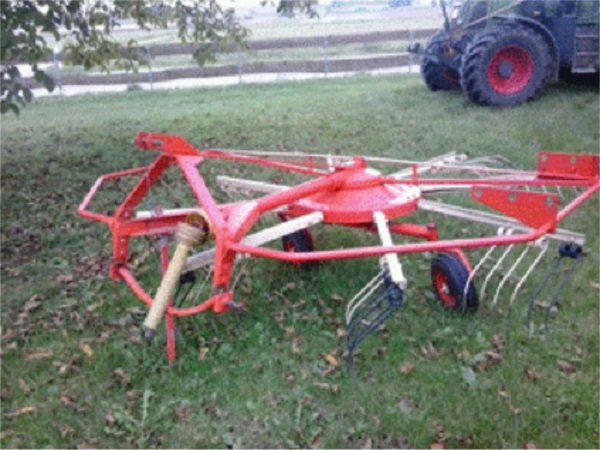
FIGURE 6
Hay-turning rake. Source: Author´s file.
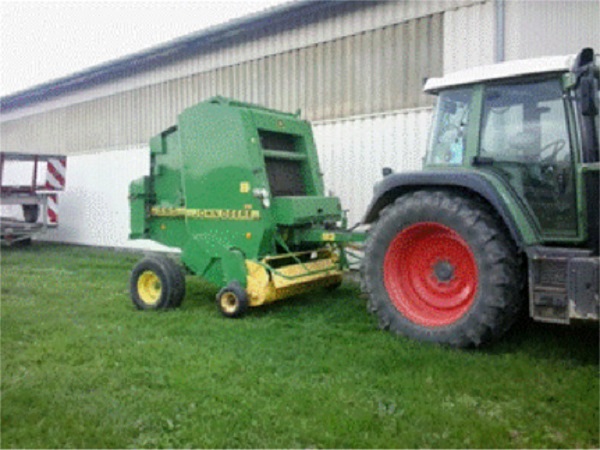
FIGURE 7
Roller packer machine. Source: Author´s file.
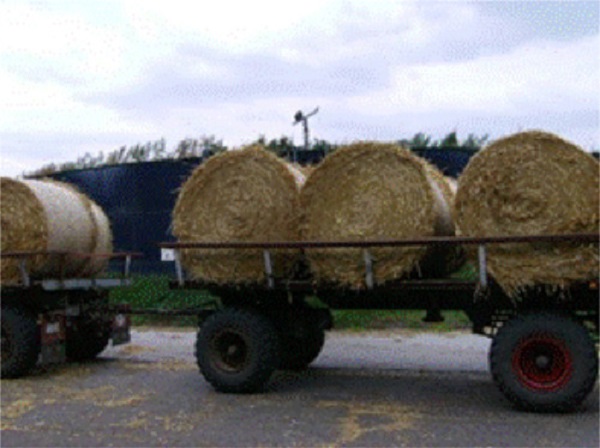
FIGURE 8
Baller transportation. Source: Author´s file.
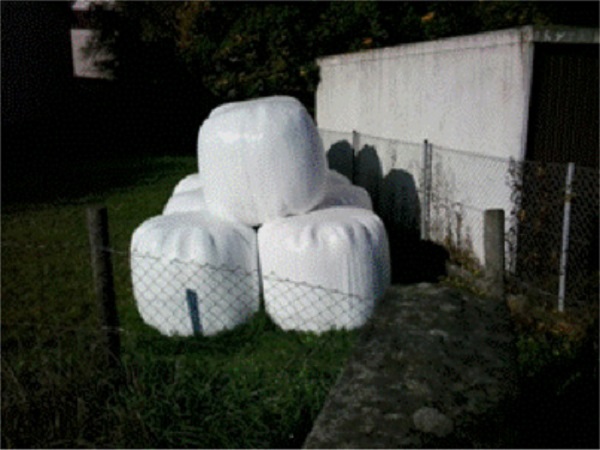
FIGURE 9
Baller covered with plastic cover, waiting their transfer to the warehouse. Source: Author´s file.
The hay and silage technologies are much utilized in Germany, due to the climatic characteristics of that country. The feeding, by means of pasture and fresh green forage is used little, only in summer months, which is generally very short period; for such a reason, cattle feeding is guaranteed with these technologies the rest of the year.
Cuban Case
In Cuba, the technologies of cattle feeding are specified according to the purpose of the breeding (dairy, beef or dual-purpose) and so are the characteristics of the installation, in order to guarantee the different purposes of the cattle mass. As Martínez (2015) referred, the facilities on median and large scale, for the dairy, beef or dual-purpose, are managed in a state way, being defined the following types for dairy breeds:
-
Typical dairy for 120 cows;
-
Typical dairy for 288 cows with troughs to the shadow;
-
Typical dairy for 288 cows with troughs in the sun;
-
Genetic center for 120 cows.
-
Besides, other very specific dairy projects such as the cases of the dairy rotolactor, experimental dairy with natural shadow and the specialized dairies.
-
While for the beef breeds (fatten), the Corralón for bull fattening in pasture, is the most representative. To small scale, the private producers possess rustic facilities with very low mechanization, which have been object of improvements in the last two years with the creation of Mini-pymes (private micro-companies). In each type of existent facilities, the feeding is based on the managing of the herd in their areas of grasses and forages (generally, in each installation, there is an established area of energy grasses and another of protein grasses). Very scarce is the use of concentrated food, called pienso or fodder, due to its high cost (NR AG 035:1978, 1978; NRAG-103:1979, 1980; NRAG-105:1979, 1980; NR AG 792:1985, 1985; NR AG 957:1989, 1989; NRAG 185:2011; NC 884: 2012). Fodder is used in small proportions in some types of special facilities, either in those for dairy breeds or for beef breeds. The second more utilized feeding method is the cutting and chopping of fresh green forage for its distribution to the cattle stabled in shadow paddocks of these facilities which generally have a silo-cropper or part of this machine (chopping mechanism) of mobile or stationary working for the chopping of these forages. The silage technology is practically nonexistent in Cuban facilities NR AG 748:1984 (1984); NRAG 185: (2011); NC 884: (2012) and the hay making technology is severely depressed since the 1990s, due to the domestic economic-financial difficulties to acquire modern technologies in these spheres or to restore the existent ones, and also due to the poor commitment of the decision-makers to modernize and prioritize this type of agricultural production. It should be referred that there is a National Experimental Station of grasses and forages called "Indio Hatuey" in Matanzas Province, which is in charge of the introduction and improvements of grasses and forages in the Cuban agricultural production. However, it has not been effective in cattle facilities due to several Becker (1967); Kimakobski et al. (1979); NR AG 720:1984 (1984) y Martínez (2015), the quality of the hay depends on several factors like content of humidity, quantity of forages, grass type, cutting time, time to begin making the hay, overgrowths (weeds), sanity (pests and diseases that affect mainly the leaves), phenology state of the plants and structure of the plant (shafts, leaves, flowers). As it can be observed, a rigorous technological discipline is required to obtain quality hay. Other alternative methods of feeding cattle, created in Cuba in the 1980s, (Projects KORK-15-1; Typical plant of creole fodder; Pajumel; Complex REVOC; Bagacillo-Miel-Urea (B.M.U); Bagacillo pre-digested and Gicabu), referred by Iglesias & Soto (2002) and Martínez (2015) have not been reactivated due to the economic - financial and administrative problems enunciated previously.
ANALYSIS AND DISCUSSION
The previous analysis allowed inferring that, except the silos of large format (Figure 5), all the other variants of animal feeding are feasible of being introduced in Cuba if the necessary equipment for the application of each one of them is available. According to the authors' approaches, the technology of silage of small format used on the floor (Figure 3) is advantageous because it is of low cost compared to the other ones analyzed. However, a fundamental question is the technological discipline. This silo type from its beginning to its termination does not exceed 72 working hours in Germany, using only three workers for its realization (one in the crop, another in the transport and the last one in the compaction-closing of the silo). The workers are generally members of an own family that is devoted to the exploitation of its dairy cattle. Other particulars and elements of the cattle facilities and the form of conserving the food for this type of livestock in Germany can be consulted in Jungbluth et al. (2013; 2017).
CONCLUSIONS
This study confirms the fundamental premise of guaranteeing enough yearly quality food for cattle husbandry, whether dairy, beef or dual-purpose cattle. The work shows the German methodologies for the preparation of simple, reliable and robust cattle food. These methodologies are used on small, median and large scale in the German cattle facilities. All these technologies could be transferred to the Cuban case to real scale for their valuation and putting into practice using endogenous agricultural resources, that is, the technologies and the agricultural materials for obtaining the maximum productive potential with different purposes cattle. However, the availability of financial resources and the political will to make them reality are the essential prerequisites. A road to achieve the above-mentioned could be the foreign-owned investment, which has proven their effectiveness in other domestic productive areas.
Finally, it is inferred that without the sufficient and quality animal feeding, increments cannot be expected in cattle production in Cuba in next years. For such a reason, with this work, it is suggested that decision-makers have the possibility to carry out an analysis and pondered valuation of these technologies for their possible introduction in the country.
GRATEFULNESS
To the University of Hohenheim and the University of Rostock to support the existent collaboration among our Universities.
REFERENCIAS BIBLIOGRÁFICAS
BECKER, M.: Análisis y valoración de pastos y forrajes, Ed. Editorial Ciencia y Técnica, Instituto del Libro, La Habana, Cuba, 201 p., 1967.
HANDBUCH: Landwirtschaftliche Betriebsgebaude, Ed. Planungshilfe, Germany, Funktions und Bauanleitungen, 2001, ISBN: 3-7843-3039-8.
IGLESIAS, C.; SOTO, M.W.: Mecanización de los procesos pecuarios, Ed. Editorial Félix Varela, 2002.
JUNGBLUTH, T.; BUESCHER, W.; KRAUSE, M.: Techik Tierhaltung, Ed. Verlag Eugen Ulmer. Stuttgart, Gundwissen Bachelor ed., Germany, 304 p., 2013.
JUNGBLUTH, T.; BUESCHER, W.; KRAUSE, M.: Techik Tierhaltung, Ed. Verlag Eugen Ulmer. Stuttgart, 2. Auflage ed., Germany, 322 p., 2017.
KIMAKOBSKI, B.I.; ORTIZ, R.; BENÍTEZ, D.: Consumo de hierba de animales en pastoreo. Metodología para su determinación, Inst. Instituto de Ciencia Animal (ICA), La Habana, Cuba, 15 p., 1979.
MARTÍNEZ, C.: Instalaciones agropecuarias. Fundamentos y elementos de cálculo, Ed. Editorial Félix Varela, La Habana, Cuba, 241 p., 2015, ISBN: 978-959-07-1708-6.
MARTÍNEZ, C.; CRUZ, M.D.: Fundamentos de mecanización agropecuaria, Ed. Editorial Félix Varela, La Habana, Cuba, 215 p., 2019, ISBN: 978-959-07-2327-8.
MARTÍNEZ, C.; OECHSNER, H.; KANSWOHL, N.; SCHLEGEL, M.: Instalaciones para ganado vacuno lechero. Tendencias actuales. (Facilities for livestock bovine milkman. Current tendencies), [en línea], Inst. Sección: Lechería - Tambo-Instalaciones, Germany, Sección: Lechería-Tambo-Instalaciones, 2009, Disponible en:www.e-campo.com.
NC 884: 2012.: Código de Buenas prácticas de alimentación animal, Oficina Nacional de Normalización, La Habana, Cuba, 17 p., Vig. 2012.
NR AG 035:1978: Pienso y sus materias primas. Metodología elemental de muestreo, Inst. Ministerio de la Agricultura, Norma Ramal, La Habana, Cuba, 3 p., Vig. de 1978.
NR AG 720:1984: Pastos y forrajes. Áreas de corte, manejo y control, Inst. Ministerio de la Agricultura, Norma Ramal, La Habana, Cuba, 5 p., Vig de 1984.
NR AG 748:1984: Alimento del ganado ensilado. Método de ensayo, Inst. Ministerio de la Agricultura, Norma Ramal, La Habana, Cuba, 5 p., Vig. de 1984.
NR AG 792:1985: SNPHT. Producción de piensos. Requisitos generales de seguridad, Inst. Ministerio de la Agricultura, Norma Ramal, La Habana, Cuba, 5 p., Vig. de 1985.
NR AG 957:1989: Alimentos para consumo animal. Fábrica de pienso criollo. Regulaciones higiénico-sanitarias generales, Inst. Ministerio de la Agricultura, Norma Ramal, La Habana, Cuba, 3 p., Vig de 1989.
NRAG-103:1979: Piensos y sus materias primas. Materia seca. Determinación. Método de secado en la estufa, Inst. Ministerio de la Agricultura, Norma Ramal, La Habana, Cuba, 5 p., Vig. de 1980.
NRAG-105:1979: Piensos y sus materias primas. Cenizas. Determinación. Método de incineración, Inst. Ministerio de la Agricultura, La Habana, Cuba, 3 p., Vig. de 1980.
NRAG 185:2011: Suelos. Ensilado de forraje, Inst. Ministerio de la Agricultura, La Habana, Cuba, 10 p., Vig. de 2011
PIEPER, D.: Technologie und Produktentwicklung GMBH, Inst. Dr. Pieper Technologie und Produktentwicklung GMBH, Catálogo, Silomais, Germany, 2002.
VIVIANI, E.; BARBAROSSA, R.: Heno de calidad, [en línea], Sitio Argentino de producción animal, Argentina, 2020, Disponible en:https://www.produccion-animal.com.ar.
Notes
Author notes
*Author for correspondence: Carlos M. Martínez-Hernández, e-mail: carlosmh@uclv.edu.cu
Conflict of interest declaration