ORIGINAL ARTICLE
Irrigation Management for Coffee Seedling Production in Technified Nurseries
Manejo del riego para la producción de posturas de cafeto en viveros tecnificados
 Ciro Sánchez Esmoris
Amaray Ortiz Arbolaes
Vidalina Pérez Salina
Felicita González Robaina
Ciro Sánchez Esmoris
Amaray Ortiz Arbolaes
Vidalina Pérez Salina
Felicita González Robaina
Irrigation Management for Coffee Seedling Production in Technified Nurseries
Revista Ciencias Técnicas Agropecuarias, vol. 31, no. 4, e04, 2022
Universidad Agraria de La Habana
Received: 02 March 2022
Accepted: 14 September 2022
ABSTRACT: The work was developed at the Experimental Agroforestry Station "Jibacoa" with the aim of defining the partial and total net irrigation requirements for the production of coffee tree seedlings in tubes. For the study, three substrate variants were tested (50% rice husk + 50% soil + 2g multicote, 50% coconut fiber + 50% soil + 2g multicote) and technical standards (50% organic matter + 50% soil) with three levels of moisture in the substrate (85, 70 and 50%) available water. Parameters of morphological development were measured to know the influence of irrigation management on the quality of seedlings. Each treatment was made up of four trays containing 54 tubes with a capacity of 180 cm3, where seedlings of Coffea arabica L., variety "Isla 6-14", were developed, of which 10 of the central part were evaluated at the end of the experimental period. As a result, the average partial irrigation standards per type of substrate are: rice husk (14,44 mL plants-1), coconut fiber (12,1 mL plants-1) and technical standards (13,87 mL plants-1). Consequently, the total net irrigation standards vary, where the largest volumes of water needed are in the rice husk substrate followed by technical standards and coconut fiber with 46,01; 42,37 and 36,16 mL m-2, respectively. From the morphological point of view, the best seedlings are achieved in the rice husk substrate and maintaining a humidity level of 85% of the total available water.
Keywords: water needs, substrates, humidity levels, morphological index.
RESUMEN: El trabajo se desarrolló en la Estación Experimental Agroforestal “Jibacoa” con el objetivo de definir las normas de riegos netas parciales y totales para la producción de posturas de cafetos en tubetes. Para el estudio se probaron tres variantes de sustratos (50% cascara de arroz + 50% suelo + 2g multicote, 50% fibra de coco + 50% suelo + 2g multicote) y según normas técnicas (50% de materia orgánica + 50% suelo) con tres niveles de humedad en el sustrato (85, 70 y 50%) del agua disponible. Fueron medidos parámetros del desarrollo morfológico para conocer la influencia del manejo del riego en la calidad de las posturas. Cada tratamiento estuvo conformado por cuatro bandejas que contenía 54 tubetes con una capacidad de 180 cm3, donde se desarrollaron posturas de Coffea arabica L., variedad “Isla 6-14”, de las cuales fueron evaluadas 10 de la parte central al finalizar el período experimental. Como resultado se tiene que las normas de riegos parciales promedio por tipo de sustrato son: cascarilla de arroz (14,44 mL plantas-1), fibra de coco (12,1 mL plantas-1) y normas técnicas (13,87 mL plantas-1). En consecuencia, las normas netas totales de riego varían donde los mayores volúmenes de agua necesarios son en el sustrato cascarilla de arroz seguido de normas técnicas y fibra de coco con 46,01; 42,37 y 36,16 mL m-2 respectivamente. Desde el punto de vista morfológico las mejores posturas se logran en el sustrato de cascarilla de arroz y manteniendo un nivel de humedad del 85% del agua total disponible.
Palabras clave: necesidades hídricas, sustratos, niveles de humedad, índice morfológico.
INTRODUCTION
After oil, coffee is the most important product in the world in terms of exports and income generations (DaMatta et al., 2007), constituting the main crop in 70% of tropical countries.
The opening of new coffee areas, as well as the replacement of old plantations with high-yielding varieties requires producing large volumes of good quality plants in nursery (almácigo) to establish healthy, vigorous plantations and, therefore, capable of producing high yields (Carvajal, 1984).
According to Morales & Jerez (1982), the coffee plant responds, like the other plant species, to the supply of water to the soil, resulting in the application of this through irrigation a beneficial practice both to the plant and to the producers through a better physiological state of plants that make it possible to obtain greater productions.
In the world, the production of coffee seedlings is carried out mainly in black polyethylene bags of different dimensions according to the time the plants will remain in the nursery (Sánchez et al., 2009). However, in recent years, in several coffee-producing countries such as Brazil, Guatemala, El Salvador, Nicaragua and Costa Rica, experiments have been developed using plastic tubes and it has been shown that optimal quality seedlings are obtained, increasing the efficiency of labor in filling, irrigation, transplantation and reducing the amount of inputs and transport costs from the nursery to the farm, in relation to black polyethylene bags production (Irogoyen, 2000; Blandón, 2008; Trujillo, 2012).
In Cuba, isolated studies have been carried out that have made it possible to elaborate a technology without contemplating the complete technological process; therefore, it is necessary to perfect it to respond to the new technical nurseries acquired.
Taking into account all the above, the present work was developed with the aim of defining the partial and total net irrigation requirements for production of coffee tree seedlings in tubes.
MATERIALS AND METHODS
The experiments were carried out in the nursery of the Experimental Agroforestry Station "Jibacoa", Villa Clara Province, located at 22°01 ́N and 79°58 ́W, at 340 meters above sea level during the 2019-20 campaign. To fill the tubes, a reddish-brown Fersialitic soil was used (Hernández et al., 2015; 2019).
Three substrates were selected according to the criteria of Sánchez (2019), which were subjected to three humidity levels.
Factor A (substrate)
Substrate 1. (50% Rice husk + 50% soil + 2g multicote)
Substrate 2. (50% Coconut Fiber + 50% soil + 2g multicote)
Substrate 3. Technical standards (50% organic matter + 50% soil)
Factor B (moisture level)
85, 70, 50% of the upper limit of available water in the substrate.
The experimental design used was randomized blocks with three replications.
The fertilizer was applied mixed with the substrate prior to filling the tubes with the complete formula (N, P, K) 7-14-7. In the 3rd and 5th pair of leaves it is applied liquefied at 12% to a rate of 20 mL per plant.
The irrigation technique used was microspray with emitters of microjet type C series 2 x 140º with outlet diameter of 1 mm and a flow rate of 41 L h-1.
The time of irrigation was determined by weightings and the sheet of water to be applied from the criterion of 1g of water is approximately equivalent to 1 mL, applied in the early hours of the morning and in the late afternoon (after 4:00 pm), always replenishing the amount consumed.
To establish the irrigation strategy, 30 tubes were weighed with the dry substrate of each treatment and the average dry weight was determined, water was added until they were saturated with water, when they stopped draining they were considered to be at the upper limit of available water or field capacity (FC). Then, they were weighed again, the average weight obtained corresponds to the tube at FC. The difference between dry weight and wet weight is the amount of water contained in grams. This water content was determined to be 85, 70 and 50% of the FC that corresponds to the humidity level of each treatment. The sheet of water to be applied corresponds to the previous relationship, that is, the difference in grams to bring the tube to the humidity limit set for each case.
During each phase of development of the coffee seedlings, 10 samples were taken for the determination of height and total weight by the destructive method. The total weight of the seedling in grams was subtracted from the weight of the tube.
To characterize the development of the seedlings when they reached seven months, the following variables were evaluated:
Plant height: It was measured with a graduated ruler from the neck of the plant to the apex (cm).
Stem diameter: Measured with a Vernier to the neck (cm).1 cm
Number of pairs of leaves: It was performed by counting, considering a fully formed leaf when it reached more than 10 cm2 of leaf area.
Leaf area: This variable was estimated using the method developed by Soto (1980), from the linear dimensions of the leaves and the subsequent application of the following formula: AF = length x width x 0,64 (cm2).
Dry mass: The plants were separated by organs (leaves, stems, root) and placed on a stove at 65ºC until they reached constant dry mass. The value of total dry mass for each organ (g) was determined as the sum of the dry mass of roots, stems and leaves.
Data were processed using analysis of variance (ANOVA Double classification). The differences between the means of the treatments studied were determined according to the Tukey HSD multiple comparison test with 95% reliability.
The tubes used have a capacity of 180 cm3 and weigh approximately 22 g. The trays are 9 x 6 tubes which is equivalent to 54 tubes / trays, with this format a density of 204 plants m-2 was achieved. Figure 1 shows the tube tray for technical nurseries.
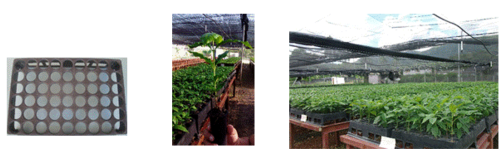
FIGURE 1
Tube tray, tubes and nursery technified.
RESULTS AND DISCUSSION
Analysis of the Storage Capacity of each Substrate Studied
As part of the study, an analysis of the water storage capacity in each substrate was carried out to get an idea of the irrigation moments. The following results were obtained from the research, which are shown in Table 1.

Legend: CA: Rice husk; FC: Coconut fiber; MO: organic matter, Cc: field capacity.
In addition, it was possible to define that for all substrates irrigated at 85% of their storage capacity, the time of irrigation is approximately every two days, for those irrigated at 70% between three and four days, while those irrigated at 70% the time of irrigation was between four and five days. This factor is very important in defining the frequency of irrigation according to Wendling (2002).
Study of Rainfall
During the experimental phase, rainfall was recorded (Figure 2), which was taken into account to define the time of irrigation and the standard to apply. Total rainfall during 2020 was 2402,4 mm in 81 events. In the months from February to July, which corresponds to the nursery stage, rainfall was 569,5 mm in 23 events, which were higher in May with 368 mm. Of the total rainfall, only 24% occurred during the nursery stage. After each precipitation, the tubes were weighed to know the contributions by rain and to subtract them from the amount of water to be applied at each moment.
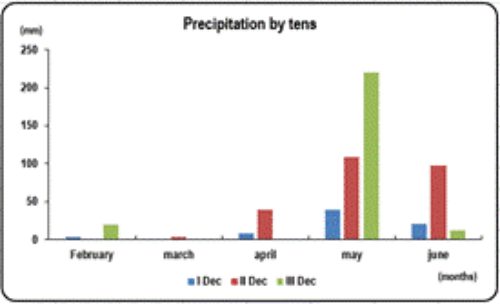
FIGURE 2
Rainfall during the experimental phase.
Morphological Variables of Development
Figure 3 shows the dynamics of average development of the coffee seedlings for the three treatments during the nursery phase. As it is seen, as the seedling grows, the height and total weight progressively increases. In the first days the average height was 6 cm and the total weight 1,1 g, at the end of the cycle the total average height was 19,2 cm and the total average weight was 10,1 g.
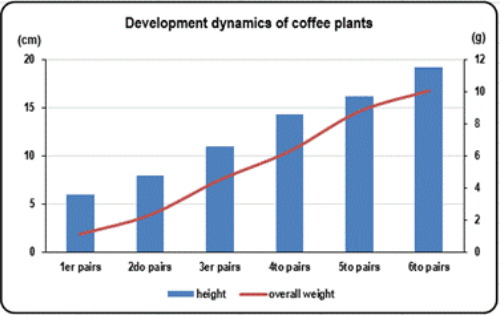
FIGURE 3
Progress in the development of two morphological variables of coffee seedlings during the research phase.
The values obtained of total weight of the seedlings in each phase of development were those taken into account in the weighing of the tubes to define the irrigation sheet to be applied.
Irrigation Management in the Three Treatments
In Figure 4 A, B and C, the amounts of water applied at each moment of the life cycle of the seedlings vary and they are in correspondence with the size of the plants and the evaporative demand of the atmosphere, highlighting moments where the amounts of water to be applied vary from 6 mL to values of 32 mL. From the point of view of irrigation monitoring, all treatments irrigated at 85% of the upper limit of water available for each substrate had similar behavior for each type of substrate.
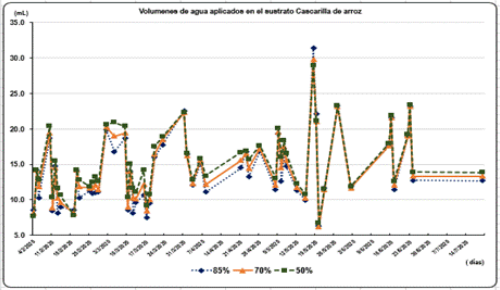
FIGURE 4A
Volume of water applied to coffee seedlings in the rice husk substrate.
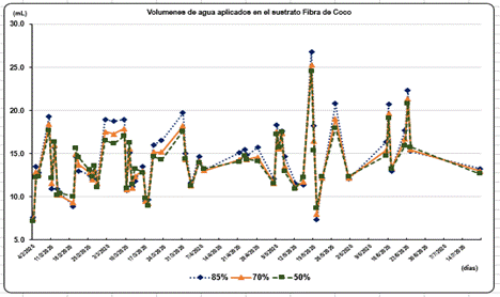
Figure 4B
Volume of water applied to coffee seedlings in the coconut fiber substrate.
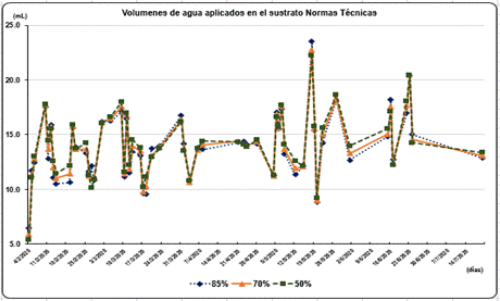
FIGURE 4C
Volume of water applied to coffee seedlings in technical standards substrate.
Consequently, with the types of substrates, the net partial standards also varied (Figure 5), where all were adjusted to an ascent linear equation with strong determination coefficients for the same humidity level (85% of the upper limit of water available in the substrate). In the case of rice husk, they were in the range of 11,71 and 17,18 mL plants-1, followed by coconut fiber with values between 8,98 and 15,22 mL plants-1 and finally, by technical standards which are between 11,02 and 16,73 mL plants-1. From the equations shown in the graph, it is possible to estimate the amount of water to be applied based on the pairs of leaves with a high pressure level.
Similar results were obtained by Morales (1986) in a work he carried out on the growth of coffee seedlings under different moisture contents in the soil, he concluded that there was a greater development of the plants when there was greater availability of water in the soil.
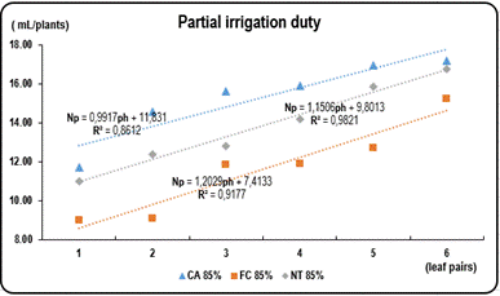
FIGURE 5
Net partial irrigation duty for treatments
Total net irrigation duty behavior is appreciated in Figure 6, where the greatest amount of water during the entire life cycle of the seedlings in the nursery is needed in the rice husk substrate, with a value of 46,01 mL m-2, followed by the treatments technical standards and coconut fiber.
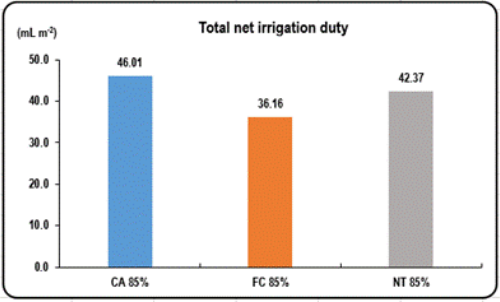
FIGURE 6
Total net irrigation duty for treatments during the nursery phase.
Morphological Response of Plants to Irrigation Management by Type of Substrate
The fundamental premise to have highly productive coffee plantations is to obtain healthy and vigorous seedlings, for that, it is necessary to use seeds with high varietal purity, which express their maximum productive potential and maintain an adequate nutritional and water balance in the substrate, that allows this condition to be met (Sánchez et al., 2006).
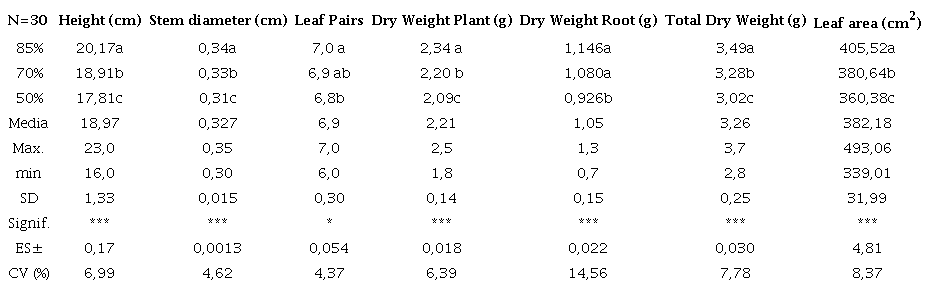
Table 2 shows the morphological variables studied for the rice husk substrate with three humidity levels where there are highly significant differences for all variables and where the best behaviors of the seedlings are achieved when 85% of the water available in the substrate is irrigated. Correspondingly, these variables deteriorate as the water content in the substrate decreases.
Similar analysis is performed for the substrate of coconut fiber (Table 3), where also the best results are reached by watering to 85% of the upper limit of water available in the substrate with a high level of significance. The coefficient of variation in all cases is less than 20%, which indicates a homogeneity among the values obtained.
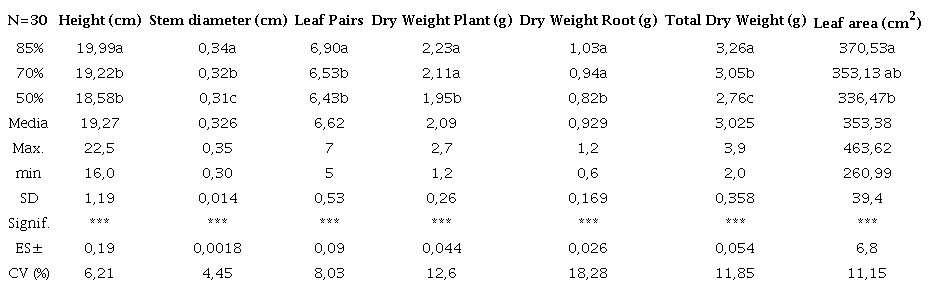
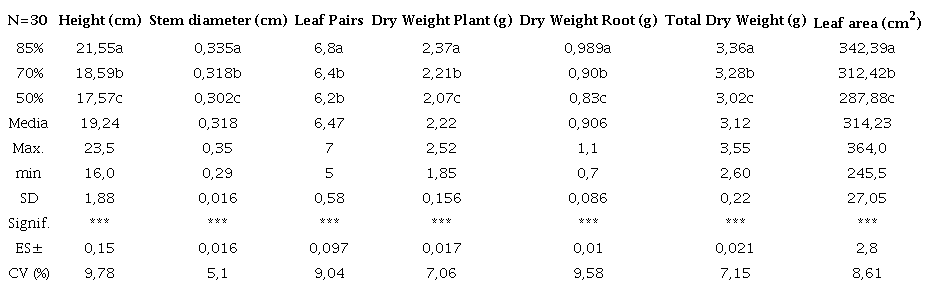
Table 4 shows the effect of humidity levels on the morphological development of coffee seedlings for the substrate prepared according to the technical standards of the crop. As can also be seen, watering with a high level of humidity (85% of the water available in the substrate) brings with it an adequate response by achieving the best indicators of the development of coffee seedlings with a high level of significance when compared to medium and low levels of humidity.
In a general sense, for the three types of substrates studied, the best morphological responses of the coffee plant seedlings are found when irrigating at 85% of the available water in the substrate. Even when in the rice husk substrate, the total net irrigation duty is higher with respect to the other substrates, it is where the best development indexes are reached for most of the morphological variables studied. This confirms that with humidity levels close to the upper limit of available water in the soil, plants are able to carry out their physiological activities without limitations, influencing their proper development. Similar results were reported by Silva et al. (1991); Abad et al. (1992).
Analysis of the Interaction Substrates - Humidity Levels
Making an analysis of the combination of type of substrate and humidity levels, with all the samples, it is obtained that for the production of healthy seedlings the best response is achieved with the rice husk substrate (Table 5), where there are highly significant differences of all the morphological variables in favor of such substrate, maintaining the humidity at 85% of the available water. Of the variables studied, only height did not present significant differences.
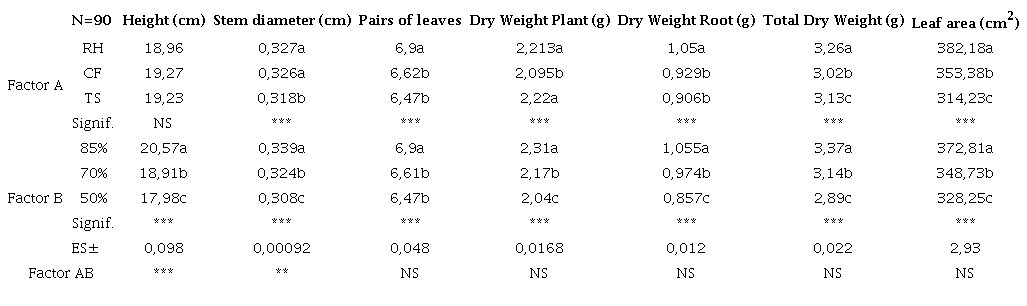
Legend: Rice Husk (RH); Coconut Fiber (CF); Technical Standards (TS)
Table 6 presents the results of the combined analysis of factors A (substrate) and B (humidity levels) for all the variables studied.
As observed, the best quality of seedlings is achieved in the rice husk substrate and watering with a high level of humidity.
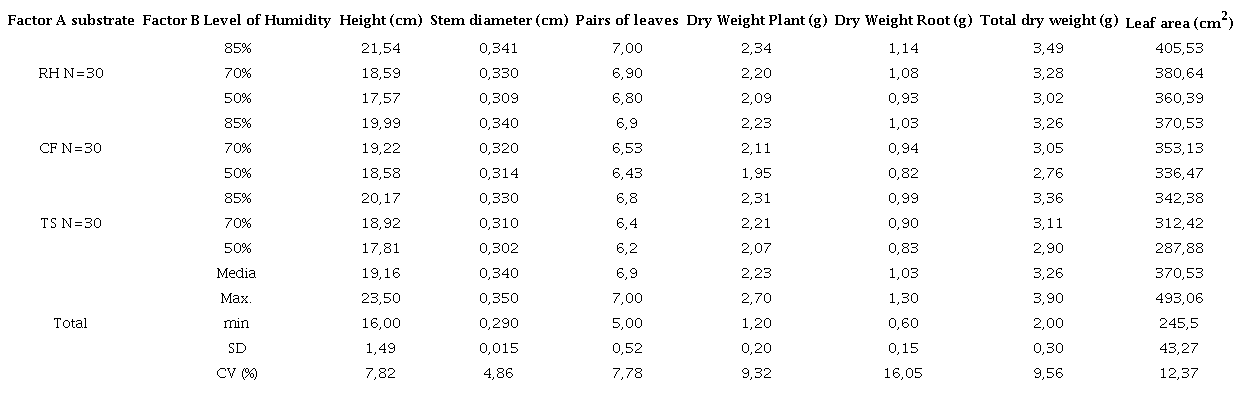
Legend: Rice Husk (RH); Coconut Fiber (CF); Technical Standards (TS)
CONCLUSIONS
-
The average partial irrigation duty by substrate type are: rice husk (14,44 mL plants-1), coconut fiber (12,1 mL plants-1) and technical standards (13,87 mL plants-1).
-
Consequently, the total net irrigation duty varies for each type of substrate where the largest volumes of water needed are in the rice husk substrate followed by technical standards and coconut fiber with 46,01, 42,37 and 36,16 mL m-2, respectively.
-
Of the substrates studied, the one with the highest water storage capacity is 50% coconut fiber + 50% soil, followed by 50% rice husk + 50% soil and finally the technical standards (50% organic matter + 50% soil) with 40,8%, 32,0% and 21,2%, respectively.
-
From the morphological point of view the best seedlings are achieved in the substrate composed of 50% rice husk + 50% soil + 2g multicote and maintaining a moisture level of 85% of the upper limit of available water.
-
To achieve high quality coffee seedlings, apply the following standards in phases:
-
Phosphorite -1st pair of leaves, daily watering with water volume of 23,89 m3 ha-1
-
1st pair - 2do pair of leaves, daily watering with water volume of 29,68 m3 ha-1
-
2do - 4to pair of leaves, watering every 2 days with water volume of 64,75 m3 ha-1
-
After 4to pair of leaves, water every 4 days with water volume of 140,19 m3 ha-1.
-
REFERENCES
ABAD, M.; MARTÍNEZ, H.M.D.; MARTÍNEZ, C.J.; MARTÍNEZ, G.P.F.: “Evaluación agronómica de los sustratos de cultivo”, En: Actas de horticultura, Ed. SECH, vol. 11, pp. 141-154, 1992.
BLANDÓN, J.: Producción de almácigos de café en tubetes en tres sustratos y tres tipos de fertilización, Inst. Proyecto Especial del Programa de Ingeniero Agrónomo, Zamorano, Honduras, 20 p., 2008.
CARVAJAL, J.F.: Cafeto-Cultivo y Fertilization, Inst. Berna, Instituto Intemacional de la Potassa, Berna, 254 p., publisher: Bern [Coffee-Cultivation and Fertilization]-, 1984.
DAMATTA, F.M.; RONCHI, C.P.; MAESTRI, M.; BARROS, R.S.: “Ecofisiologia do crescimento e da produção do cafeeiro”, Brazilian Journal of Plant Physiology, 19(4): 485-510, 2007, ISSN: 1677-0420.
HERNÁNDEZ, J.A.; PÉREZ, J.J.M.; MESA, N.A.; BOSCH, I.D.; RIVERO, L.; CAMACHO, E.: Nueva versión de la clasificación genética de los suelos de Cuba., Ed. AGRINFOR, La Habana, Cuba, Barcaz L L ed., vol. I, La Habana, Cuba, 64 p., 2015, ISBN: 959-246-022-1.
HERNÁNDEZ, J.A.; PÉREZ, J.M.; BOSCH, I.D.; CASTRO S N, L.: “La clasificación de suelos de Cuba: énfasis en la versión de 2015”, Cultivos Tropicales, 40(1), 2019, ISSN: 0258-5936.
IROGOYEN, J.N.: “Guía para la producción de viveros de café..”, Agenda cafetalera (El Salvador), 1(2): 1-24, 2000.
MORALES, D.: Influencia de la humedad del suelo y diferentes condiciones de aviveramiento del Coffea arabica L, Instituto Nacional de Ciencias Agrícolas (INCA), Tesis de Grado (Dr. C. en Ciencias Agrícolas), San José de las Lajas, La Habana, Cuba, 139 p., 1986.
MORALES, D.; JEREZ, E.: “Influencia de la humedad del suelo en el crecimiento del café, medido a los ocho meses, en viveros al sol”, Cultivos Tropicales, 4(4): 675-683, 1982, ISSN: 0258-5936.
SÁNCHEZ, C.; CABALLERO, D.; CUPULL, R.; GONZÁLEZ, C.; RIVERA, R.; URQUIAGA, S.: “Los abonos verdes y la inoculación micorrízica de plántulas de Coffea arabica sobre suelos Cambisoles Gléyicos”, Cultivos Tropicales, 30(1): 5-10, 2009, ISSN: 0258-5936.
SÁNCHEZ, C.; CABALLERO, D.; RIVERA, R.; CUPULL, R.: “Respuesta de cepas de hongos micorrizógenos (HMA) sobre el desarrollo de posturas de cafeto (Parte I). Suelo Pardo Gleyzoso”, Centro Agrícola, 33(1): 33-38, 2006.
SÁNCHEZ, E.C.: Comunicación personal sobre ssustratos de cultivo de plántulas de Coffea arábica L., 2019.
SILVA, N.; GONZÁLEZ., R.; RÍOS, M.; LÓPEZ, A.V.: “Gestión del riego en viveros de café del Tercer Frente. Santiago de Cuba”, Revista Baracoa, 12(2): 7-21, 1991.
SOTO, F.: “Estimación del área foliar en C. arábica L. a partir de las medidas lineales de las hojas”, Cultivos tropicales, 2(3): 115-128, 1980, ISSN: 0258-5936.
TRUJILLO, E.: “Aspectos económicos y financieros en plantaciones forestales”, En: Bogotá, Colombia, p. 24, 2012.
WENDLING, I.: Substratos, adubação e irrigação na produção de mudas, Ed. Aprenda Fácil, 2002, ISBN: 85-88216-32-9.
Author notes
*Author for correspondence: Enrique Cisneros Zayas, e-mail: enrique.cisneros@iagric.minag.gob.cu, cisneroszayasenrique@gmail.com
Conflict of interest declaration