ORIGINAL ARTICLE
Evaluation of the Mechanization Level of Aldeia Nova Farm
Avaliação do nível de mecanização da fazenda Aldeia Nova
 Mário Alfredo Albino marioalfredoyannick@gmail.com
Fernando do Souza Neto
Manuel Octávio Isaac Spinola
Yoandrys Morales Tamayo
Mário Alfredo Albino marioalfredoyannick@gmail.com
Fernando do Souza Neto
Manuel Octávio Isaac Spinola
Yoandrys Morales Tamayo
Evaluation of the Mechanization Level of Aldeia Nova Farm
Revista Ciencias Técnicas Agropecuarias, vol. 32, no. 2, e01, 2023
Universidad Agraria de La Habana
Received: 15 September 2022
Accepted: 13 March 2023
ABSTRACT: Agricultural mechanization plays a major role in food production. Its proper implementation requires knowing the indicators that affect its performance. The aim of the present investigation was to evaluate the main mechanization indices of Aldeia Nova Farm in Cela Municipalty. For this, the execution of the study consisted of a non-experimental descriptive investigation, which was divided into two parts. The first consisted of collecting personal data for the operation of the machine and tractor park, maintenance and repair, as well as production. Subsequentle, the mechanization indicators were determined by following methodological recommendations established by various authors. Within the results, the ratio values of tractors per hectare (0,008 tract ha-1), the ratio of average power per tractor (108,86 kW tract-1), the machines per tractor ratio (2,05), the ratio of arable hectares per tractor (126,5 ha tract-1) and the ratio of arable hectares per combine (631,25 ha col-1) were magnitudes studied that behaved outside the established. Finally, the level of mechanization of Aldeia Nova Farm was evaluated using the indices established for this purpose, and it was shown that it is low, since although the value of the available power per hectare (0,86 kW ha-1) is higher than the 0,75 kW ha-1 established in the specialized literature, the rest of the indicators register unfavorable magnitudes, except technical assistance indicators.
Keywords: Agricultural machinery, tractor, combine harvester, potency, availability.
RESUMO: A mecanização agrícola desempenha um papel primitivo na produção dos alimentos sua implementação adequada requer conhecer os indicadores que incidem em seu desempenho. O objetivo da presente investigação foi avaliar os principais índices de mecanização da fazenda Aldeia Nova do Município da Cela. Para isso a execução do estudo consistiu em uma investigação do tipo descritiva não experimental, a qual foi divida em duas partes. A primeira consistiu em efetuar uma coleta de dados com o pessoal que atende a exploração do parque de máquinas e tractores, sua manutenção e reparação assim como, a produção. Posteriormente foram determinados os indicadores de mecanização para o qual se seguiram as recomendações metodológicas estabelecidas por vários autores. Dentro dos resultados ressaltam os valores de a relação tractores por hectares (0,008 tract ha-1), a relação potência média por tractor (108,86 kW tract-1), a relação máquinas por tractor (2,05), a relação hectares cultiváveis por tractor (126,5 ha tract-1) e a relação de hectares cultiváveis por colheitadeira (631,25 ha col-1) magnitudes que se comportaram fora do estabelecido. Finalmente, avaliou-se o nível de mecanização da fazenda Aldeia Nova mediante os índices estabelecidos para isso, e se comprovou que o mesmo é baixo, pois apesar de que o valor da potência disponível por hectare (0,86 kW ha-1) é superior aos 0,75 kW ha-1 estabelecido na literatura especializada, o resto dos indicadores apresentaram magnitudes desfavoráveis. A exceção dos indicadores de assistência técnica.
Palavras chave: Maquinaria agrícola, tractor, colhedoras, potência, disponibilidade.
INTRODUCTION
Agricultural mechanization is for the world, the mechanism for the development of agriculture and the right answer to the need to meet the demand generated by the population increase of men in society and animals in production. Likewise, the benefits of mechanization that attract the most attention from farmers are the opportunity for field operations, high efficiency, productivity and reduction of heavy work (Pérez de Corcho et al., 2017).
Therefore, it is an agricultural process that requires a work programming and activity control system for both production indicators and economic, technical and technological indicators that allow for increased efficiency (Herrera et al., 2011).
In agricultural mechanization, three levels are differentiated (human, animal and driving) considering the energy source used (Shkiliova et al., 2014; Daum and Birner, 2020; Gavino et al., 2020). In addition, mention should be made of the incorporation of sensors, drones and robots (Marinoudi et al., 2019; Franco et al., 2020) that allowed the optimization of resources, considering this as a new level. The tractor, due to its variability, is the main symbol to measure the mechanization index, whose calculation uses basic information from the production area (Magalhães et al., 2013; Sharifi and Taki, 2016; Kumar and Tripath, 2019).
At an international level, several investigations have been carried out with the aim of diagnosing the level of agricultural mechanization. They were developed through the calculations established for their future planning, having as a premise the knowledge of the amount of agricultural land available and the desired production, in order to be able to make the right decisions (Gutiérrez et al., 2018; Macías et al., 2018; Rodríguez and Orbegoso, 2018; Loor et al., 2019; Hernández et al., 2020; Llano, 2021; Aragundi and Pacheco, 2022).
However, in Angola and specifically in the province of Cuanza Sul, there are no evidences of scientific publications on studies to diagnose or evaluate the level of mechanization of agricultural production companies. Only the report carried out by Gutiérrez et al. (2018), who referred that, in Africa, there is an estimate of 0,6 tractors for every 100 hectares.
Aldeia Nova Farm (S.A.) has a wide range of agricultural machines and tractors, which are designed to tackle mechanized tasks, humanizing work, in addition to increasing the productivity and yield of the different crops grown there. However, despite having modern technology and qualified personnel in the field of mechanization, no evidence was found to demonstrate that they take control of the different indicators of mechanization on the farm. This deficiency does not allow neither carrying out a correct planning of the exploitation of the machinery and tractors and the production plan, nor developing an assessment of whether with the available technique is possible to rationally fulfilling the mechanized tasks. Bearing in mind the above, the present investigation was carried out, which aimed to evaluate the main mechanization indices of the Aldeia Nova Farm in the Municipality of Cela.
MATERIALS AND METHODS
Location and Characterization of Aldeia Nova Farm
The investigation was carried out at Aldeia Nova-Waco Kungo S.A. Farm. Its main objective is agricultural production, industry and commerce, located on the right street of Kissanga. It is located in the city of Waco Kungo, Cela Municipality, Cuanza-Sul Province.
Diagnosis of Mechanization Level of Aldeia Nova Farm
For the evaluation of the diagnosis of the Aldeia Nova Farm, the mechanization indicators were determined, following the methodological recommendations established by Jróbostov (1977), Garrido (1989), González (1993), Muñoz et al. (2011) and Azoy et al. (2016) referring to the fundamentals of operating and maintaining the fleet of tractors and machines.
Tractors per Hectares ()
Where:
: is the total number of tractors: is the total hectares of land cultivated with and without mechanization.Average Power per Tractor ( )
Where:
: is the power in kW: is the total number of tractorsAvailable Power per Hectare ( ) or Mechanization Index (IM)
Where:
: is the power in kW: is the total hectares of land cultivated with and without mechanizationRatio of Machines per Tractor (Ri.t)
Ratio of Arable Hectares per Tractor (Rha.t)
Ratio of Arable Hectares per Harvester (Rha.c)
Technical Availability (DISP)
Where:
: is active park: is total parkTechnical Preparation ()
Where:
: is the average number of machines in good technical condition during the working period: is trim equipment: is the average number of tractors during the periodDC: is the total number of machinesUse of the Park ( )
Where:
: is the sum of machine-days actually worked in the period: is the sum of days planned machines.RESULTS AND DISCUSSION
Tractors per Hectare
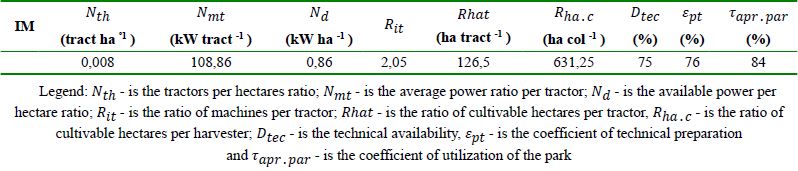
Table 1 presents the values of the indicators that characterize the level of mechanization of the Aldeia Nova Farm. For the ratio of tractors per unit of arable land area with and without mechanization, a value of 0,008 tractor ha-1. was obtained. This result is cataloged as low, as it indicates that the amount of tractors that the farm has to tackle agricultural tasks is insufficient. This magnitude is also lower than the value reported by Gutiérrez et al. (2018) which is 0,25 tractor ha-1 to the region of San Pablo Atotonilco. The difference between the results obtained in the present investigation and those presented by this author is the amount of hectares of arable land, which in our case is 2 525 ha.
Average Power per Tractor
As for the magnitude relating the average power per tractor (), the result was 108,86 kW tract-1 (Table 1). Result that is considered low, because thirteen tractors of the total (60% of tractors) have a power inferior to this magnitude. The average power value per tractor obtained in this investigation exceeds the 61,14 kW tract-1 reported by Larqué et al. (2012), result conditioned by the power values presented by the tractors of Aldeia Nova Farm, (82,02 to 171,51 kW). Magnitudes greater than those reported by Larqué et al. (2012), because in their investigation the tractors that were inspected did not exceed 74,57 kW.
Power Available per Hectare
The ratio of power available per hectare () obtained is 0,86 kW ha-1 (Table 1). This result can be considered as satisfactory since Gaetan (2007) cited by Sánchez et al. (2014), state that this indicator should be 0,75 kW ha-1. These results are above those reported by Rodríguez and Orbegoso (2018) as well as by Llano (2021), who reported values of 0,24 kW ha-1 and 0,12 kW ha-1, respectively (Figure 1).
This indicates that the farm has a higher mechanization rate than many regions of Latin America and even countries like Peru. However, the latter presents a mechanization index that is not 0,75 kW according to Gaetan (2007) cited by Sánchez et al. (2014), it means that it is low. It has the highest yields for major crops such as rice, corn and sugar cane, which denies the thesis supported by researchers who maintain that the highest level of mechanization technology corresponds to the highest yields.
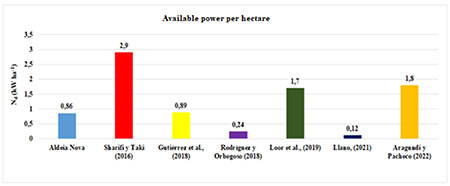
FIGURE 1
Available power per hectare.
On the other hand, this indicator is lower (Figure 1) than the values reported by Sharifi and Taki (2016)Gutiérrez et al. (2018), Loor et al. (2019) and Aragundi and Pacheco (2022) This is due to the fact that the research carried out by these authors demonstrates that the tractors that are used to tackle agricultural tasks have more power than necessary per unit of area to be worked or worked on. Even so, the value obtained for this indicator is good.
Ratio Machines per Tractor
The machine per tractor ratio resulted in 2,05 (Table 1). This magnitude is classified as low, as referred by authors such as Negrete (2011) and Macías et al. (2018), as these researchers state that this indicator should be between 4 and 7. This parameter behaves below those reported by Gutiérrez et al. (2018), Macías et al. (2018) and Hernández et al. (2020), with magnitudes of 3,31; 3,82 e 4,59 machines per tractor, respectively.
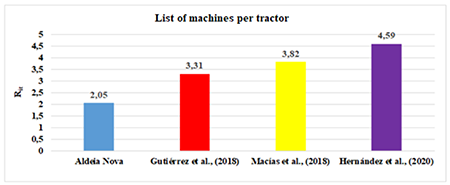
FIGURE 2
List of machines per tractor.
Hectare Ratio per Tractor
The magnitude of the hectare per tractor ratio () determined is 126,5 ha tract-1 (Figure 3), value that is high if it is considered that FAO (2011) reports that this indicator should be around 50 ha tract-1. This result indicates that in order to tackle agricultural tasks on the 2,525 hectares of land that the farm has, it is necessary to buy more tractors or rent them. Other investigators such as Larqué et al. (2012), Gutiérrez et al. (2018), Loor et al. (2019) and Hernández et al. (2020) determined this indicator. The values reported by them are equal to 10,96; 12,4; 48,8 e 13,08 ha tract-1, respectively, results that are below and close to the maximum reported by FAO (2011) which is 50 ha tract-1. However, in this investigation, the value of this indicator exceeds the magnitudes found by these authors and the FAO, which indicates that this indicator is not good, since the area to be worked is greater than the number of tractors.
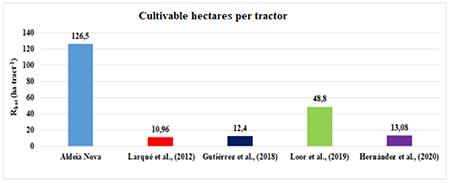
FIGURE 3
Cultivable hectares per tractor ratio.
Ratio of Harvesters per Arable Land Area
In the same way, the ratio of harvesters per arable land area behaves () with a magnitude of 631,5 ha col-1. This result indicates that the number of harvesters that the farm has is also insufficient to face the total area of arable land. For this reason, farm management should consider purchasing new harvesters on the market or renting the service to other companies. The value obtained for this indicator is more than ten times above the 50 ha tract-1 established by FAO (2011). This indicates that the number of harvesters is insufficient to face the harvesting processes.
Technical Availability and Technical Preparation
In the case of technical availability, the value obtained is 75%. This magnitude can be said to be acceptable, as Pérez (2006) and Zingg (2009) reported that this coefficient should range from 70 to 90%. Which indicates that despite the technical failures that occurred, the administration acceptably manages the inputs and spare parts that are required. In our case, it can be seen in Figure 4 a) that the value obtained (75%) is similar to that reported by Azoy et al. (2016).
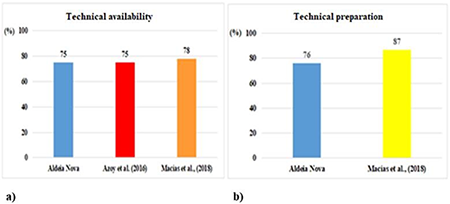
FIGURE 4
Technical assistance to machinery. a) Technical availability and b) Technical preparation.
But it behaved below the value reported by Macías et al. (2018) which was 78%. Although the said value is lower, it is considered acceptable since it is in the same range mentioned by other authors.
Technical Preparation
The coefficient of technical preparation () determined is 76% (Figure 4 b), which is low, as Jróbostov (1977) referred that the parameter values should oscillate in an interval between 85 and 95%. Evidencing that good management must be done to keep most tractors in good condition. As with technical availability, the coefficient of technical preparation obtained (76%) is below that reported by Macías et al. (2018) which was 87% (Figura 4 b).
Use of the Park
The coefficient of utilization of the park was 84%. Considering this result as acceptable, since it is within the range (80 - 95%) reported by Gutiérrez (2007), result superior to that reported by Macías et al. (2018) ) which is 77% (Figure 5). This result indicates that the management of the use of the park of machines and tractors is better than that carried out in the study of the previous authors. They state that this low result is due to the fact that the days actually worked on machines were below machine per day planned. The cause is attributed to the equipment that were inactive and for not having the spare part to carry out the repair work.
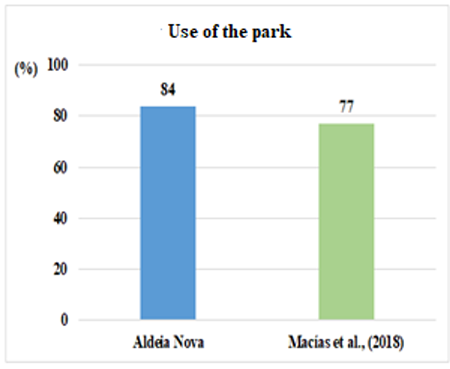
FIGURE 5
Use of the park.
CONCLUSIONS
-
The level of mechanization of the Aldeia Nova Farm was evaluated through the indices established for this purpose, and it was proved that it is low, because despite the fact that the value of available power per hectare (0.86 kW ha-1) is higher than the 0.75 kW ha-1 established in the specialized literature, the rest of the indicators showed unfavorable magnitudes. Except for the indicators related to technical assistance and the use of the park, which, although not high, are within the range.
-
The determination of the mechanization indicators under the real working conditions of the farm allows stating that the ratio hectares per tractor is high with a value of 126.5 ha tract-1 behaving above the 50 ha tract-1 established, and the 60% of the tractors are below the 108.86 kW tract-1 of average power, which indicates that to fulfill the tasks, it is necessary to reorient the planning of the tractor park or rent its service.
-
The ratio of agricultural machines per tractor does not exceed two implements per tractor, which limits the full use of the tractor in an agricultural cycle of the crops grown there, such as corn, soybean and sorghum.
REFERENCES
ARAGUNDI, D. M. A.; G. H. A. PACHECO: "Índice de mecanización agrícola de la Parroquia Crucita, Manabí - Ecuador", La Técnica: Revista de las Agrociencias, (Edición Especial): 37-52, 2022.
AZOY, C. A.; S. M. FERNÁND; L. SHKILIOVA: "Evaluación de la gestión del mantenimiento y la reparación de los tractores mediante indicadores", Ingeniería Agrícola, 6(2): 40.44, 2016.
DAUM, T.; R. BIRNER: "Agricultural mechanization in Africa: Myths, realities and an emerging research agenda", Global food segurity, 26: 1-10, 2020.
FAO, F. Dirección de Estadística, [en línea], Inst. Organización de las Naciones Unidas para la Agricultura y la Alimentación [en línea] Disponible en:http://faostat.fao.org/site/576/DesktopDefault.aspx?PageID=576#ancor[Consulta: 20 de Janeiro del 2022].
FRANCO, W.; F. BARBERA; L. BARTOLUCCI; T. FELIZIA; F. FOCANTI: "Developing Intermediate Machines for High-Land Agriculture", Development Engineering, 5: 2-14, 2020.
GARRIDO, J. P.: Implementos, máquinas agrícolas y fundamentos de su explotación., Ed. Pueblo y educación, Primera reimpresión ed, Ciudad de La Habana, 1989.
GAVINO, R.; V. CAMASO; C. TIW-AN: "Assessment of Mechanization Level of Onion Production in Nueva Ecija", CLSU International Journal of Science & Technology, 4: 81-98, 2020.
GONZÁLEZ, R. V.: Explotación del Parque de Maquinarias, Ed. Felix Varela, La Habana. Cuba, 1993.
GUTIÉRREZ, F.: Fundamentos para la investigación, administración y explotación de la maquinaria agrícola, Ed. México S. A. Universidad Autónoma de México, México, 2007.
GUTIÉRREZ, R. F.; Á. J. HERNÁNDEZ; H. GONZÁLEZ, ANDRÉS.; L. D. D. J. PÉREZ; C. R. SERRATO; C. A. LAGUNA: "Diagnóstico de tractores e implementos agrícolas en el municipio de Atlacomulco, Estado de México", Revista Mexicana de Ciencias Agrícolas, 9(8): 1739-1750, 2018.
HERNÁNDEZ, Á. J.; R. F. GUTIÉRREZ ; H. A. GONZÁLEZ; S. H. C. BAILÓN: "Nivel de mecanización agrícola en el municipio de Zinacantepec, Estado de México", Ciencia Ergo-Sum. Revista Científica Multidisciplinaria de Prospectiva, 27(1): 1-12, 2020.
HERRERA, M. I.; A. TOLEDO y M. P. GARCÍA: "Elementos de gestión en el uso del parque de tractores", Revista Ciencias Técnicas Agropecuarias, 20(1): 20-24, 2011.
JRÓBOSTOV, S. N.: Explotación del parque de tractores y máquinas, Ed. Mir, Moscú, 1977.
KUMAR, M. T.; A. TRIPATH: "Determination of agricultural mechanization parameters for Western Region of Uttar Pradesh, India", International Journal of Current Microbiology and Applied Sciences, 8(9): 132-140, 2019.
LARQUÉ, S. B. S.; E. L. CORTÉS; H. M. SÁNCHEZ, ÁNGEL.; G. A. V. AYALA; J. D. M. SANGERMAN: "Análisis de la mecanización agrícola de la región Atlacomulco, Estado de México", Revista Mexicana de Ciencias Agrícolas, Pulicación Especial(4): 825-837, 2012.
LLANO, G. W. O.: Índice de mecanización, oferta y demanda de tractores agrícolas en cinco provincias de la región Puno. Tesis en presentada en opción al título de Ingeniero Agronómo, 119pp., Facultad de Ciencias Agrarias, Universidad Nacional del Altiplano, Perú, 2021.
LOOR, S. O. A.; M. R. X. CEVALLOS y L. SHKILIOVA: "Diagnóstico de la mecanización agrícola en cuatro comunidades de la provincia de Manabí, Ecuador", Revista Ciencias Técnicas Agropecuarias, 28(1): 1-8, 2019.
MACÍAS, S. I.; A. A. A. DE LA ROSA; P. H. P. BASTIDAS; E. B. G. GASKIN; A. A. L. BARRERA; R. M. B. ZAMBRANO: "Evaluation of the exploitation of machinery in the grain Granma agribusiness", Revista Ciencia y Tecnología al Servicio del Pueblo, 5(2): 139-148, 2018.
MAGALHÃES, A.; J. SOUZA; M. SANTANA; O. SABBAG: "Analysis of the Mechanization Index of Wheel Tractors in Rural Farm Holdings", Journal of Agricultural Science, 5(11): 127-138, 2013.
MARINOUDI, V.; S. C. G.; S. PEARSON; D. BOCHTIS: "Robotics and labour in agriculture. A context consideration", Biosystems Engineering, 184: 11-121, 2019.
MUÑOZ, R. M.; L. LLANOS; D. SÁES: "Relación entre el Parque de Tractores Agrícolas y el Patrón de Difusión y Adopción mediante un Modelo Logístico", Información Tecnológica, 22(6): 121-128, 2011.
NEGRETE, J. C.: "Políticas de mecanización agrícola en México. Soc. Artículo de Portafolio. 22 p. http://www.revistacts.net/files/Negrete-editado.pdf", Revista Iberoamericana de Ciencia Tecnología y Sociedad, (1): 1-21, 2011.
PÉREZ DE CORCHO, F. J. S.; S. M. HERRERA; V. R. J. VIVAS; G. GARCÍA; R. VALDIVIEZO: "La mecanización agrícola: campo de acción de la ingeniería agronómica", Revista Siembra, 4(1): 60-65, 2017.
PÉREZ, M.: "Rendimiento de un tractor agrícola en función del sistema de labranza y la carga. Características de la tracción", BIOAGRO, 18(1): 41-51, 2006.
RODRÍGUEZ, D. S. C.; N. L. A. ORBEGOSO: "Diahnóstico de los sistemas de producción y mecanización en Perú", Revista Tzhoecoen, 10(3): 483-494, 2018.
SÁNCHEZ, H. M. A.; G. AYALA, A. V.; O. R. CERVANTES; H. M. GARAY; O. M. DE LA O; T. G. MARTÍNEZ; L. N. VELÁZQUEZ: "Diagnóstico de la maquinaria agrícola en Amecameca y Texcoco, Estado de México. 11(4):499-516.", Agricultura Sociedad y Desarrollo, 11(4): 499-516, 2014.
SHARIFI, M. A. y O. TAKI: "Determination of agricultural mechanization indices for rice cultivation in Iran: A case study of Isfahan province", Ecology, Environment and Conservation, 22(3): 41-47, 2016.
SHKILIOVA, L.; P. R. FUNDORA; C. C. JARRE: "La mecanización en la Intensificación Sostenible de la Producción Agrícola (ISPA)", La Técnica Revista de las Agrociencias, (13): 32-43, 2014.
ZINGG, R.: "Vida útil y uso anual de los tractores agrícolas en el Valle de Cajamarca Departamento de Cajamarca. Periodo 1996-2007", Anales Cientifícos, 70(2): 27-37, 2009.
Author notes
*Author for correspondence: Alain Ariel de la Rosa-Andino, alainariel41@gmail.com
Conflict of interest declaration