ORIGINAL ARTICLE
Feasibility of the Adequate Anaerobic Biodigestion Technology for a Dairy Agroecosystem
Factibilidad de la tecnología de biodigestión anaerobia adecuada para un agroecosistema lechero
 Darielis Vizcay-Villafranca darielisv@unah.edu.cu
Ramón Pelegrín-Rodríguez pelegrinramon458@gmail.com
Malgreter Noguera malgreternoguerabetancourt@gmail.com
Darielis Vizcay-Villafranca darielisv@unah.edu.cu
Ramón Pelegrín-Rodríguez pelegrinramon458@gmail.com
Malgreter Noguera malgreternoguerabetancourt@gmail.com
Feasibility of the Adequate Anaerobic Biodigestion Technology for a Dairy Agroecosystem
Revista Ciencias Técnicas Agropecuarias, vol. 32, no. 3, e04, 2023
Universidad Agraria de La Habana
Received: 03 February 2023
Accepted: 24 June 2023
ABSTRACT: The present investigation is oriented towards the determination of the economic, environmental and energetic feasibility of the anaerobic biodigestion technology suitable for a dairy agroecosystem, established in "El Guayabal" University Farm, belonging to the Agrarian University of Havana. For this, animal species existing in the scenario is determined, since it will contribute the organic waste to the biodigester. The number of animals is also determined, considering the movement of the herd, which would make it possible to determine the biomass generated daily with the purpose of establishing the sizing of the appropriate biodigester technology and knowing the behavior of the economic and energy parameters. Among the main results obtained, it was evidenced that the installation of a tubular polyethylene biodigester is more feasible than the installation of a fixed dome biodigester, meaning an economic saving of 19,796 pesos for the concept of technology selection. The necessary volume of this technology must be 20 m3, making it possible to produce 190 kg/day of biofertilizers, which represent an economic contribution of 2,375 pesos (95 USD) constituting an added value, in addition to the energy and economic benefits to be obtained. Moreover, with the introduction of the selected anaerobic biodigestion technology, it is possible to generate electrical energy to drive a fodder mill, a refrigeration system, a mechanical milking system, lighting, electric fencing and a water pumping system, all which require the acquisition of a 35 kW biogas generator.
Keywords: Renewable Energy, Dairy Production, Anaerobic Digestion, Energy Feasibility, Environmental Impact.
RESUMEN: La presente investigación se orienta en la determinación de la factibilidad económica, ambiental y energética de la tecnología de biodigestión anaerobia adecuada para un agroecosistema lechero, establecido en la Granja Universitaria “El Guayabal”, perteneciente a la Universidad Agraria de la Habana. Para ello se determina la especie animal existente en el escenario, dado que aportará los residuos orgánicos hacia el biodigestor, también se determina la cantidad de animales, considerándose el movimiento de rebaño, lo cual posibilitaría determinar la biomasa generada diariamente con el propósito de establecer el dimensionamiento de la tecnología de biodigestor adecuada y conocer el comportamiento de los parámetros económicos y energéticos. Entre los principales resultados obtenidos, se evidenció que la instalación de un biodigestor tubular de polietileno resulta más factible que la instalación de un biodigestor de cúpula fija, significando un ahorro económico de 19 796 peso por concepto de selección de la tecnología; el volumen necesario de esta tecnología debe ser de 20 m3, siendo posible producir 190 kg/día de biofertilizantes, que representan un aporte económico de 2 375 peso (95 USD) constituyendo un valor agregado, además de los beneficios energéticos y económicos a obtener. Además, con la introducción de la tecnología de biodigestión anaerobia seleccionada es posible generar energía eléctrica para el accionamiento de: un molino forrajero, un sistema de refrigeración, un sistema de ordeño mecánico, luminarias, cercado eléctrico y un sistema bombeo de agua, requiriéndose para ello de la adquisición de un generador de biogás de 35 kW de potencia.
Palabras clave: Energía renovable, producción lechera, digestión anaerobia, factibilidad energética, impacto ambiental.
INTRODUCTION
The current world faces two basic problems for the existence and future progress of humanity: stopping the growing environmental pollution and the search for and obtaining new sources of energy (Guardado-Chacón, 2006). The only way to have a secure energy future is to find an environmentally sustainable way to produce and use energy. If society's concerns about energy and the natural environment are not addressed, the steady and secure energy supply on which economies depend will be jeopardized (Priddle, 1999). It is necessary to take advantage of renewable energy sources based on the best use of local resources that, through the best use of appropriate technologies, contribute to saving conventional fuel and serve to return to the soil the nutrients it needs and protect the environment from pollution (Santos-Abreu et al., 2011).
A clear example of renewable energy sources is biomass, a term that refers to all organic matter generated from photosynthesis or produced by the trophic chain. And as raw material for recycling processes, it originates from recently expelled feces and urine (animal excrement), which are made up of the surplus of food already digested, but not used by the body, apart from waste such as bedding, food residues or added material (Grundey & Juanos, 1982).
Anaerobic digestion is a good alternative to treat waste with high content of biodegradable organic matter (Flotats-Ripoll et al., 2001; Sosa, 2017). Therefore, this treatment is indicated for agro-industrial wastewater, with a high load of biodegradable organic matter like discharges from the production of sugar, alcohol, meat, paper, preserves and distilleries (Rahayu et al., 2015; Suárez-Hernández et al., 2018). Besides, agricultural residues, such as slurry, manure (Bansal et al., 2017) and urban waste that includes both the organic fraction of solid waste (Biogas Association, 2016) and sludge from plants for treatment of urban wastewater (Frankiewicz, 2015).
Precisely, the biodigester is an anthropogenic remarkable technology to highlight in the biotechnological process of anaerobic digestion of biomass to obtain biogas. It is a hermetic reactor with a side inlet for organic matter, a top outlet through which the biogas flows and an outlet for obtaining effluents with biofertilizing properties, both products that contribute to solve producers’ needs and to promote organic agriculture, as an economically feasible and ecologically sustainable alternative (Zheng et al., 2012)
To these aspects, the high prices of fuels and the high local tariffs for electrical energy should be added, as factors to consider for the introduction of biodigesters or biogas plants at a national and regional levels to produce energy from agricultural production wastes (Parra-Ortiz et al., 2019).
Considering the previous criteria, at "El Guayabal" University Farm located in San José de las Lajas, Mayabeque Province, Cuba, a feasibility study was carried out on the anaerobic biodigestion technology suitable for introducing into a dairy agroecosystem, with the aim of producing biogas and biofertilizers.
MATERIALS AND METHODS
Dairy 021 of "El Guayabal" University Farm, belonging to the Agrarian University of Havana (UNAH), is located at 23°00'12.5" North latitude and 82°09'57.9" West longitude in San José de Las Lajas Municipality, Mayabeque Province, Cuba. It limits to the northwest with Dairy 023, to the northeast with the National Highway, to the southeast with Dairy 025 and to the southwest with Dairy 022. The total area is 36 ha, with typical Red Ferralitic soil according to Hernández-Jiménez et al. (2019). It has a flat relief, height above sea level of 120 m and annual insolation of 1825kWh/m2. The meteorological variables recorded during the period 2015-2021 at the Tapaste Meteorological Station (Figure 1), showed that the maximum temperatures reached in the region exceeded 26 ºC between the months of June to September and the coldest fell on average to 20,76ºC in January. Rainfall showed increases from May and indicated the highest mean values in June and August with 255,50 and 245,16 mm, respectively. The relative humidity varied between 72,8% (minimum, in March) and 84,6% (maximum, in December), while the wind speed expressed its maximum peak of 5,46 km/h during the month of February. The behavior of these climatic variables allows the satisfactory development of dairy farming.
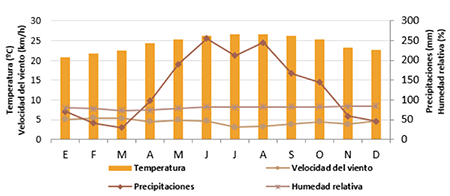
FIGURE 1
Monthly averages of the climatic variables in Dairy 021, period 2015-2021. Source: Tapaste
The consumption of electrical energy in the Dairy 021 during the year 2021 was analyzed and it showed a high monthly average consumption equivalent to 3 102,083 kWh is obtained.
The dairy has 34 milking cows, which reached an average daily milk production during 2021 of 7, 4 L/cow, so this dairy has a daily production potential of 251,6 L/day.
The existing means and equipment in the scenario under study, as well as their operating time, the energy consumption per operation, as well as the percentage of representation of each energy source are reflected in the Table 1.
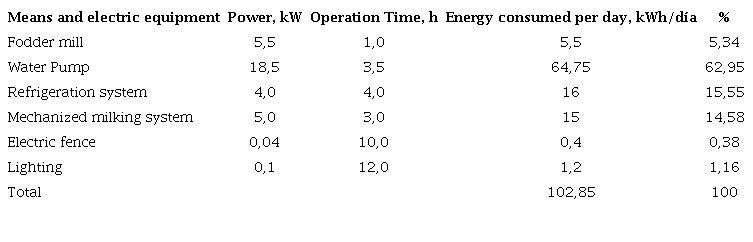
So that in this dairy 102,85 kWh of electrical energy are consumed daily, an element that demonstrates the high consumption of this productive scenario and only water pumping represents 62,9% of the energy consumed .
Methodology for the Sizing and Installation of Anaerobic Biodigesters
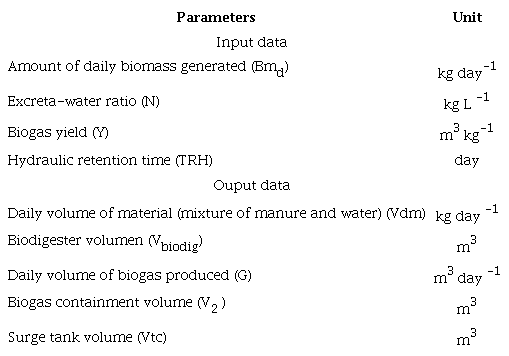
To calculate the design parameters of an anaerobic biodigester, it is necessary to know the input data, and those that must be determined (Table 2).
The daily amount of material (Bmd) is directly related to the amount of biomass that is generated, be it domestic, agricultural or animal waste. In addition, the maximum quantity that is obtained and the plans for productive increases must be taken into account.
The amount of daily biomass generated (Bmd) is determined through the following expression:
where: Ca- Number of animals; Ce-Amount of excreta per animal, kg/day; Rp- Ratio between the average live weight of the animal population and the tabulated equivalent live weight; Rt- Fraction between the time of confinement with respect to the length of the day, h/day
where: PVp-Average live weight of the animal population, kg; PVe- Tabulated equivalent live weight; Te-Hours of the day that the animal remains stabled, h/day
The daily volume of material (mixture of manure and water) (Vdm) is not more than the sum of the residual and the dilution of the biomass (residual and water).
where: N: Excreta-water ratio, kg L -1, it is required to know that the density of water is: 1000 kg/m3.
Meanwhile, the volume of the biodigester (Vbiodig) is calculated taking into account the value of the volume of material (mixture of manure and water) Vdm that enters the biodigester and the retention time TRH.
Subsequently, the daily volume of biogas (G) produced is calculated:
where: Y- Biogas yield, m3. kg-1
The biogas yield (Y) is determined by the expression:
where: X- energy conversion coefficient of the manure produced daily, that is, the daily production of biogas depending on the type of organic waste, m3/day.
For all types of biodigesters, the volume of the compensation tank (Vtc) is equivalent to the volume of gas produced, that is, it ranges between 25…30% of the volume of the biodigester.
In the specific case of the calculations for the sizing of a fixed dome biodigester (characterized by its three parts: conical, cylindrical and spherical cap, represented in Figure 2), they are presented below.
The steps that must be followed for its use are the following:
-
The total volume of the biodigester (Vbiodig) is calculated, based on the volume of the water-manure mixture and the retention time, as shown in expression 4.
-
The radius of the predefined volume (R) is calculated.
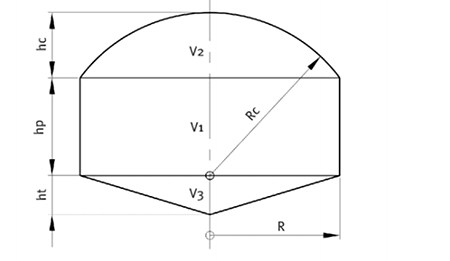
FIGURE 2
Main parts into which a fixed dome biodigester is divided. Source: Guardado-Chacón (2006) .
To calculate the radius of the predefined volume (R), the expression is considered:
where: R-Basic radius, m
Taking the radius of the predefined volume (R), the unit in meters is determined (U = R/4).
where: U- Proportional unit
This proportional unit allows determining the rest of the denominations, substituting U in the following proportions:
where: Rc-Radius of the dome, m; D-Diameter, m; hc=Height of the dome, m; hp= cylinder height, m; ht=Height of the base cone, m
From the determination of the main geometric parameters, the volumes corresponding to the base cone, cylinder and spherical segment of the dome are calculated:
RESULTS AND DISCUSSION
Technical-Economic Assessment of the Introduction of a Biodigester in the Conditions of Dairy 021
To determine the appropriate biodigester technology to install in the conditions of Dairy 021, belonging to "El Guayabal" University Farm, the sizing and construction cost of the fixed dome and tubular polyethylene biodigester technologies were taken into account. This analysis will allow determining which of the two technologies would be more feasible based on construction or acquisition costs in the market.
For the correct sizing of the fixed dome biodigester, the determination of the following parameters is required:
-
Amount of daily biomass generated (Bmd);
-
Daily volume of material (mixture of manure and water) (Vdm);
-
Volume of the biodigester (Vbiodig);
-
Volume of the fermentation chamber (Vcf);
-
Volume of the cylinder (V1);
-
Biogas containment volume (V2);
-
Volume of the base cone (V3);
-
Volume of the surge tank (Vtc).
On the other hand, to determine the potential energy contribution to be obtained based on the number of animals available, the determination of the following parameters is required:
-
Biogas productivity (Y);
-
Daily volume of biogas (G).
Before proceeding to the aforementioned determinations, the herd movement in the scenario under study must be known, which is reflected in Table 3.

The results obtained from each of these sizing parameters are represented in Table 4; these values are obtained from the herd movement conceived by the farm management during the period 2021-2022, represented in the previous table.
Considering that, for every 350 kg of cattle, 10 kg of manure are obtained, generating 0.36 m3 biogas/day, with a proportion of 1:1-3 of manure -water (taking a proportion of 1:1) and with a recommended retention time of 40 days, the sizing of the fixed dome biodigester for that species and number of animals will be determined.

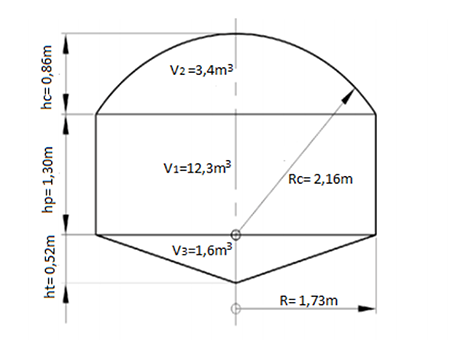
FIGURE 3
Main dimensions of the proposed fixed-dome biodigester.
Based on the values obtained in the sizing of the fixed dome biodigester, it is proposed that this biodigester have a volume of 20 m3, with the purpose of facilitating the process of installation and acquisition of the necessary materials.
To determine the energy contribution, the amount of biomass generated daily, the biogas yield and the daily volume of biogas are considered (Table 5).

As represented in Table 5, the biogas yield to be obtained according to the species is 0,036 m3/kg, if the total number of animals is considered, 1,22 m3/kg is obtained and for that number of stabled animals it is possible obtain a daily volume of biogas of 8,26 m3/day.
In order to have an estimate of the cost of the construction and installation process of the fixed dome biodigester system (without considering labor), Table 6 lists the materials required for the construction and installation of the technology.
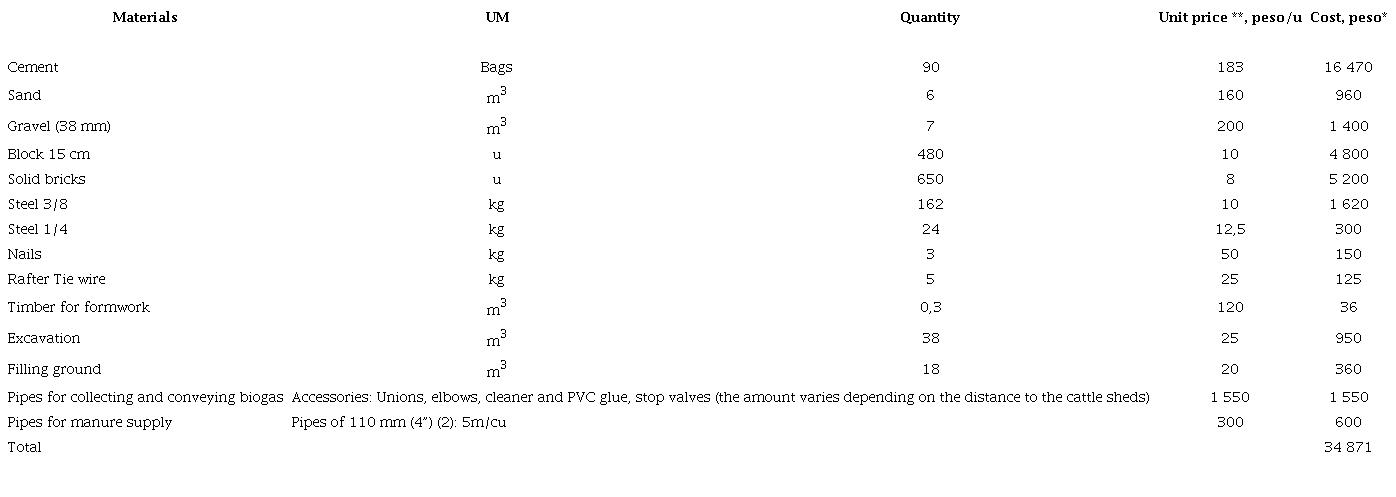
*peso: refers to the national currency (MN), the exchange rate is considered 25 MN = 1 USD ** Prices of construction materials established by the Ministry of Domestic Trade (MINCIN) in Cuba
In the case of the variant of the tubular polyethylene biodigester, the materials required for the construction and installation of the technology are listed in Table 7, in order to have an estimate of the cost of the construction and installation process (without considering labor). To have greater accuracy in the economic values, the main dimensions for a biodigester of 20 m3 were determined, these are reflected in Figure 4.
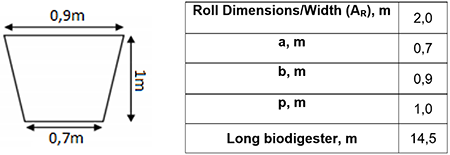
FIGURE 4
Main dimensions of the trench and the proposed polyethylene tubular biodigester.

As can be seen in Tables 6 and 7, the cost of these technologies is not high, although there is a difference between the two. In order to achieve a better understanding of the aspects related to the dimensioning of both technologies, as well as the energy contribution to be obtained with the biogas produced by the introduction of these technological variants, in Table 8, these values of both design and energy are summarized.
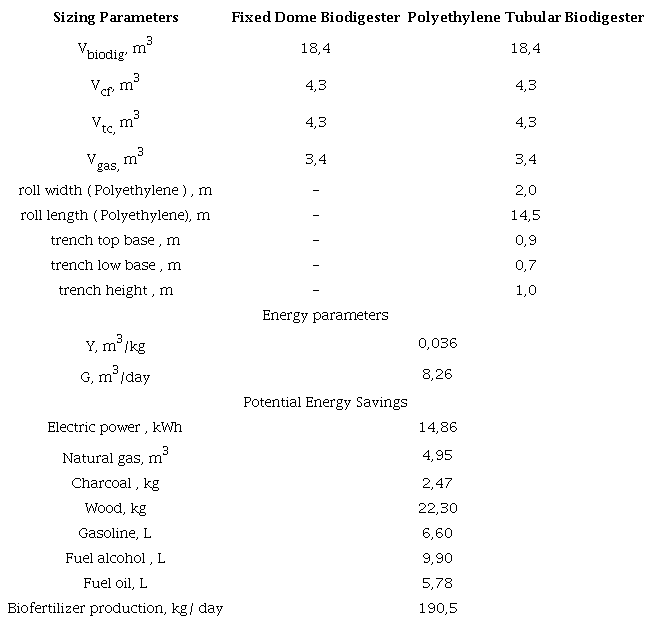
In the case of the fixed dome biodigester, if the investment required for construction materials is considered, which amounts to a cost of 34,871 pesos. If this is analyzed based on the energy savings to be obtained, for gasoline with a daily equivalent production of 6,60 L, based on the price of this fuel, which is equivalent to 25 pesos, a daily saving of 165 pesos would be obtained. Therefore, in one year (considering 365 days), this saving would be equivalent to 60 225 pesos, which shows that in just seven months of operation the investment for materials required for construction is recovered and a profit of 25 354 pesos is obtained in the rest of the year.
In the same way if the same analysis is carried out, but considering the saving of electrical energy, from the potential generation to be obtained with the use of biogas, which amounts to 14,86 kWh daily and taking the rate established by the Electric Company in Cuba:
-
From 0 kWh to 100 kWh: 0,33;
-
From 101 kWh to 150 kWh: 1,07;
-
From 151 kWh to 200 kWh: 1,43;
-
From 201 kWh to 250 kWh: 2,46;
-
More of 250 kWh: 3,12 for every kWh.
Then, there would be an average monthly saving of 890 pesos, which means an annual saving equivalent to 10 680 pesos. This evidences that in just 3,4 years of operation the investment for materials required for construction is recovered, so that there would be 16,6 years of gain, taking into account that the useful life of a fixed dome biodigester amounts to 20 years. These elements demonstrate the economic feasibility of the analyzed proposal.
For the tubular polyethylene biodigester, the investment required for construction materials amounts to a cost of 15 075 pesos. If this is analyzed based on the energy savings to be obtained, only for gasoline with an equivalent daily production of 6.60 L, from the price of this fuel that is equivalent to 25 pesos, daily there would be a saving of 165 pesos. Therefore, in one year (considering 365 days) this saving would be equivalent to 60 225 pesos, which shows that in just three months of operation, the investment for materials required for construction is recovered and a profit of 45 150 pesos is obtained in the rest of the year. This element demonstrates the economic feasibility of the proposal.
In the same way if the same analysis is carried out, but considering the saving of electrical energy, from the potential generation to be obtained with the use of biogas, which amounts to 14,86 kWh daily and taking the rate established by the Electric Company in Cuba:
-
From 0 kWh to 100 kWh: 0,33;
-
From 101 kWh to 150 kWh: 1,07;
-
From 151 kWh to 200 kWh: 1,43;
-
From 201 kWh to 250 kWh: 2,46;
-
More of 250 kWh: 3,12 for every kWh.
Then, there would be an average monthly saving of 890 pesos, which means an annual saving equivalent to 10 680 pesos. This evidences that in just 1,5 years of operation the investment for materials required for construction is recovered, so that there would be 3,5 years of profit, taking into account that the useful life of a tubular polyethylene biodigester amounts to 5 years. These elements demonstrate the economic feasibility of the analyzed proposal.
It is valid to point out that the correct dimensioning of this type of technology favors the maximum use of the waste obtained in the productive scenarios.
As evidenced in Table 8, the installation of biodigesters in agricultural production units constitutes an energetically viable option, to which the contribution to conservation and care of the environment should be added.
Therefore, in order to adopt biodigestion technology in the dairy under study, it is advisable from an economic point of view to introduce a tubular polyethylene biodigester.
With the introduction of this technology it would be possible:
-
To generate electrical energy to drive a fodder mill, a refrigeration system, a mechanical milking system, lighting fixtures, an electric fence, and a water pumping system. For that, the acquisition of a biogas generator of 35 kW of power is required. Considering all energy sources, if pumping water is excluded, then a biogas generator of 16,5 kW of power is required. On the other hand, if the acquisition of a biogas generator is considered for each energy source, then:
-
For the fodder mill, a 5,5 kW biogas generator is required;
-
For the refrigeration system, a 4 kW biogas generator is required;
-
For the mechanized milking system, a 5 kW biogas generator is required;
-
For lights and electric fencing, a 0,14 kW biogas generator is required.
-
According to the Chinese company Shenzhen Teenwin Environment Co, the price of these biogas generators ranges from 550… 1250 USD (13 750…31 250 pesos MN)
-
In addition, it is possible to obtain 190 kg/day of biofertilizers, which represent an economic contribution of 2 375 pesos (95 USD), based on the price of biofertilizers in the international market, which reaches a value of 500 USD/t (12,500 peso/t).
CONCLUSIONS
-
The proposed theoretical-methodological foundations made it possible to determine the economic, energetic and environmental feasibility of the appropriate anaerobic digestion technology to be introduced in the conditions of Dairy Farm 021 of "El Guayabal" University Farm.
-
With the installation of a 20 m3 tubular polyethylene biodigester, it is possible to produce 190 kg/day of biofertilizers, which represent an economic contribution of 2 375 pesos (95 USD), that constitutes an added value, in addition to the energy benefits and cheap to get.
-
With the introduction of anaerobic biodigestion technology, it is possible to generate electrical energy to drive a fodder mill, a refrigeration system, a mechanical milking system, lighting, electric fencing and water pumping system, which requires the acquisition of a 35 kW biogas generator.
REFERENCES
BANSAL, V.; TUMWESIGE, V.; SMITH, J.U.: “Water for small‐scale biogas digesters in Sub‐Saharan Africa”, GCB Bioenergy, 9(2): 339-357, 2017, ISSN: 1757-1693, e-ISSN: 1757-1707, Publisher: Wiley Online Library.
BIOGAS ASSOCIATION: Municipal guide to biogas Ottawa, Canada: Biogas Association, [en línea], Inst. Biogas Association, Ottawa, Canada, Ottawa, Canada, 4 de junio de 2016, Disponible en:https://biogasassociation.ca/resources/municipalguide_tobiogas. [04/06/2016].
FLOTATS-RIPOLL, X.; CAMPOS-POZUELO, E.; PALATSI-CIVIT, J.; BONMATÍBLASI, A.: “Digestión anaerobia de purines de cerdo y codigestión con residuos de la industria alimentaria”, Porci, (65): 51-65, 2001, ISSN: 1130-8451.
FRANKIEWICZ, T.: “People’s Republic of China Urban Municipal Waste and Wastewater Program”, [en línea], En: línea], En: Technology, Process and Evaluation Best Practices for Utilizing Organic and «Kitchen» Waste from the Municipal Solid Waste Stream» Workshop. Global Methane Initiative, Ningbo, China, Ningbo, China, p. 16, 2015, Disponible en:http://communitybysesign.co.uk/.2015.
GRUNDEY, K.; JUANOS, C.B.: Tratamiento de los residuos agrícolas y ganaderos, Ediciones GEA ed., Barcelona, España, 278-280 p., 1982, ISBN: 84-7287-025-1.
GUARDADO-CHACÓN, J.A.: Manual del Biogás, Ed. Editorial CUBASOLAR, La Habana, Cuba, 2006.
HERNÁNDEZ-JIMÉNEZ, A.; PÉREZ-JIMÉNEZ, J.M.; BOSCH-INFANTE, D.; CASTRO-SPECK, N.: “La clasificación de suelos de Cuba: énfasis en la versión de 2015”, Cultivos Tropicales, 40(1): 93, 2019, ISSN: 0258-5936, Publisher: Ediciones INCA.
PARRA-ORTIZ, D.L.; BOTERO-LONDOÑO, M.; BOTERO-LONDOÑO, J.M.: “Biomasa residual pecuaria: revisión sobre la digestión anaerobia como método de producción de energía y otros subproductos”, Revista UIS Ingenierías, 18(1): 149-160, 2019, ISSN: 2145-8456.
PRIDDLE, R.: “Energía y desarrollo sostenible”, IAEA Bulletin, 41(1): 2-6, 1999.
RAHAYU, A.S.; KARSIWULAN, D.; YUWONO, H.; TRISNAWATI, I.; MULYASARI, S.; RAHARDJO, S.; HOKERMIN, S.; PARAMITA, V.: “Handbook POME-to-biogas project development in Indonesia”, Winrock International, United States of America, : 8-19, 2015.
SANTOS-ABREU, T.; MEDINA-MORALES, N.; MACHADO-MURO, Y.; MARTÍN-SANTOS, T.: La Educación Agropecuaria en la Escuela Cubana Actual, Ed. Editorial “Félix Valera", Estudio de la Educación Ambiental. Villa Clara, Cuba ed., Villa Clara, Cuba, 2011.
SOSA, R.: “Indicadores ambientales de la producción porcina y ganadera”, En: VII Seminario Internacional de Porcicultura Tropical, Instituto de Investigaciones Porcinas, La Habana, Cuba, 2017.
SUÁREZ-HERNÁNDEZ, J.; SOSA-CÁCERES, R.; MARTÍNEZ-LABRADA, Y.; CURBELO-ALONSO, A.; FIGUEREDO-RODRÍGUEZ, T.; CEPERO-CASAS, L.: “Evaluación del potencial de producción del biogás en Cuba”, Pastos y Forrajes, 41(2): 85-92, 2018, ISSN: 0864-0394, e-ISSN: 2078-8452.
ZHENG, Y.; WEI, J.; LI, J.; FENG, S.; LI, Z.; JIANG, G.; LUCAS, M.; WU, G.; NING, T.: “Anaerobic fermentation technology increases biomass energy use efficiency in crop residue utilization and biogas production”, Renewable and Sustainable Energy Reviews, 16(7): 4588-4596, 2012, ISSN: 1364-0321.
Author notes
*Author for correspondence: Yanoy Morejón-Mesa, e-mail: ymorejon83@gmail.com o ymm@unah.edu.cu
Conflict of interest declaration