Dossiê: Comparação internacional de modelos de empreendimentos de economia social e solidária
Collectivity in the generation of income and local development: A comparison between Israeli Moshavim and an association of Maria da Fé, Braz
Coletividade na geração de renda e desenvolvimento local: comparativo entre os Moshavim israelenses e uma associação de Maria da Fé, Brasil
Collectivity in the generation of income and local development: A comparison between Israeli Moshavim and an association of Maria da Fé, Braz
Ciências Sociais Unisinos, vol. 52, no. 3, pp. 354-361, 2016
Universidade do Vale do Rio dos Sinos

This work is licensed under Creative Commons Attribution 4.0 International.
Received: 01/08/2016
Accepted: 15/09/2016
Abstract: The exercise of thinking about local development involves considering all the complexity of the actors and their interactions in the economic, environmental and social fields in an articulated way. Some of the forms of articulation for income generation are cooperatives and associations that, through collective work and management, give the community and those involved the role of agents. As a way of thinking about local development through collective initiatives for income generation, our aim is to conduct a transnational comparative analysis of rural cooperative Israeli communities, Moshavim, and an Association of Artisans in the municipality of Maria da Fé, in the state of Minas Gerais, Brazil. The methodology took into account the local context of the enterprises, structuring the comparative case study on the basis of the parameters of pluriactivity, rural enterprises, use of natural resources, alternative generation of income, cooperative organization and mutual assistance. The results indicate similarities in the rurality of both, in the use of natural resources and in mutual assistance. The main differences are in the pluriactivity and in the use of manpower (self-labor and wage -labor).
Keywords: local development, generation of income, collective organizations, Moshav, Association of Craftsmen, comparative analysis.
Resumo: O exercício de pensar o desenvolvimento local implica considerar toda a complexidade de atores e suas interações nos campos econômico, ambiental e social de forma articulada. Uma das formas de articulação para a geração de renda são as cooperativas e associações, que, por meio da coletividade no trabalho e gestão, conferem à comunidade e aos envolvidos o papel de agentes. Como forma de pensar o desenvolvimento local por meio das iniciativas coletivas de geração de renda, este artigo objetiva realizar uma análise comparativa transnacional entre as comunidades rurais cooperadas israelenses, o Moshavim, e uma Associação de artesãos do município de Maria da Fé, na região sul do estado de Minas Gerais. A metodologia se fez levando em conta os contextos locais entre os empreendimentos, estruturando o estudo de caso comparativo com base nos itens pluriatividade, empreendimentos rurais, uso de recursos naturais, geração de renda por meios alternativos, organização cooperada e assistência mútua. Os resultados obtidos apontam similaridades quanto à ruralidade de ambas, ao uso de recursos naturais e à assistência mútua. As principais diferenças estão na pluriatividade e no uso da mão de obra (self-labour e wage labour).
Palavras-chave: desenvolvimento local, geração de renda, organizações coletivas, Moshavim, Associação de Artesanato, análise comparativa.
Introduction
Blending local development with alternative ways of generating income depends on the organizations and social movements that promote new opportunities for communities and their actors. This reflection is based on the view that the concept of development differs from economic growth. While the latter refers to increased production of goods and services within a society, economic development is related to continued economic growth, greater than the population growth, but mainly involves social and environmental changes in the country’s structure, leading to quality of life for society (Souza, 2011).
From perspectives which covers local particularities and each social structure being dealt with, local development can be defined as an endogenous process that occurs in certain localities, fostering economic growth and improving the quality of life in the region. Two types of social movements will be presented: a type of cooperative, the Moshavim, and an Association of Craftsmen, based on the premise that they contribute to their local development.
This research focuses on a comparative study between an organization inserted in the informal market and an informal one, although they are distant from each other. The comparison will track an analysis of the main differences and similarities between the Moshavim in Israel, characterized by the mobilization of a rural community in the agricultural area, and the Association called ‘Casa do Artesão Mariense’, which is located in the municipality of Maria da Fé, in the southeast of the state of Minas Gerais. In this case, the type of Moshav that will be discussed in this paper is the original one, that existed up to the 1980s. The Moshavim underwent major changes during the past 20 years, and these changes will be shown during the discussion. The characteristics of the original type of Moshavim and the modern one will be described throughout this article.
The choice of these groups in particular is justified by the structural similarities between them, their forms of cooperative for production and sales, and the fact that both are rural. A parallel is drawn between the social movements in question, outlining the points they have in common and their differences ones. The research has an interdisciplinary basis and aims to integrate different disciplinary proposals through the relationship between economics and social sciences as a complementary perspective.
Literature review
Informal market in the context of local development
The accelerated process of contemporary industrialization has contributed to the expansion of cities, setting off a migration stimulated by employment opportunities and social ascension. However, in this process, not all workers are absorbed by the formal market; workers and enterprises thus enter the informal economy. This is one of many paths that lead to the informal economy. According to the International Labour Organization (OIT, 2006),
The informal economy absorbs workers who would otherwise be without work or income, especially in developing countries that have a large and rapidly growing labour force, for example in countries where workers are made redundant following structural adjustment programmes.
The procedure to define the informal economy is complex and involves different disciplines, perspectives, policies and norms set by government agencies in each society. Thus, conceptions change according to the territory, to the predominant type of economic activity and to the existence of niche markets. Also, the reasons behind the informality in employment can vary: restructuring of the labor market, unemployment, and alternative sources of income generation or even a way to escape the bureaucracy and taxes when opening of a new business. According to a report by the International Labour Organization (OIT, 2016) the unemployment rate will continue to grow around the world by 2017, creating 700,000 new unemployed people in the next year. Therefore, the informal employment rate is likely to increase as a response to this wave of layoffs and fewer offers of new jobs (Vieira and Araújo, 2016; OIT, 2011, Krein and Proni, 2010; Schneider, 2011).
In this context, these developments have been gaining ground in the economy, as globalization allows for the creation of new markets mainly for regional products (Dagnino, 2004). The discussions about economic development also include social entrepreneurs, because they provide income to many families who, in turn, move the local economy. In this case study, the Association of Artisans is inserted in the informal economy and the Moshavim in the formal one. Through a comparative analysis, the possible causes that led one social movement to formality and the other one to informality will be discussed.
In the field of social issues, Sen (2010) argues that the persistence of poverty and several problems, such as hunger, violation of political freedoms and, in this case, formal basic freedoms and denial of access to the formal market, have to be overcome. In this sense, social entrepreneurs are assumed to play an important role in fighting these problems (Sen, 2010).
Autonomous and collective cooperatives and associations, such as cooperatives and associations at the local level, have induced the development processes for the articulation of actors3 in harnessing local potential (Freitas and Freitas, 2013). These collective forms of organization, management and entrepreneurship are natural, according to Klaes (2005), and are the result of feelings of cooperation, solidarity and mutual support. Another point to note in the regional development process is that windows of opportunity are emerging in “that regions and locations outside the major axes of agglomeration trigger development processes” (Fochezatto 2010, p. 167, translation by the authors).
Lately, regional development approaches have gone from the microeconomic to the mesoeconomic level, focusing on a region and its competitive and globalized potential. The alternative is increasing the capacity of the region to mobilize its local resources. Cooperative and associative organizations are intermediate forms of arrangements based on a set of peripheral/central relations on both the supply side and the demand side. This articulation is made through the interaction between the actors and collective learning through cooperation (Fochezatto, 2010; Cândido and Abreu, 2000; Ferreira, 2012).
Understanding Moshavim and the Association
Inserted in relations formed between collective organizations focused on the generation of income and local development are the social movements, such as cooperatives and associations. In this article, more specifically, they are represented by the Association of moshavim and artisans, building a bridge between Israel and Brazil, but respecting their different contexts and purposes.
According to Haruvi and Kislev (1984), the Moshavim are cooperative communities located in Israel, in most cases, family settlements and farmers. The majority of these settlements “are planned and organized as cooperative societies and registered as legal entities” (Soffer and Applebaum, 2006, p. 326).
It is important to point out the differences between moshavim and kibbutzim. The kibbutz is a self-contained social and economic unit in which decisions are taken by its members, and property and means of production are communally owned. In 2013, 1.7% of the population were in 267 kibbutzim, but now they are increasingly engaged in industry, tourism, and services. Many kibbutzim have modified their traditional collective approach and are in various stages of privatization (Israel Ministry of Foreign Affairs, 2013). Kibbutzim began to develop activities focused on industry and still have a significant percentage of their population employed in non-agricultural activities. This is one of the most remarkable differences between Kibbutzim and Moshavim (Sofer and Applebaum, 2006).
The moshavim emerged when the state of Israel had not yet been created, in the 1920s, along with the kibbutzim. These early communities were created with a socialist character by immigrants fleeing from pogroms in Russia (Scheindlin, 2003).
In 2001, there were about 410 of them scattered in Israel, usually covering 60 to 100 families (Sofer, 2001). Their members are called moshavnik, and “the first moshav was established in Jezreel, or Yezreel, Valley (Emeq, Yizreel is also known as the Valley of Esdraelon) in 1921” (Metz, 1988). Around 2010, there were about 408 moshavim throughout Israel, comprising about 35% of all rural settlements. The average moshav contains between 60 and 100 family holdings (Ben-Dror and Sofer, 2010).
There are two types of moshavim, and the more numerous ones are the moshavey ovdim, which are based on the purchase of inputs and marketing of products, and the family is the basic unit of production and consumption. The second type is called shitufim moshavim; although their consumption is family or household-based, production and marketing are collectivized. Contrary to the moshavey ovdim, the land is not given to families or individuals, but is collectively worked on (Metz, 1988).
Compared to other cooperative groups in Israel, among them Kibbutzim (collective settlements), Moshav Shitufi (semi-collective settlements), and Yishuv Kehillati (unifamilial settlements), the moshavim comprise the largest group (Soffer and Applebaum 2006), and the emphasis is on “equal distribution of the means of production” (Baldwin, 1972, p. 42).
Another feature is that cooperatives (moshavim) are located within a community and all their inhabitants are members of this community and practice mutual assistance. Another point relates to the offering of municipal services to the cooperative members, such as ease of access to education, culture, sports, religion, health services, roads, lighting of public areas, among other guarantees.
In the present, the Moshavim underwent changes concerning foreign labour, in-moving of urban citizens who are not working in agriculture, and internal problems – all together causing a decline of their cooperative character (Applebaum and Sofer, 2012, p. 205).
The transition from dependence on agriculture to a more diversified economic base has changed the nature of the moshav from a relatively homogeneous farming community into a multi-functional heterogeneous space. Furthermore, the influx of new residents has brought about new patterns of demand for goods and services. Hence, the moshav has changed from a space of production to a space of mixed production and consumption.
Before entering into the definitions of Association and the description of the characteristics of ‘Casa do Artesão’, it is necessary to outline the differences between the concepts of association and cooperative. Cooperative is the union of people who voluntarily associate to produce, sell or provide a service, through a jointly owned and democratically managed enterprise (Becho, 2002; Cruzio, 2005; Frantz, 2009). A cooperative includes on its agenda political, social, cultural and economic questions, and there is a political perception of a social movement by the cooperative. An association is a complex organization with social objectives and has legal instruments such as bylaws and regulations. In rural areas, the association can be understood as an instrument of participation in land and citizenship (in contrast with exclusion) (Ricciardi and Lemos, 2000; Inojosa and Junqueira, 2008; Picolotto, 2008).
The concept of association is connected “to adopting working methods that foster trust, mutual aid, strengthening human capital, among other factors”, while the concept of cooperative “is connected to gathering people to care for common aspirations and economic, social and cultural needs, through a collective company” (SEBRAE, 2014).
The Association ‘Casa do Artesão Mariense’ was inaugurated on June 7, 2008 and has 40 members, half of whom participate in the sale and maintenance activities of the showroom area. One of the factors that led to the creation of the Association was the closing down of the ‘Com Arte’ shop; part of the artisans joined the Cooperative ‘Gente de Fibra’4 and the remaining ones were excluded. There was also the interest of local authorities in integrating artisans who had never participated in any social movement. The showroom operation takes place in a former railway station, with authorization for use granted by the municipal administration, located in the cultural center of the municipality of Maria da Fé, Minas Gerais (Figures 1a and 1b). The handicraft production is distributed in the artisans’ homes.
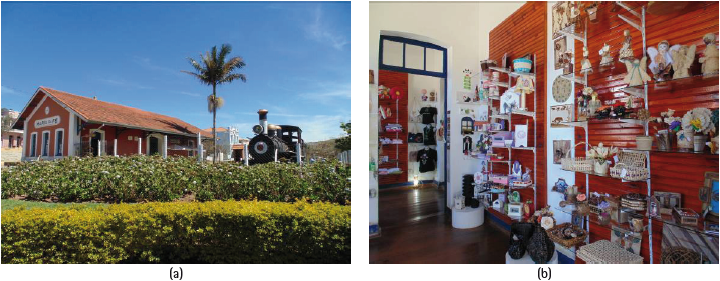
Figure 1
Association of Artisans – Maria da Fé.
According to the text on the website of the municipal administration of Maria da Fé (Prefeitura Municipal de Maria da Fé, 2013, translation by the authors),
Because there are many artisans who are not part of a cooperative or association, the City Department of Culture and Tourism decided to create the ‘Casa do Artesão’, a nonprofit organization aiming to provide them with a place where they could make, exhibit and sell their products. With the cooperation among the artisans who belong to the Association, a rotation system was established among them.
Each craftsman has a segmentation of products, materials and production processes, constructing the inherent diversity that is the brand of the Association. Sales of items are concentrated in the sale area of ‘Casa do Artesão’, and the key inputs used in craft production are banana fiber, fabric, husk, wood, jute, seeds, olive oil, recycled newspapers, among others. The means of acquiring inputs is mostly from their own production, through donation or purchase. As a means to disseminate crafts and other products produced in the city, the Winter Art and Design Festival is annually organized, and several regional artists and artisans exhibit their works and products, integrating the creative economy to the regional tourist circuit. The event also provides space for dining, entertainment and workshops.
Comparative analysis
This study covered two types of organizations (Moshavim and Maria da Fé Association) located in two different regions: South America and the Middle East. The methodology consists of data collected from bibliographic and field research: information on the Moshavim was obtained in the texts of Galor (2002) and Sofer (2001), and data about the Maria da Fé Association were obtained through a field research carried out in the Association.
The comparative analysis concentrated on six parameters that guided the discussion on collectivity and local development: (a) pluriactivity, (b) rural businesses, (c) natural resource use, (d) generation of income by alternative means (cooperativity and associativism), (e) self-labour and wage-labour, and (f) cooperative organization and mutual assistance.
The similarities and differences between the moshavim and the Association are listed in Table 1. They are compared in terms of their characteristics and their respective concepts, highlighting and considering that the concepts are selected and adapted to the discussions of this comparative analysis. The Moshavim today is different, with changes in many features:
The emerging image is one of transition from the previous hegemonic formation of rural Israel, based on principles of equality and cooperation, towards a commodified, multi-functional countryside, associated with both agricultural and non-agricultural activities, and the appearance of a new middleclass territory. This process of transition is reshaping and redefining the moshav basic principles and is raising questions about its ability to retain its identity as a unique rural community and its future course of development (Applebaum and Sofer, 2012, p. 205).
The characteristics were listed based on similarities and differences that sustain the cooperative and associative collective organizations (Table 1).
| Features | Concept | Moshav | Association ‘Casa do Artesão Mariense’ |
| Pluriactivity | “Combination of agricultural activities with other monetary activities within or outside the family property, unifying the concepts of productive diversification and part-time farming” (IBGE inCruz, 2012, p. 257). | There are activities for production, storage, supply of inputs, marketing, consumption, housing and construction, transportation, accounting, insurance and technical services (Galor, 2002). | In addition to crafts, the members produce products based on olive extract and plant compounds that are abundant in the municipality of Maria da Fé, Minas Gerais, besides producing and selling teas and beverages that are typically regional (Field Notebook, 2013)*. |
| Rural businesses | Business management with rural location that goes beyond agriculture and production of raw materials, incorporating trade and industries. This form of development is subject to climate issues and restrictions imposed by nature (Uecker et al., 2005). | The moshavim are established on farms and/or settlements with rural location and community, consisting of the farmers’ families and hired labor (Sofer, 2001). | The Association ‘Casa do Artesão Mariense’ is located in the municipality of Maria da Fé, with about 14,600 inhabitants. The city has a vocation for rural tourism and ecotourism. Several of the artisans get your materials and produce in rural districts of the municipality. |
| Natural resource use | Natural resource is defined here as “any element or aspect of nature that is in demand, is liable to or is being used by man, directly or indirectly” (Venturi, 2006, p. 13). | Among the economic activities practiced in the moshav, agriculture remains the main source of income. Galor (2002) mentions that there are families whose income is based solely on agriculture, or on combining agriculture with other income-generating activities. | The artisans use the fiber from banana grown in their properties and which is intended, in addition to craft production, for local sales (Field Notebook, 2014)**. |
| Generation of income by alternative means | Ways of obtaining income “based on a new thought allow realizing that the solution is within our possibilities [...] breaking with exogenous standards” (Lisboa, 2014, p. 9). | Cooperativity is the principles of moshavim, which are legally organized and structured as a cooperative society (Galor, 2002). | At the ‘Casa do Artesão Mariense’, the money from the sale of an item is destined to the artisan who produced it, and 20% or 40% of the sale amount is directed to the monthly stock for sales space, 20% for those who participate in sales activities, and 40% for those who do not participate. |
| Self-labour and wage-labour | Self-labour (or self-employment) means “self-work”, too. Wage-labour is characterized by socioeconomic relationships between worker and employer. | Formerly, each family was able to perform most of the agricultural work without resorting to hired labor. Currently, some moshavim hire workers according to the season and sector, locally or from foreign countries (Sofer, 2001). | The Association falls within the concept of self-labour, since the artisans collect and prepare the fibers, and then manufacture and sell the piece in the showroom. |
| Cooperative organization and mutual assistance | Organization structured on collective work, fair and free solidarity and democratic, with social, economic and political purposes (Monje-Reyes, 2011). | “The cooperative was formed to deal with joint purchasing, marketing activities and mutual financial commitments. Mutual assistance is provided by other members to help work on their land when one of their members is incapacitated” (Sofer, 2001, p. 365-366). Without this form of cooperation and mutual assistance, the moshavim would not exist (Galor, 2002). | Banana tree fiber and various inputs and tools are shared among the artisans, along with craft objects used in manufacturing. The sales activity is conducted on a monthly scale; one or two artisans are in charge of selling all the craft products. The cleaning and maintenance of the space are also shared. |
Among other aspects, it is noteworthy that both organizations have the same average number of members (between 40 and 80). The moshavim are scattered in the country, but each has its peculiarities (number of members, services offered, size of the farm on which it is located, among others) and have self-sufficiency in the development of the works and procurement of inputs. The Association only counts on a store; production is decentralized in the artisans’ homes. It should be emphasized that all items compared in the table influenced the socio-economic transformation in these groups.
The comparative analysis allows verifying that, in the pluriactivity, the moshav provides a wider range of services than the Association, which offers a larger number of products. As both are rural, they are characterized by having the land as their main source of natural resources.
Regarding cooperative and associative features, it is worth highlighting that both have economic purposes, but they are different as regards profit. The moshavim are legally organized and structured as a cooperative. The Association only uses the sales space to organize and to individually exhibit craft items produced in their homes, in which 80% or 60% of the income from sales is directed to the artisan who produced it, and the other portion is allocated to a reserve for maintaining the sales space; in other words, it is nonprofit.
The differences in the field of labour use are those between self-labour and wage-labour. Moshavim took one step forward as regards hiring labor (wage-labour). Formerly, there was only self-labour – as in the Association – and the need to hire emerged from new demands for products and services. Currently, ‘Casa do Artesão’ uses self-labour, and the labour of artisans is not exclusively for the production of handicrafts, but also to obtain the inputs for production, maintenance and sales.
The similarity is not solely related to pluriactivity and rural location, but also to the cooperative and mutual assistance organization. The sharing of inputs, financial assistance and development of activities are present both in the moshav cooperative organization and in the Association.
In short, the main similitude between the two types of enterprises refers to the concept behind their formation, that is, both were built on the view that cooperation can provide greater sustainability to small producers. On the other hand, the great difference between them seems to be the fact that in the case of Association this kind of organization led to indulgence by the members, which generated a standstill. This seems to not have happened with moshavim.
Final remarks
This article has sought to show the differences and similarities between two rural organizations in two different locations designed to promote local development through cooperativity and associativism. The main similarities are related to the location – for both are rural – and to the use of natural resources – with the soil as the primary source. Both have cooperative organization and mutual assistance, sharing supplies, financial aid and work.
The most remarkable differences are pluriactivity and use of manpower; whereas the moshavim offer greater diversity in services and labour of the moshav members (self-labour) and hired labour (wage-labour), and a greater diversity in products, the Association only uses the craftsmen’s labour (self-labour).
As far as the questions between Moshav/Kibbutz are concerned, it is important to say that the immigrants who went to Moshavim – or founded Moshavim – would have had the option to move to a Kibbutz. So, why did they choose a Moshav? It was not only because of the economic necessity of the immigrants, but it also involved an ideological decision to neither stay in a town nor to choose a Kibbutz, but to look for some less radical version of a socialist model.
One of the differences between the enterprises’ contexts is that the Association of Maria da Fé is a result of the initiative of citizens, and the Moshavim are funded by the Israeli government. An important point is that the starting point of each of these initiatives seems to have provided a work dynamics and development in each of the organizations studied. The installation of moshavim occurred out of necessity and arose from initiatives of immigrants facing a difficult situation in their countries of origin. They settled in inhospitable regions and created productive communities since then, and played an important social and political role in the creation of the State of Israel. In Brazil, this movement somehow resembles the immigration that occurred in the late 19th century, when immigrants, mostly Italians and Germans, fled from difficult situations in Europe, looking for better living conditions, and established rural communities which subsequently became cities.
In the case of the Association of Maria da Fé, on the other hand, the starting point came from the municipal government, which urged the creation of an Association to alleviate the unemployment caused by the closing down of the store ‘Com Arte’ and also to provide a way to centralize the sales of several artisans who had no place to present their crafts. Therefore, the showroom at the Cultural Center attracts tourists and consumers to the region.
Through comparative mechanisms, the contrasts and multi-scale dimensions of the cases allow us to understand social phenomena and idiosyncrasies (Giraud, 2009, p. 16). The vast differences between Israel and Brazil in economic, cultural and social terms constructed the context of this study. In a country marked by Judaism, Israel boosted its economy through entrepreneurship, education, innovation and technology. In less than 70 years, the country has achieved the 35th place in the Gross Domestic Product (GDP), while Brazil ranks 9th according to the IMF (International Monetary Fund). The territorial dimensions present a high contrast: Israel corresponds to 1/123 of Brazil’s territory, and the instability of its neighboring countries (Lebanon, Syria, Jordan, Egypt and the Gaza Strip) brings the country to the world news headlines.
A striking similarity between the countries is the fact that the capitals do not correspond to their financial centers. Brazil’s financial center is the city of São Paulo, and Tel Aviv is the financial center of Israel, while Brasilia is the capital of Brazil and Jerusalem is the capital of Israel5. In terms of political systems, there is parliamentarianism in Israel and presidentialism in Brazil. The two countries have been experiencing a diplomatic tension in their relations since 2010 because of the different views on the Arab-Israeli conflict, triggering a series of bilateral incidents.
References
APPLEBAUM, L.; SOFER, M. 2012. The moshav in Israel: Agricultural communities in a process of change – a current view. In: J.O. MAOS (ed.), Themes in Israeli Geography (Special Issue of Horizons in Geography, 79-80). Israel, University of Haifa, p. 194-209.
BALDWIN, E. 1972. Differentiation and Co-operation in an Israeli Veteran Moshav. Manchester, Manchester University Press, 240 p.
BECHO, R.L. 2002. Elementos do direito cooperativo. São Paulo, Dialética, 120 p.
BEN-DROR, G.; SOFER, M., 2010. Aspects of Weakening Cooperation in the Israeli Moshav. Journal of Rural Cooperation, 38(2):156-172.
CÂNDIDO, G.A.; ABREU, A.F. 2000. Aglomerados industriais de pequenas e médias empresas como mecanismo para promoção de desenvolvimento regional. Revista Eletrônica de Administração – REAd, 6(6):1-26.
CRUZ, S.S. 2012. O fenômeno da pluriatividade no meio rural: atividade agrícola de base familiar. Serviço Social,110:241-269. https://doi.org/10.1590/s0101-66282012000200003
CRÚZIO, H.O. 2005. Como organizar e administrar uma cooperativa. 4ª ed., Rio de Janeiro, Editora FGV, 155 p.
DAGNINO, R. (org.). 2004. Tecnologia social: uma estratégia para o desenvolvimento. Rio de Janeiro, Fundação Banco do Brasil, 216 p.
FERREIRA, A. 2012. Desenvolvimento regional: limites e possibilidades institucionais: um estudo de caso da região do Vale do Paraíba – RJ. Rio de Janeiro, RJ. Tese de Doutorado. Universidade Federal do Rio de Janeiro, 239 p.
FOCHEZATTO, A. 2010. Desenvolvimento regional: recomendações para um novo paradigma produtivo. O ambiente regional. Três décadas de economia gaúcha. Porto Alegre, Fundação de Economia e Estatística, vol. 1, 33 p.
FRANTZ, W., 2009. Reflexões em torno da agricultura familiar. In: A.I. ANDRIOLI (org.), Tecnologia e agricultura familiar: uma relação de educação. Ijuí, Ed. Unijuí, p. 137-187.
FREITAS, A.F.; FREITAS, A.F. 2013. Interações entre organizações coletivas na promoção do desenvolvimento local. Interações, 14(2):177-188. https://doi.org/10.1590/s1518-70122013000200004
GALOR, Z. 2002. Conditions for the success of a new moshav: the stage-by-stage approach. Available at: http://www.coopgalor.com/doc/CONDITIONSFORTHESUCCES.doc. Accessed on: 28/01/2016
GIRAUD, O. 2009. Comparação dos casos mais contrastantes: método pioneiro central na era da globalização. Sociologias, 22:54-74. https://doi.org/10.1590/s1517-45222009000200004
HARUVI, N.; KISLEV, Y. 1984. Cooperation in the moshav. Journal of Comparative Economics, 8:54-73. https://doi.org/10.1016/0147-5967(84)90021-0
INOJOSA, R.M.; JUNQUEIRA, L.A.P. 2008. Práticas e saberes: desafios e inovações em gestão social. Organizações & Sociedade, 15(45):171-180. https://doi.org/10.1590/S1984-92302008000200013
ISRAEL MINISTRY OF FOREIGN AFFAIRS. 2013. The Land: Rural Life. Available at: http://www.mfa.gov.il/mfa/aboutisrael/land/pages/the land- rural life.aspx. Access on: 15/11/2015.
KLAES, L.S. 2005. Cooperativismo e ensino a distância. Florianópolis, SC. Tese de Doutorado. Universidade Federal de Santa Catarina, 270 p.
KREIN, J.D.; PRONI, M.W. 2010. Economia informal: aspectos conceituais e teóricos. Escritório da OIT no Brasil. Brasília, OIT, 40 p.
LATOUR, B. 2012. Reagregando o social. Salvador, Editora EDUFBA/Edusc, 400 p.
LISBOA, A.M. 2014. Os desafios da economia popular solidária. Available at: http://pt.scribd.com/doc/11776071/Os-Desafios-Da-Economia-Popular-Solidaria. Accessed on: 23/02/2013.
MARKUSEN, A. 2005. Mudança econômica regional segundo o enfoque centrado no ator. In: C.C. DINIZ; M.B. LEMOS (org.), Território e Economia. Belo Horizonte, Editora UFMG, p. 57-76.
METZ, H.C. 1988. A Country Study – Kibbutz and Moshav. Washington, GPO for the Library of Congress, 80 p.
MONJE-REYES, P. 2011. Economía solidaria, cooperativismo y descentralización: la gestión social puesta en práctica. Cadernos EBAPE.BR,9(3):704-723. https://doi.org/10.1590/s1679-39512011000300003
OIT. 2006. A OIT e a economia informal: O trabalho digno e a economia informal. Available at: http://www.ilo.org/public/portugue/region/eurpro/lisbon/pdf/economia_informal.pdf. Accessed on: 16/05/2013.
OIT. 2011. ILO Decent Work Country Programmes: A Guidebook, Version. Geneva, ILO, 42 p.
PICOLOTTO, E.L. 2008. Novos movimentos sociais e econômicos: economia solidária e comércio justo. Otra Economia: Revista Latinoamericana de Economía Social y Solidaria, 2(3):74-92.
PREFEITURA MUNICIPAL DE MARIA DA FÉ. 2013. Onde visitar. Available at: http://www.prefeiturademariadafe.com/#!onde-visitar/c1b13. Accessed on: 02/02/2013.
RICCIARDI, L.; LEMOS, R.J. 2000. Cooperativa, a empresa do século XXI: como os países em desenvolvimento podem chegar a desenvolvidos. São Paulo, LTr, 183 p.
SCHEINDLIN, R.P. 2003. História Ilustrada do Povo Judeu. Rio de Janeiro, Ediouro, 397 p.
SCHNEIDER, F. 2011. The Shadow Economy and Shadow Economy Labor Force: What do we (not) know? IZA Discussion Paper nº 5769. Bonn. Available at: http://ftp.iza.org/dp5769.pdf. Accessed on: 21/08/2013
SEBRAE. 2014. Desenvolvimento territorial – associativismo e cooperativismo. Available at: http://arquivopdf.sebrae.com.br/customizado/desenvolvimento-territorial/temas-relacionados/associativismo-e-cooperativismo. Accessed on: 18/01/2013.
SEN, A. 2010. Desenvolvimento como liberdade. São Paulo, Companhia das Letras, 416 p.
SOFER, M. 2001. Pluriactivity in the moshav: family farming in Israel. Journal of Rural Studies, 17(3):363-375. https://doi.org/10.1016/S0743-0167(01)00012-2
SOFER, M. 2005. The future of family farming in Israel: The second generation in the moshav. The Geographical Journal, 171(4):357-368. https://doi.org/10.1111/j.1475-4959.2005.00171.x
SOFER, M.; APPLEBAUM, L. 2006. The rural space in Israel in search of renewed identity: The case of the moshav. Journal of Rural Studies, 22:323-336. https://doi.org/10.1016/j.jrurstud.2005.10.004
SOUZA, N.J. 2011. Desenvolvimento Econômico. 5ª ed., São Paulo, Atlas, 336 p.
UECKER, G.L.; UECKER, A.D.; BRAUN, M.B.S. 2005. A gestão dos pequenos empreendimentos rurais num ambiente competitivo global e de grandes estratégias. In: Congresso da Sociedade Brasileira de Economia, Administração e Sociologia Rural, 43, 2005, Ribeirão Preto. Anais... Ribeirão Preto, SOBER.
VENTURI, L.A.B. 2006. Recurso natural: a construção de um conceito. Revista GEOUSP – Espaço e Tempo, 20:9-17. https://doi.org/10.11606/issn.2179-0892.geousp.2006.74004
VIEIRA, B.; ARAÚJO, J.P. 2016. Perda de emprego leva pessoas para o trabalho informal. Agência USP de Notícias. São Paulo, 29 jan. Available at: http://www.usp.br/agen/?p=226794. Accessed on: 29/03/2013.
Notes
Author notes