Ensayos
Received: 18 February 2020
Accepted: 15 January 2021
DOI: https://doi.org/10.22201/cisan.24487228e.2021.1.471
Abstract: Based on a comprehensive assessment, this article argues that Mexico’s national power in the field of finance is feeble. Therefore, the Mexican state is not prepared to assertively address the increasing expression of systemic geopolitical rivalries through financial channels. Like-wise, its close economic ties to the United States increase Mexico’s exposure to a potential external disruption. As a result, structural imbalances and vulnerabilities exist that jeopardize the country’s national security. Moreover, this dangerous situation is heightened by a lack of appropriate policies and institutional capabilities.
Key words: Mexico, geopolitics, finance, geoeconomics, grand strategy.
Resumen: Este artículo argumenta, basado en un análisis integral, que México, en el campo de las finanzas, es débil. Además, el Estado mexicano no está preparado para desenvolverse de una manera firme ante la expresión cada vez más directa de las rivalidades geopolíticas sistémicas a través de canales financieros. Asimismo, sus estrechas relaciones económicas con Estados Unidos incrementan el grado de exposición de México a que estas relaciones potencialmente se interrumpan por parte del exterior. Como resultado, existen desequilibrios estructurales y vulnerabilidades que arriesgan la seguridad nacional del país. Más aún, esta peligrosa situación se agrava por falta de políticas apropiadas y capacidades institucionales.
Palabras clave: México, geopolítica, finanzas, geoeconomía, gran estrategia.
MEXICO’S GEOECONOMIC BACKGROUND
Paradoxically, New Spain -which would eventually become Mexico- achieved a considerable degree of geopolitical and geoeconomic projection during the colonial period thanks to several factors, like the development of its maritime potential, the exploitation of its mineral wealth, and the global circulation of a currency minted with New Spanish silver, as well as the country’s favorable position for interoceanic trade with both Europe and Asia (Escalona-Ramos, 1959). The action of local merchant guilds was crucial for this to happen (Stein and Stein, 2002). Hence, New Spain was, by far, the most strategically valuable colony for the Spanish crown (Ostos, 2015).
Later, during the country’s early years as an independent national state, it considered an ambitious foreign policy agenda. Many believed that Mexico could become one of the world’s leading centers of gravity as a rising power that could pursue its national interests in Europe, the Asia-Pacific region, and the Western Hemisphere. After all, recent history indicated that such an ambitious plan was feasible (Ramírez- Bonilla, 2016).
In the same period, in order to obtain England’s diplomatic recognition, Mexico negotiated a loan with leading English banking establishments like Barclays and Goldsmith, both headquartered in London (Guerrero, 1901). In other words, this period illustrated that, as a young sovereign state, Mexico resorted to financial vectors to satisfy its geopolitical imperatives.
In contrast, during the early and mid-nineteenth century, Mexico constantly had to resort to foreign creditors, mainly Britain, France, and Spain, to make ends meet. However, its inability to repay those debts due to internal turmoil generated military and diplomatic tensions with those European powers, something that could have potentially compromised the country’s sovereignty or territorial integrity at the time (Payno, 1982).
Likewise, Mexico has also been a battlefield where competing geoeconomic interests have clashed. This situation was clear when the United States, Great Britain, Germany, and France essentially regarded Mexico as a chessboard before and during the chaos unleashed by the Mexican Revolution (Katz, 2013). Their rivalries were motivated by their interests in increasing the market share of their national companies active in Mexico, controlling investments in large infrastructure projects, and having privileged access to the country’s deposits of natural resources, mainly minerals and energy.
ASSESSING MEXICO’S NATIONAL FINANCIAL POWER
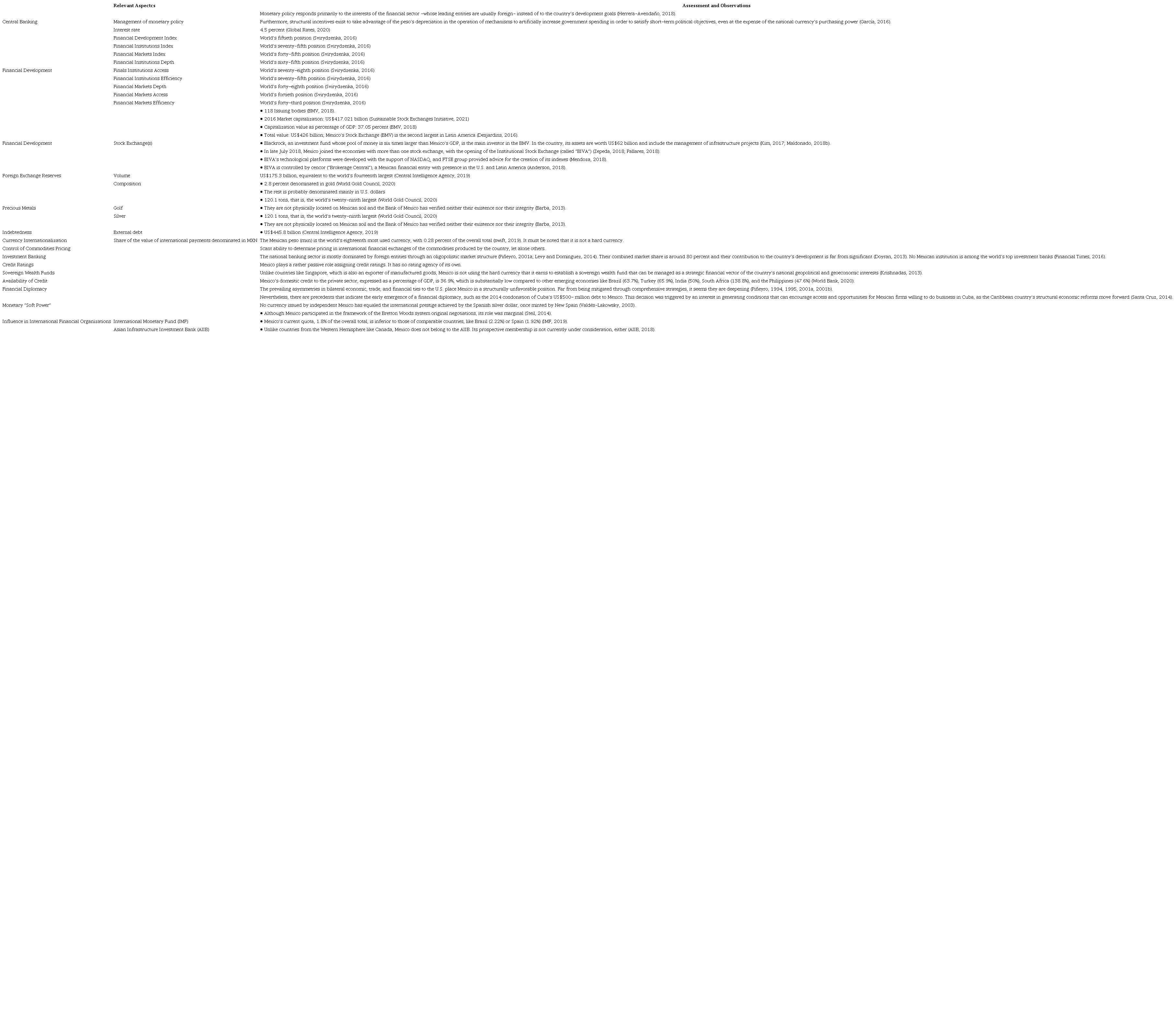
Concerning the current scope of the country’s national power in the field of finance, the following table, developed by the authors based on the references mentioned in each case, reflects several important aspects worth considering. It is important to underline that these analytical categories follow the model proposed by Alonso-Trabanco (2019).
Hence, based on the contents shown in Table 1, Mexico’s financial power is clearly feeble and underdeveloped in terms of central banking, financial development, foreign exchange reserves, holdings of precious metals, indebtedness, currency internationalization, financial control of commodities, investment banking, the ability to assign credit ratings, sovereign wealth funds, credit availability, financial diplomacy, monetary “soft power,” and influence in institutional frameworks related to international financial governance. Moreover, in the hierarchical model called the “currency pyramid” (Cohen, 2010), the Mexican peso is not regarded as a heavyweight. From a holistic perspective, these weaknesses are thus a source of vulnerability in a strategic environment shaped by a growing systemic intersection between geopolitics and international finance.
Comprehesive assessment of Mexico,s National Power in the field of Finance
Source: Developed by the authors based on the references mentioned in each case
In fact, it can even be argued that Mexico faces severe obstacles when it comes to strengthening its financial muscle, due to its heterogeneous and complex geography: it is full of mountains, deserts, and jungles and also has a distinct lack of networks of navigable rivers that could facilitate internal trade. This represents a persistent challenge for both effective governance (Geopolitical Futures, 2018) and for a degree of economic dynamism that could foster a strong national financial sector able to respond to the country’s needs and to eventually become internationally competitive (STRATFOR, 2009).
Furthermore, even though widespread economic instability in Mexico is ultimately harmful for U.S. national interests (Blackwill and Harris, 2016), the strong assertion of its southern neighbor as a rising power is not in Washington’s interest either (Hongbing, 2013). In this sense, it is necessary to recognize that the implementation of the North American integration project embodied by the NAFTA framework and its derivatives has produced mixed results.
It is noteworthy that the contrast with the U.S. is overwhelming. Mexico’s northern neighbor is catalogued as a financial superpower because of its condition as the issuer of the world’s top reserve currency, the worldwide prominence of the U.S. financial sector (including world-class investment banking firms), the relevance of the Fed as a global cornerstone regarding the formulation of monetary policy, as well as its influence on multilateral financial bodies -like the Bretton Woods institutions- and international financial nerve centers, like the swift network (Zarate, 2013; Luft and Korin, 2019; Vander Straeten, 2018). In other words, in the strategic domain of finance, the bilateral U.S.-Mexico balance of power is profoundly asymmetric.
On one hand, NAFTA fueled economic dynamism by quadrupling trade among the bloc’s members. However, when analyzed from the perspective of grand strategy, it also firmly anchored Mexico to the U.S. geopolitical and geoeconomic orbit (Rouquié, 2015) by reshuffling the country’s profile as a manufacturing economy deeply aligned with U.S. industrial productive chains (Zeihan and Nayebi-Oskoui, 2019). It has even been argued that NAFTA had placed Mexico “forever under [U.S.] America’s strategic umbrella” (Khanna, 2008).
This situation of overreliance probably made sense when the so-called “unipolarity” (that is, U.S. global hegemony) looked like a new permanent reality. Nevertheless, this trend has continued well into the twenty-first century. For instance, the fact that the country’s external debt is disproportionately denominated in U.S. dollars (nearly 60 percent of the overall total, an amount that exceeds the value of the country’s foreign currency reserves) firmly places Mexico in the sphere of influence of the U.S. dollar. This compromises the country’s economic independence and exposes the stability of its national currency to a wide spectrum of plausible contingencies in any of the fields that emanate from multidimensional bilateral relations (Shapiro, 2018).
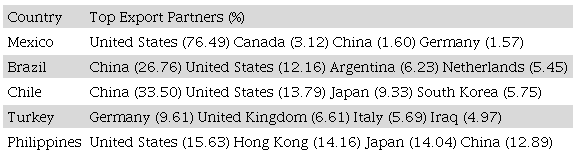
TOP EXPORT PARTNERS, MEXICO AND COMPARABLE DEVELOPING COUNTRIES (2018)
Source: Developed by the authors with data from the World Integrated Trade Solution (2020).
Moreover, it must be kept in mind that the U.S. consumer market absorbs the overwhelming majority of Mexican exports (nearly 80 percent), a reality that compromises the country’s maneuverability in terms of grand strategy. This imbalance is even more astonishing if one compares Mexico’s situation to that of other developing countries that have managed to achieve much more balanced external economic ties. This condition makes it difficult for Mexico to accumulate other hard currencies aside from the U.S. dollar.
Nonetheless, Mexico’s intelligence community was unable to conceive of -let alone foresee- the eventual advent of a U.S. administration potentially hostile to Mexican national interests, especially considering that, given the prevailing bilateral imbalances, it would have the power to effectively threaten Mexico with coercive economic, commercial, and financial measures. This lack of foresight was dismal for a country like Mexico, particularly because developing effective foreign intelligence capabilities is not something only great powers can achieve, as the cases of both Israel and Cuba demonstrate (Hope, 2017).
It is important to point out that Donald Trump’s administration assumed a position that, at best, conveyed a great deal of distrust toward Mexico (Riva-Palacio, 2018). This attitude is probably motivated to a certain extent by the idea that Mexico can potentially develop, in the long run, a critical mass that could enable it to challenge the U.S. for the geopolitical control of North America as a whole, thanks to factors like changing transnational demographic balances and conduits of sociocultural influence, as noted by a prominent U.S. political scientist (Huntington, 2004). In fact, this scenario was originally portrayed by a renowned U.S. geopolitical analyst (Friedman, 2009).
Likewise, it has become clear that the Trump administration was fully aware that it could harness existing bilateral ties as a strong geopolitical tool to force Mexico to comply with Washington’s agenda. In other words, Mexico was not being treated as a close strategic partner. Considering the prevailing relationship of forces, even the mere threat to impose tariffs on Mexican goods is a powerful incentive for Mexico to proceed extremely carefully when it comes to decisions regarding matters that happen to be sensitive for U.S. interests. Needless to say, as in any other case is which a country’s fate can be determined by others, this situation entails a potentially dangerous level of exposure.
Furthermore, on a global scale, the U.S. is seemingly operating under the impression that the costs of preserving a liberal rules-based order that facilitates the international circulation of trade flows are higher than the benefits, as far as the U.S. national interest is concerned (Zeihan, 2018b). This shift might reshape North American economic interaction patterns: “Trump’s hardball on NAFTA is most definitely neo-imperial. He is attempting nothing less than the forcible change of the economic structure of [U.S.] America’s neighbors to meet specific American structural needs” (Zeihan, 2018a).
However, Mexico’s inability to anticipate a deterioration in bilateral relations is hardly surprising, considering that one of the reasons that explain why the country has not become a relevant stakeholder in international politics during the last few decades is the absence of a consolidated Mexican school of geopolitical thinking (Cuellar, 2012). It must be borne in mind that this ingredient turns out to be critical for the formulation of a long-term assertive national project (Cabriada, 2015).
On the other hand, basing the management of economic, commercial, and financial policy purely on a technical viewpoint is not enough to deal with the complexity of geopolitical and geoeconomic phenomena that manifesting in the realm of finance, because mainstream economists tend to disregard the importance of multi- disciplinary analytical approaches (Rickards, 2012). That seems to be the case even during the so-called “Fourth Transformation” (Urzua, 2019).
Therefore, Mexico’s structural overreliance on external factors compromises national security since it limits the country’s ability to act as the master of its own fate (Herrera-Avendaño, 2018). This concern is even more pressing when it is evident that Washington can “pull the trigger” by implementing aggressive measures that can disrupt Mexico’s macroeconomic stability or the value of its national currency.
For the time being, the main outcome of the trilateral negotiation process has been a new trade agreement called USMCA (or T-MEC in Spanish) (Zeihan and Nayeb- Oskoui, 2019), which has provided a more or less reasonable degree of temporary certainty. However, the process was not particularly smooth, since it involved a great deal of complicated diplomatic negotiations and internal politics in all three countries. Tellingly, said agreement limits Mexico’s ability to establish formal commercial ties to China (Navarro, 2018).
Likewise, liberalization and deregulation policies have turned Mexico’s financial system into a conduit whose flows and circuits offer opportunities for both state and non-state actors to advance their agendas in Mexico.
Moreover, compared to other countries, Mexico is being left far behind. For instance, the United States is in the process of developing an acute sense of situational awareness about the ramifications in terms of national security and of the expression of geopolitical rivalries through financial conduits. Hence, Washington is interested in strengthening its position as a financial superpower, its dominant role in global financial governance, the projection of its financial hubs, the hegemonic leadership of the U.S. dollar as the world’s top reserve currency, and its control of international financial circuits. Actually, these concerns are being actively discussed by the country’s intelligence community, including both civilian and military institutions (McConnell, 2008; Department of the Army, 2008; Cohen, 2011; Rickards, 2012; National Intelligence Council, 2012; Zarate, 2013; White House, 2017).
However, the United States is not the only country involved in such pursuits. Actually, some of its top geopolitical competitors, including China, Iran, and Russia, have also being systematically studying the symbiosis between geopolitics and finance, in order to acquire both defensive and offensive capabilities (Rickards, 2014, Zarate 2013-2014).
Although no uniform consensus exists regarding the definition of institutional responsibilities for these matters, several states have involved different agencies. For instance, in 2004, the United States created the Office of Intelligence and Analysis as a branch of the U.S. Treasury Department, which, among other activities, carries out intelligence tasks for both offensive and defensive purposes (Zarate, 2013). Likewise, the Pentagon, with assistance from professional financiers, has sponsored war games to study how a geopolitical conflict fought in a financial operational theater would unfold (Rickards, 2012).
In China, the Central Bank takes into account geopolitical and strategic factors for formulating monetary policy (Stroupe, 2006). In addition, the Chinese military has been studying the principles and reach of financial warfare for at least a couple of decades (Qiao and Wang, 1999). In the case of Russia, several governmental institutions, including monetary authorities, have been exploring alternatives that might challenge the U.S. dollar’s still unmatched monetary supremacy in the near future (Townsend, 2018; Luft and Korin, 2019).
The aforementioned indicates that securitization of financial stability by the major powers has become a priority, particularly since systemic financial disruptions could threaten a country’s overall economic stability (Buzan, Waever, and Wilde, 1998), as the 2008 financial crisis clearly illustrates. Furthermore, it is important to keep in mind that, as evidenced by historical experience, economic interdependence is a multiplier that increases the intensity of the chaos unleashed by financial crises (Baylis and Smith, 2001).
In light of the above, the worldwide intensification of geopolitical rivalries expressed through financial channels is an external source of vulnerability that places Mexico at risk. That is certainly detrimental to the country’s national interests and, taking into consideration the potentially disruptive economic, commercial, financial, and even socio-political consequences of financial warfare, it constitutes a strategic matter of national security.
Nevertheless, this dangerous condition cannot be entirely attributed to external factors. It is, above all else, a direct result of the inertia that has prevailed in Mexico due to defective foresight, which is reflected in three key instances:
It was mistakenly assumed that the U.S. victory in the Cold War would lead to a perpetual unipolarity, a deeply ahistorical perspective, since it seems to overlook the fact that geopolitical forces are in permanent flux, so the constant rise and decline of great powers is consistent with the behavior of long-range patterns.
It was thought that interdependence would forge an enduring sense of bilateral friendship. Of course, that viewpoint made sense during the 1990s, but the possibility that Washington’s position might change or that the national interests of both countries might not necessarily converge in all cases was never contemplated. Contrary to that optimism, it seems that economic and demographic tensions are brewing nowadays. If these trends accelerate in the near future, it is clear that the balance of power would not favor Mexico.
Despite having the conduits to develop closer ties to other partners (that is, free trade agreements), Mexico arguably put all its eggs in a single basket: North American consumer markets. In other words, Mexico did not strategically hedge its bets. As a result, today it is facing the consequences of insufficient diversification.
Based on what has been discussed above, an examination of the Mexican government’s institutional preparedness is necessary in order to identify both gaps and windows of opportunity, so that the state can develop a meaningful capacity for managing financial events that could threaten the nation’s security and well-being.
ASSESSMENT OF INSTITUTIONAL PREPAREDNESS
Concerning the capabilities of Mexican governmental institutions, the production of financial, economic and fiscal intelligence is one of the attributions of the Economic Planning Unit, whereas the Financial Intelligence Unit (UIF) is responsible for fighting money laundering, terrorism financing, tax evasion, corruption, and embezzlement. Both these bodies come under the aegis of the Ministry of Finance. In other words, the Mexican UIF, like the overwhelming majority of its counterparts all over the world, basically operates as a law enforcement agency (International Monetary Fund, 2004). Nevertheless, these bodies’ mandates do not address the risks in terms of national security that are associated with the increasing worldwide intersection be- tween geopolitics and finance.
Additionally, the performance of the National Banking and Exchange Commission (CNBV) also leaves much to be desired if one considers that it has been either un- willing or unable to counter the proliferation of insider trading, a phenomenon regarded as a habit in Mexico’s financial business environment (Davis, 2018). It is thus likely that more dangerous risks are not even being noticed.
On the other hand, despite the Bank of Mexico’s being the country’s monetary authority, whose policies have preserved overall financial stability, its activities and legal frameworks fail to take into account the importance of the role it could play for statecraft, especially in terms of national security, understood as a permanent vital interest of the Mexican state. Even though it can carry out transactions involving precious metals, it is not clear if a corresponding strategic plan that includes both offensive and defensive measures has been formulated. Although it has analytical units responsible for examining systemic risks, it remains to be seen if their methodologies are appropriate for covering the growing global involvement of geopolitical forces in financial and monetary affairs.
It is pertinent to emphasize that the statement of principles called “Strengthening Cybersecurity for the Stability of Mexico’s Financial System,” agreed upon back in October 2017 by several financial governmental agencies, is a step in the right direction. It encourages the exchange of information between private financial entities and authorities, the enhancement of regulatory frameworks, the dissemination of the cybersecurity culture, and collaboration in projects and policies conceived to control risks (Comisión Nacional Bancaria y de Valores, 2017).
Nevertheless, the inadequacy of concrete progress in developing effective capabilities was abruptly exposed by the so-called “speigate,” a criminal incident in May 2018, in which several banking servers and their connections to the Interbank Electronic Payments System (SPEI) were targeted by a cyberattack. This operation involved the theft of nearly Mex$300 million, in a strike that entailed a vast network of complicities (Hernández, 2018a; Leyva, 2018a; Maldonado, 2018a).
Plus, remarkable negligence was shown in this particular episode. First of all, several risk factors related to the proliferation of hostile actions in cyberspace, launched by multiple actors, against Mexican economic interests had been previously identified (Consejo de Seguridad Nacional, 2014). And, in 2017, activities that can be regarded as rehearsals for later offensive actions were observed (Hernández, 2018a).
Despite the official hermetic attitude that prevailed regarding that attack (Flores, 2018), based on the modus operandi, it seems that a highly specialized cell with sophisticated operational capabilities was responsible (Hernández, 2018a). In fact, according to some accounts, local criminal rings collaborated with the Lazarus Group, an entity involved in acts of cybercrime allegedly tied to North Korea (Leyva, 2018b).
Remarkably, the affected institutions, including Banorte, Banjercito, and Inbursa, share the common denominator of being Mexican-owned (El Universal, 2018). Nevertheless, the implications of this incident go well beyond monetary losses and the field of criminal justice. Actually, they also represent a breach of the cybersecurity of the country’s monetary authority, the Bank of Mexico, and important national banking establishments. This could potentially endanger the country’s financial system as a whole (Flores, 2018).
Shortly afterwards, the Bank of Mexico announced the creation of a cybersecurity directorate. This department will be responsible for the design and implementation of measures that can shield the digital systems of the country’s leading active financial nerve centers from hostile external disruptions (La Jornada, 2018).
Furthermore, a cybersecurity protocol was consensually designed by both federal authorities and representatives of the country’s financial sector to foster coordination in case of sensitive incidents that threaten the security of the digital platforms operated by the Mexican financial system, as well as to create an Immediate Response Team, to address them jointly in a speedy manner (Flores, 2018; Hernández, 2018b).
Despite the fact that the aforementioned event revealed critical vulnerabilities, it seems that -for the time being- the actions that are being envisaged focus only on countering threats that jeopardize banking institutions’ assets and the continuity of the services offered to their customers. More complex challenges are not yet being considered, like the involvement of state actors or the influence of geopolitical agendas, issues that go well beyond the need to avert criminal operations whose pursuits are all about profits.
Therefore, in the grand scheme of things, the so-called “speigate” can be seen as a warning shot and also as a symptom of a deeper underlying issue. This episode illustrates the critical vulnerabilities related to the lack of a strategic, multidimension- al, proactive national security approach. Hence, it is impossible to anticipate risks that are not even being contemplated; and, accordingly, if the Mexican state is not ready to effectively counter a cyberattack against its financial system launched by foreign criminal operatives, it would be much more difficult to prevent or mitigate an eventual act of financial aggression motivated by geopolitical interests.
One way or another, existing institutional developments must not be disdained. They constitute a cornerstone for widening the horizon so that, in the near future, the Mexican state can also handle potential geopolitical threats to the national interest that flow through financial conduits, regardless of whether they come from state or non-state actors with their corresponding capabilities and intentions.
Nevertheless, Mexico’s National Security Law does not cover economic or financial threats and, even though it mandates the membership of the Ministry of Finance in the country’s National Security Council -mainly for budgetary reasons-, the Bank of Mexico is not included. It is also noteworthy that the National Intelligence Center (CNI) has the legal attribution of carrying out economic studies related to its area of responsibility, but the true reach of its specific capabilities regarding this matter or the criteria that define their pertinence are not known.
In fact, recent editions of the Agenda Nacional de Riesgos (National Risk Agenda), an annual official document that establishes the country’s priorities in terms of strategic intelligence for national security and which is coordinated by the CNI itself, were leaked to a digital publication. Its perusal shows it to be full of clichés (organized crime, social tensions, terrorism, proliferation of weapons of mass destruction, cyberattacks, and pandemics, among others) (Reyes, 2016). However, it does not even discuss the structural vulnerabilities related to an excessive overreliance on the U.S. in the fields of trade and finance or the complex dynamics of global geoeconomic struggle that are reshaping the balance of power within the international system. Since it is not a publicly available document, it is impossible to tell if its latest versions have something to say about all this.
Even in specialized academic circles that regularly explore national security issues, discussions about finance are usually limited to the struggle against money laundering, as part of a strategy conceived to dismantle criminal structures by neutralizing their ability to legitimize their illicit profits (Flores, 2016). From a geoeconomic viewpoint, this scope is fairly limited.
In short, important institutional blind spots and deficiencies exist concerning the Mexican state’s ability to protect the national interest from the potentially harmful impact of geopolitical forces closely aligned with global financial dynamics. In contrast, as discussed in previous sections, several major powers are already developing institutional capabilities to address these issues as a priority for their own national security.
Accordingly, Mexico is a vulnerable position. However, elements already exist that can be employed as building blocks to broaden, deepen, and strengthen the Mexican state’s institutional frameworks, especially its intelligence services, so the country can be strategically prepared to protect its financial security and nation- al interests comprehensively and proactively. Countering money laundering, tax evasion, and terrorism financing are far from being the only concerns in this regard. A broader spectrum is thus clearly needed.
For that purpose, it would be pertinent to resort to the learning, knowledge, and expertise derived from the practice of economic intelligence, including both business intelligence and financial intelligence, in order to acquire and calibrate the necessary analytical skills (Csurgai, 2017).
LOOKING AHEAD
Everything seems to indicate that the complex phenomena derived from the growing systemic intersection between geopolitics and finance are having an increasingly larger impact than in the past on the correlation of forces within the international system.
As expected, major powers are playing a leading role in these dynamics. However, middle-sized powers like Mexico cannot afford to ignore this emerging reality. If unpreparedness prevails, then they will likely find themselves at the mercy of circumstances beyond their control, a dangerous condition that could compromise their national security.
Hence, Mexico will be unable to address such issues if it does not resort to strategic intelligence as a multidimensional tool of statecraft to navigate these unchartered waters. Otherwise, a purely reactive approach will not suffice in any meaningful way to satisfy the national interest.
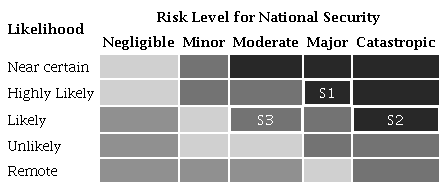
No unique prediction exists when it comes to envisaging what the fate of the Mexican state will look like concerning the field where geopolitics and finance meet. Actually, several plausible scenarios need to be considered, as shown in Table 3, developed by the authors as a simple risk assessment matrix). The materialization of one or another will depend on the decisions made in the near future. This exercise is thus useful for anticipating the importance of the aforementioned topic in terms of national security.
-
Scenario 1 (S1): Mexico as a financial and geopolitical satellite of the U.S. (extrapolation of current trends)
-
Scenario 2 (S2): Mexico as a collateral casualty of a systemic geopolitical conflict fought through financial channels (worst-case scenario)
-
Scenario 3 (S3): Mexico as a rising geopolitical power with stronger financial capabilities (best-case scenario)
Risk assessment for each scenario
CONCLUDING THOUGHTS
In light of the above, Mexico needs to rethink its grand strategy and define its long- range national interests in order to determine the criteria that can shape -as a compass of statecraft- the decision-making process regarding the growing convergence between geopolitical and financial forces. The recent decision to reclassify taxation as a matter of national security can be a step in the right direction but, in the early twenty-first century, the influence of geopolitical realities is felt in many other aspects of finance.
Perhaps it would be far more useful to pursue the enhancement of Mexico’s national financial power as a permanent interest of the Mexican state, as well as the protection of its financial security and economic stability from potential aggressors, especially considering the risks associated with the density, depth, worldwide reach, and dynamism of modern finance, as well as the active presence of various state and non-state actors in the financial domain. This is a must in a competitive arena in which geopolitical rivalries are being manifested through financial conduits on a global scale. Likewise, the explicit identification of both potential partners and potential rivals, along with offensive and defensive measures, would also have to be considered.
This imperative entails the need to reformulate the role Mexico intends to play when it comes to international economic interconnectedness, mitigating structural vulnerabilities, both internal and external, and overcoming institutional gaps that might compromise national security. However, that does not mean that either autarky or isolation from global markets and international financial circuits should be pursued. The most pragmatic course of action would be to seek a more favorable re- insertion of Mexico as an assertive player that can be capable of reaching a more advantageous position, instead of being passive or reactive.
Therefore, a stronger sense of situational awareness about the critical relevance of these issues is needed in governmental institutions whose areas of responsibility involve trade, finance, foreign policy, security, and intelligence. That means that it is crucial to nourish the country’s national security system as a whole with substantial geopolitical and geoeconomic contents.
Furthermore, the collaborative involvement of the private sector is certainly required for the creation of strategic capabilities of economic and financial intelligence, in order to protect the vital financial and monetary components that fuel the economic cycles of the Mexican state and, consequently, the country’s economic development prospects.
POLICY SUGGESTIONS
In order to craft a comprehensive policy that responds to the needs and vulnerabilities of the Mexican state identified above, the following recommendations can be taken under consideration. All of them meet the criteria of pertinence, advisability, and feasibility. Even though the Mexican state lacks the critical mass to decisively influence the course of global events, their implementation can represent an instrumental contribution to the pursuit of the best-case scenario: a country that is both a rising geopolitical player and an emerging economy with the ability to strengthen its financial national power.
- 1. Explicitly identifying the vulnerability of the country’s financial stability as a threat to national security that must be dealt with, in order to generate a sense of situational awareness amongst the country’s policymaking cadre about the importance of preventing financial disruptions, whether provoked by the action of systemic market forces or as the result of deliberate hostile action or imbalances, due to their harmful effects for the country’s permanent national interests.
- 2. Establishing a permanent, interinstitutional intelligence unit responsible for undertaking analytical assessments, forecasts, strategic plans, and recommendations. The purpose would be to combine resources and to create interdisciplinary expertise for fostering the development of adequate institutional capabilities. Governmental institutions (like the Bank of Mexico, the Ministry of Finance, the National Intelligence Center, the Ministry of Foreign Affairs and the Armed Forces, as well as Mexico’s state-owned Exim Bank, called Bancomext) should be included, as well as senior financial analysts from both private and state-owned Mexican banking institutions.
- 3. Carrying out war games that simulate a geopolitical confrontation fought in a financial operational theater. The point would be to envisage plausible scenarios to anticipate contingencies, detect critical vulnerabilities, establish protocols, and prepare both preventive and reactive measures. Another advantage would be the generation of the cognitive ability to understand the dynamic behavior of a new expression of conflict and strategic competition.
- 4. Designing a multi-sector strategic plan conceived to foster the diversification of Mexico’s foreign partnerships when it comes to trade and investment. This suggestion responds to the geostrategic rationale of diminishing the overcon-centration of the country’s international economic ties. Mexico needs to take full advantage of the potential offered by the free trade agreements it has signed with European, Asian, and Latin American countries and explore potential business opportunities with the BRICS emerging markets. Likewise, this course of action would facilitate the gradual accumulation of monetary reserves denominated in several hard currencies.
- 5. Studying the prospect of joining the Asian Infrastructure Investment Bank (AIIB). This would give Mexico an institutional financial conduit to boost economic ties to China, particularly in terms of investment, opportunities for Mexican companies to do business with partners from the Asia Pacific region, access to alternative sources of funding for the development of infrastructure projects, and the chance to participate as an active stakeholder in the emerging parallel order of international financial governance Beijing is promoting. However, that does not mean that Mexico should abandon its membership in the Bretton Woods institutional framework, but only that it would be a good idea to hedge its geoeconomic bets as a priority in terms of grand strategy.
- 6. Strengthening the domestic consumer market. Mexico’s position as an exporting powerhouse means the country is highly vulnerable to external disruptions. To compensate for this structural weakness, it is necessary to increase the dynamism of its domestic market as well through education, industrial policies, the generation of a competitive business environment, the availability of credit for productive projects, the encouragement of entrepreneurship, public and private investment, the creation of infrastructure, and the implementation of innovative R&D projects.
- 7. Generating a consensus that includes the state, various political forces, social sectors, and corporate entities in order to craft a long-term national geoeconomic strategy. The point would be to align industrial, commercial, financial, and monetary policies according to said plan, define the country’s economic and financial profile in a foreseeable future, foster the creation of new comparative advantages, and combine resources and efforts meant to bolster the country’s geoeconomic power and security as a matter of statecraft.
- 8. Verifying the existence and integrity of the country’s gold reserves held abroad. If both can be satisfactorily ascertained, then it would be pertinent to study the feasibility of their repatriation in the near future, so they can be kept in custody in secure facilities by Mexican military personnel on Mexican soil.
- 9. Examining the potential advantages of promoting the partial remonetization of silver in Mexico in the near future, especially in an international context, in which both great and middle-sized powers are accumulating increasingly greater amounts of precious metals because of their geoeconomic importance and the potential role those assets could play in the eventual rearrangement of the global monetary order. Mexico’s position as a prominent silver producer is perhaps a card worth playing.
- 10. Using a portion of the country’s hard currency earnings to establish a Sovereign Wealth Fund that can be managed not only as an investment vehicle to increase profits, but -above all- as a strategic financial vector whose actions respond to the country’s geopolitical interests, foreign policy agenda, and national security priorities.
- 11. Promoting the growth of geopolitical and geoeconomic studies as specialized disciplines of strategic importance, including the implementation of academic programs and the establishment of research centers or think tanks whose communities welcome scholars, representatives of the private sector, independent analysts, and both civilian and military government officials.
- 12. Revitalizing development banking as a tool of economic statecraft, whose role would be instrumental in supporting the growth of strategic industries, upgrading the competitive performance of Mexican firms, developing new comparative advantages, and encouraging the diversification of exports.
BIBLIOGRAPHY
AIIB (Asian Infrastructure Investment Bank) 2018 “Members and Prospective Members of the Bank,” AIIB (Asian Infrastructure Investment Bank) 2018 “Members and Prospective Members of the Bank,” https://www.aiib.org/en/about-aiib/governance/members-of-bank/index.html, accessed October 27, 2019.
Alonso-Trabanco, José Miguel 2019 “Hacia un análisis integral de la creciente intersección entre geopolítica y finanzas como factor en la reconfiguración del balance global de poder en el siglo XXI e implicaciones previsibles para México,” master’s thesis in the Security and Strategic Intelligence program, Instituto Ortega Vasconcelos de México, Mexico City.
Anderson, Bárbara 2018 “Biva al fin viva,” Milenio, July 25, Anderson, Bárbara 2018 “Biva al fin viva,” Milenio, July 25, http://www.milenio.com/opinion/barbara-anderson/nada-personal-solo-negocios/biva-al-fin-viva, accessed October 27, 2019.
Barba, Guillermo 2013 “Reservas de oro: la ingenuidad de Banxico,” Forbes, December 7, Barba, Guillermo 2013 “Reservas de oro: la ingenuidad de Banxico,” Forbes, December 7, https://www.forbes.com.mx/reservas-de-oro-la-ingenuidad-de-banxico/, accessed October 27, 2019.
Baylis, John, and Steve Smith 2001 The Globalization of World Politics, Bath, Oxford University Press.
Blackwill, Robert, and Jennifer Harris 2016 War by Other Means: Geoeconomics and Statecraft, Cambridge, Massachusetts, Harvard University Press.
BMV (Bolsa Mexicana de Valores) 2018 “Capitales,” Grupo BMV, BMV (Bolsa Mexicana de Valores) 2018 “Capitales,” Grupo BMV, http://www.bmv.com.mx/es/mercados/capitales, accessed October 27, 2019.
Buzan, Barry, Ole Waever, and Jaap de Wilde 1998 Security: A New Framework for Analysis, London, Lynne Rienner.
Cabriada, Alba 2015 “Brasil y el nuevo liderazgo mexicano,” in A. Ponce, ed., Escenarios geopolíticos para el México actual, Mexico City, Cenzontle, pp. 75-96.
Centro de Estudios de las Finanzas Públicas 2016 Ingresos del Fondo Mexicano del Petróleo para la estabilización y el desarrollo, Mexico City, Cámara de Diputados.
CIA (Central Intelligence Agency) 2019 “North America: Mexico,” CIA World Factbook, CIA (Central Intelligence Agency) 2019 “North America: Mexico,” CIA World Factbook, https://www.cia.gov/library/publications/the-world-factbook/geos/mx.html, accessed October 28, 2019.
Cohen, Benjamin 2011 The Future of Global Currency (the Euro versus the Dollar), Oxford, Routledge.
______, 2010 Currency and State Power, Santa Barbara, Department of Political Science, University of California.
Comisión Nacional Bancaria y de Valores 2017 “Fortaleciendo la ciberseguridad para la estabilidad del sistema financiero mexicano,” Gobierno de México, October 23, Comisión Nacional Bancaria y de Valores 2017 “Fortaleciendo la ciberseguridad para la estabilidad del sistema financiero mexicano,” Gobierno de México, October 23, https://www.gob.mx/cnbv/prensa/la-cnbv-en-el-foro-sobre-ciberseguridad-fortaleciendo-la-ciberseguridad-para-la-estabilidad-del-sistema-financiero-mexicano, accessed October, 27, 2019.
Consejo de Seguridad Nacional 2014 Programa para la Seguridad Nacional 2014-2018, Mexico City, Presidencia de la República.
Csurgai, Gyula 2017 “Geoeconomic Strategies and Economic Intelligence,” in M. Munoz, ed., Advances in Geoeconomics, New York, Routledge, pp. 285-294.
Cuéllar, Rubén 2012 “Geopolítica. Origen del concepto y su evolución,” Revista de Relaciones Internacionales de la UNAM, no. 113, pp. 59-80.
Davis, Michelle 2018 “México es un paraíso de información privilegiada y no pasa nada,” El Financiero, March 25, Davis, Michelle 2018 “México es un paraíso de información privilegiada y no pasa nada,” El Financiero, March 25, http://www.elfinanciero.com.mx/bloomberg-business-week/mexico-es-un-paraiso-de-informacion-privilegiada-y-no-pasa-nada, accessed October 27, 2019.
Department of the Army 2008 Army Special Operations Forces Unconventional Warfare, Washington D.C., John F. Kennedy Special Warfare Center and School.
Desjardins, Jeff 2016 “All of the World’s Stock Exchanges by Size,” The Money Project, February 16, Desjardins, Jeff 2016 “All of the World’s Stock Exchanges by Size,” The Money Project, February 16, https://money.visualcapitalist.com/all-of-the-worlds-stock-exchanges-by-size/, accessed October 2019.
Doyran, Mine 2013 “Mexico’s Financial Industry Structure: Trends, Challenges and Opportunities,” in ASBBS Annual Conference, Las Vegas, ASBBS, pp. 500-509.
Escalona-Ramos, Alberto 1959 Geopolítica mundial y geoeconomía, Mexico City, Ateneo.
Fedirka, Allison 2018 “Diversifying Mexico’s Export Markets,” Geopolitical Futures, August 16, Fedirka, Allison 2018 “Diversifying Mexico’s Export Markets,” Geopolitical Futures, August 16, https://geopoliticalfutures.com/diversifying-mexicos-export-markets/, accessed October 27, 2019.
Financial Times 2016 “League Tables: Top Banks,” Financial Times 2016 “League Tables: Top Banks,” https://web.archive.org/web/20170221190229/org/web/20170221190229/ https://markets.ft.com/data/league-tables/tables-and-trends, accessed August 16, 2020.
Flores, Leonor 2018 “Firman protocolo de ciberseguridad tras hackeos a bancos,” El Universal May 24, Flores, Leonor 2018 “Firman protocolo de ciberseguridad tras hackeos a bancos,” El Universal May 24, http://www.eluniversal.com.mx/cartera/economia/firman-protocolo-de-ciberseguridad-tras-hackeos-bancos, accessed October 27, 2019.
Flores, Nancy 2018 “Cisen y Banxico conocían vulnerabilidad cibernética,” Contralínea, May 18, Flores, Nancy 2018 “Cisen y Banxico conocían vulnerabilidad cibernética,” Contralínea, May 18, https://www.contralinea.com.mx/archivo-revista/2018/05/18/cisen-y-banxico-conocian-vulnerabilidad-cibernetica/, accessed October 27, 2019.
______, 2016 “Cárteles han lavado 2 billones de pesos en este sexenio,” Contralínea, August 24, http://www.contralinea.com.mx/archivo-revista/2016/08/24/carteles-han-lavado-2-billones-de-pesos-en-este-sexenio/, accessed October 27, 2019.
Friedman, George 2009 The Next 100 Years, New York, Anchor Books.
García, Samuel 2016 “El gran negocio del gobierno con la depreciación del peso,” El Universal, October 3, García, Samuel 2016 “El gran negocio del gobierno con la depreciación del peso,” El Universal, October 3, https://www.eluniversal.com.mx/entrada-de-opinion/columna/ samuel-garcia/cartera/2016/10/3/el-gran-negocio-del-gobierno-con-la?fb_comment_id=1109198569133470_1109536229099704, accessed October 27, 2019.
Geopolitical Futures 2018 “Obstacles to Mexico’s Territorial Control,” March 16, Geopolitical Futures 2018 “Obstacles to Mexico’s Territorial Control,” March 16, https://geopolitical-futures.com/obstacles-mexicos-territorial-control/, accessed October 27, 2019.
Global Rates 2020 “Banxico Overnight Interbank Rate,” Global Rates 2020 “Banxico Overnight Interbank Rate,” http://global-rates.com/interest-rates/central-banks/central-bank-mexico/banxico-interest-rate.aspx, accessed August 21, 2020.
Guerrero, Julio 1901 La génesis del crimen en México, Paris, Imprenta de la vda. de Ch. Bouret.
Hernández, Antonio 2018a “Bancos ignoraron 5 hackeos anteriores,” El Universal, May 22, Hernández, Antonio 2018a “Bancos ignoraron 5 hackeos anteriores,” El Universal, May 22, http://www.eluniversal.com.mx/cartera/economia/bancos-ignoraron-5-hackeos-anteriores, accessed October 27, 2019.
______, 2018b “Así opera el grupo de respuesta ante hackeos a bancos,” El Universal, May 25, http://www.eluniversal.com.mx/cartera/finanzas/asi-opera-el-grupo-de-respuesta-ante-hackeos-bancos, accessed October 27, 2019.
Herrera-Avendaño, Carlos Eduardo 2018 México, su seguridad económica y su seguridad nacional, Mexico City, Instituto de Investigaciones Estratégicas de la Armada de México.
Hongbing, Song 2013 La Guerre des Monnaies: La Chine et le Nouvel Ordre Mondial, Aube, Éditions Le Retour aux Sources.
Hope, Alejandro 2017 “Los espías que fallaron,” El Universal, February 1, Hope, Alejandro 2017 “Los espías que fallaron,” El Universal, February 1, http://www.eluniversal.com.mx/entrada-de-opinion/columna/alejandro-hope/nacion/2017/02/1/los-espias-que-faltaron, accessed October 27, 2019.
Huntington, Samuel 2004 “El desafío hispano,” Letras libres, April 30, Huntington, Samuel 2004 “El desafío hispano,” Letras libres, April 30, https://www.letraslibres.com/mexico/el-desafio-hispano, accessed February 10, 2020.
IMF (International Monetary Fund) 2019 “IMF Members’ Quotas and Voting Power, and IMF Board of Governors,” IMF (International Monetary Fund) 2019 “IMF Members’ Quotas and Voting Power, and IMF Board of Governors,” https://www.imf.org/external/np/sec/memdir/members.aspx, accessed October 28, 2019.
______, 2004 Financial Intelligence Units. An Overview, Washington D.C., International Monetary Fund.
Jornada, la 2018 “Bancos bajo ciberataque,” May 17, Jornada, la 2018 “Bancos bajo ciberataque,” May 17, http://www.jornada.unam.mx/2018/05/17/opinion/002a1edi, accessed October 27, 2019.
Katz, Friedrich 2013 La guerra secreta en México, Mexico City, Ediciones Era.
Khanna, Parag 2008 The Second World: Empires and Influence in the New Global Order, New York, Random House.
Kim, Crystal 2017 “BlackRock in Mexico: It’s About Distribution,” Barron’s, November 29, Kim, Crystal 2017 “BlackRock in Mexico: It’s About Distribution,” Barron’s, November 29, https://www.barrons.com/articles/blackrock-in-mexico-its-about-distri bution-1511980888, accessed October 27, 2019.
Krishnadas, Devadasi 2013 Sovereign Wealth Funds as Tools of National Strategy: Singapore’s Approach, Newport, U.S. Naval War College.
Levy, Noemi, and Christian Domínguez 2014 “Los bancos extranjeros en México: diversificación de actividades y su efecto en la estructura de ingresos,” Economía UNAM, vol. 11, no. 32, pp. 102-119.
Leyva, Jeanette 2018a “Maquinaron el hackeo con ‘clientes’ de bancos,” El Financiero, May 16, Leyva, Jeanette 2018a “Maquinaron el hackeo con ‘clientes’ de bancos,” El Financiero, May 16, http://www.elfinanciero.com.mx/economia/maquinaron-el-hackeo-con-clientes-de-bancos, accessed October 27, 2019.
______, 2018b “México, a la caza de intrusos en el SPEI,” El Financiero, June 16, http://www.elfinanciero.com.mx/opinion/jeanette-leyva/mexico-a-la-caza-de-intrusos-en-el-spei, accessed October 27, 2019.
Luft, Gal, and Anne Korin 2019 De-Dollarization, United States, independently published.
Maldonado, Mario 2018a “Magnate de Wall Street pide a AMLO no frenar inversión,” El Universal, May 9, Maldonado, Mario 2018a “Magnate de Wall Street pide a AMLO no frenar inversión,” El Universal, May 9, http://www.eluniversal.com.mx/columna/mario-maldonado/cartera/magnate-de-wall-street-pide-amlo-no-frenar-inversion, accessed October 27, 2019.
______, 2018b “El speigate y el desaire de AMLO al BBVA,” El Universal, May 16, http://www.eluniversal.com.mx/columna/mario-maldonado/cartera/el-speigate-y-el-desaire-de-amlo-al-bbva, accessed October 27, 2019.
Mcconnell, Michael 2008 Annual Threat Assessment of the Intelligence Community, Washington D.C., House Permanent Committee on Intelligence.
Mendoza, Viridiana 2018 “BIVA inicia operaciones y termina con el monopolio bursátil de la BMV,” Forbes, July 25, Mendoza, Viridiana 2018 “BIVA inicia operaciones y termina con el monopolio bursátil de la BMV,” Forbes, July 25, https://www.forbes.com.mx/biva-inicia-operaciones-y-termina-con-el-monopolio-bursatil-de-la-bmv/, accessed October 27, 2019.
National Intelligence Council 2012 Global Trends 2030, Washington D.C., National Intelligence Council.
Navarro, María Fernanda 2018 “México compró el pleito de Trump con China en el USMCA,” El Financiero, October 2, Navarro, María Fernanda 2018 “México compró el pleito de Trump con China en el USMCA,” El Financiero, October 2, https://www.forbes.com.mx/mexico-compro-el-pleito-de-trump-con-china-con-usmca/, accessed October 27, 2019.
Ostos, María del Pilar 2015 “Una metodología geopolítica para un México del siglo XXI,” in A. Ponce, ed., Escenarios geopolíticos para el México actual, Mexico City, Cenzontle , pp. 35-56.
Pallares, Miguel 2018 “El ABC de la nueva bolsa de valores de México,” El Universal, July 25, Pallares, Miguel 2018 “El ABC de la nueva bolsa de valores de México,” El Universal, July 25, http://www.eluniversal.com.mx/cartera/finanzas/el-abc-de-la-nueva-bolsa-de-valores-de-mexico, accessed October 27, 2019.
Payno, Manuel 1982 México y sus cuestiones financieras con la Inglaterra, la España y la Francia, Mexico City, Secretaría de Hacienda y Crédito Público.
Piñeyro, José Luis 2001a “La seguridad nacional con Zedillo,” Foro Internacional, pp. 939-962.
______, 2001b “La seguridad nacional del México POSTLC: ¿realidad o proyecto?,” Casa del Tiempo, vol. 3, no. 25, pp. 9-21.
______, 1995 “La política de defensa de México frente al TLCAN,” Nueva Sociedad, no. 138, pp. 142-157.
______, 1994 “La seguridad nacional con Salinas de Gortari,” Foro Internacional, vol. 34, no. 4, pp. 754-772.
Quintana, Enrique 2018 “Ya hay tratado, ¿y ahora qué?” El Financiero, October 1, Quintana, Enrique 2018 “Ya hay tratado, ¿y ahora qué?” El Financiero, October 1, http://www.elfinanciero.com.mx/opinion/enrique-quintana/ya-hay-tratado-y-ahora-que, accessed October 27, 2019.
Qiao, Ling, and Xiangsui Wang 1999 Unrestricted Warfare, Beijing, PLA Literature and Arts Publishing House.
Ramírez-Bonilla, Juan José 2016 “Redescubriendo Filipinas: encuentros y desencuentros a cada lado del Pacífico,” in T. Calvo and P. Machuca, eds., México y Filipinas. Culturas y memorias sobre el Pacífico, Zamora, Michoacán, El Colegio de Michoacán / Ateneo de Manila University, pp. 79-98.
Reyes, José 2016 “Seguridad nacional: México, al borde del colapso,” Contralínea, August 7, Reyes, José 2016 “Seguridad nacional: México, al borde del colapso,” Contralínea, August 7, http://www.contralinea.com.mx/archivo-revista/index.php/2016/08/07/seguridad-nacional-mexico-al-borde-del-colapso/7, accessed October 27, 2019.
Rickards, James 2014 The Death of Money, New York, Portfolio/Penguin.
______, 2012 Currency Wars: The Making of the Next Global Crisis, New York, Portfolio/Penguin.
Riva Palacio, Raymundo 2018 “Los ojos de la CIA,” El Financiero, March 16, Riva Palacio, Raymundo 2018 “Los ojos de la CIA,” El Financiero, March 16, http://elfinanciero.com.mx/opinion/raymundo-riva-palacio/los-ojos-de-la-cia, accessed October 27, 2019.
Rouquié, Alain 2015 “México y el TLCAN, veinte años después,” Foro Internacional, vol. 55, no. 2, pp. 433-453.
Santa Cruz, David 2014 “¿Por qué México condonó una deuda de 500 mdd a Cuba?” Forbes, February 19, Santa Cruz, David 2014 “¿Por qué México condonó una deuda de 500 mdd a Cuba?” Forbes, February 19, https://www.forbes.com.mx/por-que-mexico-condono-una-deuda-de-500-mdd-cuba/, accessed October 27, 2019.
Shapiro, Jacob 2018 “The Currency Crisis of 2018,” Geopolitical Futures, August 15, Shapiro, Jacob 2018 “The Currency Crisis of 2018,” Geopolitical Futures, August 15, https://geo politicalfutures.com/currency-crisis-2018/, accessed October 27, 2019.
Shukla, Adrija 2017 “Top 10 Largest Sovereign Wealth Funds,” Business Standard, June 26, Shukla, Adrija 2017 “Top 10 Largest Sovereign Wealth Funds,” Business Standard, June 26, http://www.business-standard.com/article/international/top-10-largest-sovereign-wealth-funds-117062600074_1.html, accessed October 27, 2019.
Steil, Benn 2014 The Battle of Bretton Woods, Princeton, New Jersey, Princeton University Press.
Stein, Stanley, and Barbara Stein 2002 Plata, comercio y guerra, Barcelona, Crítica.
STRATFOR 2009 The Geopolitics of Mexico: A Mountain Fortress Besieged, Austin, Strategic Forecasting Inc.
Stroupe, Joseph 2006 “Russian Rubicon: Impending Checkmate of the West,” Global Events Magazine, http://www.Joseph%20Stroupe.-%20Russian%20Rubicon%20(1).pdf(no longer available online).
Sustainable Stock Exchanges Initiative 2021 “Bolsa Mexicana de Valores,” Sustainable Stock Exchanges Initiative 2021 “Bolsa Mexicana de Valores,” https://sseinitiative.org/stock-exchange/bmv/, accessed May 18, 2021.
Svirydzenka, Katsiaryna 2016 Introducing a New Broad-based Index of Financial Development, Washington, D.C., International Monetary Fund.
SWIFT (Society for Worldwide Interbank Financial Telecommunication) 2019 RMB Tracker, La Hulpe, Belgium, SWIFT.
Townsend, Erik 2018 Beyond Blockchain: The Death of the Dollar and the Rise of Digital Currency, Coppell, Texas, Independently published.
Universal, El 2018 “Banorte, Inbursa y Banjército, entre los afectados por ciberataque,” May 16, Universal, El 2018 “Banorte, Inbursa y Banjército, entre los afectados por ciberataque,” May 16, http://www.eluniversal.com.mx/cartera/banorte-inbursa-y-banjercito-entre-los-afectados-por-ciberataque-maerker, accessed October 27, 2019.
Urzúa, Carlos 2019 “La Cuatroté y el Consenso de Washington,” El Universal, October 28, Urzúa, Carlos 2019 “La Cuatroté y el Consenso de Washington,” El Universal, October 28, https://www.eluniversal.com.mx/opinion/carlos-m-urzua/la-cuatrote-y-el-consenso-de-washington, accessed October 29, 2019.
U.S. Geological Survey 2017 Mineral Commodity Summaries 2017, Reston, Virginia, U.S. Geological Survey.
Valdés-Lakowsky, Vera 2003 “El peso mexicano en el Este de Asia después del siglo XVIII,” in XI Congreso Internacional de ALADAA, Mexico City, El Colegio de México.
Vander Straeten, Pascal 2018 An Overture to Geofinance, Dallas, Value4Risk LLC.
White House 2017 National Security Strategy of the United States of America, https://trumpwhitehouse.archives.gov/wp-content/uploads/2017/12/NSS-Final-12-18-2017-0905.pdf
World Bank, The 2020 “Domestic Credit to Private Sector (percent of GDP),” World Bank, The 2020 “Domestic Credit to Private Sector (percent of GDP),” https://data.worlbank.org/indicator/FS.AST.PRVT.GD.ZS, accessed August 7, 2020.
World Gold Council 2020 “Latest World Official Gold Reserves,” World Gold Council 2020 “Latest World Official Gold Reserves,” https://www.gold.org/goldhub/data/monthly-central-bank-statistics, accessed October 28, 2019.
World Integrated Trade Solution 2020 “Mexico Exports by Country 2018,” -World Integrated Trade Solution 2020 “Mexico Exports by Country 2018,” -https://wits.worldbank.org/CountrProfile/en/Country/MEX/Year/2018/TradeFlow/Export/Partner/by-country, accessed August 12, 2019.
Zarate, Juan 2013-2014 “Conflict by Other Means: The Coming Financial Wars,” Parameters, vol. 43, no. 4, pp. 87-97.
______, 2013 Treasury’s Warfare, New York, PublicAffairs.
Zeihan, Peter 2018a “I Think They Get It Now, Part I,” Zeihan on Geopolitics, June 11, Zeihan, Peter 2018a “I Think They Get It Now, Part I,” Zeihan on Geopolitics, June 11, http://zeihan.com/i-think-they-get-it-now-part-i/, accessed October 27, 2019.
______, 2018b “Here We Go,” https://mailchi.mp/zeihan/here-we-go?e=[UNIQID], accessed October 27 2019.
Zeihan, Peter, and Michael N. Nayebi-Oskoui 2019 “The Cutting Room Files, Part 2: The Future of Mexico,” Zeihan on Geopolitics, October 21, Nayebi-Oskoui 2019 “The Cutting Room Files, Part 2: The Future of Mexico,” Zeihan on Geopolitics, October 21, https://us11.campaign-archive.com/?u=de2bc41f8324e6955ef65e0c9&id=71921b8614, accessed October 27, 2019.
Zepeda, Clara 2018 “BIVA da primer ‘campanazo’ tras 5 años de preparativos,” El Financiero, July 25, Zepeda, Clara 2018 “BIVA da primer ‘campanazo’ tras 5 años de preparativos,” El Financiero, July 25, http://www.elfinanciero.com.mx/mercados/mexico-tendra-dos-bolsas-de-nuevo-tras-mas-de-cuatro-decadas, accessed October 27, 2019.
