2023
253
20012022
10042023
 Gabriela Cabral Chizzolini gabrielachizzolini@estudante.ufscar.br
Federal University of São Carlos, Brasil
Lidia Maria Marson Postalli
Federal University of São Carlos, Brasil
Abstract: This study’s objective was to replicate the study by Hayashi et al. (2013) and assess the emergence of letter naming after teaching auditory-visual matching online during the Covid-19 pandemic. Four students aged five to ten, both genders, participated: three with Down syndrome and one with Autistic Spectrum Disorder. Data were collected individually through the Zoom platform; specific software was used to program and record the answers. The teaching session consisted of the children selecting, on a computer screen, among written letters presented in a set, the one that corresponded to the letter name dictated. Next, the children were supposed to name the letters during the assessment. A multiple probe design between letter sets was adopted. The results showed that all four participants increased the number of letters named correctly for most sets after attending the teaching sessions. Hence, this teaching procedure is a potential alternative to establish letter recognition and naming among children eligible for special education, complementing regular school. Additionally, teachers and family members can implement it.
Keywords: Tele-education, letter naming, matching to sample, Down syndrome, Autism Spectrum Disorder.
Resumo: Este artigo realizou uma replicação sistemática do estudo de Hayashi et al. (2013) e teve como objetivo avaliar a emergência de nomeação de letras a partir do ensino de emparelhamento auditivo-visual, no contexto do ensino remoto, diante da pandemia de Covid-19. Participaram da pesquisa quatro alunos, de ambos os gêneros, com idades entre 5 e 10 anos, três deles com síndrome de Down e uma participante com Transtorno do Espectro Autista. A coleta de dados realizou-se por meio da plataforma Zoom, individualmente, e utilizou um software específico para programação e registro das respostas. O ensino constituiu na seleção da letra maiúscula impressa, apresentada na tela do computador simultaneamente com as demais letras impressas do conjunto, diante do nome da letra ditado. Na avaliação, a criança deveria nomear a letra. Foi empregado um delineam ento de múltiplas sondagens entre conjuntos de letr as. Os r esult ados mostr aram que os quatros participantes apresentaram aumento da nomeação correta das letras após as sessões de ensino para a maioria dos conjuntos. Os dados indicaram que o procedimento de ensino pode ser uma alternativa viável para estabelecer o reconhecimento e nomeação de letras com pessoas público-alvo da educação especial, suplementando o ensino da escola regular e podendo ser conduzido por professores e familiares.
Palavras-chave: Tele-educação, nomeação de letras, aprendizado por discriminação, síndrome de Down, Transtorno do Espectro Autista.
Resumen: Esta investigación tuvo como objetivo replicar el estudio de Hayashi et al. (2013) y evaluar el surgimiento de la denominación de letras desde la enseñanza del binomio auditivo-visual, en el contexto de la enseñanza remota, frente a la pandemia del Covid-19. Participaron en la investigación cuatro estudiantes, de ambos sexos, con edades entre 5 y 10 años, tres de ellos con síndrome de Down y uno con Trastorno del Espectro Autista. La colecta de datos se realizó a través de la plataforma Zoom, de forma individual. El proceso de enseñanza consistió en la selección de la letra mayúscula impresa presentada en la pantalla de la computadora simultáneamente a las letras impresas del conjunto frente al nombre de la letra dictada. En la evaluación, el niño nombró la letra. Se utilizó un diseño de sonorización múltiple entre conjuntos de letras. Los resultados mostraron que los cuatro participantes tuvieron un aumento en la denominación correcta de las letras después de las sesiones de enseñanza para la mayoría de los conjuntos de letras. Los datos indicaron que el procedimiento de enseñanza puede ser una alternativa viable para las personas que requieren de educación especial al establecer el reconocimiento y el nombramiento de las letras, este método puede ser un suplemento de la escolarización y puede llevarse a cabo por profesores y familiares.
Palabras clave: Tele-educación, denominación de letras, aprendizaje por discriminación, síndrome de Down, Trastorno del Espectro Autista.
Psychology and Education
THE EFFECTS OF REMOTELY TEACHING AUDITORY-VISUAL MATCHING OF LETTERS ON LETTER-NAMING AMONG CHILDREN WITH DOWN SYNDROME OR AUTISM
EFEITOS DO ENSINO REMOTO DE EMPARELHAMENTO AUDITIVO-VISUAL COM LETRAS NA NOMEAÇÃO DE LETRAS EM CRIANÇAS COM SÍNDROME DE DOWN E AUTISMO
EFECTOS DE ENSEÑAR A DISTANCIA DEL EMPAREJAMIENTO AUDITIVO-VISUAL COM LETRAS PARA NOMBRAR LAS LETRAS EM NIÑOS CON SÍNDROME DE DOWN Y AUTISMO
Gabriela Cabral Chizzolini gabrielachizzolini@estudante.ufscar.br
Lidia Maria Marson Postalli
Received: 20 January 2022
Accepted: 10 April 2023
As declared by the World Health Organization, since the beginning of 2020, the world has experienced a pandemic caused by the Sars-CoV-2 virus. As a result, social distancing measures were implemented given the high geographical spread of the new coronavirus (Sars-CoV-2) (UNA-SUS, 2020). As a result, face-to-face classes were suspended, and students had to attend classes online, leading educational institutions to seek digital technologies to continue school activities (Almeida & Alves, 2020). The challenges imposed by the Covid-19 pandemic also influenced scientific research, which sought to find ways to adapt remote teaching and review teaching modalities and procedures using technological resources, laptops, and mobile phones, to enable the use of videoconferencing platforms, the exchange of material, and other strategies to expand and adapt remote teaching — for example, WhatsApp, Google Classroom, Google Meet, Zoom, and Teams (Almeida & Alves, 2020).
Given this context, working on teaching skills that promote literacy among children requiring Special Education became even more relevant, making it urgent to identify and contextualize procedures and pedagogical strategies for this new model of remote teaching. According to Soares (2004), there are different methods and procedures for teaching the conventional writing system (teaching literacy). Thus, for effective learning of written language, multiple teaching methods must be considered, defined (i) by the linguistic nature, which indicates specific teaching procedures; (ii) by the characteristics of each group of children; and (iii) also considering that each child may need different pedagogical strategies. The author mentioned previously highlights the importance of explicit, direct, and systematic teaching of phoneme-grapheme correspondences and the development of phonemic awareness (ability to identify and manipulate individual sounds) for learning written language.
Foulin (2005) notes that children able to name letters and with phonemic sensitivity (sound discrimination) may learn to read more easily. In other words, identifying and naming the minimum units of a word, such as naming letters, may be prerequisites for reading and writing skills, facilitating learning. Therefore, studies based on Behavior Analysis indicated the importance of teaching units smaller than a word (letters or syllables) for developing reading and writing skills (Abdelnur, 2007; Connell & Witt, 2004; Hayashi et al., 2013; Matos, 2007).
The study by Connell and Witt (2004) investigated the teaching of relationships between a letter’s name and its sound and the written letter with two preschool children. They were trained on the relationship between capital letters and their respective names, lowercase letters and their respective names, and capital letters and their respective sounds. The emergence of relationships between uppercase and lowercase letters was tested, and between lowercase and uppercase letters, lowercase letters, and their respective sounds, besides the selection of the word “Jed” in uppercase and lowercase letters when it was dictated. The results showed that teaching the relationships between uppercase and lowercase letters with their respective names enabled the participants to establish a relationship between written uppercase and lowercase letters without additional training and enabled them to learn the relationship between lowercase letters and their respective sounds. Finally, for one participant, training to match capital letters with their respective names was sufficient for selecting the word “Jed.” Note that the study mentioned previously used only three letters of the alphabet (J, E, D) as a stimulus; the authors suggest expanding the set of stimuli.
Abdelnur (2007) investigated the ability to discriminate between letters with similar spellings using three teaching procedures (trial-and-error, stimulus fading, and stimulus shaping). Twelve illiterate children aged between 2 and 6 were divided into three experimental groups according to the type of procedure to which they were exposed: trial-and-error (no letter dimension changed), fading (the color of the incorrect letter was manipulated to be less intense than the model stimulus), and shaping (figures with meaning were being modified until they reached the shape of letters). The children were randomly exposed to one of three simple discrimination procedures between pairs of similar letters. Each child was taught one to three pairs of similar letters (a/o, a/e, b/d, and f/t) depending on their performance in the pre-test. The results showed that the fading stimulus generated fewer errors for the pairs b/d, d/b reversion, a/e, and a/o, and shaping generated fewer errors in the training of f/t pairs, t/f reversion, and o/a reversion. Although these two stimuli presented fewer errors in the acquisition of discrimination, they were insufficient to transfer stimulus control in the post-tests.
Matos (2007) also worked with the discrimination of similar letters, seeking to verify whether a simple discrimination procedure using delayed cue would generate discrimination between graphically similar letters and their inversions. Nine typically developing students aged between 3 and 6 and with difficulties recognizing graphically similar letters performed the simultaneous simple discriminative training of letters and their respective inversions. Only four of the nine children presented results compatible with the emergence of conditional relationships, suggesting that the simple discrimination training was insufficient to ensure all the participants’ good performance in the post-test. The results also showed that the participants performed better when capital letters were used.
Hayashi et al. (2013) investigated the emergence of letter naming based on teaching letter identification to two typically developing three-year-olds (Art and Abby) and a four-year-old with Down syndrome (Haley). A multiple baseline design across sets of letter was adopted. The letters were organized into five sets of four, excluding x and y, and those considered potentially challenging to discriminate (b, d, r, n for Abby; b, d, p, q for Art and Haley). Letter naming was assessed by individually presenting each letter before and after teaching a set of letters. The 20 letters (lowercase) selected from the alphabet were randomly presented, one at a time, on a computer screen for 5s, and the participant was asked to name it. Differential consequences were not used, and the 20 letters were presented regardless of whether the participant named them.
Auditory-visual matching was taught; i.e., a letter was dictated, and the child had to select its corresponding written lowercase letter, which was placed on one of the four corners of a computer screen. There were differential reinforcements for hits and misses. Stars would flash, and bells would ring for 1 second, after which the researcher would praise the child whenever s/he provided a correct answer; a black screen (1 second) and a buzzing sound (0.5 seconds) would follow incorrect answers. A white screen would remain on the computer screen for 1.5 seconds during intervals. The letters were introduced one at a time. A new letter would be the correct answer on every trial until the participant provided four correct answers. Then, the second letter name was presented in all trials. After the child identified the second letter correctly in four consecutive trials, the following trials would mix both letters. The third and fourth letters were introduced. Once the four letters were interspersed (six trials per letter), the children were supposed to correctly answer 90% of the trials, with no more than one error per letter. After mastering the second and each subsequent set of four letters, the participants attended review sessions that included all letters taught. Again, they should obtain at least 90% correct answers to proceed with the letter-naming probe. The teaching of specific letters was resumed whenever the child performed poorly in selecting such letters.
The results showed that all children learned to select the written letters as they were dictated, and, based on this learning, they named most of the letters (Abby 65%; Art and Haley 75%). However, one participant (Haley) had difficulty performing the tasks presented in the teaching sessions. Hence, he repeated the sessions more than other participants and completed only two sets of letters during the study period. The authors highlighted the importance of teaching the letter name-grapheme relationship, considering that the ability to name letters predicts reading. In addition, the authors reported the extension of the teaching condition for the participants to learn the relationship between a dictated and written letter: Abby required from four to seven (mean=5.6) 24-trial sessions (and intervals) to learn each set of four letters; Art required from seven to 26 (mean=16.5); and Haley required from 22 to 25 (mean=23.5). Hayashi et al. (2013) suggest that the number of letters per set may have affected the participant’s performance, and using lowercase letters may have reduced the probability of correctly naming the letters; one of the participants had difficulties visually discriminating similar letters (t/f; p/q). The authors also noted the importance of participants understanding the tasks, suggesting the inclusion of pre-experimental tasks.
Considering the relevance of creating and evaluating teaching conditions to establish correspondence between a letter’s name and its written version and letter naming among children of the target audience of special education, this study presents the systematic replication of the study proposed by Hayashi et al. (2013). The modifications proposed here involve including all letters of the alphabet; using capital letters; three-letter sets; a pre-training stage; fewer trials per block; establishing a criterion of 100% correct answers; sounds emitted by the computer and praises emitted by the researcher (with no images on the computer) if the participant answers correctly; and incorrect answers followed by a black screen and motivational reinforcement emitted by the researcher (no sounds on the computer).
Given the previous discussion, this study’s objective was to evaluate the emergence of letter naming after teaching auditory-visual matching between dictated and written letters among children with Down syndrome or autism in the context of remote teaching implemented during the Covid-19 pandemic.
The participants were four children of the target audience of special education enrolled in regular early childhood education, aged between 5 and 10. Lavinia was 5 years old and presented Autistic Spectrum Disorder (ASD); Monica was 6; Nadia was 8; and Michel was 10, all with Down syndrome. The participants were from different cities in São Paulo or Goiás. They were selected according to convenience and were invited via social media, such as from WhatsApp groups composed of special education educators, where the author presented the study proposal directed to students with difficulty in naming the letters of the alphabet. Inclusion criteria were (a) having a performance in naming the letters of the alphabet equal to or less than 50% of correct answers; (b) having a computer with internet access; (c) being available to participate at least three times a week; and (d) not presenting motor difficulties in handling the mouse.
Lavinia lived in the countryside of São Paulo with her parents and two older brothers, one of whom was diagnosed with ASD. During the study period, she underwent several multidisciplinary assessments indicated by her pediatrician and was diagnosed with mild ASD (ICD 10 – F84) with high cognitive ability. The participant attended a public nursery school up to the age of two. Before the pandemic, a Specialized Educational Service teacher provided her assistance once a week, even though she did not have a medical diagnosis at the time. Lavinia took Risperidone from the age of three, and before the pandemic, she was also monitored by a speech therapist, a pediatric neurologist, and an occupational therapist.
Monica lived in the countryside of São Paulo with her parents and an older sister. She attended a public kindergarten since she was three. However, in 2021 the family transferred her to a private school because public schools were closed during the pandemic. An occupational therapist-assisted her before the pandemic. According to her medical report from May 2015, Monica was diagnosed with Severe Mental Disability (ICD 10 – F72) and Down syndrome (ICD 10 – Q90).
Nadia lived in the countryside of São Paulo with her parents and attended kindergarten since she was one. In 2020, she started studying in a private school and attended online classes during the pandemic. At the end of October, Nadia returned to face-to-face classes and performed extra tasks focusing on literacy. She attended the Associação Pais e Amigos dos Excepcionais (APAE) [Parents and Friends of Disabled People Association], where a speech therapist and an occupational therapist assisted her. She also took some online sessions during the pandemic. A psycho-pedagogue also assisted her before the pandemic. Her medical report (from October 2014) stated that she had body dysmorphic signs compatible with Down syndrome. Hence, a karyotype test on peripheral blood lymphocytes was performed using the banding technique. The results, 47XX,+21[15], confirmed the clinical suspicion of trisomy 21, resulting from free trisomy.
Michel was 10 years old and lived in the countryside of Goiás with his mother and his older sister. He attended early education since the age of 4 and was attending the 3rd grade in 2020. Before the pandemic, he attended Specialized Educational Service (AEE) after school hours and was assisted by a speech therapist and pedagogue at the Pestalozzi Association. Additionally, he practiced physical exercises with a Down Syndrome Group belonging to an association in his city. During the pandemic, he continued attending the activities of a dance project online. His mother fetched school materials every week from his regular school and provided feedback to his teacher (she would send pictures of school tasks). However, his mother reported that he needed to adapt the tasks to her son. According to the medical report, Michel was diagnosed with Down Syndrome (ICD 10 – Q90) and Congenital Hypotonia (ICD 10 – P94.2), i.e., the individual presents decreased muscle tone. Michel presented difficulty speaking.
This study was submitted to and approved by the Institutional Review Board of a Higher Education Institution after an amendment was requested for its online implementation. The volunteer parents provided their consent with the free and informed consent form. The students also consented to participate in the study via a free and informed assent form.
Data were collected online; thus, the researcher and participants were in their respective homes. The individual sessions were scheduled at times and days agreed upon by the families. Data were collected 3 to 5 times a week, depending on the family’s availability, and lasted 30 minutes on average. The MTSIII was used (Dube, 2013) to present the stimuli and record the answers. The naming activity answers were video recorded via the Zoom Platform. Up to three blocks of experimental activities were interspersed with online access to videos, coloring pages, and games according to the child’s preference on each day of data collection. The participants’ preferences were identified when the researcher introduced herself and established rapport with the participants.
The participants needed a computer with Internet access to attend the sessions. Initially, the researcher set up an account on the Zoom Platform, free of charge, to schedule the meetings. The platform allowed for the identification, description, date, and time of videoconferences and video recording. After scheduling the meetings, the platform generated an ID, password, and a shareable link. The researcher sent this information via email or WhatsApp for the famillies to access the meetings. In addition, the researcher could mirror her computer screen with the participant’s computer during videoconferences and give them access to her mouse so that the participants could perform the tasks.
Visual stimuli (written capital letters) and auditory stimuli (letters’ names) were used. The stimuli were organized into eight sets of three and one set of two letters. Phonology principles were considered when the letters were distributed into sets, starting with the vowels and then consonants (Seabra & Capovilla, 2004). The visual stimuli were presented in automatic font, Arial, size 80, in white squares measuring 5.8cm x 5.8cm. The auditory stimuli were recorded by a speech therapist using the letter’s name. The sets of letters were presented as follows: Set 1 – A, I, U; Set 2 – E, O; Set 3 – F, J, M; Set 4 – N, V, Z; Set 5 – L, S, R; Set 6 – X, B, C; Set 7 – P, D, T; Set 8 – G, Q, H; Set 9 – K, W, Y.
The study design included multiple probe between sets of letters. Gast et al. (2014) indicate that this design is characterized by collecting data from the assessments or probes intermittently before presenting the following stimuli set. The dependent variable was letter naming, and the independent variable was the selection of letters, i.e., spoken letters (letter’s name) matched to their written version (matching-to-sample).
Data were collected individually and consisted of (1) familiarization and (2) application of the teaching and assessment procedures.
Initially, the researcher interviewed the parents to see the participants’ letter-naming skills and their preferences concerning leisure activities and cartoon characters. Next, the researcher established rapport with the participants and their families. Finally, considering the meetings were held remotely via a computer screen (not in person), the researcher interacted with the children and asked about their preferences regarding games and cartoon characters. In this context, she implemented pre-training tasks of auditory-visual matching and picture naming (doll, sun, and car).
For the participants to become familiar with the computer tasks, two blocks of trials were programmed with three figures (a doll, a car, and the sun) presented randomly, in which the child would hear the recorded instruction with the name of the figure (dictated word) and should click on the corresponding figure. The researcher also repeated the word corresponding to the figure whenever necessary (i.e., when the participant did not respond). The block consisted of 36 randomized trials for two participants (Lavinia and Michel) and nine trials for the other two (Monica and Nadia) according to changes in the procedure, based on the first two participants’ performances and on the remote condition. The correct responses were followed by sound and intermittent social consequences expressed by the researcher, while incorrect responses were followed by the subsequent trial. The criterion was correctly responding 90% of the tasks in two blocks.
This task exposed the participants to the same three pictures randomly presented and they were asked to name each picture. The instruction was repeated three times every 2500 milliseconds. The block consisted of nine trials. If the child did not respond after 2 seconds, the researcher would ask: “Do you know the name of this figure?” The subsequent trial would be presented if there was no answer or a correct or incorrect response. There were no reinforcements for hit or miss. The criterion was 90% correct responses to the tasks in two blocks.
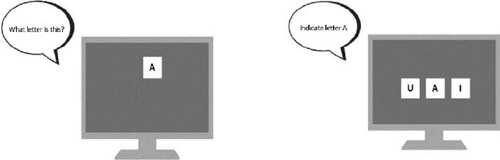
The teaching condition of the experimental stimuli consisted of assessing letter naming and matching dictated and written letters. Figure 1 shows a letter-naming trial (left image) and a letter-identification trial (right image).
The letter-naming task was evaluative and was implemented before and after teaching each set of letters. The 26 letters of the alphabet were randomly distributed (out of alphabetical order) in three blocks, two consisting of nine letters and one consisting of eight letters. The blocks could be implemented on different days, depending on the participant’s performance.
The letters were individually centered at the top of the computer screen, and the question “What letter is this?” was simultaneously asked. Hence, the participants had to name each letter in the first three trials of each block (shown in Figure 1 on the left). The researcher advised the participants that they could name the letters they knew and that there would be no problem if they did not know any of the letters, in which case the subsequent trial would be presented. There were no reinforcements for correct or incorrect responses.
The teaching task consisted of a block of nine trials, three trials with each stimulus for the three-stimuli sets or a block of eight trials for the two-stimuli set. The sample stimuli were presented randomly and, in each trial, the comparison stimuli were positioned semi-randomly between the three positions on the computer screen. Each trial presented the dictated letters (letters’ names) simultaneously with the written letters of the set at the center of the computer screen, one next to the other (Figure 1 on the right). The dictated letter was repeated three times at most every 2500 milliseconds. The participant should click with the mouse on the letter corresponding to the dictated letter. If the child did not select any alternative, the program continued to present the visual stimuli for comparison without the auditory stimulus. Then the researcher repeated the instruction (she dictated the letter again or asked the participant to click on the letter). Correct responses were followed by sound and intermittent social consequences emitted by the researcher. Incorrect responses were followed by a black screen lasting 1200 milliseconds and motivational reinforcement emitted by the researcher, such as “Let’s try again.”
The criterion was correctly responding 100% of the tasks in a block of trials. If the criterion was met, the participant named the letters. Otherwise, the participant would answer the block again with a new sequence of sample stimuli and distribution of comparison stimuli. The child could repeat the teaching block 20 times at most. If the participant reached the maximum number of repetitions without meeting the criterion, He/She performed the letter-naming task and started a new set of stimuli.
The family members and participants assessed the teaching program by answering a questionnaire on Google Forms. The form for the family members consisted of 10 questions, divided into three topics rated on a five-point Likert scale (completely unsatisfactory, unsatisfactory, indifferent, satisfactory, and totally satisfactory) in which the parents reported their satisfaction with the program’s content, the researcher’s skills, and program’s duration. In addition, five open questions were included to provide suggestions that would improve the meetings and contribute to the procedure, besides reporting what they liked the most and the least about the intervention and whether they would recommend the program.
The researcher applied the questionnaire to the participants during a session at the end of the procedure. First, they were asked about their opinion of the researcher and the tasks performed on the computer with her. The answer options were “cool,” boring,” or “neither cool nor boring.” They were also asked if they liked each task, both the assessment and teaching. Thus, prints of the activities were presented to illustrate each activity and facilitate the children’s understanding and answers. Responses included “I didn’t like it,” I liked it a little,” or “I liked it a lot.” Finally, they answered the part of the session they liked the most: “letter tasks,” games/ videos,” or “time to say goodbye.” Hence, the researcher would read each question, explain each of the alternatives, and the child would answer by clicking on the choice with the mouse.
Inter-observer agreement was analyzed after the intervention ended on approximately 30% of each participant’s responses to the letter-naming task. The agreement index was calculated as follows: agreement number, divided by the number of disagreements plus agreements, multiplied by 100 (Sella et al., 2020). The results concerning inter-observer agreement were 91.8% for Lavínia; 76.2% for Monica; 73.3% for Nadia; and 60.3% for Michel, in which the researcher and the second observer pointed out that familiarity with the participant could be an important factor for understanding him since he presented speech difficulties.
Implementation accuracy assessed whether the teaching procedure was employed as intended. For example, the second observer indicated that the researcher did not present prompts or consequences in the sessions assessing letter naming. There were also no prompts in the teaching sessions. In this condition, consequences were presented, primarily for correct response and intermittent for error. In general, the researcher provided instructions for both conditions in case the participant requested or did not response.
The integrity index was also calculated to assess the implementation of the procedures. It was calculated by dividing the number of correct implementations by the total number of implementations, and the quotient was multiplied by 100 (Sella et al., 2020). Therefore, the results obtained were: 100% for participant Lavínia; 96.5% for Monica; 89.6% for Nadia; and 96.3% for Michel.
Data were collected between July 2020 and April 2021. Table 1 presents the months in which the participants initiated and ended the activities, the total number of sessions (including assessment, teaching, and other sessions, e.g., familiarization and play), the number of auditory-visual matching teaching sessions, and the number of letter-naming sessions. Lavinia and Michel started the sessions in July 2020 and ended in February 2021. Lavinia performed 103 sessions; sets 3, 4, 7, and 9 were performed twice, because she did not correctly perform the letter naming after the first teaching session, while Michel attended 82 sessions. Monica and Nadia started in August and September 2020, respectively, and ended in April 2021, totaling 84 and 78 sessions, respectively.

Two participants (Lavinia and Michel) performed two auditory-visual matching sessions with 36 trials in the pre-training sessions: matching dictated words and pictures, and naming figures (doll, sun, and car). Lavinia presented correct responses in 100% and 97.2% of the tasks respectively, and Michel presented correct responses 91.6% in both sessions. Two sessions of nine trials were conducted for the other two participants (Nadia and Mônica). Nadia presented correct responses in 77.8% and 89% of the tasks, and Monica in 89% and 100%, both respectively. The four participants performed two sessions naming figures with nine trials and obtained 100% correct responses.
Figure 2 shows the percentage of correct responses in letter naming and matching dictated and written letters in each set of letters for each participant. The first two letter-naming task probes included 26 letters of the alphabet randomly assigned for Lavinia and Michel; however, separating them into three blocks was necessary. Note that in the initial assessment (before the teaching session), three participants (Lavinia, Monica, and Michel) named vowels, and all the four participants named consonants, mainly of Sets 5 (LSR) and 6 (NBC).

Lavinia performed the teaching sessions concerning Set 3 (F, J, M). She needed 12 teaching blocks for the first set (FJM). Lavinia made changes in the naming of letters in these sets, mainly F and J. For letter F, she made changes with letters that have similar pronunciation (such as S and C) and also with different letters (such as T and P). After attending the teaching sessions a second time, she started to name the letter J correctly. In some trials, she named the letter F with its sound (/f/). She attended the teaching sessions of four sets a second time: 3 (FJM), 4 (NYZ), 7 (PDT), and 9 (KWY) after she was uncertain about naming all the letters in the sets. In Set 9 (KWY), she named the letter W as M in three trials (3, 4, and 7) and answered, “I don’t know” in the other probes. She named the letter K correctly only after the teaching sessions and correctly named Y three times. In the last assessment, Lavinia presented correct responses 84.6% of the tasks in two evaluation sessions and obtained 100% correct responses in Sets 1, 2, 5, 6, and 8.
Monica attended the teaching sessions on all letter sets, requiring two to 10 teaching blocks to meet the learning criterion. In general, she maintained a high performance in naming the letters of Set 1 (AUI) and showed an increase in the naming of letters after learning Sets 2 (EO), 7 (PDT), and 8 (GCH). In Set 3 (FJM), Monica named the letter J with the word “jewel” and more frequently named the letter correctly after the teaching session. Additionally, she named the letter M as W in most trials. The researcher’s unsystematic observations indicated that Monica mentioned the letter Was response to several letters. In Set 5 (LSR), Monica mistook L and S with different letters and, after the teaching sessions, named C as S (similar sounding letters). Additionally, she named R correctly in most trials (providing M as an answer in four trials but then naming it correctly in the final ones). In Set 6 (XBC), she correctly named the letter X in all probes but mistook the letter B with L, N, M, and F and answered “boneca” [doll] in probe 11. In Set 8 (GQH), she answered: “meow,” “gato” [cat], and “Nina” (the participant had a cat named Nina) to name the letter G in trials 5, 8, and 10. Her answers for the letter H sounded close to its pronunciation, but she named it correctly in the final probes. In Set 9 (KWY), Monica answered “quei” to the letter K in trial 5 and mistook it with the letter H in most probes.
Nadia attended the teaching sessions of all sets of letters, requiring from two to 10 teaching blocks to meet the learning criterion. She obtained high percentages of correct responses in the letter-naming task (except for the last set, KWY) and maintained them in the subsequent trials. In the initial probes, Nadia answered with words that started with the corresponding letter and, in the final trials, she named the letters and then said a word with the respective letter. In Set 1 (AIU), she correctly named all the letters; however, when presented with the letter U, she answered “uva” [grape] in six trials. In Set 2 (EO), she first answered “elefante” [elephant] to name the letter E and named it É (an answer considered correct) in the final trials. In Set 4 (NVZ), she named the letters V, N, and Z as W and provided words that were initiated with these letters. For example, she said her own name for N; the same occurred with other letters (Z and M). She answered “zebra” for the letter Z in the first assessment and in trial 15. In Set 5 (LSR), Nadia mistook S with letters with similar pronunciations (C, Z, and F). In Set 7 (PDT), she mistook the letter D with Z, F, and B. Additionally, she mistook the letter T with I in one of the trials and said: “tomate” [tomato] in another four. In Set 8 (QGH), she had difficulty naming the letter H, answering “hi” or “hipopótamo” [hippopotamus], and several other letters. For the letter Q, she initially answered “queijo” [cheese] and then answered O and J in other probes. She mixed the letter G with F in two probes and S and Q in other probes. However, she correctly named all the letters after the teaching sessions. In Set 9 (KWY), Nadia mistook K with R and F in the initial probes and later started naming it H. She named W correctly in most trials and named the letter Y as “Yakult” in seven trials, Z in one, and V in five probes. After the teaching sessions, she continued naming W correctly and also named the letter Y correctly in one probe.
Participant Michel did not perform Set 2 (E, O). He performed a maximum of 17 teaching blocks on the first set of consonants (FJM); for the others, Michel required between two and six teaching blocks. He presented speech difficulties, so he responded by babbling in some sessions. As a result, it was impossible to identify some spoken letters, even though he was asked to repeat them occasionally. Participant Michel showed variability in naming letters. The researcher’s unsystematic observations indicated that the participant was distracted in some sessions and uninterested in performing the tasks. Additionally, he named the letters randomly. For example, he made frequent mistakes when naming the letters in Set 3 (FJM); he named the letter J as different letters (V, G, T, L, and I). He presented the correct answer for the letters F and M, even though he did not maintain the correct answer in all probes, and also mixed F for L, naming it with its sound (/f/); in one probe, he named M as W.
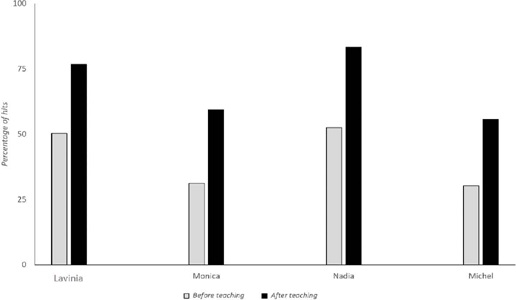
Figure 3 shows the percentages of correct responses in naming letters before and after the teaching session. For the calculation, the total number of correctly named trials before the teaching was divided by the total number of trials evaluated before and after the teaching sessions. Note that the four participants improved their performances after the teaching sessions. Lavinia correctly named 50.3% of the letters before and 76.7% after the teaching sessions. Monica named 31.2% and 59.4% of the letters correctly before and after the teaching sessions, respectively. Nadia named 52.5% of the letters before and 83.3% after the teaching sessions. Michel named 30.3% and 55.7% of the letters correctly before and after the teaching sessions, respectively.
The four participants’ mothers answered the questionnaire. They evaluated the characteristics of the program’s content as “totally satisfactory” and “satisfactory”, such as clarification of objectives, organization, planning, quality of the platform used, graphic design (diagramming and images), and the program’s effectiveness. How easy it was to use the platform was evaluated as “satisfactory” by one mother and “totally satisfactory” by three. Regarding the researcher’s skills, the mothers evaluated all items as “totally satisfactory”: availability and communication (accessibility and helpfulness); interaction (stimulating the child’s interest); quality of sessions; and the researcher’s organization of activities. The mothers also evaluated the items related to time, duration of daily sessions, frequency of sessions (weekly sessions), and duration of the entire procedure as “totally satisfactory”. The parents reported that they would recommend the teaching program to other people. In the open question about suggestions to improve, one mother replied, “If the project were being applied as an established method, I would suggest correcting the child’s choices so that s/he would understand his/her mistake in naming the letter and in choosing the letter, but considering it was only for evaluation and research purposes, I believe it was within the expected.” When providing suggestions to contribute to the procedure, a mother noted, “In the specific case of a child with Down syndrome, I believe that the repetition has presented good results... at least with my daughter, yes”. In the question about what they liked the most about the sessions, all the parents answered “the interaction with the researcher.” To the question inquiring what they liked the least, three answered “the end of the activities.”
In the participants' assessments, the four children (100%) answered “cool” to the questions concerning what they thought of the researcher and about performing tasks on the computer with the researcher. Regarding letter-naming tasks, Michel answered that he liked them a little while the other participants liked them. As for the auditory-visual matching activities, Lavinia and Michel said they liked them a lot, and Monica and Nadia said they liked them a little. When asked which part they liked the most, Michel answered that he liked the letter tasks the most; Nádia answered that she liked the games and videos, and Lavinia and Monica answered that they liked the time to say goodbye the most; it was a time when the researcher played with the children. For example, Lavinia asked for her to be responsible for ending the video call, and then the researcher should “zip her mouth” and wait; at other times, the session would take longer because the participants and researcher would be saying goodbye, and this made them laugh.
This study presented the systematic replication of the study by Hayashi et al. (2013). The objective was to evaluate the emergence of letter naming based on the teaching of auditory-visual matching among children with Down syndrome or autism during remote teaching. In general, the results showed an increase in the correct naming of letters at the end of the procedure compared to the initial evaluations and are in line with those obtained by Hayashi et al. (2013), in which teaching improved the performance of participants in letter-naming activities, although not immediately. The results also showed an increase in the number of letters correctly named after teaching other sets of letters. However, only one participant (Lavinia) was exposed twice to sets, which she did not learn after finishing all sets of stimuli. Future studies are suggested to investigate the reapplication of sets of letters among participants who do not show acquisition and stability after completing all sets.
Compared to the other participants, Michel showed less stability in naming letters. He presented speech difficulties, which may have interfered with his performance in letter naming, as he had difficulties correctly and clearly pronouncing the letters. The inter-observer agreement index was equal to 60.3% for this participant’s letter-naming responses. One possibility for the high discrepancy rate may be related to unintelligible speech. Future studies are needed to assess strategies to promote speech ability, mainly intelligibility, e.g., in this case, it would be interesting to include echoic behavior in the teaching condition. Hence, echoic behavior could be included in a block of trials before teaching matching dictated and written letters. Teaching strategies could also include prompts when the child makes a mistake and in the case of non-response after some time the stimulus was presented, such as to pronounce the letter longer.
Nadia could name several letters before the teaching sessions (11 letters in the baseline) but would name letters using words initiated with the respective letter. After the teaching sessions, she increased the number of letters named correctly (23 letters in the last two trials) and would only provide a word initiated with the respective letter after naming it. Monica presented similar results. In the first trials, she would provide words beginning with the letters instead of naming them, but after the teaching sessions, she named most of the letters correctly. This performance may be related to a recent study by Durães and Barrera (2021) in which the effectiveness of using a mnemonic alphabet in teaching letters to preschoolers was assessed. In the previous study, the participants were divided into two groups: one participated in the intervention with a mnemonic alphabet, and the other learned the conventional alphabet. Six unknown letters were taught to the children. The results showed that children from both groups showed significant progress in recognizing the letters. However, only those in the mnemonic alphabet group showed significant progress in learning the alphabet in general, writing the letters, and identifying dictated words.
In this study, the organization and distribution of letters in sets were intended to use the phonology principles Seabra and Capovilla (2004) pointed out as a reference. In the teaching sessions concerning Set 3 (FJM), three participants, Lavinia, Nadia, and Michel, performed 12, 10, and 18 sessions, respectively, and only Nadia obtained 100% of the correct responses. The high number of sessions suggests the need to review the teaching conditions. One aspect that future studies can address concerns the first set of consonants. We suggest modifying the order of the sets to control this variable. The results obtained in this study on the initial naming evaluations show that all the participants provided a more significant number of correct answers in Set 6 (XBC).
Another important aspect to be verified in future studies concerns the use of specific consequences to favor the discrimination of letters’ names. Varella and de Souza (2015) taught a 3-year-old child with autism to identify relationships between lowercase letters (Set 1) and uppercase letters (Set 2) and used a compound stimulus that consisted of an auditory component (dictated letter) and a visual component (an uppercase letter for Set 1 or a lowercase letter for Set 2) consequently for a correct response. The child learned the relationships and presented the emergence of arbitrary relationships between uppercase and lowercase letters, between lowercase letters and uppercase letters, dictated letters and uppercase letters, and dictated letters and lowercase letters. The authors suggest that incorporating consequences for each potential emerging class in an MTS task can improve the efficiency of the teaching procedure since it allows the emergence of relationships without direct teaching. According to Sidman (2000), equivalence classes could be formed from contingencies of three terms (discriminative stimulus, response, and reinforcement). In this sense, an arrangement of contingencies should be employed in which two different discriminative stimuli would control two different responses maintained by specific consequences. Given this arrangement, specific consequences could become part of the equivalent stimuli class.
The participation of parents or family members was important in this study, as the researcher had to pay attention and deal with situations in which the mothers answered for the students. Whenever the researcher faced such a situation, she reinforced the initial guidelines, instructing that family members could encourage the students to answer but should not answer in their place because the teaching procedure was planned to address these difficulties. However, on some occasions, such interference could not be controlled, and the responses given by a family members were disregarded. Future studies are suggested to train the parents or caregivers to promote teaching conditions that ensure effective learning, besides enabling them to apply the instructional resource at home. Gomes et al. (2021) evaluated the use of information and communication technologies to train the caregivers of children with autism in the context of Intensive Behavioral Intervention, showing that this alternative can provide quality interventions and contribute to the development of children with autism.
Similar to the results presented by Hayashi et al. (2013), letter naming also emerged in this study before teaching was implemented via experimental procedures. However, this study’s results must be analyzed cautiously, considering that its participants were selected according to convenience. However, intervening variables should be identified to contribute to the improvement of the experimental condition. Because these are basic skills for learning to read and write and the participants were enrolled in regular schools, their performance is likely to have been acquired during their exposure to classroom teaching. Furthermore, this study was conducted online during the Covid-19 pandemic when children had restricted access to school activities. Even though this study has limitations, it also presents promising results for letter teaching, indicating that the teaching procedure can be a viable alternative to establish letter recognition and the emergence of letter naming for special education-targeted individuals. Hence, it is a way to contribute to these students’ learning process, complementing regular school teaching. Additionally, teachers and family members could implement this procedure.
* Correspondence concerning this article should be addressed to Gabriela Cabral Chizzolini, Rua Élio Rabano Sanches, 128 – Parque Ibiti do Paço, Sorocaba, SP, Brazil. CEP 18086337. Email: gabrielachizzolini@estudante.ufscar.br
