Artículos

This work is licensed under Creative Commons Attribution-NonCommercial-ShareAlike 3.0 International.
Received: 07 March 2020
Accepted: 15 April 2020
DOI: https://doi.org/10.5281/zenodo.3808739
Abstract: This article analyzes the role of psychological empowerment as an intervening variable on the relationship between transformational leadership and employees innovative work behavior (IWB). This research used a quantitative approach with a total of 100 employees from local branded fashion businesses in Indonesia to fill out the questionnaires. The sample was taken using a non-probability sampling technique. This study adds to innovative work behavior literature by empirically testing the mediating role of psychological empowerment on transformational leadership and innovative work behavior relationship. This study resolves the research gap between transformational leadership and innovative work behavior with the concept of psychological empowerment.
Keywords: Innovative work behavior, local branded fashion, transformational leadership, psychological empowerment..
Resumen: Este articulo analiza el papel del empoderamiento psicológico como una variable interviniente en la relación entre el liderazgo transformador y el comportamiento laboral innovador de los empleados (IWB). Se utilizó un enfoque cuantitativo con un total de 100 empleados de empresas locales de moda de marca en Indonesia para completar los cuestionarios. La muestra se tomó utilizando una técnica de muestreo no probabilística. Este estudio se suma a la literatura innovadora de comportamiento laboral al probar empíricamente el papel mediador del empoderamiento psicológico en el liderazgo transformacional y la relación innovadora de comportamiento laboral y resuelve la brecha de investigación entre el liderazgo transformador y el trabajo innovador.
Palabras clave: Comportamiento laboral innovador, moda de marca local, liderazgo transformacional, empoderamiento psicológico..
INTRODUCTION
The role of a leader towards employees in the organization is very important. Leaders should be able to realize innovative work among employees, in this case, leadership with a transformational style. This type of leadership is believed to be one of the driving factors for employees to innovate. Transformational leaders tend to be open-minded and visionary; therefore employees are supported to be more innovative. Companies need to have transformational leadership that can be a motivation for employees to work beyond expectations (Qu et al.: 2015, pp. 286-299; Madrid et al.: 2014, pp. 234-256). To realize innovative work behavior in the company, employees need to have confidence. It means employees should believe that they are capable of doing their jobs properly. Employees who have such beliefs will enjoy and value their jobs. Enjoyment may lead an employee to perform better and in the long run, he may come up with brilliant ideas. This creates an awareness that psychological empowerment among employees is needed since it may affect employees’ performance at work (Shalley & Gilson: 2004, pp. 33-53; Sun et al.: 2012, pp. 55-65; Alge et al.: 2006, pp. 221-232).
Some previous studies on creative performance stated that creative performance is much influenced by leadership behaviors. Transformational leadership tends to build strong bonding relationship with the followers, due to their effective communication (Mohamed: 2016, pp. 49-59; Qu et al.: 2015, pp. 286-299). However, some studies say transformational leadership does not have a significant role in creative performance (Brown: 2008, pp. 414-462; Wang et al.: 2014, pp. 79-89). Therefore there is a missing link between the study of transformational leadership on creative performance, so this research is expected to resolve the research gap that has occurred through the psychological empowerment concept as a mediator.
METHODS
Literature Review
Transformational Leadership and Innovative Work Behavior
There are various kinds of leadership styles that can be applied in an organization, but not all of them can effectively build innovative work behavior. However, some studies stated that transformational leadership is believed to have the most impact on employees’ work innovation. Some characteristics of transformational leadership are inspirational motivation, individualized consideration, idealized influence, and intellectual stimulation (Afsar et al.: 2014, pp. 1270-1300; Choi et al.: 2016). First, motivation provided by a leader can help employees realize and explore their potential. Motivated employees will tend to be more creative and can find new ways to overcome problems. Second, attention from the leader will encourage employees to perform innovation as a return favor. Third, transformational leaders can be seen as role models for their optimism in improving organizational innovation. Next, through intellectual stimulation, leaders can influence employees to be more committed to the organization. Employees may then strive to produce innovative performance, and to achieve the organization's vision (Afsar et al.: 2014, pp. 1270-1300; Choi et al.: 2016; Kayumova et al.: 2019, pp. 81-92).
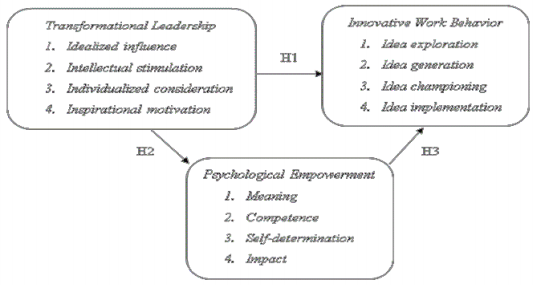
H1: Transformational Leadership has a positive effect on Innovative Work Behavior.
Transformational Leadership and Psychological Empowerment
Previous studies have shown a positive relationship between transformational leadership and psychological empowerment. A leader does play an important role in influencing the psychological condition of employees. Similar to innovative work behavior, psychological empowerment is also influenced by the existence of transformational leadership. Transformational leadership can build a positive work environment, so employees will feel motivated. This leadership style usually provides support to its employees through concrete actions. Such as giving authority to employees to participate in decision making and encourage employees to create and implement the idea. In other words, transformational leaders help their employees in achieving future goals.organization. This is certainly related to the four dimensions of transformational leadership, especially individualized consideration and inspirational motivation (Afsar et al.: 2014, pp. 1270-1300; Han et al.: 2016, pp. 130-149).
H2: Transformational Leadership has a positive effect on Psychological Empowerment.
Psychological Empowerment and Innovative Work Behavior
Employees who obtain psychological empowerment will generally be motivated to work more creatively and effectively. This is due to a change in the way employees look at themselves and their work. Through psychological empowerment, employees will have better self-confidence and realize their potential. Also, psychological empowerment helps employees to appreciate the work. When these values have emerged, employees’ behavior automatically at work will also change. Employees will tend to work more creatively to produce something that impacts the organization. This is certainly related to innovative work behavior, given that creativity is important in it. Therefore, psychological empowerment plays a role in increasing the possibility of innovative work behavior in the workplace (Afsar et al.: 2014, pp. 1270-1300; Afsar & Badir: 2016).
H3: Psychological Empowerment has a positive effect on Innovative Work Behavior.
Research Framework
Figure 1 shows the conceptual framework for this research that explains the relationship among variables.
This research used quantitative research. Quantitative research is a scientific research that uses systematic methods and emphasizes a measure of performance. This research focuses on measurement and statistics because they are the links between empirical observations and mathematical expressions of relations. The focus of quantitative research is to develop and test hypotheses and theories that explain behavior. The period needed to conduct this research can be said to be relatively short, and the results also have a high level of generalization. Although conducted in a short time, quantitative research can cover extensive data. Therefore, this type of quantitative research is often used by researchers (Hoy & Adams: 2016; Flick: 2015).
This study aims to provide an overview of transformational leadership on innovative work behavior, through psychological empowerment as an intervening variable. For this reason, it is necessary to test the hypothesis to understand the relationship between one variable and the other.
The measurement of transformational leadership is adapted from Multifactor Leadership Questionnaire(Avolio et al.: 1999), Innovative Work Behavior (de Jong & Den Hartog: 2010, pp. 23-36), and Psychological Empowerment (Spreitzer: 1995, pp. 1442-1465).
Population and Sample
The population is a generalization area consisting of subjects or objects that have the same characteristics, which are previously determined by researchers for the study (Hair et al.: 2011, pp. 414-433). In this study, the population is all employees who work on local fashion brands. The population in this study is unknown. Therefore, it is necessary to take several samples to represent the existing population.
The sample is part of the number and characteristics possessed by the population (Hair et al.: 2010). Thisstudy uses a non-probability sampling technique that is purposive sampling. The use of this technique is due to the specific criteria specified in determining the sample. The first criterion is that the respondent must have a leader figure, not an independent worker. The second criterion is that samples are taken from employees who work in local fashion brand businesses in Indonesia (Surabaya and surrounding areas). In determining the minimum number of samples, this study uses the Slovin formula with an error level of 10% so a sample size of 100 respondents is obtained (Sekaran & Bougie: 2016; Bunakov et al.: 2019, pp. 85-96).
Data Collection
The data collection method used in this study is by distributing questionnaires directly to respondents. The questionnaire is a data collection technique that is done by giving a set of questions or written statements to respondents to be answered (Sekaran & Bougie: 2016). In this study, the questionnaire is made in the form of a list of statements related to each indicator for each variable. Respondents were asked to provide an assessment of the statements given with a Likert scale (1-5). The questionnaire given was confidential.
Apart from distributing questionnaires, the data collection method in this study is through literature studies. It was done by collecting data or information from books, journals, and websites.
Data Analysis
This study uses a path analysis technique because of the intervening variable in it, namely the psychological empowerment variable. Data processing will be done using the help of PLS software (SEM). Also, SPSS software is used as a descriptive statistical analysis tool in this study.
RESULTS
Validity Test
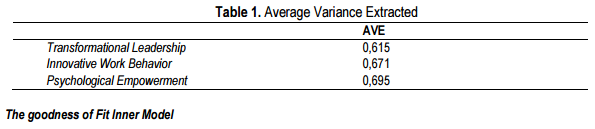
AVE (Average Variance Extracted) is part of the validity test that must be completed. This test is seen based on the extracted average value of each variable. The AVE value should be greater than 0.5, as can be seen in Table 1 below. This shows that the results meet the requirements for convergent validity evaluation.
The goodness of Fit Inner Model

The R-square result of innovative work behavior is 0.463 or equal to 46.3%. This shows that the variables of transformational leadership and psychological empowerment can influence innovative work behavior by 46.3%. The remaining 53.7% is the influence of other variables outside the research variable. Whereas the R- square result of psychological emotion is 0.232 or equal to 23.3%. This shows that the variable transformational leadership can affect psychological empowerment by 23.3%. The remaining 76.7% is the influence of other variables outside the discussion of this study. The value of Q-square predictive relevance can be known by the following calculation formula:
Q = 1 – (1 – R2 Psychological Empowerment) x (1 – R2 IWB)
= 1 – (1 – 0,232) x (1 – 0,463)
= 1 – (0,768 x 0,537)
= 1 – 0,412416
= 0,587584
The results of the calculation of the Q-square value indicate that the model has predictive relevance, because the result is greater than 0, 0.587584.
Hypotheses Test
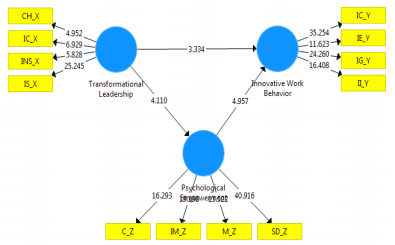
Figure 2. Bootstrapping
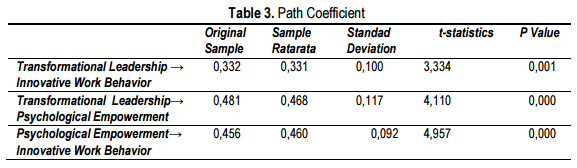
Through table 3 above, the influence of exogenous variables on endogenous variables can be seen in each of the hypotheses below:
-
Transformational leadership has a positive effect on innovative work behavior. It can be seen in the table that the results of the t-statistic transformational leadership test on innovative work behavior are3.334. Therefore, it can be stated that transformational leadership has a positive effect on innovative work behavior because its value is greater than 1.96. Hypotheses 1 is accepted.
-
Transformational leadership has a positive effect on psychological empowerment. It can be seen in the table that the results of the t-statistic transformational leadership test on psychological empowerment are 4.110. Therefore, it can be stated that transformational leadership has a positive effect on psychological empowerment because its value is greater than 1.96. Hypotheses 2 is accepted.
-
Psychological empowerment has a positive effect on innovative work behavior. It can be seen in the table above that the results of the t-statistic psychological empowerment test on innovative work behavior are 4.957. Therefore, it can be stated that psychological empowerment has a positive effect on innovative work behavior because its value is greater than 1.96. Hypotheses 3 is accepted.
-
Psychological empowerment has an important role as an intervening variable (mediator) of transformational leadership on innovative work behavior. It can be seen in the table and figure above that the effect of transformational leadership on innovative work behavior mediated by psychological empowerment is equal to 20,373 (4,110 x 4,957). This is far greater than the direct effect of transformational leadership on innovative work behavior which is only 3,334. Therefore, it can be stated that psychological empowerment does play an important role as an intervening variable of transformational leadership in innovative work behavior.
DISCUSSION
Among various kinds of leadership styles that can be applied in an organization, transformational leadership seems to be a leadership style that creates the most impact on directing employees to innovation at work. Previous studies show that there four characteristics of transformational leadership, namely inspirational motivation, individualized consideration, idealized influence, and intellectual stimulation (Afsar et al.: 2014, pp. 1270-1300; Choi et al.: 2016).
Previous studies have also shown a positive relationship between transformational leadership and psychological empowerment. A leader does influence the psychological condition of employees. Similar to innovative work behavior, psychological empowerment is also influenced by the existence of transformational leaders. Employees who obtain psychological empowerment will generally be motivated to work more creatively and effectively. This is due to a positive change in the way employees see themselves and their work. Through psychological empowerment, employees will experience an increase in self-confidence and also realize their potential (Mostafa: 2017, pp. 266-272). Besides, psychological empowerment also helps employees to better appreciate the work instead of taking it as a burden. When these values have arisen in employees, their behavior at work will also change. Employees will tend to work more creatively to produce something that impacts the organization. This is certainly related to innovative work behavior, since creativity is an inseparable aspect of innovation (Hughes et al.: 2018, pp. 549-569; Pradhan & Jena: 2019). Thus, psychological empowerment may increase the possibility of innovative work behavior in the workplace (Afsar et al.: 2014, pp. 1270-1300; Afsar & Badir: 2016).
Research on the role of psychological empowerment as an intervening variable of transformational leadership on innovative work behavior is still very rare. There is only one previous research that shows that psychological empowerment does act as a mediator of transformational leadership and innovative work behavior (Afsar et al.: 2014, pp. 1270-1300). More studies investigate the role of psychological empowermentas a moderating variable instead of intervening (Saeed et al.: 2019, pp. 254-281; Pieterse et al.: 2009, pp. 609-623).
CONCLUSION
From the results of data processing and analysis that has been done, it can be concluded that: transformational leadership has a positive effect on innovative work behavior; transformational leadership has a positive effect on psychological empowerment; psychological empowerment has a positive effect on innovative work behavior; and psychological empowerment acts as an intervening variable of transformational leadership on innovative work behavior.
Leaders need to give special attention to their employees and realize that each individual has different abilities. For this reason, leaders can provide support to each employee. For example, by providing active coaching and feedback to employees. The leaders play an important role because in general employees will be motivated by the attitudes and habits of their leaders (Sandvik: 2018, pp. 39-53; Siachou & Gkorezis: 2018, pp. 94-116).
Leaders and employees are expected to work well together. A leader sometimes needs to provide new opportunities for his employees, for example by giving confidence to employees to participate in corporate decision making. Responding to this, employees will appreciate the opportunities provided and try to prove the best (Mostafa: 2017, pp. 266-282; Sandvik: 2018, pp. 39-53; Siachou & Gkorezis: 2018, pp. 94-116).
BIODATA
R Setiawan: Roy Setiawan is a lecturer in the Management Study Program of Business and Economics Faculty at Universitas Kristen Petra with research interests in the field of Human Resource Management and Organizational Behaviour. He previously served as the Chairman of the Business Management Study Program and Head of the Leadership Laboratory at Universitas Kristen Petra. He is currently completing doctoral studies in Management at Universitas Airlangga Surabaya and is developing a new model in his research.
T Suryani: Tatik Suryani is a Professor at Sekolah Tinggi Ilmu Ekonomi Perbanas in Surabaya Indonesia with a research interest in organizational behavior and marketing. She once served as Chairwoman of the Sekolah Tinggi Ilmu Ekonomi Perbanas, Surabaya Indonesia, and is currently serving as the Director of Master of Management at the same University. She also teaches as a guest lecturer at Universitas Airlangga at the Faculty of Psychology and the Faculty of Economics and Business. Furthermore, she is also active as an assessor in LLDIKTI and several other activities.
G Tirsa: Gisela Tirsa is an alumnus of the Management Study Program at Universitas Kristen Petra. Her current profession is a young entrepreneur. She is interested in exploring the field of organizational behavior to be implemented in the business that she is currently engaged in. During her time as a student, she had good academic achievements and good scientific writing skills. The business she is currently doing is in fashion. Her love for fashion has made her interested to develop the field through research.
A Eliyana: Anis Eliyana is a Professor at the Department of Management in Universitas Airlangga. She works as a lecturer in the Department of Management in Universitas Airlangga as well as in Universitas Negeri Jakarta. Currently, she serves as the Head of Research in Management and Business Development Laboratory in Business and Economics Faculty Universitas Airlangga. Her research interests cover organizational behavior and human resource management. Presently, she is still active as an assessor at the National Accreditation Board.
BIBLIOGRAPHY
AFSAR, B, & BADIR, Y (2016). “The mediating role of psychological empowerment on the relationship between person-organization fit and innovative work behaviour”. Journal of Chinese Human Resource Management.
AFSAR, B, BADIR, YF & SAEED, BB (2014). “Transformational leadership and innovative work behavior”. Industrial Management & Data Systems, 114(8), pp. 1270–1300.
ALGE, BJ, BALLINGER, GA, TANGIRALA, S & OAKLEY JL (2006). “Information privacy in organizations: Empowering creative and extra role performance”. Journal of Applied Psychology, 91(1), pp. 221 – 232.
AVOLIO, BJ, BASS, BM & JUNG, DI (1999). Re-examining the components of transformational and transactional leadership using the Multifactor Leadership Questionnaire.
BROWN, EA (2008). “Dimensions of transformational leadership and relationship with employee performance in hotel front desk staff”. Journal of Occupational and Organizational Psychology, 72, pp. 414-462.
BUNAKOV, O. A., ASLANOVA, D. K., ZAITSEVA, N. A., LARIONOVA, A. A., CHUDNOVSKIY, A. D., & EIDELMAN, B. M. (2019). “RELIGIOUS AND HALAL TOURISM ORGANIZATION PECULIARITIES IN MUSLIMREPUBLICS”, European Journal of Science and Theology, 15(3), pp. 85-96.
CHOI, SB, KIM, K, ULLAH, SME, & KANG, SW (2016). “How transformational leadership facilitates innovative behavior of Korean workers: examining mediating and moderating processes”. Personnel Review, 45(3).
DE JONG, J & DEN HARTOG, D (2010). “Measuring Innovative Work Behaviour”. Creativity and Innovation Management, 19(1), pp. 23-36.
FLICK, U (2015). “Introducing research methodology (2nd ed.)”. London: SAGE.
HAIR, JF, BLACK, WC, BABIN, BJ & ANDERSON, RE (2010). “Multivariate Data Analysis 7th Edition: Pearson Prentice Hall”.
HAIR, JF, SARSTEDT, M, RINGLE, CM & MENA, JA (2011). “An assessment of the use of partial least squares structural equation modeling in marketing research”. Journal of the Academy of Marketing Science, 40(3), pp. 414-433.
HAN, SH, SEO, G, YOON, SW & YOON, DY (2016). “Transformational leadership and knowledge sharing: Mediating roles of employee’s empowerment, commitment, and citizenship behaviors”. Journal of Workplace Learning, 28(3), pp. 130–149.
HOY, WK & ADAMS, CM (2016). “A quantitative research in education: A primer (2nd ed.)”. United States: SAGE.
HUGHES, DJ, LEE, A, TIAN, AW, NEWMAN, A & LEGOOD, A (2018).” Leadership, creativity, and innovation: A critical review and practical recommendations”. The Leadership Quarterly, 29(5), pp. 549-569.
KAYUMOVA, G., SHEYMARDANOV, S., AKHTARIEVA, R., & ZHUNDIBAYEVA, A. (2019). “Developingcreative potential of a schoolchild by means of native language”, Journal of Social Studies Education Research, 10(1), pp. 81-92.
MADRID, HP, PATTERSON, MG, BIRDI, KS, LEIVA, PI & KAUSEL, EE (2014). “The role of weekly highactivated positive mood, context, and personality in innovative work behavior: A multilevel and interactional model”. Journal of Organizational Behavior, 35, pp. 234–256.
MOHAMED, LM (2016). “Assessing the effects of transformational leadership: A study on Egyptian hotel employees”. Journal of Hospitality and Tourism Management, 27, pp. 49-59.
MOSTAFA, AMS (2017). “The mediating role of positive affect on the relationship between psychological empowerment and employee outcomes”. Evidence-based HRM: a Global Forum for Empirical Scholarship, 5(3), pp. 266-282.
PIETERSE, AN, KNIPPENBERG, DV, SCHIPPERS, M & STAM, D (2009). “Transformational and transactional leadership and innovative behavior: The moderating role of psychological empowerment”. Journal of Organizational Behavior, 31, pp. 609–623.
PRADHAN, S & JENA, LK (2019). “Does Meaningful Work Explains the Relationship Between Transformational Leadership and Innovative Work Behaviour?”. Vikalpa: The Journal for Decision Makers.
QU, R, JANSSEN, O & SHI, K (2015). “Transformational leadership and follower creativity: The mediating role of follower relational identification and the moderating role of leader creativity expectations”. The Leadership Quarterly. 26(2), pp. 286-299.
SAEED, BB, AFSAR, B, SHAHJEHAN, A, & SHAH, SI (2019). “Does transformational leadership foster innovative work behavior? The roles of psychological empowerment, intrinsic motivation, and creative process engagement”. Economic Research-Ekonomska Istrazivanja, 32(1), pp. 254–281.
SANDVIK AM (2018). “Intellectual stimulation and team creative climate in a professional service firm”. Evidence-based HRM: a Global Forum for Empirical Scholarship, 6(1), pp. 39-53.
SEKAARAN, U & BOUGIE, R (2016). “Research Methods for Business (7th ed.)”. WILEY.
SHALLEY, CE & GILSON, LL (2004). “What leaders need to know: A review of social and contextual factos that can foster or hinder creativity”. The Leadership Quartely, 15(1), pp. 33-53.
SIACHOU, E & GKOREZIS, P (2018). “Empowering leadership and organizational ambidexterity: a moderated mediation model”. Evidence-based HRM: a Global Forum for Empirical Scholarship, 6(1), pp. 94-116.
SPREITZER, GM (1995). “Psychological Empowerment in The Work Place: Dimensions, Measurement, And Validation”. Academy of Management Journal, 38(5), pp. 1442-1465.
SUN, LY, ZHANG, Z, QI, J, & CHEN, ZX (2012). “Empowerment and creativity: A cross-level investigation”. The Leadership Quarterly, 23, pp. 55–65.
WANG, CJ, TSAI, HT & TSAI, MT (2014). “Linking transformational leadership and employee creativity in the hospitality industry: The influences of creative role identity, creative self-efficacy, and job complexity”. Tourism Management, 40, pp. 79-89.
