European Regional Policy

This work is licensed under Creative Commons Attribution-NonCommercial 4.0 International.
Received: 02 May 2020
Accepted: 29 June 2020
DOI: https://doi.org/10.38191/iirr-jorr.20.008
Abstract: The present article provides a detailed overview regarding the position of Spain and its Autonomous Communities in the European Territorial Cooperation (ETC) programmes where the whole country (or some regions) are eligible. This analysis compares the presence of Spain in terms of participation in projects funded by these programmes, focusing on three main variables: the regional scope, that is the relative presence of each Autonomous Community, the thematic scope, in terms of the different thematic axes of the programme, and in terms of the institutional scope, in terms of the typology of participating institutions. To perform this analysis, a brand new database has been generated, aggregating and treating data from eight different sources linked to the four programmes analysed: Interregs Europe, Atlantic, Mediterranean, and South West. The main result shown in the analysis is that Spain participates in ETC on the average of other EUs states, and that the distribution of this participation among AC depends on each programme and changes over the duration of the programming period; we also show that the distribution across the programmes’ thematic objectives is quite proportionally divided and somewhat in alignment with the use of ERDF in each territory; additionally, we conclude that the role of the private sector is still scarce and must be fostered.
Keywords: European territorial cooperation, Interreg, regional development policy, Spanish participation in European programmes.
Resumen: El presente artículo proporciona una visión detallada sobre la posición de España y sus Comunidades Autónomas en los programas de Cooperación Territorial Europea (ETC) donde todo el país (o algunas regiones) son elegibles. Este análisis compara la presencia de España en términos de participación en proyectos financiados por estos programas, centrándose en tres variables principales: el alcance regional, es decir, la presencia relativa de cada Comunidad Autónoma (CC.AA.), el alcance temático, en términos de los diferentes ejes temáticos del programa, y el alcance institucional, en términos de la tipología de las instituciones participantes. Para realizar este análisis, se ha generado una nueva base de datos, agregando y tratando datos de ocho fuentes diferentes vinculadas a los cuatro programas analizados: Interregs Europe, Atlantic, Mediterranean y SUDOE (Sur-Oeste). El principal resultado mostrado en el análisis es que España participa en ETC en la media de lo que lo hacen otros estados de la UE, y que la distribución de esta participación entre CC.AA. depende de cada programa y cambia durante la duración del período de programación; también mostramos que la distribución entre los objetivos temáticos de los programas está dividida proporcionalmente y en cierta medida alineada con el uso del FEDER en cada territorio; además, concluimos que el papel del sector privado aún es escaso y debe fomentarse.
Palabras clave: cooperación territorial europea, Interreg, política de desarrollo regional, participación española en programas europeos.
1. Introduction
The new programming period of framework budget of the European Union (EU) kicks-off in 2021, and it will last until 2027. In the EU’s budget, territorial Cohesion Policy has always played a relevant role, and it has been the main instrument to support the development of the EU’s regions. The Cohesion Policy devotes part of its budget (around 9.5 billion Euro for the period 2014-2020) to a pool of programmes under an initiative called European Territorial Cooperation (also known as Interreg). The initiative is funded by the European Regional Development Fund (ERDF), which aims at strengthening collaboration among regions and member states according to their geographical position and the common challenges they may face. This collaboration takes place under thematic projects where several institutions from different territories work together to exchange their experiences and develop new strategies to tackle these challenges.
While Interreg aims at being a relevant tool for the European Cohesion Policy, academic research on how it operates, the domains it covers and why and how specific member states participate in it is scarce and limited. Our work aims at producing a detailed analysis on a specific example by examining the logic of the participation of Spanish institutions in Interreg projects from different perspectives. It is commonly believed that Spain – usually alongside Italy – clusters a large number of Interreg projects compared to other EU countries; however, this statement is largely biased. As we will see in section 4, Spain’s participation in the programmes is right in the average (or just slightly above) when we analyse it in per capita terms, that is, when introducing the concept of relative intensity. This assessment is based on how many projects a given region has considering the size of its state’s population (including only the population of the eligible regions). As one might expect, the larger the population, the larger the number of institutions that are suitable to participate in ETC programmes. Given the large number of stakeholders, collecting data on the number of institutions and their size would be very difficult to estimate, so population becomes a good proxy.
Interreg programmes are managed by decentralised Joint Secretariats (JS), usually attached to a regional government of one of the regions that can participate in a particular programme. The JS receives the funding for the programmes from the European Commission, concretely from ERDF, and it serves as the co-funding source (on average, approximately 75-85% of the entire budget for the project). Each programme has an operational programme that lasts for 7 years (the current one is 2014-2020) and within these years, some calls for proposals are open, allowing partnerships of institutions from the territories that are eligible in each programme to present projects for which they request funding. Depending on the budget of the call (subdivided in thematic objectives), a number of projects are selected for funding according to the resolution of monitoring committees representing the different member states involved in that programme and, after signing the grant agreement, partnerships start implementing their projects, which usually last from 2 to 3 years on average. The whole implementation of the project is monitored by the respective JSs.
As stated, in most cases, Interreg programmes are oriented to common learning and capacity building; therefore, the target partnerships are those involving stakeholders that are relevant in the projects’ frameworks, and these are usually public institutions and/or private non-profit (with some exceptions). In principle, any institution meeting the eligibility criteria, and which is relevant for the topic of the project for which funding is requested, can participate in the programme, without any quota on the participation by stakeholders of one country or region. As we will see in our analysis, this leads to over- and underrepresentation of some regions. Our work aims at analysing this distribution from different perspectives, using Spain as an example, by studying its involvement as a state and from a regional perspective.
When analysing Spain’s participation in Interreg, we must also bear in mind the bigger picture, i.e. the country’s position in relative terms when compared to the rest of the EU. The Cohesion Policy (of which Interreg is an instrument) aims at improving economic and social development. Figure 1 presents four of the main indicators that are traditionally considered when discussing this policy: unemployment rate, GDP per capita, R&D investment as percentage of the GDP, and labour productivity. As we see, with the exception of unemployment (which has experienced turmoil since the beginning of the last financial crisis), Spain performs close to the European average but always with slightly worse figures, which proves that it still has room to improve its position in the convergence process. That is the exact purpose of the Cohesion Policy, supported by ETC.
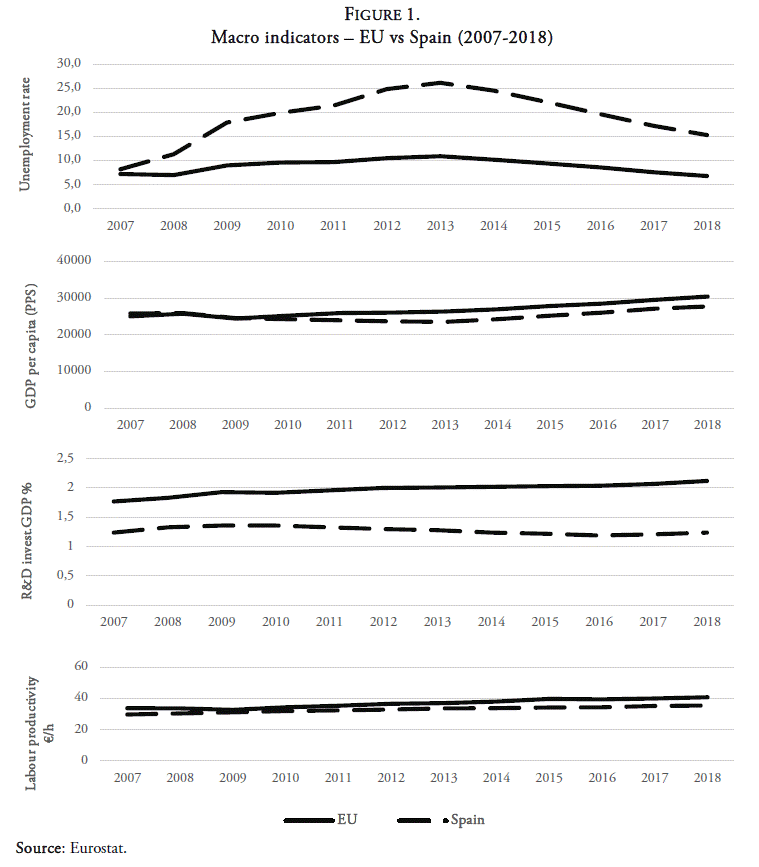
Figure 1.
Macro indicators – EU vs Spain (2007-2018)
Source: Eurostat.
To undertake the study of the role and implications of Spain’s participation in ETC, in section 2, we contextualise Interreg and the way it is implemented in the literature framework and the particular situation for Spain. In section 3, we introduce the data we work with and the methodology of the analysis. Sections 4 and 5 present the results. In Section 4, we analyse the global absolute and relative presence of Spanish participations in those programmes in which Spain (or some of its regions) – given its geographical position – is eligible. We have always considered the entire programming period 2007-2013 (all the projects) and the awarded ones in the period 2014-2020 up to the 31 December 2018. In section 5, the study expands to examine the details of this analysis, assessing three dimensions: (i) territorial, placing the scope of the analysis on the Spanish Autonomous Communities, to have regionalised approach, (ii) thematic, linking it to the priority axes of the ERDF and the intensity in which Spanish institutions participate in ETC projects given these priority domains, and (iii) institutional, analysing which type of institutions (public authorities, R&I providers, industry, etc.) participate in these programmes. Finally, the conclusions of our work aim at putting all these dimensions together in a global analysis relevant for policymaking and the implementation of Interreg in Spain.
2. Precedents and logic of the European Territorial Cooperation (Interreg)
As stated in the introduction, Interreg is the common name of the European Territorial Cooperation (ETC) policy of the European Commission. Its purpose is to serve as a framework for collaboration and joint capacity building for European local, regional, and state stakeholders in different European Union (EU) member states. It aims at fostering the harmonisation of the design, development, and implementation of policies throughout the Union, especially regarding those topics aligned to the logic of the European Structural and Investment Fund (ESIF) and, more particularly, the ERDF, which represents a large volume of funding for European territories to implement projects in different fields, mostly related to competitiveness, sustainability, and social aspects. The Interreg collaboration is usually put in practice through projects of exchange of best practices, joint cooperation of territories to tackle a challenge, development of joint pilot actions, etc.
Perkmann (2003) presents how European cross-border cooperation (referring to the general concept, not the ETC programmes) surged especially in the 90s, and it has been evolving towards a key dimension of the European regional policy. As explained by Heredero and Olmedillas (2009), Interreg’s first edition (1989-1993) sought to work towards the planning and joint development of cross-border programmes, as well as applying measures to increase information exchange between institutions across borders and the creation of joint administrative and institutional structures that would foster cooperation. The evaluation of the second edition (1994-1999) permitted member states to design and introduce multi-territory action programmes in this context in order to reduce existing administrative obstacles (Baños & Iglesias, 1995). In the third period (2000-2006), Interreg was already a key mechanism given the relevance that cooperation was having in Europe when designing regional policy in the new century, aiming at having more cohesive territories (Plaza, 2002; Madeiros, 2013). In our work, we will study the present and the previous programming periods, 2007-2013 and 2014-2020, as they can provide more up-to-date information when it comes to understanding the logic behind Spanish participation throughout several projects in all the programmes. Currently, Interreg is being analysed and re-shaped towards the new programming period 2021-2017 but no definitive measures have been decided yet.. Proposals have already been published by the EU bodies (European Commission, 2018).
EU Regulation 1083 of 2006 (European Council, 2006) defined European Territorial Cooperation as a separate objective of Cohesion Policy. The main goals of Interreg programmes in the 2007-2013 programming period were to: (1) Strengthen cross-border cooperation through joint local and regional initiatives; (2) Strengthen transnational cooperation by means of actions conducive to integrated territorial development linked to the Community priorities, and; (3) Strengthen interregional cooperation and exchange of experience at the appropriate territorial level. In this context, one of the main goals of Interreg is to support the ‘Europeanisation’ of the approach to public policies. In this context, Hachmann (2011) differentiates horizontal from vertical Europeanisation, where the former refers to practices and strategies sharing leading to a convergence in policy making logic, and the latter to (1) the enlargement of the implementation of EU policies to national or sub-national levels (top-down), and/or (2) to place national or sub-national policies at the EU level (bottom-up). In the technical note published by CPMR (2018), following a survey answered by representatives of 32 EU regions, Interreg is seen as successfully improving this Europeanisation process, increasing cooperation among regions and the reasoning behind policy making and implementation. The evidence shows that Europeanisation brings public authorities and regional and local stakeholders closer to the complex decision-making system of the EU (Kohler-Kock, 2004).
Interreg links to the largely studied concept of Regional Innovation Systems (RIS), which have a vast presence in the literature (some relevant examples are Autio, 1999, Braczyk et al., 1998, or Cooke et al., 2000), which elaborates on the context around the stakeholders of territories that generate innovation ecosystems when interacting and cooperating among themselves (Edquist, 2005). ETC aims at developing ‘transregional’ innovation systems, where two or more RIS interact to generate spillovers that benefit all of them. Letamendía (2010) distinguishes the Interreg cooperation of stakeholders on two levels: vertical, where agents collaborate in a mixed logic EU – states – regions – cities, and a horizontal one, where cross-border stakeholders collaborate. Interreg merges all these approaches, offering the possibility to implement projects that tackle challenges that are common to a set of stakeholders from different territories.
The ex-post evaluation of Interreg programmes 2007-2013 (European Commission, 2016) analysed the role of ETC in the three levels of cooperation, stating favourable results in terms of cooperation. Additionally, analyses on the connectivity between macroregions (union of regions in two or more member states) and Interreg have been conducted proving their parallel logic (see, for instance, Sielker, 2016). However, as introduced by Medeiros, E. (2017) no detailed impact assessment analysis has been introduced to evaluate ETC. Most of the existing monitoring and evaluation documents related to a set of objective indicators that can be directly obtained throughout projects (meetings organised, analysis and reports generated, pilot actions introduced, etc.) and, in some cases, some general and imprecise estimations. The programming period 2021-2027 should consider introducing innovative ways of measuring the actual impact of ETC when it comes to the areas they aim at influencing (innovation, environment, sustainability, blue economy, etc.). Likewise, academic research around ETC is still weak and it has not entered in detail into the impact assessment; expanding the research in this direction seems relevant.
Among the challenges that Interreg programmes face, and as presented in the According to documents from Interact Programme (2015), Halleux (2019), and others, Interreg programmes face several challenges, amongst them the perceptions that funding to tackle large challenges is scare;, that coordination and administration burdens are a barrier; that there is insufficient policy baking; and that there is a scarce use of the project outputs, as well as the limited complementarity they have with other ESIF programmes. Additionally, and as the results in sections 4 and 5 present, fostering the role of the private sector and more cooperation dynamics with the managing authorities would add value to the projects and their results.
The new programming period will begin in 2021 and will require some changes to ETC, since the budget might be slightly reduced and the member states have been advocating for a redesign of Interreg, making it a more results-based tool. One of the reasons why impact measurement is a complex aspect of analysing Interreg is that its effects are quite subjective, because they are mostly support measures for institutions to collaborate and improve external policies, programmes or projects. If ETC is to continue in the long run it will certainly require some interregional projects for which results can be directly measured. For instance, a proposal might be to design research and innovation projects with stakeholders from different regions that are facing common challenges, where managing authorities can learn from these pilot actions and translate what they have learned to policy design. In any case, these next months and years will be key for the redesign of Interreg, something that is on the European institutions’ tables in the present.
3. Methodology and data
The analysis leading to the results (sections 4 and 5) is based on the data from the projects of the selected Interreg programmes for both periods 2007-2013 (whole programming period) and 2014-2018 (most updated information). Data has been obtained directly from the original sources (i.e. the official databases of each analysed programme) and it includes the totality of the projects for which funding was allocated with the mentioned period. Therefore, we are not considering a sample but the whole set.
However, programmes data is not available in a homogeneous format, which means that each database had to be treated independently to unify the information it contains and make it comparable to the other. From each database, 3 data variables were extracted and unified under common criteria:
- Territorial dimension: usually based on the NUTS2 information (corresponding to Autonomous Communities in Spain). This information is directly comparable among databases.
- Thematic dimension: for each participant, we consider the project in which they are involved, and through this project whether it was possible to know what ERDF Thematic Objective they were tackling. For some programmes, this information was already available in the databases; in other cases, it had to be obtained individually.
- Institutional dimension: since there is not a common way to associate participants to clustering typologies (R&D providers, industry, public authorities, other), each participant was considered individually in order to assign them to a newly built classification.
We also introduce the concept of ‘participation’ to perform our analysis. Just measuring the number of projects in which Spanish institutions are present could be biased, for in many projects two or more stakeholders from Spain participate, and therefore, their presence should be accounted for twice (or more, respectively). On the other hand, if we only analysed the number of institutions present in Interreg programmes, we would find that many of them participate in several projects, and we would therefore diminish their global role. In order to consider these two perspectives, our analysis measures the number of ‘participations’, where every ‘participation’ means one stakeholder in one project. If, for example, in one project there are two Spanish stakeholders, we consider two participations. On the other hand, if, for instance, an institution participates in three projects of a programme, we consider it as three participations for that programme.
The main obstacle when gathering data is the disparities in the way in which it is presented for each programme. Additionally, it would be useful to be able to relate the different participations to budgets for each case, since it would give an additional perspective to the study, analysing how relevant each participation is (in any of its dimensions). However, this information is not available for every project nor for every programme, with very limited possibilities of obtaining it. Therefore, even if this extra dimension would be interesting for the analysis, introducing it was not possible.
In the following sections, we present the results of the analysis, which has been based on contrasting absolute and relative figures of the variables referring to the territorial, thematic, and institutional approaches, establishing conclusions on the trends that Spain and its regions present for each of these axes.
4. National results: Spanish presence in interregional and transnational Interreg programmes
In the Interreg parlance, for the present programming period 2014-2020 – and following the logic of the previous ones –, we can distinguish 3 main categories of programmes: interregional, where all the EU regions and states (and some external countries) can participate; transnational, devoted to European macro-regions of different regions/countries sharing a same geographical perspective; and cross-border, for regions located on two sides of the border between different member states. Besides participating in the first typology, like all other EU countries, Spain, given its geographical position, participates in the transnational Interreg programmes Atlantic, Mediterranean, and South West, and the cross-border Interreg programmes linked to the borders with Portugal, France, and Andorra (there is no programme related to the land borders with Gibraltar or Morocco). In both transnational and cross-border programmes, not all Spanish regions – the so-called Autonomous Communities – can participate, but only those aligned to the geographical dimension of each specific programme.
In our study, we will only focus on interregional and transnational programmes, excluding cross-border ones, given that – in the case of Spain – they are only based on a two-country scheme, with different objectives which require another analytical perspective. Regarding these cross-border cooperation programmes, Spain participates in MAC (Madeira, Açores, Canaries), POCTEFA (Spain and France – and Andorra), and POCTEPA (Spain and Portugal). Feliu et al. (2013), Martín-Uceda & Castañer (2018), Medeiros (2018), and Feliu (2018) offer a sound analysis on these cooperation programmes. They present how Spanish institutions have a prominent presence in these programmes, over France and Portugal, respectively, especially when leading the projects, and how the public administrations are those that have the largest relevance in the projects. Beside Spain, there are other relevant analyses on cross-border Interreg programmes in other EU territories (see, for instance, the analysis on the Baltic Region by Nilsson et al., 2010). In most cases, and as stated by Prokkola (2011), cross-border Interreg has supported the development of regionalisation in EU policies, and sometimes even developing the concept of cross-border regional innovation systems, as introduced by Trippl (2010).
4.1. Interreg interregional: Europe
Interreg Europe (previously known as Interreg I – IV C) is the name of the main all-EU-regions-included ETC programme. In addition, there are three other programmes: INTERACT, aimed at supporting technical assistance around the implementation of ETC programmes; ESPON, providing research and advisory support on territorial aspects; and URBACT, focused on tackling common urban challenges throughout cities and regions in Europe. These three programmes are not considered in our analysis because they have a different orientation (in the logic of their goals and projects they allow) that would introduce a bias in our analysis. We therefore base our study of the interregional ETC solely on Interreg Europe.
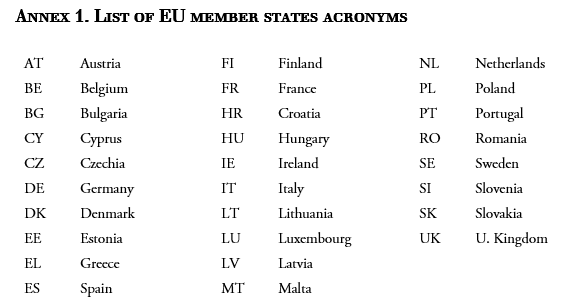
Table 1 offers an analysis in absolute terms of Spanish participation in the Interreg IV C (now known as Interreg Europe) in the period 2007-2018, classifying it by the priority axes defined by the programme. As we see, Interreg Europe provided funding to around 2,400 participations in the period 2007-2013 and 1,500 in the period 2014-2018 (3 calls for proposals). Spain had 235 participations in the former (around 10% of the total) and 182 in the latter (around 12% of the total). While in 2007-2013 it was only surpassed by Italy, Spain is the country with the largest number of participations in 2014-2018. However, even if this seems largely positive, in terms of the population of each country, i.e. in relative terms, Spain is just slightly above the EU average. Figure 2 presents (per million inhabitants in each member state) the number or participations in Interreg Europe (see annex for country acronym definitions).
We can conclude that, on average, smaller countries (in terms of inhabitants) tend to have a higher ratio of participations per capita. If we compare Spain to the other southern European countries, we see that while it follows more or less the rates of Italy and Portugal, it is below Greece. In general terms, Spain’s participation is similar to the EU15, but larger to the one of the largest EU member states (DE, FR, UK, IT).
Number of absolute participations (and %) in EU member states in Interreg IV C / Europe projects per period (2007-2018)
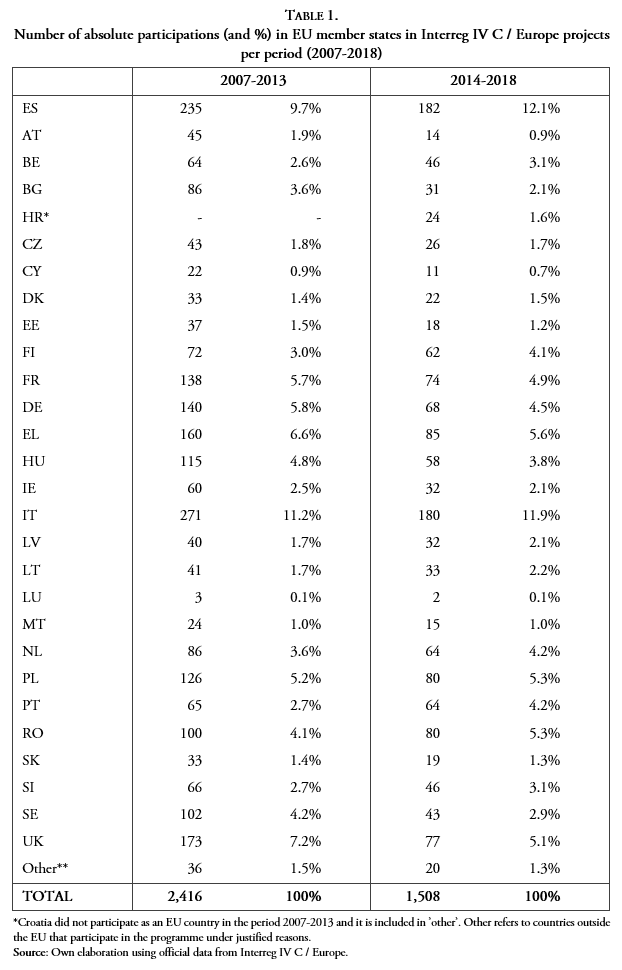
Source: Own elaboration using official data from Interreg IV C / Europe. *Croatia did not participate as an EU country in the period 2007-2013 and it is included in ’other’. Other refers to countries outside the EU that participate in the programme under justified reasons.
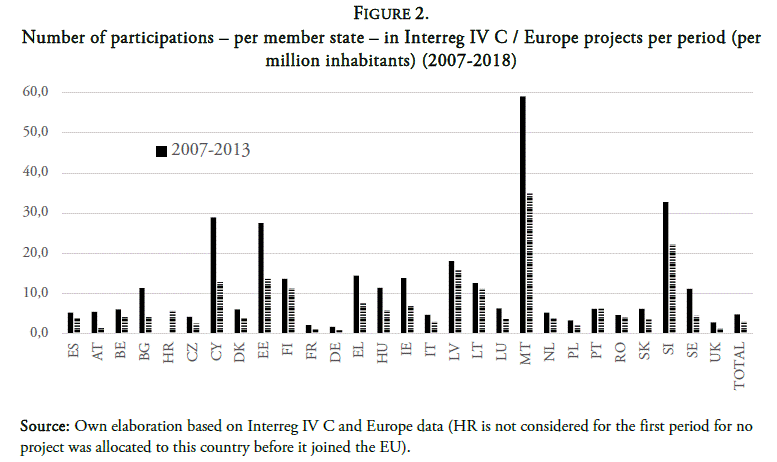
Figure 2.
Number of participations – per member state – in Interreg IV C / Europe projects per period (per million inhabitants) (2007-2018)
Source: Own elaboration based on Interreg IV C and Europe data (HR is not considered for the first period for no project was allocated to this country before it joined the EU).
4.2. Interreg transnational: Atlantic, Mediterranean and South West
Interreg is built around the concept of the macroregion, which refers to a supra-state structure including several regions on both sides of a border sharing some contextual logic, such as common challenges. Transnational Interreg programmes usually work on macroregions, which can be understood as a new institutional level with new and flexible governance systems (Faludi, 2010; Keating, 2013).
Interreg had, in the previous programming period (2007-2013) 13 transnational programmes. In the current period (2014-2020) they have been reshaped into 15. In the former, Spain could participate (through all or some of its regions) in Interregs Atlantic, South-West, Mediterranean, and Açores-Madeira-Canarias. In the current period, they participate in Atlantic, South-West, and Mediterranean. The programme where the Canary Islands are included has now been integrated in Interreg cross-border, which is tackled in section 2.3. Figure 3 illustrates which Spanish territories can participate in which transnational programmes using the current programming period 2014-2020 (excluding Interreg South West, in which all regions – except the Canary Islands – can participate) (Interreg IV C, 2012 and Interreg Europe, 2015).
In alphabetical order, the first ETC transnational programme in which Spain participates is Interreg Atlantic. As its name indicates, only regions close to the Atlantic Ocean are part of this programme. These are Galicia, Asturias, Cantabria, Basque Country, Navarra, and three provinces (NUTS3) of Andalusia (Cadis, Huelva, and Seville). In the period 2014-2020 it also included the Canary Islands. Besides Spain, the present form of the programme includes all Portugal, the Atlantic area of France, all Ireland, and the Atlantic side of Britain (Atlantic Area, 2007 and Interreg Atlantic, 2018).
As presented in table 2, in the period 2007-2013, there were 655 participations in Interreg Atlantic, 176 (27% of the total) of which were for Spanish institutions, making it the country with the largest number of participations. In the present period, and up to 2018, only the first call for projects has been awarded, with 467 participations, of which 121 were Spanish, representing 26% of the total, in line with the previous period. In per capita terms (considering only the population of the eligible regions) however, and as we can see in the first section of figure 2, Ireland is the country most represented in both periods, followed by Spain and Portugal, which are slightly above the average, with only France and Britain under it, especially in the present period’s call.
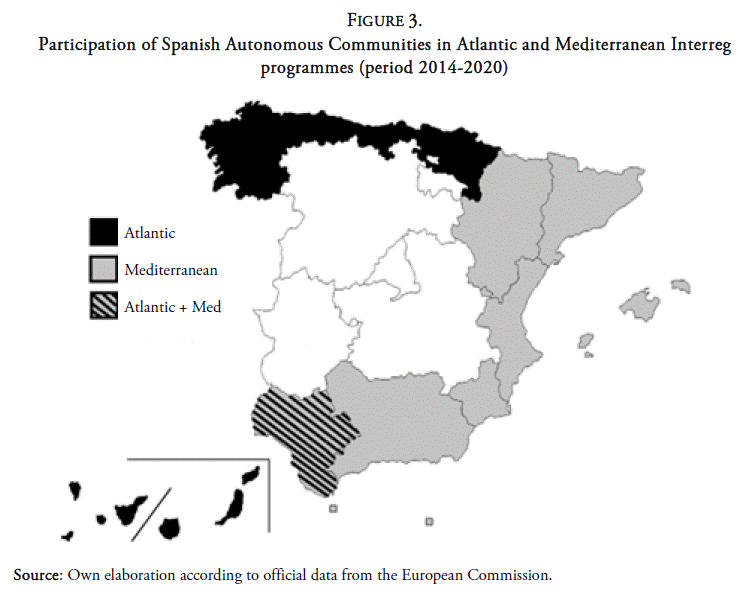
Figure 3.
Participation of Spanish Autonomous Communities in Atlantic and Mediterranean Interreg programmes (period 2014-2020)
Source: Own elaboration according to official data from the European Commission.
Percentage of the total participations in the participant countries in selected transnational Interreg programmes (2007-2018)
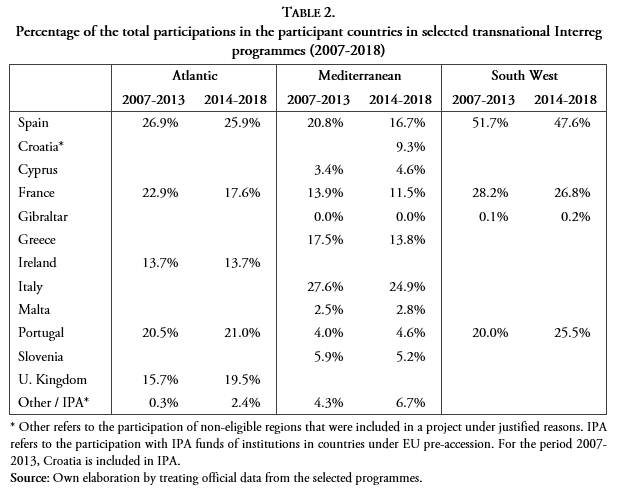
Source: Own elaboration by treating official data from the selected programmes. * Other refers to the participation of non-eligible regions that were included in a project under justified reasons. IPA refers to the participation with IPA funds of institutions in countries under EU pre-accession. For the period 2007-2013, Croatia is included in IPA.
The second transnational Interreg programme in which Spanish institutions are eligible is the Mediterranean one (often referred to simply as ‘Med’). Those Autonomous Communities bordering the Mediterranean Sea (Catalonia, Balearic Islands, Valencian Community, Murcia, and Andalusia) – and also Aragon (even if it does not border the Sea) and the Autonomous Cities of Ceuta and Melilla – are those eligible for participation. Outside Spain, current participating member states are Cyprus, Greece, Croatia, Slovenia, Malta, and some regions in Italy, Portugal, and France, as well as Gibraltar. Additionally (and using the funds under the Instrument for EU Pre-Accession – IPA) institutions in Bosnia-Herzegovina, Montenegro, and Albania can also participate.
The differences among participant countries is larger than in the Atlantic case. In absolute terms, Spain got 294 participations of a total number of 1,415 (20.8%) in the period 2007-2013 and this ratio decreased to 16.7% in the period 2014-2018, with 144 of the 864 participations. The participation of the different countries follows the logic that could be expected, with Italy, the largest participating country obtained 27.6% of the projects in 2007-2013 and 24.9% in the current period. Small member states, like Malta and Cyprus, obtained small amounts, which seems proportional to their size. However, if we analyse the per capita participation, and as it is shown in the central part of figure 3, these two country-islands are largely overrepresented, especially in the period 2007-2013. Spain is slightly above the average in the previous period and slightly under in the current one, which shows that there is room for Spain to be more present in this programme.
Finally, the third transnational programme with Spanish presence is the so-called Interreg SUDOE (South West, following the acronym as it is if using Spanish, French, or Portuguese), which currently covers the geographical area of the French South-West, all Spain (except the Canary Islands), continental Portugal, Andorra, and Gibraltar (UK). While the other two programmes (Atlantic and Mediterranean) tackle challenges more biased to those linked to the specific characteristics that sea/ocean side regions may face (which are present in many priority axes of those programmes), South West focus even more in the concept of macroregion, with a larger bias in the industrial, social, economic, and cultural characteristics that are usually more similar in these territories.
Given that Spain is, by far, the largest country in terms of size (in terms of population) of eligible territories for this programme, it got, in the period 2007-2013, 372 of the 720 participations (51.7%), while in this period it has gotten 224 of the 471 (47.6%). Portugal and France have a similar share and Gibraltar only got 1 representation in each period. This might lead to think that Spain is largely represented in this programme, which it is in absolute terms, but relative data shows otherwise. As it can be seen in the last section of figure 4, Spanish institutions are, in relative terms, underrepresented, with figures under the average in both periods. France has reduced its relative presence substantially, one of the reasons being the restructuring of the French regional scheme in the last years, which hampered the participation of many regional public institutions. Gibraltar seems overrepresented, but, as we saw, it has only one participation in each period; however, given its very small population, just one participation leads to a large relative figure. In the Spanish context, therefore, there is also room for a larger participation.
Concluding with this section, Spanish institutions, while gathering a relevant number of participations in absolute terms, are only overrepresented in Interreg Atlantic, while being quite aligned to the average in Mediterranean, and underrepresented in South West. Additionally, besides the regional analysis, two other dimensions are relevant for ETC: the thematic dimension, since challenge-based topics are those selected for these programmes, and the stakeholders dimension, as different types of institutions can provide different perspectives to support the learning process inherent to Interreg.
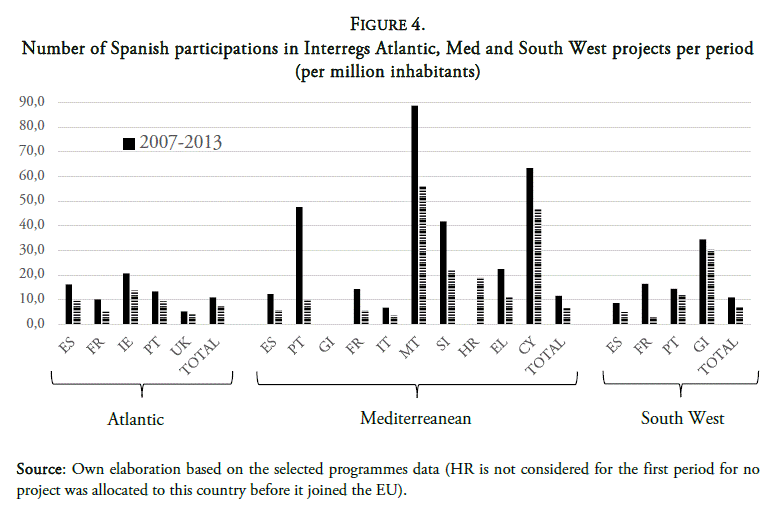
Figure 4.
Number of Spanish participations in Interregs Atlantic, Med and South West projects per period (per million inhabitants)
Source: Own elaboration based on the selected programmes data (HR is not considered for the first period for no project was allocated to this country before it joined the EU).
5. Regional results: participation of Spanish institutions by Autonomous Communities
5.1. Territorial approach
In the previous section, we have focused on analysing the role of Spain as a whole in a policy – Interreg – which is oriented to regions. We must therefore focus our attention on the regional perspective of our analysis. Table 3 presents an overview of the participation of the 17 Autonomous Communities of Spain as a share of all Spanish participations. Each programme is considered separately given that not all regions can participate in all programmes (except Interreg Europe) and that would provide a biased perspective. Figures 5 and 6 present this data in per capita terms.
If we focus first on the share of the absolute number of participations by each Autonomous Community, we see that Catalonia leads the ranking in all programmes in which it participates, which may directly relate to this region being the first one in terms of GDP per capita in Spain and the second in terms of population, assuming a larger volume of institutions and, therefore, the probability to have applications for projects is higher, especially given the relevance in innovation of Barcelona and its metropolitan area. However, if we analyse the relative figures, we see that Catalonia is much more aligned to the whole Spain’s figure, especially for South West and Mediterranean programmes.
Andalusia, for its part, is the most populous region and clusters an important number of participations, especially in the case of Interreg Mediterranean, with over 25% of the participations in both periods. However, in per capita terms, Andalusia underperforms in all programmes compared to the whole of Spain, especially in Interregs Atlantic and South West, where the southern region has around half of the per capita participations compared to Spain’s ratio. More surprising is the case of the Community of Madrid, which underperforms in Interreg South West and is nearly unrepresented in Interreg Europe. As the capital being in the region, one would expect the opposite to be the case, especially because Madrid is the largest metropolitan area in Spain and among the top 5 in the EU.
Number of absolute participations (and %) in the Spanish Autonomous Communities in selected Interreg programmes (2007-2018)
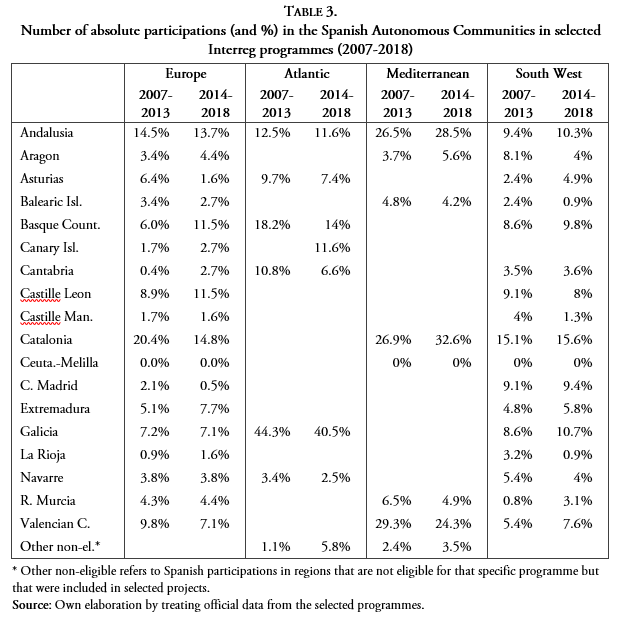
Source: Own elaboration by treating official data from the selected programmes. * Other non-eligible refers to Spanish participations in regions that are not eligible for that specific programme but that were included in selected projects.
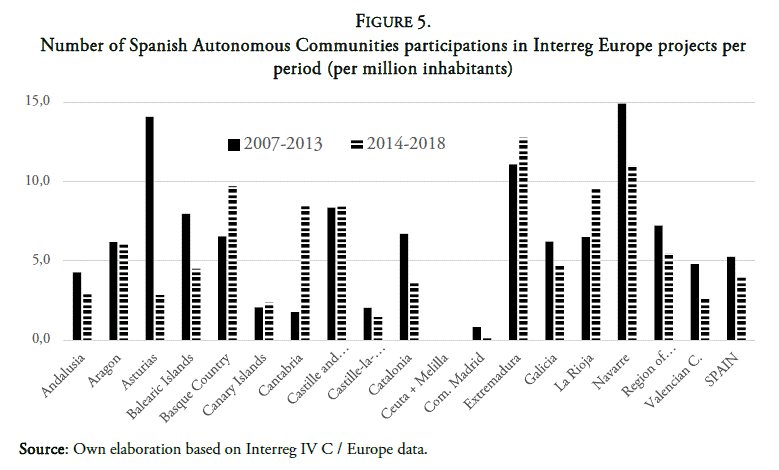
Figure 5.
Number of Spanish Autonomous Communities participations in Interreg Europe projects per period (per million inhabitants)
Source: Own elaboration based on Interreg IV C / Europe data.
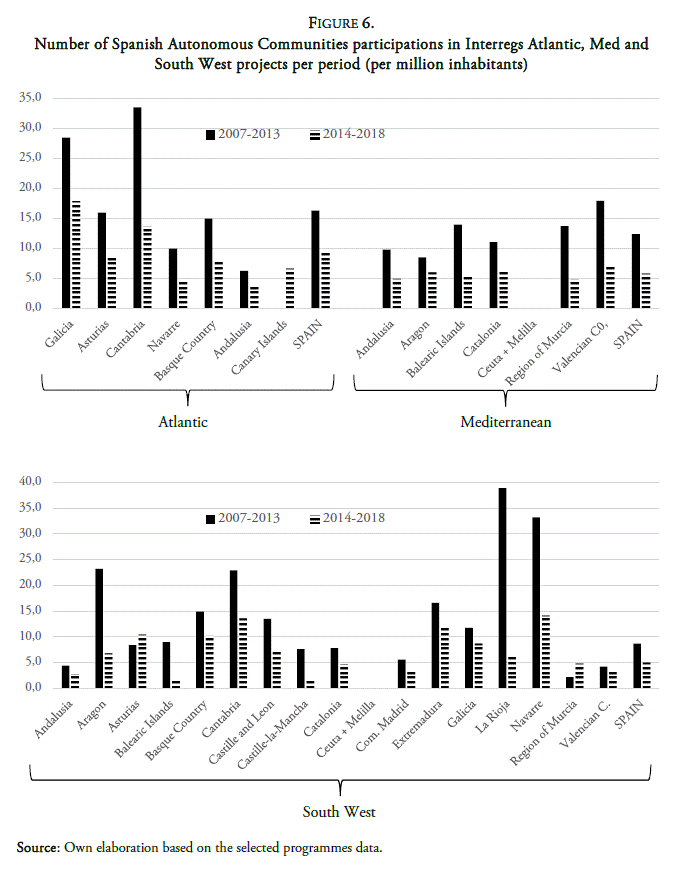
Figure 6.
Number of Spanish Autonomous Communities participations in Interregs Atlantic, Med and South West projects per period (per million inhabitants)
Source: Own elaboration based on the selected programmes data.
As for the more proactive regions, above Spain's global figure we find Aragon, Asturias, the Basque Country, Castille-Leon, and Extremadura. In the north of Spain, four cases are especially relevant: Cantabria, Galicia, La Rioja, and Navarre. Cantabria performed largely above Spain’s figure in all programmes in 2007-2013 and it follows the same tendency in the present one. A plausible explanation is the fact that the Interreg South West JS is located in Santander, Cantabria’s capital, which could increase the awareness of these programmes by stakeholders in the region. Galicia is especially active in Interreg Atlantic, doubling the Spanish participation rate, and La Rioja and Navarre did so (and even more) in Interreg South West 2007-2013.
On the other hand, the Canary Islands and Castille-la-Mancha tend to underperform, as well as the Autonomous Cities of Ceuta and Melilla on the southern shore of the Mediterranean, which, even though they are able to participate in three of the analysed programmes, have no institution participating in any project in the period 2007-2013. The three remaining regions, the Balearic Islands, Murcia, and the Valencian Community, are those most aligned to the Spanish general rate.
Figure 7 cross-analyses the participation of the Spanish Autonomous Communities in interregional (Europe) and transnational (Atlantic, Mediterranean, South West) programmes, for both periods 2007-2013 and 2014-2018. In the figure, every point is a coordinate representing the % of participation of a given region compared to the other eligible Spanish regions. The trend line confirms that, for both periods, in general, those regions that are more active in the interregional programme are better positioned on the share of participations they have.
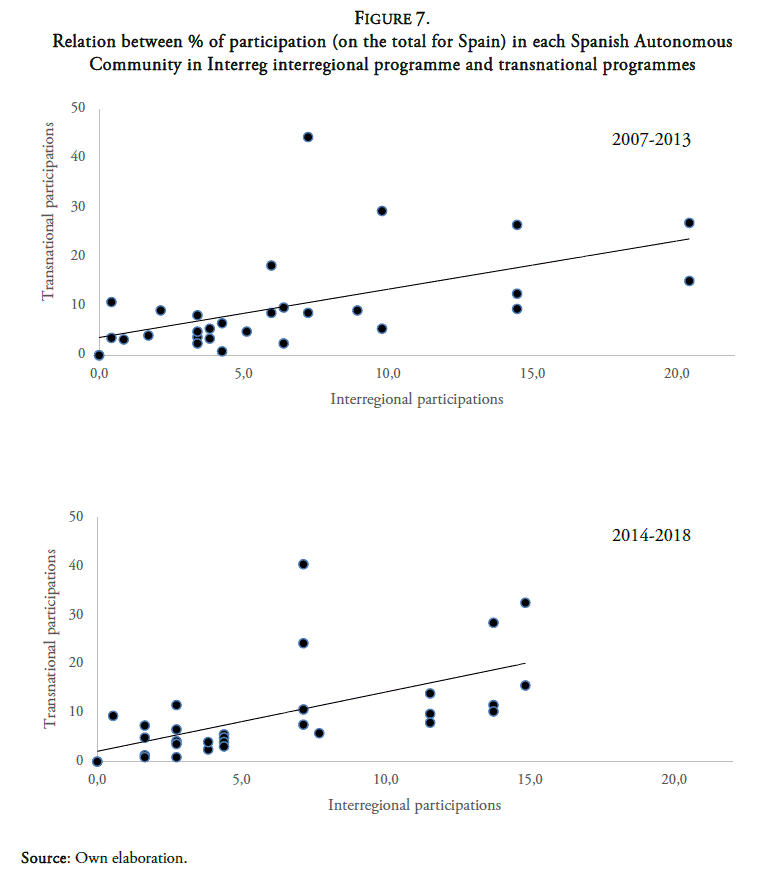
Figure 7.
Relation between % of participation (on the total for Spain) in each Spanish Autonomous Community in Interreg interregional programme and transnational programmes
Source: Own elaboration.
5.2. Thematic approach
As introduced in section 1, ETC programmes aim at linking the topics of their projects to ERDF thematic objectives. In the current period, for instance, there are 10 main ERDF objectives, which can be classified in main areas: innovation and competitiveness, environment and sustainability (that can be subdivided into environment on one side and natural/human risks on the other), and social challenges. Interreg programmes in which Spain participates tend to focus, in the current period, in the former two; besides this, in the period 2007-2013 they had also focused on a general axis that was relevant in the previous programmes, and which was linked to accessibility, as well as urban and regional sustainable development. In this section we analyse the trends of the Spanish regions in participating in projects given these thematic axes.
Measuring the relative participation in Interreg programmes by theme is complex, for aggregating data would directly lead to a number of biases. On one hand, we cannot cluster the projects of different programmes because not all regions participate in all of them and, additionally, each programme devotes different ERDF funds to each priority; it is neither possible to weight the figures according to these differences in budget because we would be assuming that all projects (in each priority axis) have the same average budget, which is not the case (projects are allocated more budget under some priorities than others). In order to provide an objective non-biased perspective, we must analyse the programmes independently and then compare if – for a given region – the dominance of a thematic axis is common in several programmes / periods.
Since data cannot be analysed in an aggregated way, we must therefore study the thematic approach by comparison, which requires the presentation of several figures. Annex 2 offers the complete overview for each programme and period, including the portion of participation by thematic area for each eligible Autonomous Communities (and also their average and the whole Spain figure), as well as the other participating countries. Figure 8 presents, for both periods 2007-2013 and 2014-2020, and after weighting – by comparison of the deviation from average of all regions – the bias of each Autonomous Community to one thematic objective over others, the predominant theme of the Spanish regions. The several thematic objectives have been aggregated into 3 main components to simplify the analysis.
These figures just compare the share of each region to the average, but does not represent the magnitude of these differences. Our data analysis, however, allows us to identify some relevant cases. In the period 2007-2013 the more significant cases of clear trends are Asturias, clearly biased towards accessibility and sustainable development, Castille-la-Mancha and the Community of Madrid, where innovation projects are much more present, and, especially, the Canary Islands, which share of participations in environment, sustainability and resources is way above the average, by 35%. For the period 2014-2018 we can mention the bias towards environment and sustainability by La Rioja, the one towards natural and human risk prevention and energy efficiency by Extremadura, and larger share of participations in innovation projects (compared to the average) by Aragon and, again, the Community of Madrid.
To further analyse this thematic role at a regional level, we must add another perspective. As we have mentioned, each Spanish Autonomous Community devotes the ERDF funding allocated in that region to several policy instruments under the ERDF priority axes. Figure 9 presents the relationship between this allocation and the Interreg projects. In the figure, each dot represents, for each region, on the x-coordinates, the percentage of ERDF devoted to a given ERDF priority (only considering those that relate to an ETC domain) and, on the y-coordinates, the percentage of Interreg projects aligned to the related priority. We have selected only Interregs Europe and South West (both periods) since those are the only ones in which all regions (except the Canary Islands in South West) can participate. Again, this relationship presents a small bias, for the same reason presented before regarding the different budget allocation of funding in each priority and the different funding of projects under different priorities; however, since our aim is to assess whether there is a logical trend or no, rather than measure exact correlations, we can still compare these figures, just having this bias in mind.
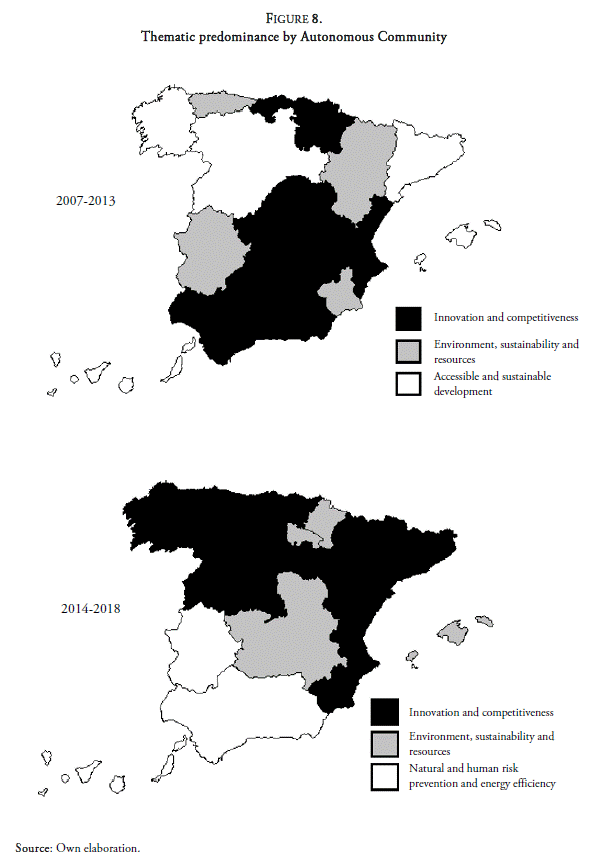
Figure 8.
Thematic predominance by Autonomous Community
Source: Own elaboration.
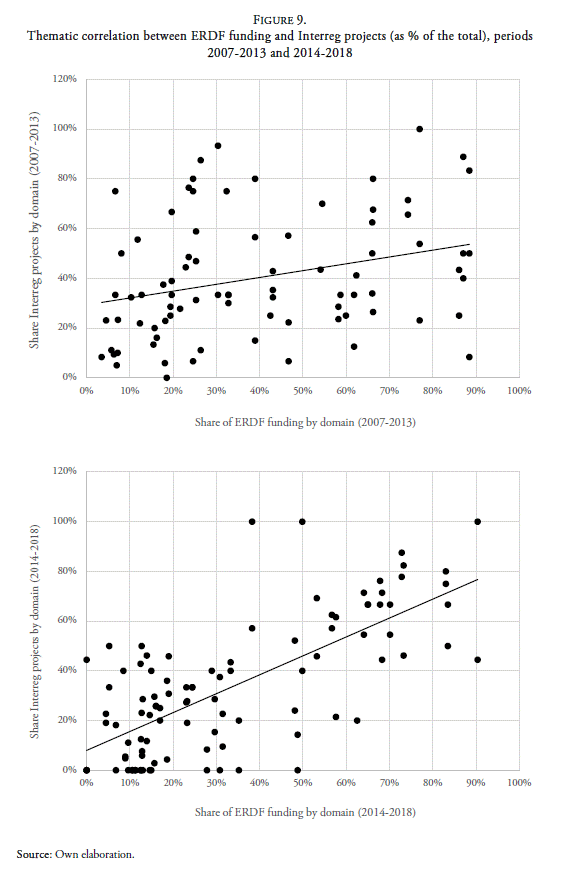
Figure 9.
Thematic correlation between ERDF funding and Interreg projects (as % of the total), periods 2007-2013 and 2014-2018
Source: Own elaboration.
As we can see, for both periods, and especially for the present one, there is a positive correlation between the percentage of ERDF that a given region devotes to a specific thematic domain and the share of projects that the same region implements linked to the same thematic domain. This proves the existence of some consistency in the choices regarding the topics of the projects and the logic of Interreg, which aims at supporting the policy scope linked to ERDF.
5.3. Institutional approach
Another relevant variable to be considered is the organisational nature of the institutions participating in Interreg projects, in order to understand the logic of these participations. The analysis on the institutions participating in Interreg projects have been undertaken by dividing the stakeholders in 4 groups, according to their institutional role: (i) public administrations – all levels – or directly dependent institutions (type 1), (ii) R&D providers, including universities, research and technology centres (type 2), (iii) institutions representing business interests, such as industry clusters, chambers of commerce, business associations, etc. (type 3), and (iv) other stakeholders, which includes users associations, transversal objectives institutions, or mixed organisations (type 4). Since there is not a single classification of agents according to these (or other) types throughout the ETC programmes, this cataloguing has been own elaborated allocating the stakeholders in these four types one by one.
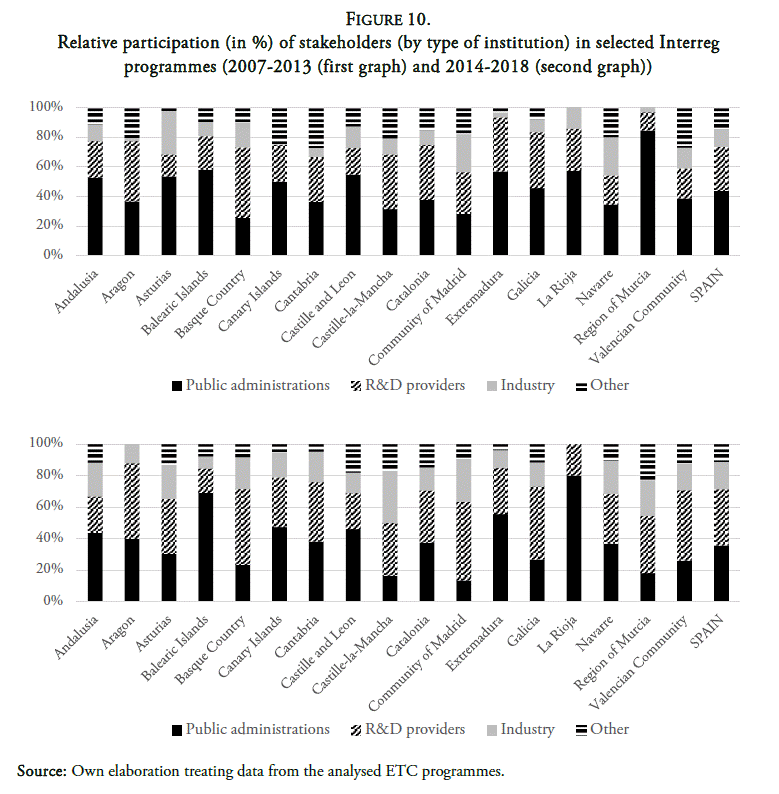
Figure 10.
Relative participation (in %) of stakeholders (by type of institution) in selected Interreg programmes (2007-2013 (first graph) and 2014-2018 (second graph))
Source: Own elaboration treating data from the analysed ETC programmes.
Figure 10 compares the distribution of stakeholders participating in Interregs Europe, Mediterranean, Atlantic, and South West – programming periods 2007-2013 and 2014-2020 altogether (projects approved before the end of 2018, i.e. 10 whole years). This comparison, by regions and the other participating states in the analysed programmes is done in a relative way, i.e. as a percentage of the total amount of participations in all programmes. We can aggregate programmes because, in all cases, there are no strict rules regarding which typology of institution must be the priority (not at least in terms specific budget dedicated to each typology). However, we should have in mind that ETC programmes aim at fostering framework changes, which often relate to public policies, which means that – in many cases – public administrations are preferred, since they are managing authorities of the topics covered by the projects.
As we can see, public administrations tend to have more predominance in the previous period (2007-2013), reducing its presence in the current one, where research and innovation providers have increased their participation. The role of the industry and its representatives is still quite small, and it should be encouraged, given that larger role that the European Commission and the member states’ governments want to confer to these stakeholders when designing their R&I policies.
At a regional level, we can see large disparities among the different Autonomous Communities, which should be considered by regional governments when deciding the promotion of ETC they undertake in their territories, deciding whether this distribution is the one they aim at or if they would like to increase or reduce the participation of a given typology of stakeholders.
6. Final remarks
Our analysis has been centred on the study of the national and regional logic of the Spanish presence in the ETC programmes where it can participate, as a whole country or some of its regions, the Spanish Autonomous Communities. In order to do so, we use descriptive data to provide a transversal overview of the scope of the Spanish presence in these programmes, focusing on the comparison with other participating countries as well as the regionalisation of this participation, focusing on three main components: this territorial perspective, the thematic approach, and the unequal participation of different organisations, divided according to their typology.
To analyse this data, a new database has been built, using two main sources: the available data from each selected programme and the two programming periods that we have included, have complementing it – in a small number of cases – with some data from the KEEP[1] database, which provides data on ETC. We must stress the fact that these databases are not homogenous and not all of them include the information that we required for our analysis, with limited information – in some cases – on the regionalised perspective, the partners that are not the project leaders, or the thematic priority. Treating each input to make it homogeneous and available for analysis was complex. We consider that harmonisation should be provided to improve comparison and, therefore, transparency. A clear example of this situation is the different classification of institutions (according to their typology) that different programmes have, which obliged us to design a new and simplified system that we can use for our study.
Additionally, the data on ETC programmes/projects does not allow studying the outcomes of their existence. Interregs aim at supporting the development of the Cohesion Policy in the EU member states. However, while it is possible to measure the impact of this policy in the macroeconomic variables (see, for instance, Montfort et al., 2017), measuring the direct impact of Interreg is more challenging, since its projects aim at supporting policy making and development, rather to achieve direct outputs/outcomes.
Our work’s results are based on a component-by-component and case-by-case (region by region) for a global perspective can just be offered at a national level, and both scenarios have been discussed, providing the most complete study – up to the date – of the state of ETC in Spain and its Autonomous Communities. If we consider first the role of Spain compared to the EU average we see that, opposite to what is often perceived, Spanish participation is right on the average of the European states. If we consider the participation of the Autonomous Communities, we see that the participation is spread across them, and that larger or smaller presence usually depends on the programme. For instance, we see that northern Autonomous Communities tend to be more represented than central or southern ones, that the largest regions (Andalusia and Catalonia) are right on the average, and that the Community of Madrid (which can only participate in Interreg Europe) surprisingly underparticipates.
In terms of thematic objectives, we saw that there is some alignment between the choice of these objectives and those for which ERDF funding is allocated in the different territories. While we see that it is possible to establish relative preferences for themes in each region, we do not find any strong element that leads us to conclude that some regions have clear preferences when choosing the thematic objectives of their projects.
When considering the stakeholders, public bodies have a predominant role; this is partially explained by the fact that Interreg fosters the participation of managing authorities for they have the possibility to improve policies in their territories (main goal of the programmes); however, the lack of participation of the private sector could be seen as a weakness for ETC, since all the programmes (and projects) tackle challenges that require the presence of the business sector to ensure that possible solutions can be actually developed. Future operational programmes should define incentives and mechanisms to foster the presence of the private sector.
While these results help to further understand ETC implications for Spain, our study has some limitations, the main one being the scarce possibilities to perform further impact analysis, studying the externalities of Interreg projects; this is due to the lack of information and homogeneous monitoring from the different programmes, and the inexistent strategy to measure the outcomes further than the actual project direct outputs. Further research could focus on establishing a model for this impact assessment, working jointly with the European Commission to ensure its applicability. Another limitation, which also opens a window for further research, is the restricted comparison with other EU member states; further seeing how Spanish territories perform compared with others across Europe could help establish patterns that could support sound policy recommendations.
While there is room for these further works, our study is especially relevant in the present moment because – as introduced in section 1 – the European Commission is designing the new logic and scope of ETC programmes for the next programming period 2021-2027. Understanding how organisations from different territories behave (in terms of which of them participate, in which topics, etc.) is extremely relevant to improve the Interreg instrument; in this framework, having this detailed perspective of Spain – a relevant member state when it comes to ETC – can provide a sound input for policy making. Further research should be focused on a larger scale analysis (several countries, for instance macroregions) on one side, and the analysis of the aggregated results of ETC programmes and projects, which would require a level of microdata that is not yet available and, the (scarce) available one is not homogenous across the programmes.
References
Atlantic Area (2007). Atlantic Area Operational Programme 2007-2013. Porto (PT): Atlantic Area Joint Secretariat.
Autio, E. (1998). Evaluation of RTD in regional systems of innovation. European Planning Studies, 6, 131-140. https://doi.org/10.1080/09654319808720451
Baños, J., & Iglesias, A. (1995). La política regional europea y la cooperación transfronteriza. Estudios regionales, 42, 181-212.
Braczyk, H-J., Cooke, P., & Heindenreich, M. (Eds.) (1998). Regional innovation systems. London: UCL Press.
Conference of Peripheral Maritime Regions (CPMR) (2018). The future of Interreg: 10 messages from CPMR. CPMR Technical Notes, June 2018. Brussels (BE): CPMR. https://cpmr.org/wpdm-package/the-future-of-interreg-10-messages-from-the-cpmr/?wpdmdl=17990&ind=1529396962494
Cooke, P., Boekholt, P., & Tödtling, F. (2000). The governance of innovation in Europe. London: Pinter.
Edquist, C. (2005). Systems of Innovation – Perspectives and challenges. In: J. Fagerberg, D. Mowery & R. Nelson (Eds.), The Oxford handbook of innovation. Oxford University Press. https://www.oxfordhandbooks.com/view/10.1093/oxfordhb/9780199286805.001.0001/oxfordhb-9780199286805-e-7
European Commission (2016). Ex-post evaluation of Cohesion Policy programmes 2007-2013, focusing on the European Regional Development Fund (ERDF) and the Cohesion Fund (CF). European Commission. https://ec.europa.eu/regional_policy/en/policy/evaluations/ec/2007-2013/
European Commission (2018). Proposal of rules of the European Parliament and the Council on specific dispositions for the objective of European Territorial Cooperation (Interreg) financed with the support of ERDF and exterior funding instruments. COM(2018): 374. European Commission. https://eur-lex.europa.eu/legal-content/EN/TXT/?uri=COM%3A2018%3A374%3AFIN
European Council (2006). Council Regulation (EC) No 1083/2006 of 11 July 2006 laying down general provisions of the ERDF, ESF and the Cohesion fund. REGULATION (EC) No 1080. European Council. https://eur-lex.europa.eu/legal-content/EN/ALL/?uri=CELEX%3A32006R1083
Faludi, A. (2010). Beyond Lisbon: Soft European spatial planning. The Planning Review, 46(182), 14-24. https://doi.org/10.1080/02513625.2010.10557098
Feliu, J., Berzi, J., Rufi, V., Castañer, M., & Llussà, R. (2013). Análisis de los proyectos y actors transfronterizos España-Francia en el período 2007-2013. Geographicalia, 63-64, 75-93. https://doi.org/10.26754/ojs_geoph/geoph.201363-64855
Feliu, J., Berzi, M., Martín-Uceda, J., Pastor, R., & Castañer, M. (2018). Cuatro fronteras europeas bajo la lupa. Una metodología para el análisis de los proyectos de cooperación transfronteriza (Interreg). Documents d’Anàlisi Geogràfica, 64(3), 443-465. https://doi.org/10.5565/rev/dag.532
Hachmann, V. (2011). From mutual learning to joint working: Europeanisation process in the Interreg B Programmes. European Planning Studies, 19(8), 1537-1555. https://doi.org/10.1080/09654313.2011.594667
Halleux, V. (2019). European territorial cooperation (Interreg) 2021-2027. Briefing; EU legislation in profess 2021-2027 MFF. European Parliamentary Research Service. https://www.europarl.europa.eu/RegData/etudes/BRIE/2018/628228/EPRS_BRI(2018)628228_EN.pdf
Heredero, M.I., & Olmedillas, B. (2009). Las fronteras españolas en Europa: de Interreg a la cooperación territorial europea. Investigaciones regionales, 16: 191-215.
Interact Programme (2015). Historical view of Interreg / European Territorial Cooperation. Fact sheet. http://www.interact-eu.net/download/file/fid/2902
Interreg Atlantic (2018). Interreg Atlantic Area cooperation programme (v3). Porto (PT): Interreg Atlantic Joint Secretariat. https://light.ccdr-n.pt/index.php?data=51343c25a34c37fe1328e15cea786151f4b 4db78b30f656eb92a33359e8a9f8682da3469fe703c0d23a892494537f0f8
Interreg Europe (2015). Interreg Europe cooperation programme document. Lille (FR): Interreg Europe Joint Secretariat. https://www.interregeurope.eu/fileadmin/user_upload/documents/Interreg_Europe_-_CP_final.pdf
Interreg IV C (2012). Programme manual (updated version). Lille (FR): Interreg IV C Joint Secretariat. http://www.interreg4c.eu/uploads/media/pdf/about_the_programme_InterregIVC_OP.pdf
Keating, M. (2013). Rescaling the European state. The making of territory and the rise of the meso (1st ed). Oxford University Press. https://www.oxfordscholarship.com/view/10.1093/acprof:oso/9780199691562.001.0001/acprof-9780199691562
Kohler-Kock, B. (2004). Gobernanza interactiva: las regiones en la red de la política europea. In F. Morata (Ed.), Gobernanza multinivel en la UE (pp. 121-158). Turant lo Blanch.
Letamendía, F. (2010). Cooperación transfronteriza europea: regulación, historia y trabajo. Documents d’Anàlisi Geogràfica, 56, 71-88.
Martín-Uceda, J., & Castañer, M. (2018). Actores y proyectos transfronterizos en las fronteras ibéricas: análisis comparativo de Interreg IV-A. Boletín de las Asociación de Geógrafos Españoles, 78, 154-179. https://doi.org/10.21138/bage.2432
Medeiros, E. (2013). Cross-border cooperation in EU regional policy: a fair deal? POCTEP. https://www.poctep.eu/sites/default/files/DOC_EdMedeiros_fair_deal_ENG.pdf
Medeiros, E. (2017). Cross-border cooperation in inner Scandinavia: a territorial impact assessment. Environmental Impact Assessment Review, 62, 147-157. https://doi.org/10.1016/j.eiar.2016.09.003
Medeiros, E. (2018). Should EU cross-border cooperation programmes focus mainly on reducing border obstacles? Documents d’Anàlisi Georgràfica, 64(3), 467-491. https://doi.org/10.5565/rev/dag.517
Montfort, P., Piculescu, V., Rillaers, A., Stryczynski, K., & Varga, J. (2017). The impact of cohesion and rural development policies 2007-2013: Model simulations with QUEST III. DG REGIO Working Paper 05/2017. European Commission. https://ec.europa.eu/regional_policy/en/information/ publications/working-papers/2017/the-impact-of-cohesion-and-rural-development-policies-2007-2013-model-simulations-with-quest-iii
Nilsson, J.H., Eskilsson, L., & Ek, R. (2010). Creating cross-border destinations: Interreg programs and regionalisation in the Baltic Sea Area. Scandinavian Journal of Hospitality and Tourism, 10(2), 153-172. https://doi.org/10.1080/15022250903561978
Perkmann, M. (2003). The rise of the Euroregion. A bird’s eye perspective on European cross-border cooperation. Lancaster University. http://www.lancaster.ac.uk/fass/resources/sociology-online-papers/papers/perkmann-rise-of-euroregion.pdf
Plaza, J.I. (2002). Orientaciones, conceptos e incertidumbres de la política regional europea para el siglo XXI. Revista de Estudios Regionales, 64, 43-63.
Prokkola, E.K. (2011). Cross-border regionalization, the Interreg III A initiative, and local cooperation at the Finish-Swedish border. Environment and planning A, 43, 1190-1208.
Sielker, F. (2016). A stakeholder-based EU territorial cooperation: The example fo European macroregions. European planning studies, 24(11), 1995-2013.
Trippl, M. (2010). Developing cross-border regional innovation system: Key factors and challenges. Tijdschrift Voor Economische En Sociale Geografie, 101(2), 150–160.
Annex 1
List of EU member states acronyms
Notes
Additional information
JEL classification: O20; R11; R58
Corresponding author: ricard.esparza@uab.cat
