Abstract: The effects of the presence of challenging behavior problems, parental conflict and violence in the community were determined by the probability of occurrence of bullying behaviors in elementary students. 664 students participated in the study, of whom 80 (12.04%) were identified as aggressors. 80 students with no reports of attacks were later selected randomly for comparison. Using logistic regression, it was found that the variables studied manifest significant differences between the student groups with and without aggressive behavior toward peers (R2 = .39). Challenging behavior (OR = 7.83), parental conflict (OR = 3.77) and Community Violence (OR = 5.36) increase the probability of belonging to the group of aggressors. We conclude that it is necessary to analyze the bullying from an ecological framework that considers variables located in the contexts in which individuals interact.
Keywords: FamilyFamily,neighborhoodneighborhood,school violenceschool violence,bullyingbullying.
Resumen: Se buscó establecer la relación de la presencia de conductas desafiantes, conflictos entre padres y violencia en la comunidad con la probabilidad de ocurrencia de comportamientos de intimidación en estudiantes de primaria. En este estudio participaron 664, de los cuales 80 (12.04%) fueron identificados como agresores; posteriormente se incluyeron al azar 80 estudiantes sin informes de ataques como grupo control. Usando la regresión lógica, se encontró que las variables estudiadas manifiestan diferencias significativas entre los grupos de estudiantes con y sin comportamiento agresivo hacia los compañeros (R2 = .39). El comportamiento desafiante (OR = 7.83), el conflicto parental (OR = 3.77) y la violencia comunitaria (OR = 5.36) aumentan la probabilidad de pertenecer al grupo de agresores. Concluimos que es necesario analizar el bullying desde un marco ecológico que considera variables ubicadas en los contextos en los que interactúan los individuos.
Palabras Clave: Familia, comunidad, violencia escolar, bullying.
Research articles
Challenging Behavior, Parental Conflict and Community Violence in Students with Aggressive Behavior
Conducta desafiante, conflicto parental y violencia en comunidad en estudiantes con comportamiento agresivo
Facultad de Psicología. Universidad de San Buenaventura, Medellín
Received: 05 October 2015
Revised document received: 04 August 2017
Accepted: 22 September 2017
School violence affects negatively both the learning en vironment and the role of educational institutions on the formation of values, attitudes and pro-social be haviors that allow children and adolescents to live with others based on tolerance, respect and equity (Elliot, 2008; Ortega & Del Rey, 2008). Studies in Mexico show that violence among students is a problem that affects the educational institutions of the country (Castillo & Pacheco, 2008; Aguilera, Muñoz, & Orozco, 2007; Muñoz, 2008; Organization for Economic Co-operation and Development [OCDE], 2017; Román & Murillo, 2011; Valdés & Carlos, 2017).
Bullying differs from other forms of aggression because of its systematic nature and its manifestation in the context of interpersonal relationships with marked asymmetries of power between the perpetrator and the victim (Rodkin, Espelage, & Hanish, 2015; Volk, Dane, & Marini, 2014). Among other negative effects, this problem leads to decreased academic performance, emotional disorders, and suicide attempts for victims (McDougall & Vaillancourt, 2015; O'Brennan, Bradshaw, & Sawyer, 2009). The attackers also are affected, as they show social adjustment difficulties during adolescence and adulthood, which are manifested in substance abuse, employment difficulties, violence in relationships and antisocial behavior (Farrington, 1993; Kim, Catalano, Haggerty, & Abbott, 2011; Olweus, 2011; Pearce, 2008; Valdebenito, Ttofi, & Eisner, 2015).
This study assumes it is necessary to address bullying from an ecological perspective since it is considered to be the result of interactions in which students operates within different contexts. This implies that there are characteristics of the student, family, school and community that are risk factors for the presence of bullying (Hong & Espelage, 2012; Swearer & Hymel, 2015).
Based on the preceding, this study investigated the relationship of variables located in the individual (challenging behavior), in the family (parental conflict) and community (community violence) with bullying in elementary school students. Although there are studies that address the relationship of these variables with bullying in the international literature (Bowes, Maughan, Caspi, Moffitt, & Arseneault, 2010; Chang, Wang, & Tsai, 2016; Kokkinos & Panayiotou, 2004; Mann, Kristjansson, Sigfusdottir, & Smith, 2015; Martínez, Amador, Moreno, & Musitu, 2011) it should be noted that few studies address this topic in Mexico (Pech, 2010; Saucedo, 2005; Valdés, Carlos, Tánori, & Madrid, 2016). Consequently, it is valuable to establish the relationship of these variables to bullying in the context of Mexican elementary schools.
Challenging behavior is manifested in a stable pattern of anger, violations of social rules, and direct or indirect confrontation with authority figures (Sutton, Reeves, & Keogh, 2000). The literature suggests that these behavioral problems relate positively with bullying (Cho, Hendrickson, & Mock, 2009; Rose, & Espelage, 2012; Van Cleave & Davis, 2006) and that when these two problems overlap, aggressive behavior is more stable over time (Pepler, Jiang, Craig, & Connolly, 2008; Wolke, Woods, Bloomfield, & Karstadt, 2000).
Parental conflict is related to parents showing less emotional availability and involvement with children (Margolin, Gordis, & John, 2001; Sturge-Apple, Davies, & Cummings, 2006; Werneck, Eder, Yanagida, & Rollett, 2014), excessive psychological control and inconsistent discipline practices (Azam & Hanif, 2011; McCoy, George, Cummings, & Davies, 2013). This conflict, which has a negative effect on parenting practices, favors the presence of externalized behavior problems (aggression, bullying) and internalization (depression, anxiety) in children (Buehler, Lange, & Franck, 2007; Kitzmann, Gaylord, Holt, & Kenny, 2003; Lee, Wesbecher, Lee, & Lee, 2015). It also damages adolescents' and children's sense of family identity and safety, effects that are exacerbated when conflict is common, if it is handled in a hostile way and when it relates to or involves children (Cummings, Goeke-morey, & Papp, 2003; Lindsey, Colwell, Frabutt, & McKinnon-Lewis, 2006).
Because interactions established within the community contribute to the internalization of expectations, values and social norms, the community exercises a major influence on the emotional development of adolescents. The influence of the community is investigated through three elements: sense of belonging, feelings of safety and exposure to vioalence (Zani, Cicognani, & Albanesi, 2001). There is evidence that the perception of danger in the place where one lives influences the presence of aggressive behavior in young people (Frías-Armenta, Duron, & Castro, 2011; Low & Espegale, 2014; Mann et al., 2015).
We addressed adolescent exposure to various types of violence in the community, including both personal experiences of aggression and exposure to incidents targeting other people who are known victims in their community. Exposure to violence is related to the presence of behavioral problems such as bullying in adolescents (Bacchini, Esposito, & Affuso, 2009; Chaux, Molano, & Podlesky, 2009; Lynch, 2003; Swearer & Hymel, 2015).
A conflictive atmosphere in the community leads to violence legitimization, and, therefore, the existence of aggressors and victims becomes perceived as standard within schools (Chang et al., 2016; Chaux et al., 2009; Phillips, 2003).
This study set out to determine the effects of the presence of challenging behavior problems, parental conflict and exposure to violence in the community on the likelihood of aggressive behavior by elementary students towards their peers. It is hypothesized that the above variables significantly increase the likelihood of students behaving aggressively toward their peers.
In a non-probabilistic way, 664 students enrolled in grades 4 to 6 in 12 public elementary schools from four school zones (three per school zone) of a city in northwestern Mexico were selected. 80 (12.04%) students were identified as aggressors by the criterion that their average score was > 2 (Sometimes, three or four times a month) on the measuring scale of violence among students. Of these, 45 (56.25%) were male and 35 (43.75%) female. Their average age was 13.8 years (SD = .86).
Of the remaining 584 students, who were not identified as aggressors, a subsample randomly selected 80 in order to perform analyses in groups of similar size. This group was composed of 42 (52.5%) males and 38 (47.5%) females with an average age of 13.6 (SD = 1.13).
Violence among students. The self-report scale developed by Valdés and Carlos (2017) was used, in which students were questioned about how often they assaulted weaker students during the last month (e.g. Hitting peers, or Insulting their classmates). This instrument consists of six items that are answered by a Likert-type scale with five response options 0 (Never), 1 (Almost never, once or twice a month), 2 (Sometimes, three or four times a month), 3 (Almost always, five to seven times a month) and 4 (Always, more than seven times a month).
A confirmatory factor analysis demonstrated that the scale is a one-dimensional model to sustainably and empirically measure the construct already mentioned (X2 = 19.73, p = .019; AGFI = .97; CFI = .99; RMSEA = .04, IC 90 [.02 - .07]). Cronbach's alpha was .83.
Challenging behavior. This instrument was developed by Sutton et al. (2000). This study used the subscale that measures the presence of challenging behavior through 11 items (e.g. I disobey the instructions and rules of adults). Using factor analysis with Oblimin maximum likelihood and rotation the factor structure of the scale was confirmed (X2 = 850. 42, p < .000; KMO = .83) which was able to explain 62% of the variance of scores. Cronbach's Alpha, which demonstrates the reliability of the measurement scale, was .87.
The instrument utilized Likert-type scales with five response options 0 (Never), 1 (Almost never), 2 (Sometimes), 3 (Almost always) and 4 (Always). From the average score on the scale, students were classified into two groups: without challenging behaviors (M < 1) and with challenging behaviors (M > 1).
Parental conflict. We used the subscale of the instrument developed by Grych, Seid and Fincham (1992), which used five items to assess childrens' perception of the frequency and intensity of parental conflict (e.g. I often see my parents arguing, My parents go crazy when arguing). An exploratory factorial analysis with Oblimin maximum likelihood and rotation, modeled the one-dimensional character of the scale (X2 = 506. 50, p < .000; KMO = .83), which explained 60% of the variance of the scores. The reliability of the scores measured by Cronbach's Alpha was .90.
The instrument used a Likert-type scales with four response options: 0 (Strongly disagree), 1 (Disagree), 2 (Disagree) and 3 (Strongly agree). According to the average total scores on the scale, students were classified into a first group, which includes those who expressed a perception of low parental conflict (M < 1) and a second group, which reflect a high level of parental conflict (M > 1).
Exposure to violence in the community. An instrument based on the review of developed instruments that measured related aspects was developed for this study (Frías-Armenta, López-Escobar, & Díaz-Méndez, 2003; Zani et al., 2001). Seven risk situations are presented to the student (e.g. Fights in the neighborhood, Presence of gangs) and then they're asked to select the option that best represents how often this situation occurs in their community.
It was answered by a Likert-type scale with five response options 0 (Never), 1 (Almost never), 2 (Sometimes), 3 (Often) and 4 (Always). Average scores were used to form a group of students with low exposure to violence (M < 1) and another group with high exposure (M > 1). The measurement reliability with Cronbach's Alpha was .77.
After presenting the study objective, we obtained authorization from school authorities for access. The written and informed consent of the parents of students who participated in the study was also required. Finally, we requested the voluntary cooperation of the students, guaranteeing them confidentiality
In data analysis, descriptive and inferential statistics were used, particularly logistic regression. The calculation of the regression model was conducted with support from SPSS software v. 22.
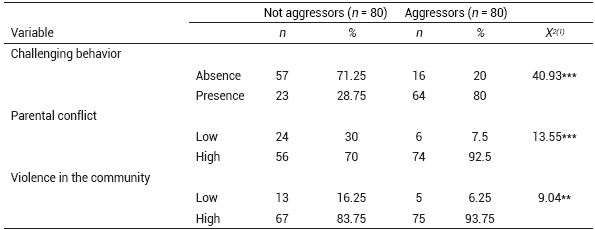
Table 1 shows that the predictive variables differ significantly between groups of students with and without reports of aggression toward peers. The group that reports higher levels of aggression has a higher proportion of students with challenging behaviors, high parental conflict and greater exposure to violence in the community.
Frequencies of the predictive variables of aggression in elementary students
*p < .05. ** p < .01. *** p < .001.
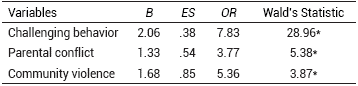
The R2 value of .39 shows that the predictive variables integrate a model with better predictive power than the base model. Hosmer-Lemeshow's test (X2 = 1.178, df = 4, p = .88) was not significant, indicating that there are no differences in the current distribution and the predicted values of the dependent variable.
All Beta coefficient values were significantly positive, implying that the probability of belonging to the group of aggressors and the incidence of challenging behaviors, perception of parental conflict and exposure to violence in the community were increased (see Table 2).
Summary of logistic regression analysis for predicting assault toward pairs
* p < .05.
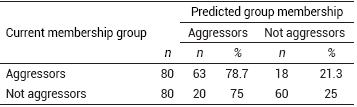
Predictive variables allowed the proper classification of 76.4% of students in the groups of aggressors and non-aggressors, which is considered acceptable for an analysis of this type (Cea, 2004; Ho, 2014). It should be noted they present slightly better discriminative power to identify aggressors than non-aggressors (see Table 3).
Analysis of the classification aggressors and not aggressor's groups
Note. Globally correctly classifies 76.4% of students
The present study analyzes the effects on elementary students of the presence of challenging behavior problems, parental conflict and exposure to violence in the community on the likelihood of aggressive behavior towards their peers. The results support the hypothesis of the study in the sense that they suggest that both challenging behavior problems, such as parental conflict and exposure to violence in the community make up a model that predicts the presence of aggressive behavior toward peers in elementary students. These findings reaffirm the importance of addressing bullying from an ecological framework that considers the effects of variables located in various contexts where the individual grows up (Hong & Espelage, 2012; Swearer & Hymel, 2015).
Matching reports in the literature, it was found that behavioral problems increase the likelihood of students to bully their peers (Cho et al., 2009; Rose, & Espelage, 2012; Verlinden et al., 2015), which suggests that bullying in some children is the manifestation of a symptom within a pattern of maladaptive behaviors (Cook, Williams, Guerra, Kim, & Sadek, 2010; Fanti & Kimonis, 2012). Although this requires more investigation, it suggests that these students form part of the group of socially marginalized aggressors, who experience little acceptance and praise from peers (Farmer et al., 2010; Swearer & Hymel, 2015; Peeters, Cillessen, & Scholte, 2010).
It was found that perception of parental conflict increases the likelihood of the student developing bullying behaviors. This is consistent with reports in the literature which suggest frequent and hostile parental conflict is related to the presence in the children of aggressive behavior toward peers at school (Buehler et al., 2007; Kitzmann et al., 2003; Lee et al., 2015).
Parental conflict explains the presence of aggressive behavior of children through their observation of aggressive parental models (Bandura, 1973) and because of the frustration associated with this situation, which they channel to aggression towards others (Dollard, Miller, Dood, Mowrer, & Sears, 1939).
Lastly, the results suggest that exposure to violence in the community increases the likelihood of students behaving like bullies, which is consistent with the literature (Bacchini et al., 2009; Chang et al., 2016; Chaux et al., 2009; Lynch, 2003; Turner, Shattuck, Hamby, & Finkelhor, 2013). Interestingly, the impact of this variable was greater than the presence of parental conflict which is a closer variable to child development. This suggests that interaction in extra-family social contexts, especially the community, has an important influence on the formation and expression of moral values, social norms and behavioral patterns (Lenzi et al., 2012; Schmidt, Pierce, & Stoddard, 2016; Vieno, Santinello, Pastore, & Perkins, 2007).
We conclude that the analysis of bullying from an ecological perspective is fruitful as it allows us to consider the impact of variables located in different contexts of individual development. From the results, we conclude that measures to prevent bullying should include: interventions, a focus on developing students' pro-social behavior, the strengthening of family life, and a reduction of the various manifestations of violence in the community. Our finding concerning the influence of exposure to violence in the community on the presence of bullying is particularly striking because it is a subject about which there have been few studies in Mexico, despite the high levels of violence in many communities and regions throughout the country. This shows that, for the prevention of bullying, public policies should be developed to prevent violence at the societal level as well as to strengthen the economic, cultural and social capital of communities.
The present study provides knowledge that can be useful for the prevention of bullying in schools. Nonetheless, it does present limitations, including the fact that we didn't consider interactions between variables, which would establish their share effects on the problem of bullying. Each context variable should also be integrated to allow for a broader perspective of violence among students. The study has a cross-sectional design that doesn't allow us to establish causal relation among variables. We suggest future studies be undertaken with an experimental and longitudinal design.
* Corresponding author: angel.valdes@itson.edu.mx
Frequencies of the predictive variables of aggression in elementary students
*p < .05. ** p < .01. *** p < .001.
Summary of logistic regression analysis for predicting assault toward pairs
* p < .05.
Analysis of the classification aggressors and not aggressor's groups
Note. Globally correctly classifies 76.4% of students
