ABSTRACT: Studies regarding soil quality and health often need to be up-to-date, as they feed new models for quantifying agricultural impacts on the environment. This study was established to understand how types of vineyard cultivation (organic and conventional) affect soil chemical and microbial attribute dynamics throughout different seasons. Vineyard management had a strong effect on chemical soil attributes. Organic carbon and phosphorus were 2.8 and 2.0 times greater, respectively, in organic vineyards than in conventional vineyards. Metabolic quotient (qCO2) values were lowest in summer and autumn, with an average of 2.31-2.49 µg C-CO2 h-1 g-1 soil, under organic management, indicating greater microbial growing efficacy. Regardless of season and sampling position, organic soil had a higher C microbial biomass than conventional vineyards, with values ranging from 179.79 to 284.71 µg g-1 soil, which were similar to those of the adjacent forest soil. Overall, there were increases in both the microbial and the chemical attributes of soil under organic vineyards compared relative to conventional management, which might have been due to the continuous input of organic matter, crop rotation, and alternative plant protection and fertilizer compounds used in organic farming.
Keywords: Basal respiration, flux C microbial, metabolic quotient, microbial biomass, Vitis labrusca.
AGRICULTURE MICROBIOLOGY
Seasonal variations in soil chemical and microbial indicators under conventional and organic vineyards
Received: 12 October 2020
Accepted: 16 December 2020
The production of organic food has increased significantly, bringing numerous benefits, mainly in productive components such as soil and water (Masoni et al., 2017; Seufert, Mehrabi, Gabriel, & Benton, 2019). Soil microbial indicators are used to evaluate the impacts of agricultural systems in connection with other soil properties, such as nutrients, to express the key characteristics of biogeochemical cycles that are crucial for soil management (Lopes et al., 2013; Amaral, Sena, Andrade, Jácome, & Caldas, 2012; Schloter, Nannipieri, Sørensen, & van Elsas, 2018). In addition to the wide variation of humidity and temperature conditions in tropical and subtropical environments, microbial indicators are of critical relevance to soil quality parameters in organic farming (Lori, Symnaczik, Mäder, De Deyn, & Gattinger, 2017; Zuber & Villamil, 2016), for instance, soil microbial biomass is recognized as the index of soil fertility and ecosystem productivity (Singh & Gupta, 2018).
Overall, organic farming has a positive effect on the abundance and activity of soil microbial communities in agricultural systems; however, microbial attributes exhibit high heterogeneity, mainly related to climatic zones and management conditions (Lori et al., 2017). In vineyards, organic farming has positive effects at the local and landscape scales on the mean and temporal stability of biological control potential (Muneret, Auriol, Thiéry, & Rusch, 2019). Increases in the microbial biomass of carbon (MBC), in the phylogenetic richness, diversity and heterogeneity of the soil microbiota are caused by the continuous input of organic matter, crop rotation, synthetic fertilizers, and reduced chemical plant protection (Vuyyuru, Sandhu, Erickson, & Ogram, 2020).
According to Lehmann, Bossio, Kögel-Knabner, and Rillig (2020), soil chemical and biological attributes such as organic carbon and microbial biomass are vital in terms of representing soil health and quality. Mendes et al. (2019) suggested that the interpretation of microbial indicators needs to be regionally adjusted to incorporate them into routine commercial soil analyses in Brazil. In previous studies, when we compared soil chemical levels and microbial characteristics under an organic vineyard with those under the adjacent forest, the results provided a noteworthy indication that organic farming could be an important tool for improving soil quality Amaral, Sena, Schwan-Estrada, Balota, & Andrade, 2011; Amaral et al., 2012). However, to our knowledge, there are few studies on the interaction between seasons and vineyard management on chemical and microbial soil attributes under subtropical conditions. Our hypothesis is that the seasons have different impacts on the soil chemical characteristics as well as the microbial biomass and activity, depending on whether vineyard managements is organic or conventional, when cultivated in the long-term under tropical conditions. Thus, this study was established to understand how the type of vineyard cultivation (organic and conventional) affects soil chemical and microbial attribute dynamics throughout different seasons and to compare these data with the soil properties of an adjacent natural forest.
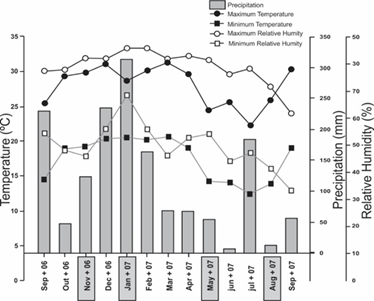
The study was carried out in two field experiments involving conventional (CONV) and organic (ORG) management that were set up in 2,000 using the American variety of Vitis labrusca (L.), which is suitable for juice production, with plantlets trained on vertical “espaldeira” driving systems. Each experimental plot consisted of four grape plants spaced 2 x 2 m in an area of 16 m2. The experimental sites are located at a latitude of 23º25′ S, longitude of 51º57′ W, and altitude of 580 m, at the Experimental Station of the State University of Maringá, Paraná State, Brazil, and the climate humid and subtropical is classified as Cfa Köppen's according to Alvares, Stape, Sentelhas, Moraes Gonçalves, and Sparovek (2014). Meteorological data on air temperature, rainfall and relative humidity during the period of soil sampling (September 2006 to September 2007) were obtained from the meteorological station located near the experimental site (Figure 1).

To avoid cross-contamination, the experiments were established in an area between the two management regimes (CONV and ORG) where there was a secondary forest (FOR) consisting of native vegetation separated by an area with a second-stage deciduous tropical forest that was used as a control, which were approximately 120 m wide and 2000 m long. The soil had a sandy texture and contained 206 g kg-1 clay, 27 silt and 767 sand, with a soil particle density of 2.65 g cm-3, and was classified as Typic Haplorthox (USDA, 2014).
The soil in the CONV experimental site was fertilized based on soil analysis and the recommendations for grape crops, with NPK fertilizer contained approximately 60 kg ha-1 of N, 12 kg ha-1 of P, and 20 kg ha-1 of K, which was applied annually and spontaneous plants were controlled by desiccant herbicide and hand weeding. The ORG experimental site was managed according to the general rules for organic cropping, as described in previous studies (Amaral et al., 2012; Amaral et al., 2011), for instance, nutrients were supplied in the form of low-solubility fertilizers such as thermophosphates and potassium sulfate and by liquid biofertilizers (e.g. fermented product of fresh manure and micronutrients). Spontaneous plants in the rows and inter-rows were controlled by a soil cover of sugarcane bagasse, in the first year only and by hand hoeing when necessary. To avoid spontaneous plants, cover crops were grown in the inter-rows in rotations of Crotalaria spectabilis Roth or Canavalia ensiformis L. in summer and with Avena strigosa Schreb in winter.
This study was undertaken considering the following treatments: factor 1, management regimes = two vineyards (M); factor 2, temporal = four seasons (T); and factor 3, spatial (S) = two soil sampling positions (row and inter-row), in a randomized block design with eight replications. Data of soil analysis of native control forest (FOR) from an adjacent area was considered only for multivariate analysis. Soil samples were collected according to vineyard phenological phases: in November 2006 (Spring= Spr), when the plants were budding and flowering; in February 2007 (Summer=Sum), during the process of fructifying; in May 2007 (Autumn=Aut), during senescence; and in August 2007 (Winter=Win), during the dormancy stage (Figure 1). Soil sampling was carried out in the topsoil layer (0-10 cm) at eight randomly chosen points in each plot. The soil samples were taken to the laboratory, where each composite sample was divided into two subsamples for chemical and microbiological analyses.
Soil subsamples were air-dried, sieved (< 2 mm) and chemically analyzed according to routine laboratory procedures (Pavan, Bloch, Zempulski, Miyazawa, & Zocoler, 1992). The soil reaction (pH) was determined potentiometrically using a soil-to-CaCl2 solution (0.01 mol L-1) ratio of 1:2.5. Potential acidity (H + Al) was determined using the SMP single-buffer method (McLean, 1982). The organic carbon (Corg) concentration in the soil was measured via the Walkley-Black potassium dichromate-sulfuric acid oxidation procedure (Nelson & Sommers, 1982). Phosphorus and potassium were extracted with the Mehlich-1 method, and their concentrations were determined colorimetrically in a UV-visible spectrophotometer and a flame photometer, respectively. Calcium (Ca+2) and magnesium (Mg+2) were extracted with a non-buffered solution of KCl (1.0 mol L-1) and measured with an atomic absorption spectrophotometer.
Field-moist soil samples were sieved (4 mm) and stored in the dark at 6-8°C until analysis. The soil gravimetric water content was determined by drying sub-samples in an oven for 48h at 105°C. The soil water holding capacity (WHC) was measured by repeatedly saturating soils (10 g fresh weight) with deionized water alternated with 2.5h of draining in a funnel with ash-free cellulose filter paper. The soil WHC of each sample was adjusted to 55-60% before performing the analyses of microbial attributes.
Soil microbial biomass (Cmic and Nmic) was assessed via chloroform fumigation-extraction, according to Vance, Brookes, and Jenkinson (1987) for Cmic and as described by Brookes, Kragt, Powlson, and Jenkinson (1985) for Nmic. Briefly, sub-samples (20 g of moist soil) were fumigated with alcohol-free chloroform in closed desiccators for 24 h and then extracted with K2SO4 (0.5 mol L-1). A second unfumigated set of soil sub-samples was extracted under similar conditions. The amount of C in the extracts was measured with the potassium dichromate-sulfuric acid oxidation procedure (Nelson & Sommers, 1982). The N contents in the extracts were determined via the Kjeldahl method (Bremner & Mulvaney, 1982) and analyzed via the green salicylic technique (Kempers & Zweers, 1986). The microbial biomass was calculated based on the differences between the C and N levels extracted from the fumigated and non-fumigated soil samples, with conversion factors of Kc = 0.33 for Cmic according to Sparling and West (1988) and Kc = 0.54 for Nmic as reported by Brookes et al. (1985).
Basal respiration (BR) was determined by incubating soil samples for 7 days at 25 ± 2°C in the dark in a closed flask with NaOH to trap CO2, followed by flow injection analysis to measure electric conductivity (Doran & Zander, 2012). The following microbial indices were calculated: ratios of i) Cmic:Nmic, ii) Cmic:Corg, iii) the microbial quotient (qMIC) by dividing microbial biomass C by Corg and multiplying by 100 to express in percentage iv) the microbial metabolic quotient (qCO2) based on the relationship of BR (µg C-CO2 g-1 soil h-1) per milligram of microbial biomass C.
To examine the microbial activity, flux of C microbes, and soil organic matter after four and seven years of vineyard cultivation, data from 2004 and 2007 were used. Annual microbial C turnover was calculated according to Srivastava and Singh (1991) assuming a biomass turnover time of 1.25 years for tropical and subtropical conditions.
Multivariate statistical analyses were applied using an approach with Box-Cox transformation of all variables. A principal component analysis (PCA) was carried out according to matrix variance accounting for the sum of the variance of the eigenvalues, diagrammed in scatter plots. Correlations between all factors and their interactions were studied by Pearson’s correlation matrix and were represented graphically, based on complete linkage cluster analysis to assess the similarity of soils under the forest area and the vineyard managements. To check the equality of variance, an exploratory analysis of variance (ANOVA) was conducted by using a general linear model (GML) within each experiment. The factors in the nested mixed model were tested in a three-way manner following a 4 x 2 x 2 factorial design. Tukey’s honestly significant difference (HSD) procedure was applied to compare means. Statistical analyses were performed with the SAS® for Windows v 9.1 software package with alpha (() set at 0.05.
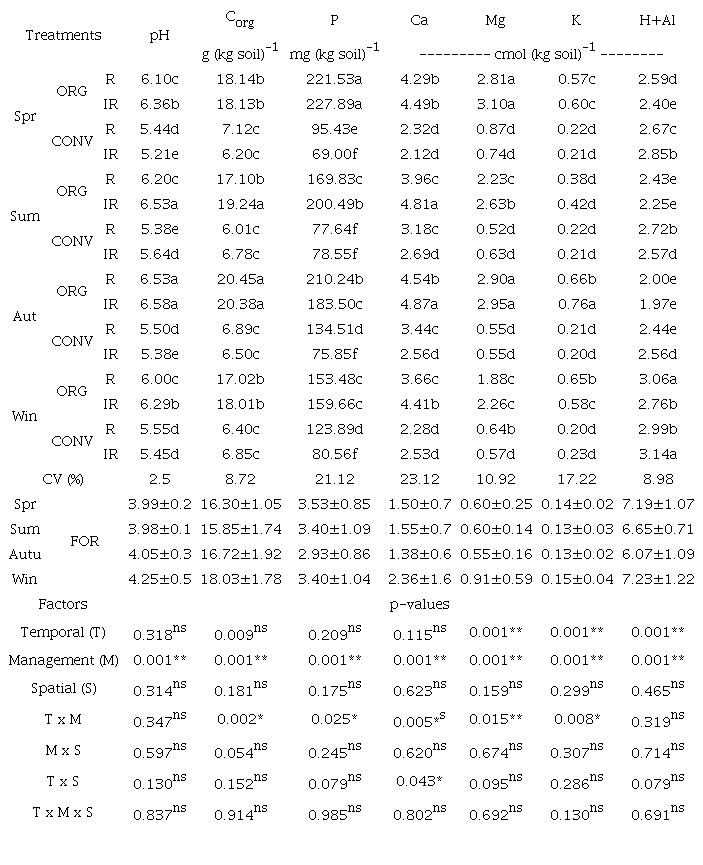
Overall, there were few changes in the chemical soil proprieties during the seasons, with the highest values being recorded in winter and the lowest in autumn, except for pH and Corg (Table 1). The vineyard management (M) factor was significant for all the soil chemical attributes, while the triple interaction (T*M*S) was not significant. The double T*M interaction was significant for the following chemical attributes: Corg, P, Ca, Mg, and K, but the pH of the soil and H+Al did not differ with the vineyard management regime or the sampling time (T). In soil under FOR, the pH ranged from 3.9 to 4.2, with low P, Ca, Mg, and K and high Corg contents (Table 1).

The soils under the ORG system presented higher levels of Ca, Mg, and K than those under CONV during autumn, probably due to organic fertilization and the cover crops present in the inter-rows. In a conventional system without cover crops, C organic oxidation is accelerated, and a low carbon input markedly decreases the values of these chemical attributes (Merino, Godoy, & Matus, 2016).
The soils under the forest presented a higher potential acidity, as expected because Oxisols were originally acidic soils, with lower levels of P, Ca, Mg, and K and higher levels of Corg.
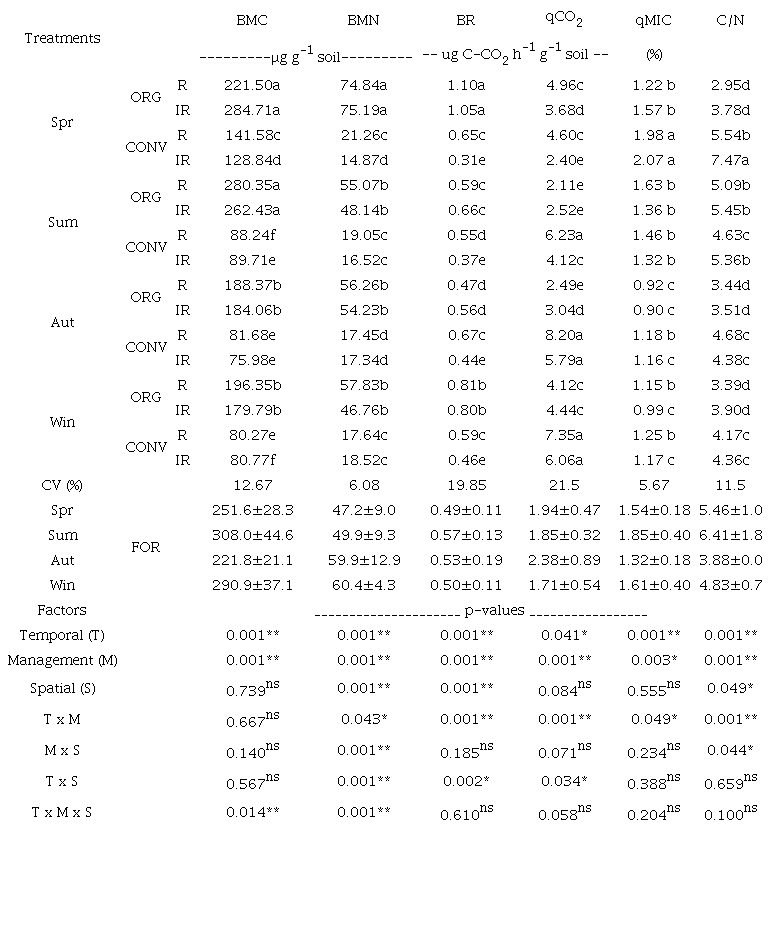
The triple interaction of the T*M*S factors was significant for BMC and BMN; the highest values of microbial biomass were observed in Spr-ORG-IR for BMC and Sum-ORG-R for BMN. The BR values showed significance for the T*M and T*S factor interactions, with the highest values being observed in springer for organic vineyard management in inter-row and row (Table 2).

In our study, in the soil under the ORG vineyard, an increase in MBN indicating a shift in the microbial community was noted, as described by Tardy et al. (2015) and Bender, Wagg, and van der Heijden (2016), who argued that the changes in the microbial community associated with the best soil microbiological conditions may contribute to the sustainability of farming systems. The use of cover crops as an agricultural practice in conservation systems increases microbial activity and diversity, and consequently, soil quality (Chavarria et al., 2018; Lori et al., 2017), including increasing the diversity of fungi in soil under vineyards (Hernandez & Menéndez, 2019).
Regarding microbial biomass, the uncultivated soil under the forest, presented low qCO2 values. In the FOR soil, the values of qCO2 were lower than in vineyard areas. Soil specific respiration (qCO2) can be used as a sensitive index of microbial population efficiency (Anderson & Domsch, 2010).
In spring, BMC, qMIC, and the BM (C/N) ratio increased, and qCO2 was reduced in association with lower temperatures, while in October to November, there was an increase, which contrasts with the values observed in autumn; when BMN was reduced, and qCO2 increased.
In CONV soils, there was a significant association between qCO2, P, and BM (C/N) in the negative Comp2, in contrast to the results for Corg and microbial biomass (BMC and BMN). When soil conditions are subject to stress, there is a decrease in the microbial population efficiency with increases in CO2 release because it the microbes use more energy for maintenance (Zheng et al., 2019). Additionally, Malik et al. (2018) observed when studying land use and soil pH and the interdependence of microbial growth efficiency and soil organic carbon accumulation using isotope tracer measurements that there is an inverse relationship between the soil organic carbon content and specific respiration (qCO2).
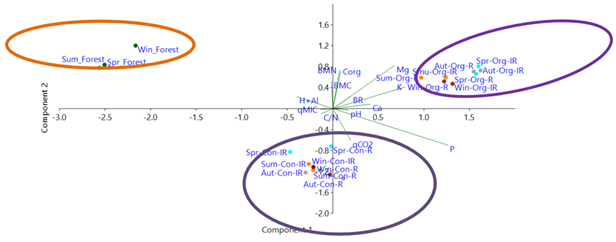
PCA of the chemical and microbial variables indicated that the first two components accounted for 80.6% of the total variance, grouping the variables into three clusters in which the management regimes and the forest were the predominant factors: 54.3% explained by component 1 (Comp-1) and 26.3% by component 2 (Comp-2). For Comp-1, the following attributes exhibited positive loads: P, K, Mg, Ca, qCO2, BR, and pH; and the following exhibited negative loads: H+Al, BM (C/N), and qMIC. For Comp-2, the attributes, BMN, Mg, BMC, and Corg, were positively loaded, while the qCO2 and P contents were negatively loaded (Figure 2).
To highlight the attributes of the soils under the ORG and CONV management regimes and the forest that were of greatest relevance to the groupings of the treatments, the PCA components were used; hence, for component 1 (comp-1), the nutrient contents (P, K, Mg, and Ca) and the microbiological perturbation index of qCO2 showed high values, resulting in a designation of "Soil fertility and microbial perturbation".
The PCA showed that the CONV vineyard treatment was placed in the negative quadrant of the two axes, which were separated into two subgroups according to row (R) in the 2nd quadrant and inter-row (IR) in the 3rd quadrant. The soil microbial and chemical attributes under FOR were located in the negative quadrant of the 1st PC (X-axis) and the positive quadrant of the 2nd PC (Y-axis). For ORG, the factors were clustered in the 1st quadrant (positive for components 1 and 2), where two subgroups were established: Sum-Win and Spr-Aut, showing higher similarity between the seasons, probably due to the amount of moisture in the soil (Figure 2).

For PCA comp-2, the cationic nutrients (K, Mg, and Ca), Corg, BMC, BMN were positively relevant, and qCO2 and H+Al were negatively relevant, resulting in a designation of "organic C flux and changes in the microbial biomass". Higher contents of Corg and microbial biomass (BMC and BMN) were observed in the soils under ORG farming, indicating soil quality related to better organization and sustainability of the agricultural system, which involves a greater organic matter input and lower application of pesticides. Bevivino et al. (2014) suggested that change in bacterial community composition is due to shifts from forest to managed meadow and vineyard while the conversion of the tropical dry sub-humid forest areas into agriculture and pastures shown a decrease in soil microbiological quality (Barros et al., 2020).
When in the low input systems, organic inputs were not sufficient to maintain soil quality, except for an accumulation of resin extractable and total P due to application of rock phosphate (von Arb et al., 2020) even after long term of organic farming system. Whereas, Menalled, Seipel, and Menalled (2020) pointed out that differences between the plant-soil feedback of the organic tillage and reduced tillage systems cannot be described as only a function of organic or chemical farm management, because these differences are best exemplified when taken into account with cropping sequence.
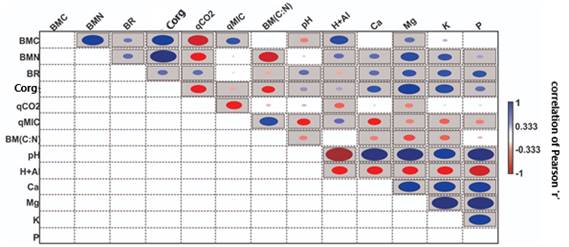
There was a significant (p < 0.05) Pearson correlation between most of the soil chemical and microbiological attributes (Figure 3).

The chemical soil proprieties presented an important function of indicating that a significant fraction of fertility (mainly Corg) had already been lost under CONV vineyard conditions as reported from a study of the response to differences in agricultural management regimes in which seasonal changes in organic carbon and the bacterial community in soil were used as quality indicators (Bevivino et al., 2014). A positive correlation between microbial biomass and the carbon soil fraction was noted by Merino et al. (2016) when they were studying microbial activity related to the C mineralization stabilization mechanism.
Microbial activity was greatly affected under CONV farming; in spring, BMC, qMIC, and BM (C/N) increased, and qCO2 was reduced, which was related to lower temperatures and their increase in October to November. In Spring-R the highest fertility was observed (mainly in terms of Mg and K) in comparison with Spr-IR, and this effect was attributed to the timing of fertilization. As early as autumn, there were increases in P and Ca observed in the rows vs. inter-rows.
Compared to a previous study conducted by Amaral et al. (2012) in the same experimental area in the summer, after three years under an ORG vineyard, there were average increases of 252% for P, 20% for Corg, 43% for Mg, and 4% for BMC. On the other hand, there was a decrease of 124% for Corg under the CONV system. Microbial activity and the chemical characteristics were affected by different temporal drivers under CONV farming.
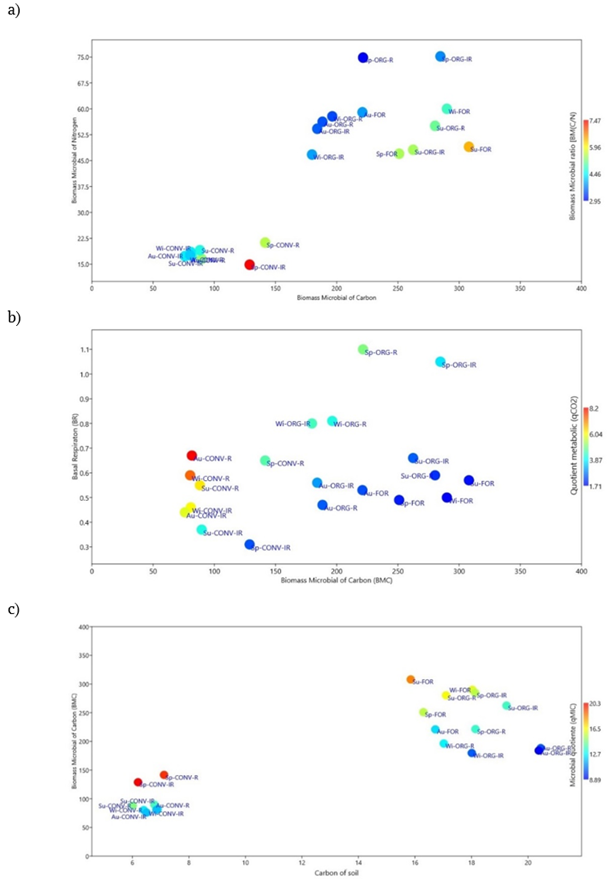
The temporal (T) and vineyard management regime (M) factors and their interactions were significant for the qCO2 attribute, which presented higher values in CONV-R, except in Spr, and lower values in ORG-R in Sum and Aut. The T*M interactions were significant for the qMIC attributes (MBC and Corg ratio), showing that in the spring, CONV-R and -IR presented higher averages, whereas the lowest qMIC was observed in autumn and winter in ORG-IR. In the soil under FOR, qMIC ranged from 12.25 to 18.37%, and for the metabolic quotient, the values ranged from 1.71 to 2.38 µg C-CO2 h-1 g-1 soil (Table 2 and Figure 4).

In the soil under the forest, BMC ranged from 221.8 to 308.0 µg C g-1 soil; BMN ranged from 47.2 to 60.4 µg N g-1 soil; and the BR values ranged from 0.49 to 0.57 µg C-CO2 h-1 g-1 soil. The T*M and M*S interactions were significant for the ratio of microbial biomass (C/N); the highest values were obtained for Spr-CONV-IR, and the lowest for Spr- and Win-ORG-R (Table 2 and Figure 4). In ORG, the metabolic quotient (qCO2) stood out from those in the other systems (Figure 4). The temporal and spatial responses of soil fertility and microbiological indicators were inherent to each vineyard management.
Our findings indicated that the temporal factor (seasons) increased the BMN contribution to BR and qCO2 in soil under ORG, mainly in spring and winter; we can highlight that during spring, Crotalaria spectabilis or Canavalia ensiformis was present, and in winter, Avena strigosa was cultivated, as described in detail in previous studies (Amaral et al., 2011; 2012).
During spring and winter, there were high values of BMC in ORG correlated with a higher RB, corroborating Lori et al. (2017) findings. In these periods, the decomposition and incorporation of the residues of the cover plants, oats and legumes, respectively, according to Amaral et al. (2011) may have resulted in such increases. It was observed seasonal shifts in soil microorganism abundance and in the microbial community from a vineyard (Mackie, Schmidt, Müller, & Kandeler, 2014).
Shifts from conventional to organic management positively affected microbial biomass and enzyme activity due to enhancements in organic matter content (Okur, Altindİşlİ, Çengel, Göçmez, & Kayikçioğlu, 2009) and also from forest to managed meadow and vineyard result in changes of bacterial communities composition, which is seasonally distinct (Bevivino et al., 2014). Recently, following extensive research on microbial activity in organic farming, Lori et al. (2017) emphasized that the inclusion of legumes as cover crops increases microbial activity and diversity. Organic soil management regimes increase soil attributes related to nutrients, chemicals and microorganisms, consistent with a lower range of temperature and moisture oscillation, leading to benefits in the soil microbial community, soil structure, nutrient retention, infiltration and aeration (Partey, Preziosi, & Robson, 2014).
The soil microbial community is affected by both the soil management and seasonal given the differences in temperature and moisture, López-Piñeiro, Muñoz, Zamora, and Ramírez (2013) demonstrated that in vineyard soils the microbial population exhibited seasonal fluctuations, which was related to the weather conditions and the phenological state of the vines.
Overall, organic practices exert a notable effect on soil functions (Lori et al., 2017); however, these effects may occur in the whole community or in specific groups; for example, the use of fertilizers may alter bacterial community structure through changes in soil pH, rather than through nutrient application (Zhang et al., 2017). The kind manure applied (eg. bovine, poultry or swine) also affects microbial communities and soil complexity in different ways (Francioli et al., 2016; Tardy et al., 2015). In a case study in northern Italy, by comparing organic and conventional vineyards using a multi criteria approach, it was concluded that the choice to an organic vineyard management does not compromise the economic productivity of vine grape, and also it improves mitigations on the environmental impacts (Borsato et al., 2020).
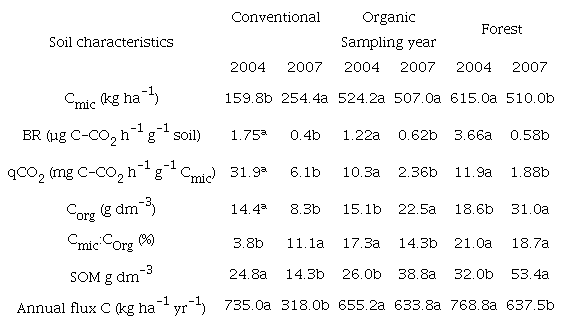
After four years of establishment (short term) of the experiments it was observed that both the Cmic and the annual flow of C in the microbial biomass were significantly higher under Org and forest cultivation than conventional management (Table 3).

Annual flux of microbial carbon showed the same values during the two period years studied under Org vineyard, however, the Corg e SOM concentrations increased from 2004 to 2007. The Conventional vineyard management not keeping the organic Corg in the soil, on the other hand, the Org management increase this soil parameter an increasing the sustainability of theses crops. Similarly, after seven years of implantation of the vines, the contents of Cmic, FAC, Ctot, and OM were higher under Org and forest. However, the Cmic:Corg ratio showed no difference between the systems, as observed in 2004.
The Cmic increased under conventional grapevine management from 2004 to 2007; in contrast, there were no changes under the organic vineyard management and forest soils (Table 3). Regardless of management or vegetation cover, microbial activity data (by BR and qCO2) were lower in 2007 than in 2004. In particular, the Cmic and annual flux remained high at 655.2 and 633.8 kg ha-1 yr-1 under organic vineyards in 2004 and 2007, respectively.
Variations in microbiological and chemical attributes throughout different seasons were specific to each vineyard management system. Soil under vineyard organic management maintained organic carbon and microbial biomass indices similar to those of a forest were higher and more stable than those of a conventional system. Understanding the soil microbial partitioning of organic substrates between respiration and biomass in response to different soil management practices affecting soil organic matter content and quality could provide useful information for designing sustainable ecosystem management strategies to enhance soil fertility and C storage.
This work was supported by the Brazilian National Council for the Improvement of Higher Education (CAPES under finance Code Grant 001); the National Council for Scientific and Technological Development (CNPq) under Grant number 312996/2017-9; and by the project INCT-CNPq under Grant INCT-CNPq-MPCPAgro 465133/2014-2 and to GAAMA - Grupo de Agroecologia de Maringá for helping with the field experiment. DSA is are also research fellows of CNPq (312996/2017-9).
* Author for correspondence. E-mail: diva@idr.pr.gov.br