Notas
Recepción: 21 Diciembre 2023
Aprobación: 12 Enero 2024
Abstract: The male of Adesmus murutinga Martins & Galileo, 2004 is described for the first time, an updated key to Colombian species of the genus is presented, and three species of longhorned beetles are reported for the first time for Colombia. The specific localities in Colombia of Miriclytus quadrifasciatus (Chevrolat, 1862) and Oedudes spectabilis (Drury, 1782) are reported.
Keywords: Biogeographic Chocó, Distribution, New records, Taxonomy.
Resumen: Se describe por primera vez el macho de Adesmus murutinga Martins & Galileo, 2004, una clave actualizada de las especies colombianas del género es presentada, además se reportan para Colombia tres especies de escarabajos longicornios. Finalmente se detallan localidades específicas en Colombia de Miriclytusquadrifasciatus (Chevrolat, 1862) y Oedudes spectabilis (Drury, 1782).
Palabras clave: Chocó Biogeográfico, Distribución, Nuevo registro, Taxonomia.
The tribe Hemilophini Thomson, 1868 is uniquely American, represented by 571 species in 131 genera (Tavakilian & Chevillotte, 2023). Morphologically, it is characterized by having finely granulated eyes, lower eye lobes shorter or the same lenght as the genae and tarsal claws bifid. Some species mimic other families of Coleoptera such as Lycidae and Cantharidae (Martins & Galileo, 2014).
The genus Adesmus Lepeletier & Audinet-Serville, 1825 is composed of 68 species distributed in the Neotropical region, being one of the most diverse genera of Hemilophini (Monné, 2023b). It is distributed from Mexico to South America, including the Caribbean. In South America, the species of Hemilophini occur mainly in the Amazon Forest and Atlantic Forest (Martins & Galileo, 2014).
Currently, six species are recorded for Colombia (Martínez 2000; Martins & Galileo 2014; Botero 2018; Monné, 2023b): Adesmusdiana (Thomson, 1860); A. divus (Chabrillac, 1857); A. laetus (Bates, 1881); A. leucodryas (Bates, 1881); A. murutinga Martins & Galileo, 2004; and A. pirauna Galileo & Martins, 1999.
Adesmus murutinga was described by Martins & Galileo, 2004 based on a single female specimen from Colombia. Herein, we describe and illustrate for the first time the male of A. murutinga; an updated key to Colombian species of the genus is provided. Additionally, three species are reported for the first time from Colombia belonging to Cerambycini, Torneutini, and Trachyderini. Detailed localities in Colombia for Miriclytus quadrifasciatus (Chevrolat, 1862) and Oedudesspectabilis (Drury, 1782) are provided.
Measurements were made using tpsDig v. 2.26 software and units are in millimeters (mm). Photographs were taken using a Nikon D3200 camera, with 18–55 mm macro lens. The following references were used for the identification of the species: Martins & Galileo (2014); Martins & Galileo (2011); Santos-Silva et al., (2018); Joly (2017); Monné & Monné (2013); and the original descriptions.
The acronyms used in the text are as follows:
CFPL= Colección Familia Pardo-Locarno, Palmira, Valle del Cauca, Colombia.
IAvH= Colecciones Biológicas, Instituto de Investigación de Recursos Biológicos Alexander von Humboldt, at Villa de Leyva, Boyacá, Colombia.
MENT-UT= Museo Laboratorio de Entomología Universidad del Tolima, Tolima, Colombia.
MEPB= Museo Entomológico de Piedras Blancas, Antioquia, Colombia.
Lamiinae Latreille, 1825
Hemilophini Thomson, 1868
Adesmus murutinga Martins & Galileo, 2004
Male (Fig. 1a-d) Head decumbent, completely covered by white pubescence. Frons transverse with a black triangular macula close to clypeus; region between upper eye lobes with transverse black pubescent band. Distance between upper eye lobes 0.34 times length of scape; in frontal view, distance between lower eye lobes 0.90 times length of scape. Clypeus truncate; apical margin truncate. Labrum convex brownish, glabrous. Mandibles black. Labial and maxillary palpomeres orange. Antennae surpassing elytral apex at antennomere VII; with long, erect white setae on inner side. Scape subcylindrical. Antennal formula based on length of antennomere III. Scape = 0.30; pedicel = 0.11 IV = 0.71; V = 0.51; VI = 0.46; VII = 0.38; VIII = 0.35; IX = 0.31; X = 0.22; XI = 0.20.
Thorax: Prothorax wider than longer. Pronotum covered with white pubescence, with a transverse black pubescent band centrally. Prosternum, mesoventrite, metaventrite, and metanepisternum with dense white pubescence. Elytra. Each elytron with a pair of circular black pubescent maculae, located on apex of anterior third, another on beginning of posterior third, posterior one greater than anterior. Humeral carina reaches posterior 2/3 of elytra. Legs. Femora orange; tibiae cylindrical, orange basally, black apically. Abdomen. Urosternites II to IV covered with dense white pubescence; urosternite with V orange pubescence, concave on apical margin.
Dimensions: male (mm). Total length, 15.10; prothorax: length, 3.35; anterior width, 4.35; posterior width, 4.45; widest prothoracic width, 4.65; humeral width, 6.30; elytral length, 10.40.
Material examined: Colombia, Valle del Cauca, bajo Calima, 70 m. Colecta manual, 1 male, 13/VI/2010, A. Silvestre col. (MENT-UT).
Remarks: Examination of the female holotype (Fig. 1e-i) shows that the most significant difference between females and males is the diameter of the elytral maculae. According to Martins & Galileo (2004), A. murutinga is similar to A. piraunaMartins & Galileo, 2004 but differs by the scape shape (subcylindrical), body color (white and black), and tarsal and antennal colors (black).
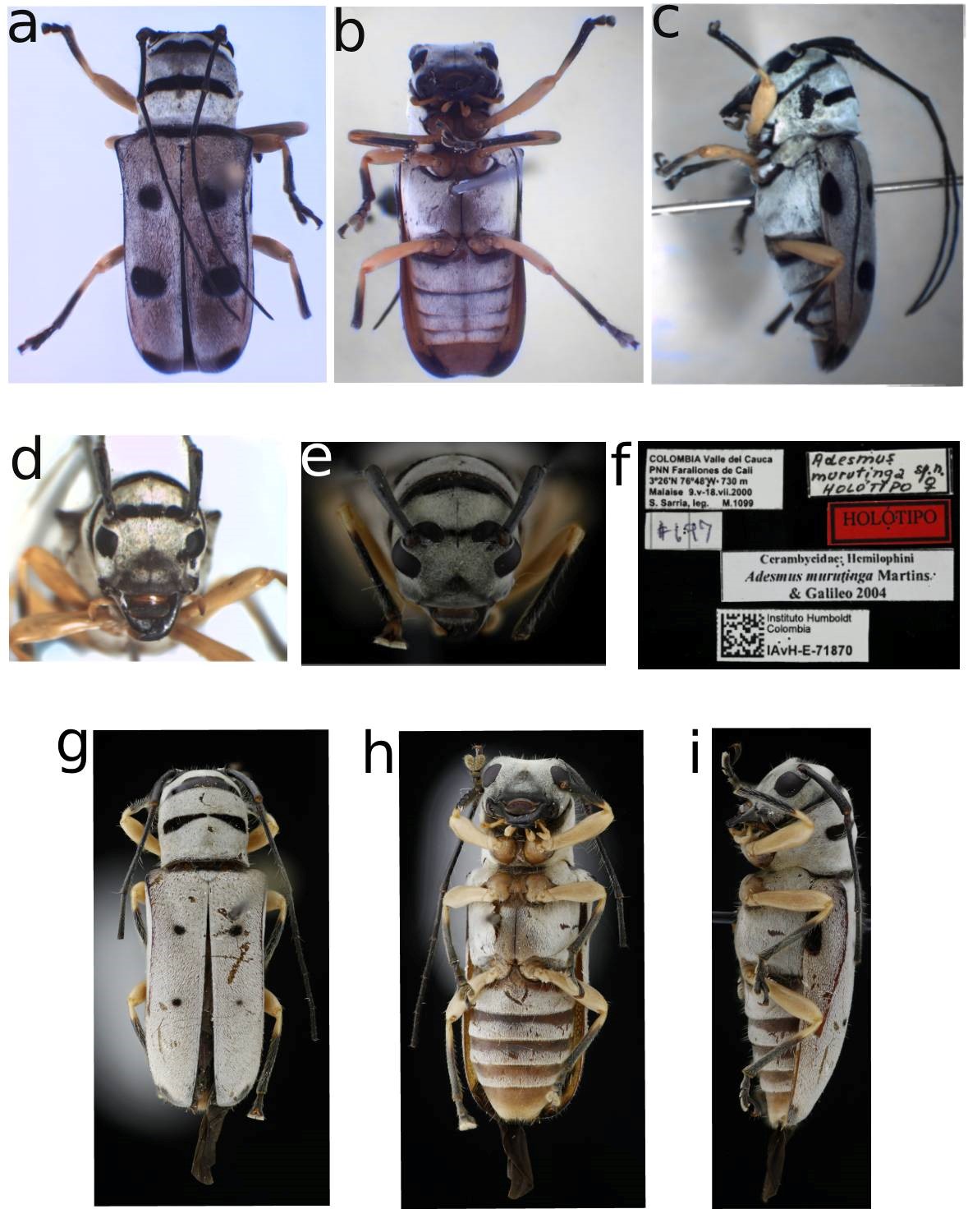
Fig. 1.
Adesmus murutingaMartins & Galileo, 2004. Male. a. dorsal habitus. b. ventral habitus. c. lateral habitus. d. head, frontal view. Female. e. head, frontal view. f. label. g. dorsal habitus. h. ventral habitus. i. lateral habitus.
Distribution of Adesmus in Colombia
Adesmus divus is distributed in the Caribbean region of the departments of Atlántico and La Guajira (Audureau 2017; García et al., 2021); A. diana occurs in the Orinoquia, specifically in the departments of Casanare and Meta (Martins & Galileo 2004); and the other three species are recorded in the biogeographic Chocó, departments of Chocó (A. pirauna) and Valle del Cauca (A. leucodryas; A. murutinga; A. pirauna) (Martins & Galileo 2004; Martins & Galileo 2014) (Fig. 2).
Key to species of Adesmus Lepeletier & Audinet-Serville, 1825 from Colombia
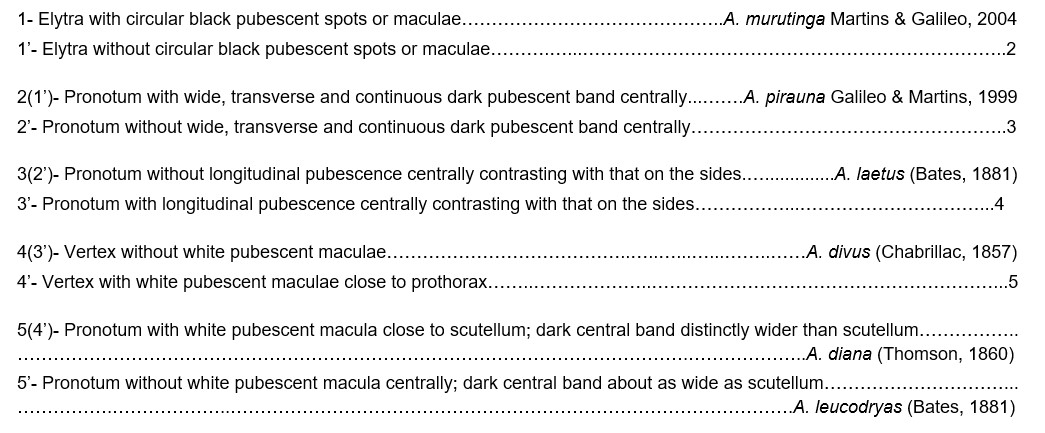
Key to species of Adesmus Lepeletier & Audinet-Serville, 1825 from Colombia
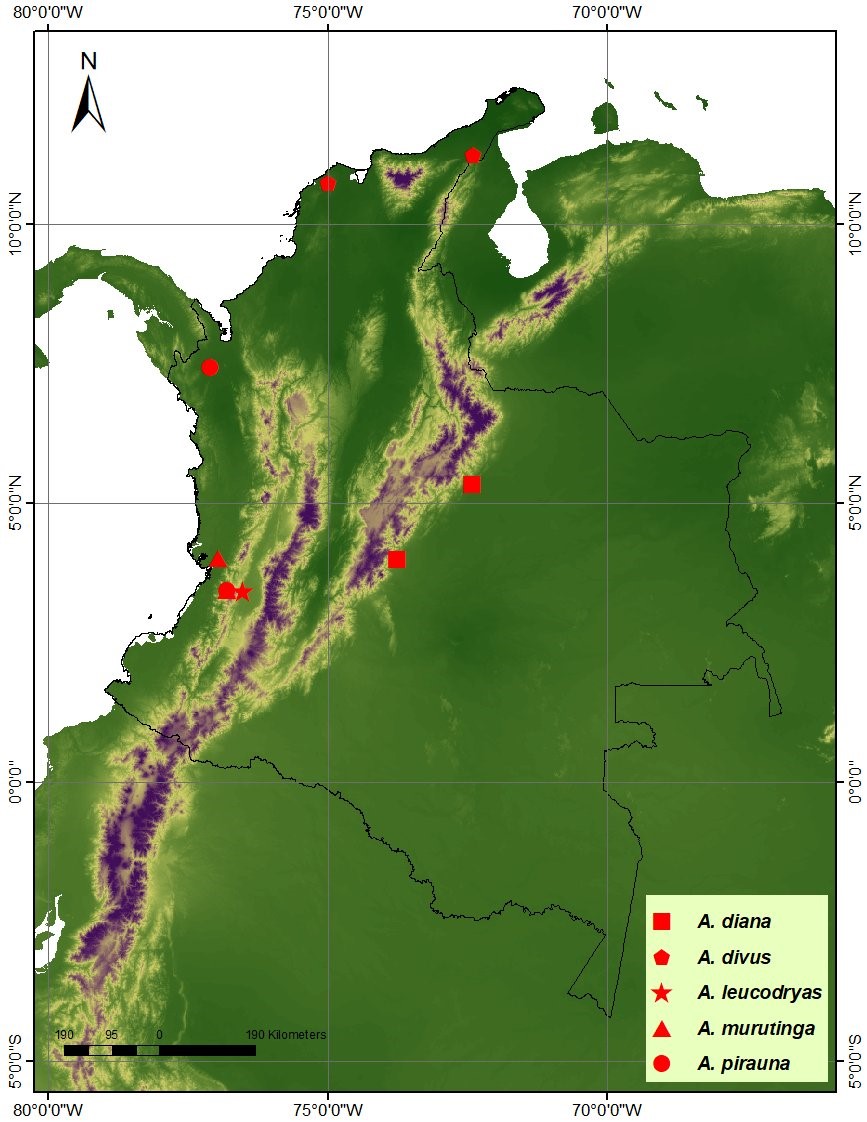
Fig. 2.
Geographical distribution of Adesmus species in Colombia.
New distribution records
Cerambycinae Latreille, 1802
Cerambycini Latreille, 1802
Sphallambyx mexicanum Galileo & Martins, 2006 (Fig. 3a)
Distribution: Mexico, Costa Rica, and Panama (Monné, 2023a).
Material examined: Colombia (new country record), Valle del Cauca, Bajo río Dagua, Quebrada Pericos. 10/2012. LC Pardo-Locarno col. (CFPL).
Clytini Mulsant, 1839
Miriclytus quadrifasciatus (Chevrolat, 1862) (Fig. 3b)
Distribution: Costa Rica, Panama, Colombia, and Ecuador (Monné, 2023a).
Material examined: Colombia, Antioquia, Vereda Piedras Blancas, Parque Piedras Blancas, 2350m. (6º17’40.62’’N–75º29’58.15’’W). 30/V/2013. J. Marín (MEPB).
Comments: The species was already recorded from Colombia but without any specific locality.
Torneutini Thomson, 1861
Praxithea travassosi Lane, 1939 (Fig. 3c)
Distribution: Costa Rica, Venezuela, Ecuador, Guyana, French Guiana, Peru, Brazil, and Bolivia (Monné, 2023a).
Material examined: Colombia (new country record), Valle del Cauca, Buenaventura, Bajo río Dagua, Córdoba, Venecia. 110-120 msnm. 09/1991. LC Pardo-Locarno col. (CFPL).
Trachyderini Dupont, 1836
Galissus cyaneipennis (Waterhouse, 1880) (Fig. 3d)
Distribution: Honduras, Costa Rica, Panama, Ecuador, and Bolivia (Monné, 2023a).
Material examined: Colombia (new country record), Valle del Cauca, Calle larga, Sabaletas, Bajo Anchicayá. 11/1996. LC Pardo-Locarno col. (CFPL).
Lamiinae Latreille, 1825
Hemilophini Thomson, 1868
Oedudes spectabilis (Drury, 1782) (Fig. 3e)
Distribution: Mexico, Guatemala, Honduras, Nicaragua, Costa Rica, Panama, Colombia, and Ecuador (Monné, 2023b).
Material examined: Colombia, Antioquia, Cocorná, corregimiento la Piñuela, vereda la Vega. 20/03/2014. Marin and Gallego col. (MEPB).
Comments: The species was already recorded from Colombia but without any specific locality.
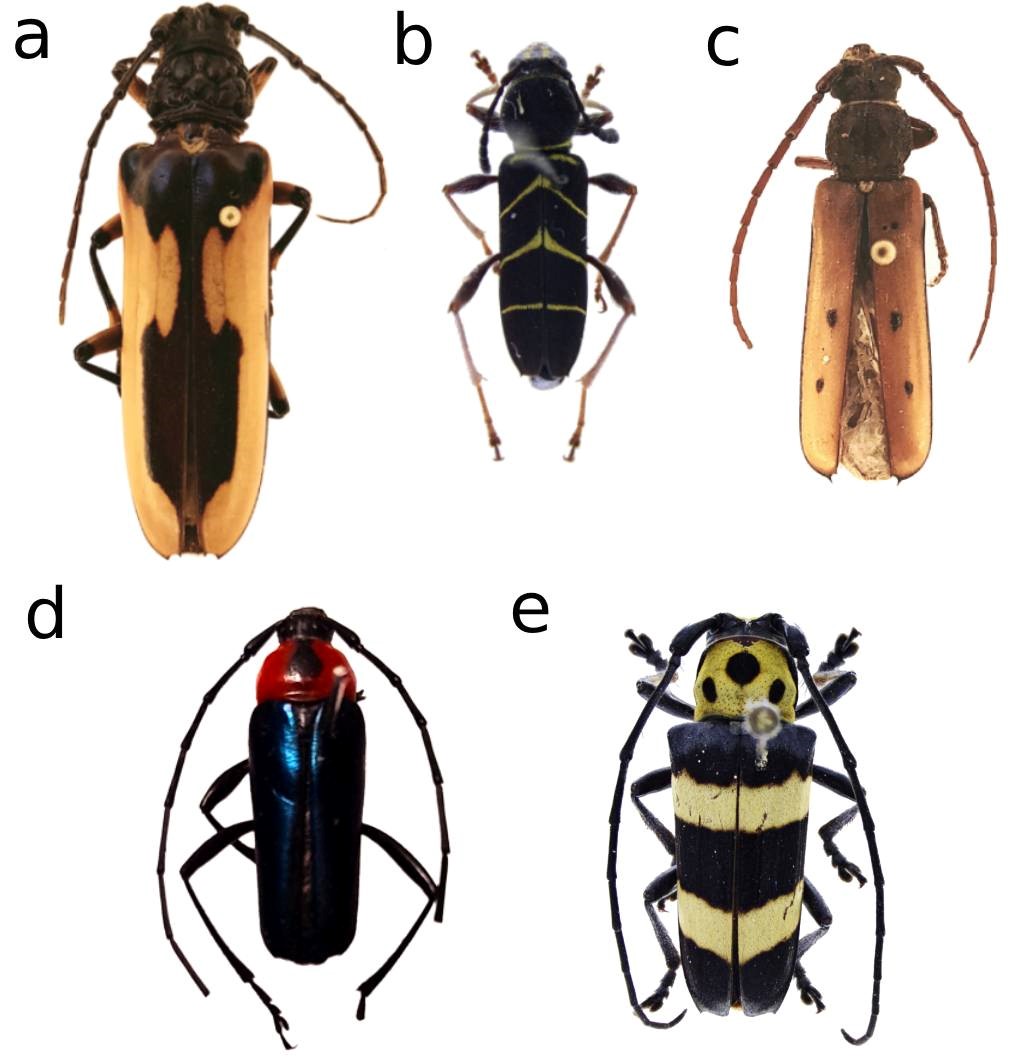
Fig. 3.
New records. a. Sphallambyx mexicanum Galileo & Martins, 2006. b. Miriclytus quadrifasciatus (Chevrolat, 1862). c. Praxithea travassosi Lane, 1939. d. Galissus cyaneipennis (Waterhouse, 1880). e. Oedudes spectabilis (Drury, 1782).
Acknowledgments
We thank Julian Clavijo and Jhon Cesar Neita (IAVH) for sharing the photos of the holotype of A. murutinga. We also thank Alfredo Lanuza (Universidad de Panamá) for sharing photos of A. pirauna. Finally, we thank Antonio Santos-Silva (MZUSP) for the taxonomic discussions and Juan Pablo Botero for reviewing the text.
References
Audureau, A. (2017) Notes sur quelques Lamiaires nouveaux ou peu connus (Coleoptera, Cerambycidae, Lamiinae). Les Cahiers Magellanes, 27, 1-9.
Botero, J. (2018) La familia Cerambycidae (Coleoptera: Chrysomeloidea) en Colombia. Escarabajos del Neotrópico (Insecta: Coleoptera) (ed. Deloya, C., & Gasca, H.), pp. 153-169. S y G Editores, Ciudad de México.
Garcia, K., Botero, J.P., & Santos-Silva, A. (2021) A new genus of Achrysonini and new records in Cerambycidae (Coleoptera, Chrysomeloidea) from Colombia. European Journal of Taxonomy, 735, 89-109. https://doi.org/10.5852/ejt.2021.735.1243.
Joly, L.J. (2017) The Torneutini (Coleoptera: Cerambycidae) of Venezuela. Entomotropica, 32(1), 1-86.
Martínez, C. (2000) Escarabajos Longicornios (Coleoptera: Cerambycidae) de Colombia. Biota colombiana, 1(1), 76-105.
Martins, U.R., & Galileo, M.H.M. (2004) Contribuição aos Hemilophini (Cerambycidae, Lamiinae) da Colômbia e do Equador. Iheringia, Serie zoologia, 94(1), 37-44. https://doi.org/10.1590/S0073-47212004000100006
Martins, U.R., & Galileo, M.H.M. (2011) Subfamília Cerambycinae, Clytini Mulsant, 1839. Cerambycidae Sul-Americanos (Coleoptera) (ed. Martins, U.R.), pp. 1-264. Sociedade Brasileira de Entomologia, São Paulo.
Martins, U.R., & Galileo, M.H.M. (2014) Subfamília Lamiinae. Tribo Hemilophini, parte I. Cerambycidae Sul-Americanos (Coleoptera) (ed. Martins, U.R.), pp. 1-231. Sociedade Brasileira de Entomologia, Curitiba.
Monné, M.A. (2023a) Catalogue of the Cerambycidae (Coleoptera) of the Neotropical region. Part I. Subfamily Cerambycinae. http://cerambycids.com/catalog/. (Accessed 01 September 2023).
Monné, M.A. (2023b) Catalogue of the Cerambycidae (Coleoptera) of the Neotropical región. Part II. Subfamily Lamiinae. http://cerambycids.com/catalog/. (Accessed 01 September 2023).
Monné, M.L., & Monné, M.A. (2013) Synonymical and nomenclatural notes on Trachyderini (Coleoptera, Cerambycidae, Cerambycinae). Zootaxa, 3686(3), 356-362. https://doi.org/10.11646/zootaxa.3686.3.4.
Santos-Silva, A., Botero, J.P., & Galileo, M.H.M. (2018) On Sphallambyx mexicanum and key to species of Sphallambyx (Coleoptera, Cerambycidae, Cerambycinae). Zootaxa, 4429(3), 572-576. https://doi.org/10.11646/zootaxa.4429.3.7.
Tavakilian, G.L., & Chevillotte, H. (2023) Titan: base de données internationales sur les Cerambycidae ou Longicornes. http://titan.gbif.fr/index.html. (Accessed 10 September 2023).
Notas de autor
carlostaboadaverona@gmail.com
