Lingüística
Received: 07 December 2017
Accepted: 17 March 2018
DOI: https://doi.org/10.15517/rfl.v44i2.34693
Resumen: Limón, provincia de Costa Rica, presenta una inusual situación lingüística que ha sido abordada desde diferentes perspectivas. Los estudios sobre inglés limonense se encuentran dentro de los paradigmas de criollos ingleses, lingüística general, y antropología y sociología. Aunque no es única, la situación lingüística de Limón presenta retos para el diseño de investigación y para la recolección de datos debido a que dicha situación se caracteriza por la presencia de varias lenguas que cohabitan en la misma área. Este estudio investiga las actitudes hacia dos variedades de inglés habladas en Limón. Se enmarca en el paradigma de Ingleses del Mundo (WE, por sus siglas en inglés) y utiliza un método mixto para la cuantificación de la calidad. Los datos provienen de cuestionarios cuantitativos y cualitativos de 109 participantes con una variedad de contacto con el inglés. Los resultados muestran que el inglés de Limón se mueve del estatus de lengua olvidada o de uso limitado hacia uno de lenguaje cuyo uso puede beneficiar a la comunidad cultural y económicamente.
Palabras clave: Actitudes, inglés limonense, Costa Rica, variedad del círculo central, constructivismo social.
Abstract: Limón, located in Costa Rica, Central America, presents an unusual linguistic situation that has been explained from different approaches. Studies on Limonese English are found within the paradigm of English Creoles, General Linguistics, and Anthropology and Sociology. Although not unique, Limón?s linguistic situation poses a challenge for research design and data collection because Limón?s linguistic situation is characterized by the presence of several languages that cohabit in the same area. This study investigates language attitudes towards two varieties of English spoken in Limón. It is framed within the World Englishes (WE) paradigm and uses a mixed-method approach to quantify quality. Data from quantitative and qualitative questionnaires from 109 participants with a variety of contact with English. Results show that Limonese English is moving from a forgotten language or a language with limited use to a status of a language whose use may benefit the community both culturally and economically.
Keywords: Attitudes, Limonese English (LE), Costa Rica, Inner Circle Variety, Social constructionism.
1. Introduction 1
Attitudes are favorable or unfavorable responses to stimuli. In the case of language attitudes, it is the response to stimuli from varieties of a single language or different languages, or alternatively to their speakers ( Hyrkstedt & Kalaja, 1998). The study of language attitudes is found in two different primary fields of inquiry: social psychology and sociolinguistics.
In social psychology, attitudes are studied from the perspective of the importance of perception, which is the foundation of all social constructions, both individual and group relationships. Perception reflects the accumulated social knowledge individuals carry with them. An example of these attitudes is when people see dialects as ?better? or ?worse.? Within this regard, Edwards ( 1999) states that sensory data is filtered through perception, and this filter is culturally established and maintained. For example, more favorable attitudes might be attached to those varieties that are perceived to sound better, or seem more mellifluous, or seem to sound more musical, and so forth (Edwards, 1999). Edwards (1999) also states that the variation found in speech-evaluation studies reflects social perceptions of the speakers of given varieties and has nothing to say about any intrinsic qualities ?logical or aesthetic? of the language or dialect itself. He also states that these social perceptions of speech are not random, they are systematic. An example of these studies is Purnell, Idsardi, and Baugh ( 1999) in which the researchers were concerned with ?the linguistic nature of housing discrimination? regarding African-American Vernacular English, Chicano English, and Standard American English. In this study, the authors asked if discrimination based on dialect can occur because of phonetic cues alone. One of the authors, who was able to talk in the three dialects under study, called several landlords about apartments they had advertised for rent. Each of the landlords was called three times, once in each dialect, and the dependent variable was whether the landlords rang back to confirm an appointment to view the apartment. Their study showed that auditory cues constitute stimuli for unequal treatment. This study and the other studies reported in Purnell, Idsardi, & Baugh (1999) serve as empirical evidence that variation found in speech-evaluation studies reflects only social perceptions of the speakers of given varieties and are not related to the language or dialect itself (Edwards, 1999).
The study of attitudes in sociolinguistics has always shared overlapping concerns and involvement with social psychology ( Garrett, 2001). Sociolinguistics shares many approaches with social psychology in addition to the quantitative and experimental research traditions that characterize both. These approaches range from relatively straightforward questionnaires and interview surveys to experimental (matched-guise) studies employing semantic differential scales. The latter are mostly all representative of social positivism where attitudes are seen as feelings, thoughts, and predispositions to act in a specific way and more recent innovations that attempt to address some of the controversies of earlier methods (Garrett, 2001). Some of the traditional studies are based on perceptual dialectological and folk linguistic approaches (e.g. Niedzielski & Preston, 2000). Hyrkstedt & Kalaja (1998) put forward a list of studies within the positivistic paradigm including studies about inner circle varieties by Alford & Strother (1990) and Starks and Paltridge (1994); about Outer Circle varieties by Shaw (1983), Sure (1991), de Klerk (1996); and about the Expanding Circle varieties by Raji Zughoul & Taminian (1984), Benson (1991), Flaitz (1993), Verkuyeten et al. (1994), Chiba et al. (1995), Pulcini (1997), Dalton (1997), Dalton-Puffer et al. (1997) (in Hyrkstedt & Kalaja, 1998, p. 346).
The newer approaches to the study of language attitudes are represented by the work of Hyrkstedt & Kalaja (1998) in which they call for a revision of the methodology of the study of language attitudes from the traditional methods mentioned above to a more discourse (oral or written) oriented one. 2 They framed their work in a new paradigm, Social Constructionism, which changes the notion of language as a direct reflection of what goes on in a person?s mind to a means of constructing the social world during everyday interactions. Hyrkstedt & Kalaja (1998, pp. 346-347) state that until recently it was taken for granted that each individual possessed a mind, an internal organ of thought that mediated between them and the world out there; and also that an individual?s mind had principles of operation of its own, owing nothing to history or society. They argue, instead, that these constructions are built out of the linguistic resources available in a society, and that they are acquired through time by its members. For example, negative or positive attitudes towards the variety of a language can arise from perception of social status, which has nothing at all to do with language. In Costa Rica, for example, the English spoken by Afro-Costa Ricans is considered ?braad talk? or ? broad talk? ( Purcell, 1993), and thus creating a negative reputation for the language. This reputation has been acquired over the years and through the contact of this variety with speakers of another language (i.e. Spanish). It is spoken by a minority of people that did not have Costa Rican citizenship until after 1948 (i.e. descendants of Jamaican workers brought to work on the construction of the railroad [see Aguilar-Sanchez (2005) for more details]).
Attitudes within this paradigm are social and context-dependent by nature. For example, people use positive or negative attitudes to externalize their view of the world through oral interactions. Thus, mental entities and processes, which include attitudes, are taken as properties of discourse. Hyrkstedt & Kalaja (1998) state that attitudes as evaluative practices can be used for different purposes in discourse and it that happens at two levels. One level is attitudes about an issue and the other is arguing about the issue. Within this paradigm words are the thoughts, and the pattern of the argument is seen as a record of the activity of thinking. Discourse is not only the outcome of thinking, but it is also a record of the thinking process (Hyrkstedt & Kalaja, 1998). Kalaja ( 1997) points out that we should not assume people hold attitudes towards a variety of a language and that attitudes are to be located as stable entities in the mind; instead, we should concentrate on analyzing how attitudes are constructed in people?s discourse, written or oral, through argumentation. Hyrkstedt & Kalaja (1998) conclude that with a shift from cognitive representation to discursive construction, scholars should reconsider their traditional definitions of attitudes. In the last decade and a half, studies on attitudes have shifted to include the study of variables such as the role of language attitudes on language survival or attrition (e.g. Bell, 2013; Cherciov, 2013; Dowling, Ellison, & Leal, 2012; among others) and on national policies, attitudes, and their relationship to language shift (e.g. Chakrani & Huang, 2014; Crezee, 2012; González-Riaño, Hevia-Artime, & Fernández- Costales, 2013; Sallabank, 2013; Simpson, 2013, among others).
2. Background of English in Costa Rica
2.1 English as a first language
English is spoken as a first language by 73% of Afro-Costa Ricans (Aguilar-Sánchez, 2005, p. 167) . This variety in particular is spoken along the Caribbean coast of the country in the province of Limón (see Figure 1). These numbers have been decreasing over the years due to the lack of preparation of teachers to teach languages different from Spanish (the official language), the language policies dictated by the government after 1948, and the immigration of Spanish monolinguals to Limón (Purcell, 1993). The situation is different from what it was three decades ago when many teachers were not aware of the importance of the language in the Caribbean (i.e. English) due to their lack of preparation in the field of Language Education and the position of Spanish as the official language (Purcell, 1993).

Because of the lack of preparation of teachers and language policies, the influence of Spanish as the official language, the migration of Spanish speakers to the province of Limón, and the low social status that the Limonese variety of English held, many native speakers of this English variety decided not to speak it anymore and adopted Spanish as their first language. There were several policies from the Ministry of Education aimed at the general status of education in Costa Rica that did not take into account the bilingualism of the residents of Limón. One such policy sent teachers trained to teach Spanish as a first language and not English. After 1948, when citizenship was granted to residents of Limón and the mass immigration from inside the country caused by the granting of land and job opportunities, the government established Spanish as the only language of instruction in the Costa Rican public school system. This policy eliminated the need for the English schools that were established by the Jamaican immigrants upon their arrival to Limón. However, people continued to be educated in English through Sunday schools ( Meléndez Chaverri & Duncan, 1974; Purcell, 1993). Even more, the social status and the perception of English and its relation to race and prestige played a major role in this phenomenon as pointed by Purcell (1993):
The insistence on Spanish was more pronounced among young Black women. I frequently spoke to a young female assistant at a pulpería3 who always used Spanish. I had begun to assume that she did not speak English until I saw her, in the company of other females at a local Saturday night dance, speaking very expressively in Limón Creole. A fair conclusion: Spanish is a component of respectability, especially in formal situations (Purcell, 1993, p. 114)
...Young people, of high school age and older, having been schooled in Spanish, are more confident in its use, especially when speaking with outsiders. They have been led to think that Limón Creole (or ?mek-a-tel-yu,? as they call it) is ?bad? language ? ?banana language,? ?braad talk.? Yet those who can speak Standard English display a proud willingness to use it in situations where others would opt for Spanish? ... (Purcell, 1993, p. 116)
Another possible reason for this decline is observed in the attitude of young women (and youngsters in general) concerning speaking Spanish with certain people and English with others mainly as a way to express knowledge of both languages in order to establish a high social position (Purcell, 1993). Purcell (1993) also points out that Afro-Costa Ricans have been led to believe that their English 4 is ?bad language?, ?banana language? or ?braad talk?.
He argues that in Limón, as in countries where other varieties of English are called Creoles (e.g. Jamaica, Guyana, Belize, and Trinidad, among others), a language continuum 5 formed by a basilect (i.e. vernacular-uninstructed language), mesolect (i.e. a mixture between a basilect and an acrolect), and an acrolect (i.e. standardized variety of a language) is found. To exemplify this, Purcell (1993) makes the following assertion ?...those who speak Standard English display a proud willingness to use it in situations where others would opt for Spanish...? (p. 116). Thus, while some believe that this variety of English was derived from Creole via decreolization of basilects under the influence of acrolects, Winford ( 1997) argues against this claim and puts forward an alternative that in the Caribbean varieties of English (Limonese English belongs to this group) a continuum such as that described by Purcell (1993) has existed since the earliest periods of contact.
Nowadays the panorama is different, for some schools are teaching English and children are encouraged to speak it in most social situations; however, Spanish is still the primary means of communication with other non-Afro-Costa Ricans.
2.2 English as a Foreign Language
Since 1824, English has been the first foreign language taught from grade 7 to grade 11 or 12 in Costa Rican public schools. It was not as popular among Costa Ricans before 1990, when the tourist industry started growing rapidly and many multinationals such as Intel settled on Costa Rican soil. When the choice of a foreign language becomes optional in grades 10 and 11, 90% of the students choose English over French ( Cabrera & Ancker, 1997). In 1997 English became the first foreign language to be taught starting in the first grade in the public school system. Former President Figueres Olsen, 1994-1998, went as far as advocating for making classes in English obligatory ( Infocostarica, 2000).
Furthermore, English is the medium of instruction in many private and international schools available to the people of Costa Rica. Some of these schools offer total immersion programs (all subjects in English) while others offer only partial immersion (half the total subjects are taught in English). An explosion of private Costa Rican and foreign schools has eased over-crowding in the public schools and has provided an alternative educational system for those who can afford it (Infocostarica, 2000), thus providing Costa Ricans with more contact situations in English.
This migration from public to private schools has increased the perception of English among Costa Ricans as a high-status language for social and economic growth. This phenomenon is not foreign to Costa Ricans in Limón for there had been previous private bilingual schools which reflected the population?s different beliefs about language. Some of these schools focus entirely on the teaching of American English (e.g. The Maria Inmaculada School) as a way for economic change and others on the teaching of English as a cultural heritage (i.e. Limonese or Jamaican English) such as The Caribbean School. While public schools are still bound to the national curriculum for the teaching of English as a foreign language, such national policy does not take into account the different varieties of English found in Costa Rica.
Similarly, majors in Teaching English and English Linguistics and Literature have been taught entirely in English at universities. However, a minimum reading proficiency was established as a foreign language requirement for graduation in all majors. For technology majors, five hours a semester for three semesters of conversational English have been added to the curriculum. Schools offer language centers for everyone who desires to study English (e.g. English Learning Center at the Universidad Interamericana, Universidad Internacional de las Americas [UIA], Universidad Autónoma de Centro America [UACA] and Centro de Inglés Conversacional-Universidad Nacional ?Center for Conversational English? [CEIC-UNA]).
Outside of the public educational system a host of Language Centers that are crowded with Costa Ricans studying English as a foreign language can be found (e.g. Pro-English, Idioma Internacional, Inglés Empresarial, Conversa, Universal de Idiomas, Intercultura Language School, and The Costa Rican-American Cultural Center, among others) ( Lazarus, 2002). Additionlly, bilingual Costa Ricans are using English more in their jobs, especially in tourism, foreign enterprises, etc. It is also common to listen to Costa Ricans practicing their English in restaurants, bars, dance clubs among other places.
2.3 Previous Studies on the study of attitude towards English
Friedrich ( 2000) studied the attitudes towards inner circle varieties (i.e. British versus American English) among students in Brazilian universities. She found that the desire for learning English for social ascension attracts people to the language. Her results also confirm that attitudes directed at the stereotype the listener holds of the speaker and his or her language indicates that speakers of one variety of English (i.e. British English), are easier to understand than speakers of other varieties (i.e. American English).
Hyrkstedt & Kalaja (1998) studied language attitudes of college students towards English in Finland. As mentioned previously, they put forward a redefinition of the terms regarding attitudes and a reconsideration of methodology in research of language attitudes based on the paradigm in social psychology. After positive and negative attitudes were identified, interpretive repertoires were created. These repertoires are the result of the classification of participants? essays according to what features regarding attitudes were found within each essay. For the negative attitudes, these repertoires included categories such as:
(a) a segregating repertoire, which deals with the concern for the decay of Finnish under the influence of English:
Example: The Finns have gone mad with English expressions, repeating them as if they were magic words (Hyrkstedt & Kalaja, 1998, p. 350)
b) the national-romanticist repertoire, which deals with the conflict between the two languages:
(b) the national-romanticist repertoire, which deals with the conflict between the two languages:
Example: Of course it is necessary for every Finn to be able to speak English in the modern world but it is at least as necessary to preserve our national language without forgetting its wealth of expression and beauty. Let us fight for the survival of our language (Hyrkstedt & Kalaja, 1998, p. 351)
(c) the fatalist repertoire, which deals with the conflict between individuals and groups that have control over the form or correctness of languages:
Example: Anglo-American culture ?fed? to us for decades, for example, by television, films and music has left traces in our use of Finnish (Hyrkstedt & Kalaja, 1998, p. 351)
(d) the realist repertoire, which deals with the possible negative consequences caused by using a mixture of both languages:
Example: The older people, especially, do not necessarily know what (English) words mean; it is actually discrimination against a part of the people, if they do not know what kind of products are sold in a shop named ?Toyland? (Hyrkstedt & Kalaja, 1998, p. 351)
For the positive attitudes, these repertoires included:
(a) the empiricist repertoire that deals with the neutralization of the arguments presented in the essay to which they had to respond, and the normalization of the influence of English on Finnish by citing historical and/or linguistic facts or through personal observations:
Example: Languages have influenced each other all through centuries, even through millennia, they seem not to remember the fact that when William the Conqueror defeated the English, it caused a similar situation. My grandmother often used loan words... My mother does so seldom and I myself hardly ever. (Hyrkstedt & Kalaja, 1998, p. 352)
(b) the nationalist repertoire that strengthens the status of Finnish, the identity of the Finns, and the image of the country by putting Finns? ability to speak languages above those of other countries:
Example: Finns speak foreign languages better than people in Southern Europe (Hyrkstedt & Kalaja, 1998, p. 352)
(c) the utilitarian repertoire, which tries to convince the audience of his/her writings of the practical advantages of adopting words from English into Finnish and of knowing English:
Example: He [the writer of the letter] could try translating English terms such as ?unisex?, ?happy hour? and ?talk show? into Finnish, and with these translations maintaining the same idea and being as apt and handy to use as the original loan words (Hyrkstedt & Kalaja, 1998, p. 352)
Battenburg ( 1997) describes the competition between English and French in Tunisian educational institutions and programs. In his recounting of the history of English in Tunisia, he states that changes in language use and preference are becoming increasingly apparent where English is gaining terrain over French. He also states that attitudes of officials concerning English in education are changing when the need to know English is included as part of the definition of being an intellectual.
Studies on language attitudes outside of the field of World Englishes have been directed to attitudes towards registers within one language (e.g. Ladegaard, 2000 in Danish), studies of attitudes towards two languages different than English in bilingual societies like Spanish and Guaraní in Paraguay ( Choi, 2003), and studies of inner circle varieties (e.g. American and/or British English) and outer circle varieties ( Thumboo, 2003). Yet, the attitudes towards an inner circle variety such as that spoken in Limón and an expanding circle variety of English like the one spoken in the rest of Costa Rica has not been widely studied. Hence, the need for the present work.
2.4 Previous Studies on Attitudes towards Limonese English (LE)
Studies on attitudes towards Limonese English and/or its speakers are limited, and because of the diverse ways of addressing the name of this variety, different names are used here. In the literature, these names are based on the authors? field of inquiry. The reader is advised that in the present paper all of the following terms refer to the same variety: Limonese English. These names are Limonese Creole, Limonese English, and Mekatelyuw. Other varieties are referred to as follows: American English (Standard American English), British English (Standard British English) and Spanish (Standard Costa Rican Spanish).
Bryce-Laporte ( 1962), Herzfeld ( 1978, 2004), and Purcell (1993) found that the place where the speaker was reared is linked to their attitudes towards Limonese English. In general, residents of rural areas expressed more positive feelings towards Limonese Creole than urban residents. Winkler ( 1999) points out a significant factor for the study of attitudes that distinguishes Purcell?s (1993) and Bryce-Laporte?s (1962) studies which may have influenced the responses from the participants. This factor was the use of two different names to refer to the language spoken in Limón. Winkler (1999) states that Purcell?s study, performed more than ten years after the Bryce study, shows a marked difference in how urban and rural Blacks feel about language, and it is worth noting that Purcell used the word English and not Limonese creole in his study. The results of Purcell?s (1993) study show that the 130 urban participants he surveyed were evenly divided between Spanish and English in terms of their language preference; notwithstanding, 74.5% of a total of 87 from rural areas preferred English.
Winkler (1999) claims that although speakers may express preferences for a language, it does not always translate into action. His claim is supported by Spence?s ( 1993) findings that 90% of her respondents said that it was important to keep Limonese English while 82% said they preferred Limonese English to Spanish. Spence?s respondents, however, make a contradiction in their responses. The contradiction is expressed by 86% of the respondents who in the same study said that it was important to keep Limonese English, but added that they did not want their children to learn it because speaking it may hinder their children?s upward mobility.
In her sociolinguistic study on Limonese Creole or Mekatelyuw, Herzfeld (2004) discovered that education level seems to be another social factor related to the use of the linguistic forms that represent the different lects. Within the basilect (i.e. vernacular- uninstructed language) unmarked forms can be found (i.e. verb roots), which are used as specific grammatical functions within the system and four marked forms (i.e. Herzfeld, 1978; {did}, [/a/ + verb], /don/, and basilectal negation /no/). The mesolect (i.e. a mixture between a basilect and an acrolect) is represented by the forms (Herzfeld) as /de/ and /a/; {did} + verb; /a/ + verb; and /don/. Finally, the acrolect (i.e. standardized variety of the language). She points out that the prohibition of English schools by the Costa Rican Government seems to have influenced the second generational group she studied because the teaching of English under the new system was not as strict as the old system. Her findings are conclusive in that those speakers who received standard English instruction (Group Age I: older generation) used the mesolect markers (i.e. be as /de/ and /a/; did + verb; /a/ + verb; and /don/) more than those who did not. Thus, young speakers and professionals tended to use more Spanish, adults both, and the elders English. Herzfeld (2004) also found that the acrolect of Limonese Creole has limited value for the younger generations. This lect has been replaced by Spanish. This process is more salient within the speakers of the mesolect.
Herzfeld (2004) concludes that Limón?s linguistic situation is more complex than other language contact situations, and that this higher level of complexity can be attributed to the interaction of different English varieties found there, and to the presence of a third language: Spanish. Herzfeld ( 1980) also found that speakers express more negative attitudes towards Limonese English than towards Spanish.
Spence (1993) suggests that the use of Spanish stems from negative attitudes towards speakers of the acrolect because it may be perceived as ?putting on airs? when the entire group in a discussion speaks the basilect or mesolect. Spence believes that the use of more standard forms contributes to social distance between interlocutors. She thinks that, in general, the use of Standard English (i.e. the acrolect) for everyday conversation is seen as pretentious and insincere. She also thinks that this perception is the likely cause of rejection of the interlocutor, as they will be perceived as putting themselves above their listeners. This behavior places pressure on the speakers to use some forms along the mesolect as a sign of solidarity. Furthermore, Spence (1993) puts forward two scenarios for the future of Limonese English: the first one is its death and the total shift to Spanish. The second is reverse bilingualism, where Spanish becomes the first language and English the second language.
Simms ( 1990) studied the attitudes of descendants of Limonese English speakers who do not speak it towards Limonese English and found that in general terms their attitudes are positive, except among those with a low level of education and low income. Simms found that the educational level of the speaker seems to influence attitudes towards Limonese English.
3. Framing Limonese English for the study of attitudes
Data collection and research design about the linguistic situation in Limón have been challenging because answers to instruments are given with a positive or negative attitude towards the language variety under study. For example, imagine young researchers attempting to collect data within the framework of Creoles. They may find it difficult because when they ask the question ?Can you speak Patuá, Mekatelyuw, or Creole for me?? and the speaker responds that he or she does not speak that language, emphatically adding that he or she speaks English, their investigations will come to a halt due to the negative attitude of the interviewee towards Creole. As a result, speakers may refuse to participate in the study. Data, in this scenario, when collected center on the belief that Limonese English is just another Creole because the young researchers only gathered data from those speakers who hold that belief and are willing to respond to the questions of the researchers. Similarly, a seasoned researcher may have already identified informants who are willing to participate and are aware of the differences between the varieties they speak, which may also hinder the randomness of the data because data points will be concentrated on structures of interest or on overgeneralizations made by the speaker to highlight the answers to research questions. Purcell?s (1993) example cited above serves as an example of potential informants using their preconceptions to respond in the language that hold a higher status regardless of how many other languages they speak. At this point of any study, despite having a good framework, the data collection process is hindered because the randomness of the data is altered rendering data that are heavily skewed towards the belief that researchers and informants hold as true together. Therefore, understanding the linguistic situation and the attitudes towards it is paramount for research design for two reasons. First, it allows the randomness of the data collected to be intact, which helps on the generalizability of the results. Second, it allows potential participants to provide language samples with little attitudinal interference. The field of World Englishes (WE) has provided a framework to collect data in such a way without jeopardizing its randomness, and shows independence of speakers? views and beliefs related to their language.
Braj Kachru ( 1984, 1985, 1990) proposed a model consisting of three concentric circles to explain the different varieties of English found worldwide. Bruthiaux ( 2003) describes this model as follows: The Inner Circle comprises locations where English is the language of a substantial, often monolingual majority (e.g. USA, UK, Ireland, Australia, etc.). A major characteristic of these varieties is that they are largely self-normative, finding within themselves the norms of correctness and appropriateness to be used and spread through language education and language curricula. The Outer Circle represents locations that were typically under British or American colonial rule before becoming independent, and where English continues to be used for inter-ethnic communication (i.e. between the colonizer and the locals or between locals that were from different ethnic groups) as well as the dominant language by those at the top of the socioeconomic ladder. These English-speaking ?or at least English-knowing? communities range in size and geopolitical importance from India to Nauru through Nigeria, Kenya, the Philippines, Singapore, and Fiji, among others. Finally, The Expanding Circle represents societies where English is not passed on naturally to infants over generations, but is taught in schools to an increasing number of learners for activities involving members of other local linguistic communities as well as for international trade and tourism. The Expanding Circle comprises every nation not included in the Inner or Outer circles. In these locations, English tends to rely on target forms of inner circle varieties for linguistic norms to be taught and spread through formal education.
Costa Rica presents an unusual situation within the World Englishes paradigm, and Kachru?s (1984, 1985, 1990) concentric circles model, because of the presence of both a variety that can be classified as belonging to the inner circle varieties, and a variety that is developing and can be classified as an expanding circle variety. It also differs from many of the contexts so far studied within World Englishes, for Costa Rica was never colonized by an English-speaking country (i.e. the United States or Great Britain). This variety of English, that is situated within the inner circle varieties, was introduced to the country by means of an immigration-work- related diaspora. Afro-Costa Ricans came to Limón for work, not as slaves, from different islands in the Caribbean, mostly from Jamaica, bringing with them their language: English. Herzfeld (1983, 2004) and Winkler (1999) believe that this variety of English was derived from Creole via decreolization of basilects under the influence of acrolects.
English of the inner circle variety (i.e. American or British) has been a target language in the Costa Rican educational curriculum as a foreign language for nearly one hundred years (Aguilar-Sánchez, 2005). This peculiarity serves as ground for language attitudes, both positive and negative, towards the two varieties of English that are found in Limón. These attitudes can be found in the general society and in the national educational system. Because of its complex linguistic position, a study on attitudes regarding varieties of English is urgently needed since the English regarded here as an inner circle variety is vulnerable due to its lack of acknowledgement as a language among non-linguists. This study aims to investigate the social perception of these two varieties of English, people?s attitudes towards each one of them, and how these attitudes affect the relationship between the two varieties.
Figures 2 and 3 below show a visual representation of the linguistic situation in Limón, and the varieties that result from this contact situation. The two varieties of English can be seen within the WE framework, a variety of Spanish, and a hybrid variety of English and Spanish are the result of such constant contact. It contributes to the complexity regarding attitudes explored in this work.

Figure 2.
Language Varieties found in Limón (indigenous languages excluded)

Figure 3.
Contact situation found in Limón (indigenous languages excluded)
4. The present study
Framed within the WE paradigm, two varieties of English are found in Costa Rica. From this perspective and based on previous studies, it can be inferred that the expanding circle variety (i.e. Target American or British English) possess a higher social status than the inner circle variety (i.e. Limonese English). The difference in status among these two varieties becomes evident when comparing the educational polices mentioned where the teaching of Limonese English is not considered or discussed in schools, and the fact that some Limonese English speakers have labeled their language as ?braad talk? ?broad talk? (Purcell, 1993). Positive attitudes towards target inner circle variety (i.e. American or British English) can be extrapolated from the literature published about it. On the other hand, Limonese English is immersed in a sea of mixed attitudes reflecting the increasing trend of negative attitudes found in many geographical areas regarding minority language varieties ( Thomason, 2001). A third factor influencing these attitudes is that Spanish is the official language of Costa Rica. Because of this, all government policies about language education are dictated from the perspective of a monolingual Costa Rica, putting Limonese English at a disadvantage. As Friedrich ( 2000) states, the study of attitudes within World Englishes, being an essential part of the field?s approach to language use, has been directed by attitudes towards the expanding circle varieties compared to attitudes towards mother languages other than English or its inner circle varieties. This study seeks to contribute to the study of language attitudes as it investigates them from a point of view that has not yet been explored: language attitudes towards both an inner circle variety and an expanding circle variety, and the struggle that the presence of both varieties within the same geographical area represents. This study contributes to the general understanding of the power relationships between traditional inner circle varieties and varieties that have not yet been included within this category. Studying the interaction of two different English varieties in a geographically small country such as Costa Rica (micro-level) will shed light on the understanding of the interaction of varieties of the same kind on a global level (macro-level). Thus, reaching a level of understanding of language attitudes that help societies understand and avoid misconceptions about languages that may arise from the lack of a bridge between theory and the real world. The present work also sets forward a methodology to quantify qualitative data to be able to carry out inferential statistical analyses such as a binomial regression.
To study the attitudes towards these varieties of English from the viewpoint of their respective speakers, two research questions must be asked:
1. What is the social perception of the inner circle variety of English in Limón, and the expanding circle variety of English in the rest of the country? What are the attitudes towards each of these varieties?
2. Does this social perception resemble the global tendency towards the preference for traditional inner circle varieties (i.e. American or British English)?
5. Methodology
5.1 Participants
A survey-essay instrument was applied to one hundred and nine Costa Ricans: eighty- one females and 28 males. The sample was composed of English teachers, prospective English teachers, and people from the community of Limón and other parts of the country. To better describe the population under study, Table 1 shows raw scores and percentages gathered from the background questionnaire.
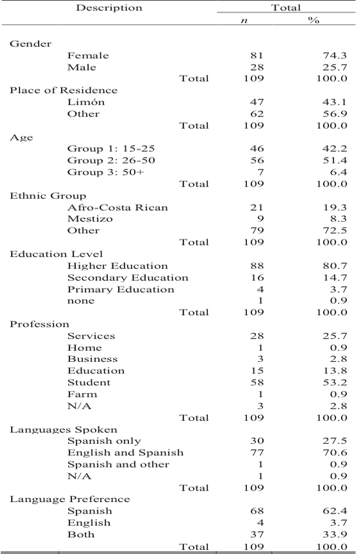
Table 1.
Distribution of participants by demographic data
5.2 Data Collection and procedure
Based on Ladegaard?s (2000, p. 227) call for the use of eclectic methods that ?...[one] could argue, a positive correlation in the quantitative data, as well as a positive relationship between open-ended responses and sociolinguistic behavior, would have provided us with the ultimate support to the tripartite model?, and on Hyrkstedt & Kalaja?s (1998) call for a change in the collection of data and how to analize it, a decision was made to use an instrument that includes both quantitative data and qualitative discourse responses to written stimuli.
These quantitative data were collected via a written questionnaire similar to the one employed by Choi (2003) in her study in Paraguay, and the qualitative data were similar to that used by Hyrkstedt & Kalaja (1998) in their study in Finland. The instrument used to elicit the data in the present study reflects both approaches in an attempt to reach a positive correlation between the two types of data.
5.2.1 Quantitative Questionnaire
The quantitative questionnaire is a series of open-ended questions as well as yes/no questions eliciting attitudes towards each of the varieties of English spoken in Costa Rica. The first eight questions of the questionnaire are background questions to elicit age, gender, economic status via the profession (in Costa Rica social and economic status can be perceived by the profession because the minimum wages per profession are government regulated), place of residence and for how long they have lived there, and languages spoken (see Figure 4).
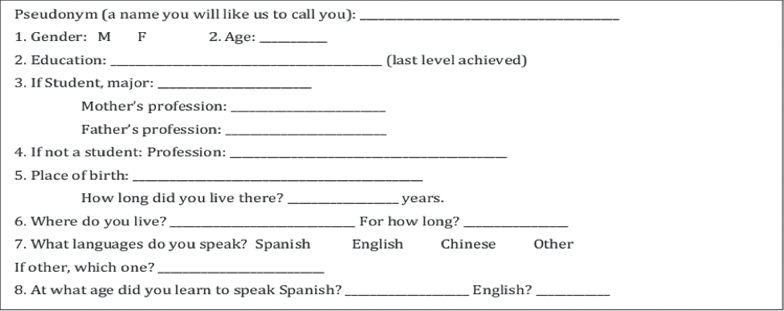
Figure 4.
Quantitative questionnaire: Background and general information
In this questionnaire the name or pseudonym was elicited in order to see how attitudes towards a specific variety are reflected through the use of identity. The expectation being that more positive attitudes toward one language (Spanish or English) would trigger the use of more traditional names in that language, which is an attitude worthy of consideration.
Questions nine through thirteen were designed to elicit attitudes via open-ended questions, towards English or Spanish. The latter being the official language of the country, and the former the language under inquiry in this study (see Figure 5).

Figure 5.
Quantitative questionnaire: Spanish/English language selection and attitudes
Two more questions were presented to the participants. These last two questions are related to choices and attitudes towards varieties of English. Question number fourteen tries to elicit a choice between the variety of English spoken in Limón and the ones believed to be the expanding circle varieties in Costa Rica (i.e. British or American English). Question number fifteen is set to elicit attitudes towards the variety spoken in Limón, and how it is perceived by the respondents (see Figure 6).
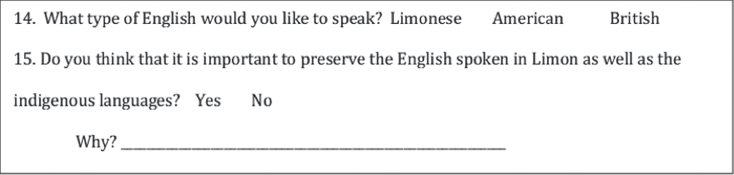
Figure 6.
Quantitative questionnaire: Attitudes towards specific varieties of English
These qualitative data were gathered through essay-writing in response to written stimuli. Participants were asked to respond to a position-argument about language perception, language policies and globalization. These passages were constructed taking either a negative position committing all of Kachru?s ( 1990) attitudinal sins (see Figure 7) or a positive position calling for the bringing of the inner circle variety to the status of an official language in Costa Rica (avoiding the sins) (see Figure 8).
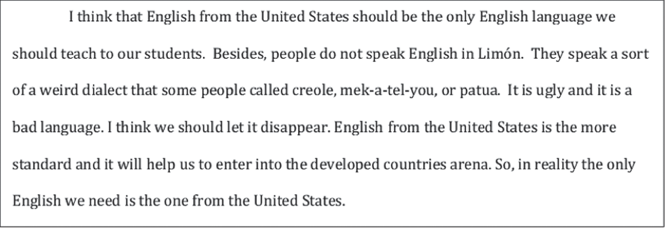
Figure 7.
Qualitative questionnaire: Scenario 1: Negative position essay towards the inner circle variety
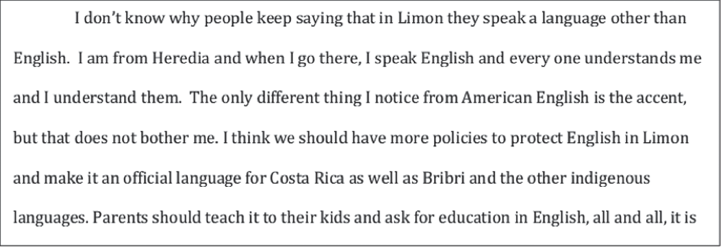
Figure 8.
Qualitative questionnaire: Scenario 1: Positive position essay towards the inner circle variety
Several known social perceptions were chosen to appear in scenario one because it is expected for such perceptions to trigger strong positive or negative attitudes and points of view towards the statements in it. Scenario one is framed within a negative attitude towards Limonese English yielding a rich source of attitudes for the analysis.
Scenario two was constructed to trigger strong positive or negative attitudes and positions as well, but it is framed within a very positive attitude towards the relationship of both varieties. The writer is said to be from a part of the country where the expanding circle variety is spoken. It was hoped that this characteristic would trigger perceptions and attitudes towards both varieties spoken in the country. Both scenarios were created to elicit attitudes and perceptions that may not appear in closed-question surveys.
Because people?s choices reflect attitudes towards a language, in this case English or Spanish, participants were given the opportunity to choose between a Spanish version and an English version of both questionnaires. This also highlights the degree of confidence the participants had towards their language abilities. Participants were asked to write as much as they would like. The questionnaire is accompanied by a set of instructions guiding participants through the task.
5.3 Data coding and data analysis
Due to the eclectic methodology of this study, all data were analyzed in a succession of steps to provide evidence of reliability of the analyses performed. Thus, results from the quantitative data were compared to results of the qualitative data from the essays. The quantitative data analysis was followed by the qualitative data analysis.
A quantification of questionnaire data was carried out and data were presented in raw scores and percentages form to describe the population (see Table 1 above). Responses given to the quantitative questions of the questionnaire were also tallied. A MANOVA was carried out to detect differences in the responses according to three different dependent variables in the overall essay attitude, type of English to learn, preservation of LE, and preservation of indigenous languages as well as the independent variables of gender, age, ethnicity, education, profession, language spoken, and language preference. All, but one variable was naturally categorical. Age was divided into three major groups (Group 1= 15-25, Group 2 = 26-25 and Group 3= 50+) to represent three different generations, and to make easy comparisons with other sociolinguistic studies.
A logistic regression utilizing a VARBRUL analysis through GoldVarb_2001 for Windows was performed. Results from this analysis show factors that predict the source of negative/positive attitudes encountered in the data with their corresponding log-likelihood and significance level. It also provides their probability weights. A probability weight of more than .5 favors/predicts the appearance of the application value set from the dependent variable while weights of less than .5 disfavors/predict the absence of it. This type of analysis has been used in studies within the variationist sociolinguistic framework (Díaz-Campos, 2003, 2004; Labov, 1972a; 1972b, among others). The information yielded by this type of analysis has helped move the variationist sociolinguistic field forward towards more precise accounts of language variation and change.
Thus, this type of analysis was selected to be able to quantify attitudes encountered in each of the respondents? essays. Coding was done based on the premise that ?a person?s attitude towards English is not necessarily a stable entity? (Hyrkstedt & Kalaja, 1998, p. 354), and the fact that within each participant?s essay, several attitudes may be found. This characteristic of the essay response makes it difficult to find a unified response within each essay. Accounting for the different attitudes found in each essay is a way to find all possible attitudes held by the participant, both overt and covert. Overt attitudes are defined as those that are clearly marked by the speaker´s intent and wording of a comment. A covert attitude is defined as those used as a justification for a specific overt attitude. Covert attitudes are part of the speaker?s opinion towards a language. These attitudes represent the population?s beliefs towards language. Therefore, a complex system of positive and negative attitudes is expected to be present within each essay. Such complexity may only be accounted for by analyzing each comment separately.
Thus, for this analysis a binomial dependent variable was created. The variable was defined by positive or negative attitude towards Limonese English. Positive attitudes include any comment in favor of Limonese English, any statement putting Limonese English at the same level as that of American or British English, any clear statement for the preservation of Limonese English, or any cultural comment that favors Limonese English. In opposition to positive attitudes, negative attitudes include any comments in favor of American or British English, any preference for the preservation of indigenous languages above Limonese English, any comments or descriptions of Limonese English that are not founded in empirical evidence (i.e. stereotypes), and any negative comment towards the Afro-Costa Rican culture.
The coding of each essay was done in three steps. The first was to identify covert and overt positive and negative attitudes towards the language within each essay. Attitude stands were grouped as positive or negative. All positive and negative attitudes were counted and totaled. The second step was to analyze each essay to account for distinct positions and beliefs towards language in order to find an overall positive or negative stand. The score was based on the total number of covert and overt attitudes found via a simple majority method. Essays that had more positive attitudes than negative ones were coded with an overall positive stand and vice versa. In cases where a tie was found, the essay was read one or two more times to account for the speaker?s overall intention. The researcher?s interpretation of the intention of the participant was the key point to give the final overall essay stand. This categorization serves as a point of departure for the quantification of the attitudes present in an essay. Figure 9 shows an example of the coding scheme used for each essay.
he third and last step was determining the qualitative nature of each essay. Because of the unique language situation, and by following the example of Hyrkstedt & Kalaja (1998), essays were categorized into interpretive repertoires. The repertoires were compared to one another in search of dichotomies in the attitudes present in the discourse, and then classified as representing negative or positive attitudes.
Results from the different analyses were used to account for the interactions of participants? attitudes towards the different varieties of English in Costa Rica, and how these social perceptions affect their view of each one.
6. Results
6.1 Quantitative analyses
Each of the following analyses is accompanied by a description of the variables and their coding with results presented accordingly.
6.1.1 Name/Pseudonym
Due to the substantial amount of missing data with respect to the name/pseudonym variable, no analysis could be carried out. However, an overview of the responses shows that participants often chose names related to their real names or popular nicknames that show no language-related preference.
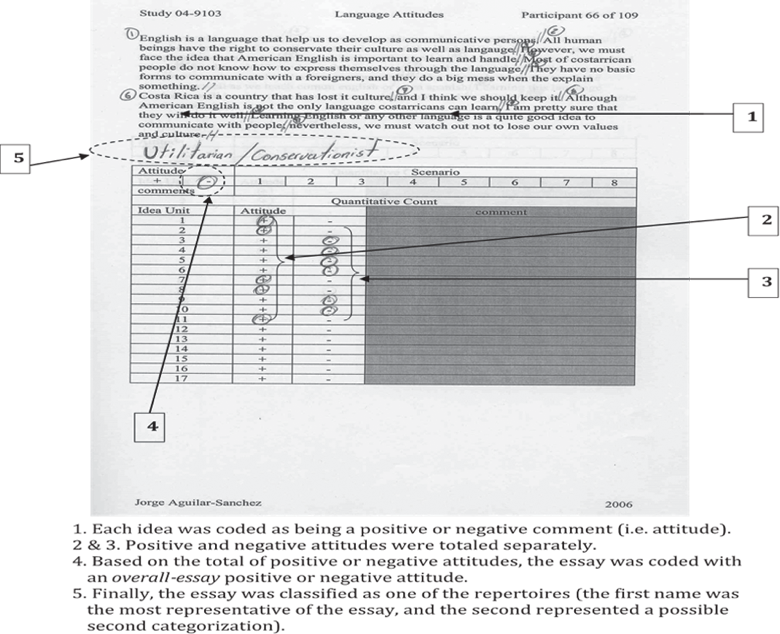
Figure 9.
Coding scheme sample
6.1.2 MANOVA
Four dependent variables were included in this analysis. The first was the overall essay attitude. The second was the language in which the participant would like to receive further education. The third was LE preservation. This third variable indicates whether participants support the preservation of Limonese English or not. The fourth variable was Indigenous Languages preservation. As with variable three, this variable shows whether or not the participant supports indigenous languages preservation. The independent variables included in this analysis were gender, age, ethnic group, education, profession, spoken language and language preference (see Table 2 above for details).
The MANOVA analysis yielded the following results: significant differences among groups were found for age (F= 2.788; df= 8, 158; p= .006), for education (F= 3.225; df= 8, 158;
p= .002), for profession (F= 1.695; df= 20, 324; p= .033), for spoken language (F= 2.630; df= 4, 78; p= .041), and for the interaction of education and language preference (F= 2.489; df= 8, 158; p= .014).
The effects of the test between subjects reveal that with age the only significant differences are found in the dependent variables overall essay attitude (F= 3.571; df= 2; p= .033) and for the preservation of LE (F= 7.089; df= 2; p= .001). In these groups, it was found that the age group 2 (26-50) behaves differently than groups 1 (15-25) and 3 (50+). Group 2 carries more negative attitudes towards Limonese English than those of the other groups (see Table 2).
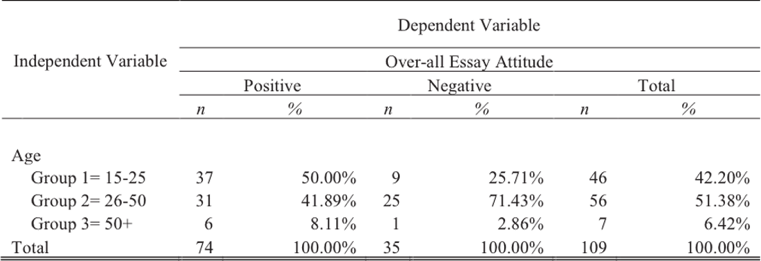
Table 2.
Overall Essay Attitudes by Age Group
In terms of the LE preservation by age group, these data show that age groups 1 and 2 are significantly different from one another (p= .001), but neither is significantly different from group 3. Age group 2 also shows a negative attitude (about 20%) towards the preservation of Limonese English. Table 3 shows the preference, by age group, for the LE preservation.
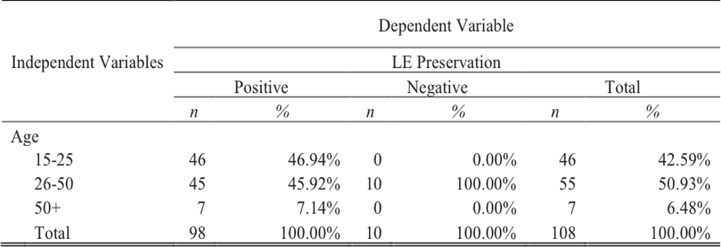
Table 3.
LE Preservation by Age Group
The level of education had a significant effect on Indigenous Languages Preservation (F= 6.809; df= 2; p= .002). Table 4 shows that people who had only attended primary school held negative attitudes towards the preservation of indigenous languages while people with a university background registered a lower percentage of negative attitudes towards the preservation of indigenous languages.
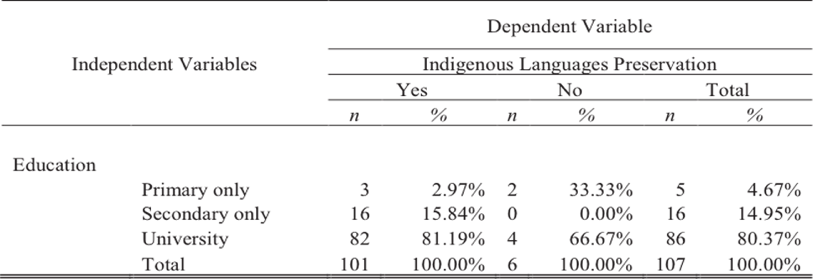
Table 4.
Indigenous Language Preservation by Age Group
The profession of the participants also revealed significant differences for the dependent variables LE preservation (F= 2.814; df= 5; p= .022) and for indigenous language preservation (F= 2.928; df= 5; p= .018). These results show that indigenous languages attracted a more positive attitude than Limonese English.
Tables 5 and 6 provide evidence for how Limonese English is subject to more negative attitudes than indigenous languages by people in the professions as well as those in services, farming, and even students whereas indigenous language preservation is subject to more support from these same groups with the exception of services and farmers, which show a low percentage of negative answers.
Spoken Language was also a source of significant differences. Differences are found only for the dependent variables overall essay attitudes (F= 6.799; df= 1; p= .011) and for the indigenous language preservation (F= 4.224; df= 1; p= .043). Table 7shows how monolingual Spanish speakers hold more negative attitude towards Limonese English than bilinguals.
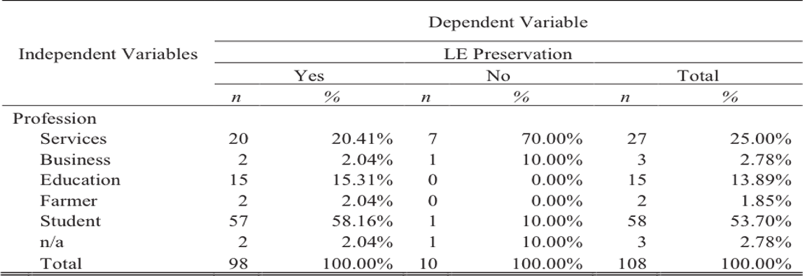
Table 5.
LE Preservation by Profession
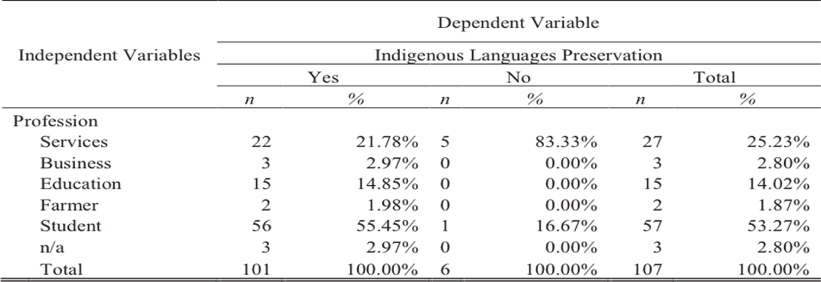
Table 6.
Indigenous Languages Preservation by Profession
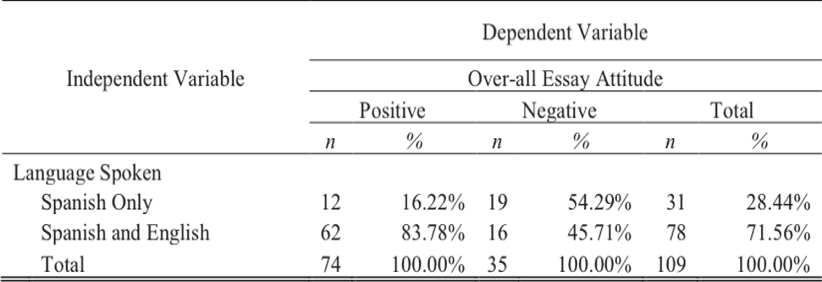
Table 7.
Overall Essay Attitudes by Spoken Language
Table 8shows how monolingual Spanish speakers tend to disfavor the preservation of indigenous languages while bilinguals have a more favorable attitude towards it.
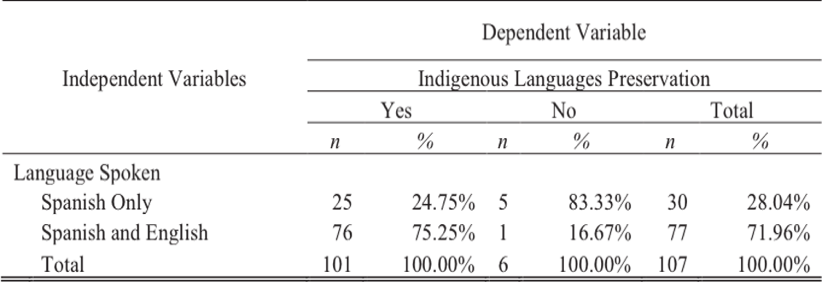
Table 8.
Indigenous Language Preservation by Language Spoken
A significant interaction was found between age and education (F= 3.906; df= 3; p=.012) and between education and language preference (F= 6.382; df= 2; p= .003) regarding LE preservation. The first interaction may be attributed to the stereotypes embedded within the Costa Rican society about Limonese English and the lack of linguistic knowledge in the community. The second may be attributed to the fact that the higher the level of education, the more an individual is in contact with the outer-circle varieties, the more negative attitudes towards the lesser known variety are evident, as pointed out in previous studies ( Herzfeld, 2004; Winkler, 1999). Independent variables such as gender or ethnic group did not yield significant differences in the responses. Nor were there any significant differences on participant responses related to the language of the questionnaire chosen. In sum, attitudes toward Limonese English are varied and come from diverse sources. Table 9 summarizes the following MANOVA results.
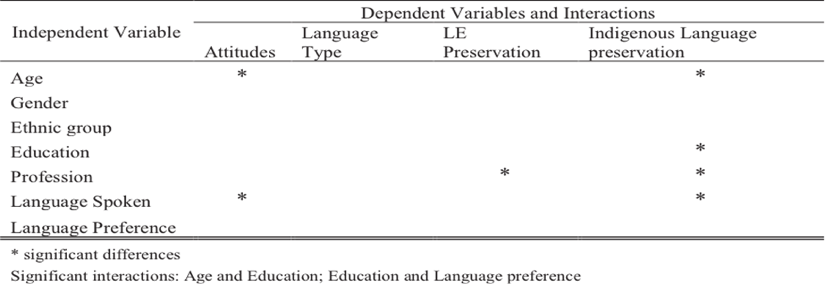
Table 9.
MANOVA Results
6.1.3 Binomial Logistic Regression
Social variables also help predict positive or negative attitudes toward Limonese English. To determine which social variables will help predict positive or negative attitudes toward Limonese English, a logistic regression with the dependent variable defined as positive or negative attitudes was conducted. Every case was accounted for from each of the covert and overt variables found in the essays.
Seven social independent variables were entered, including gender, age, ethnic group, education, profession, language spoken, and language preference.
The VARBRUL analysis was carried out with a negative attitude as the application value. A total of 623 tokens were entered in the regression. From these 623, 211 or 33.33%, were tokens of negative attitudes and 412 (66.66%) were tokens of positive attitudes. All seven independent variables were introduced into the regression analysis. From these seven social variables five were chosen as predictive groups while two others were eliminated in the process with a Log likelihood of -362.879 and a significance level of .005. The variables eliminated in the process were ethnic group and profession. The variables chosen as predictors were, in order of importance, gender, age, education, spoken language, and language preference. These results are similar to those found in the MANOVA analysis as ethnic group seems unrelated to negative attitudes toward Limonese English.
The variable gender was selected as the first predictor. In this analysis males favored negative attitudes towards LE with a probabilistic weight of .613 and females disfavored them with a weight of .460. This finding contradicts those in the sociolinguistic field because women tend to be more conservative when it comes to language change. However, in this case the attitude towards the spoken language was being discussed in the community, and women frequently identify more with their local community than men since they are the ones who spend more time in community activities such as PTA meetings, religious functions, and preparations for local festivities while men tend to be exposed to the other varieties through the job market. That said, this issue requires further investigation. In a sense, it can be claimed that conservatism as shown here is an overall desire for language maintenance.
Age was selected as the second most important factor. As with the results from the MANOVA analysis, the regression age group 1 (15-25) disfavored negative attitudes with a probabilistic weight of .188, followed by age group 2 (26-50), which favored negative attitudes with a weight of .590, and group 3 (50+), which disfavored negative attitudes with a weight of .470.
Education was the third variable to be selected as a predictor. In this group, people with a secondary level of education disfavored negative attitudes toward Limonese English with a probabilistic weight of .300 while people with only a primary level of education favored negative attitudes with a weight of .843, and whereas people with a university education favored negative attitudes with a weight of .525, the people with no education disfavored negative attitudes with a weight of .305.
The fourth group was spoken language. People who spoke Spanish only favored negative attitudes toward Limonese English whereas people who spoke Spanish and languages other than English disfavored negative attitudes with a weight of .266 alongside people who speak Spanish and English who also tended to disfavor negative attitudes towards Limonese English with a weight of .432. These results resemble those found in the MANOVA.
The last variable to be selected was language preference. People who preferred to express themselves in Spanish disfavored (i.e. did not have) negative attitudes with a weight of .435. Bilinguals tended to favor (i.e. have) negative attitudes with a weight of .563. And, people who preferred English to express themselves favored (i.e. have) negative attitudes with a weight of .773.
Because the results in both analyses patterns are similar, they are used as evidence for the reliability of the coding and the validity of the qualitative results that are presented in the following sections.
6.2 Qualitative Analyses: Attitude Repertoires?
Some of these repertoires appear in both negative and positive versions. This was done because the attitudes under study examine two varieties of English, and because there are other languages involved in this contact situation (i.e. Spanish, Chinese, and indigenous languages). For negative attitudes seven repertoires emerged. The first one was the minimizer repertoire. In this repertoire the person did not mention Limonese English at all and tended to avoid talking about it.
Example: Es muy importante hablar el ingles porque costa Rica es muy visitado por Extranjeros y debemos aprender tanto los adultos como los niños para asi poder defendernos en el turismo. Participant: M3NS
It is very important to speak English because Costa Rica is widely visited by foreigners and both adults and children must learn to be able to work in the tourist industry (my translation).
The second repertoire is the utilitarian. In this repertoire, the person talks about the advantages of using American or British English as a means for social mobility and job opportunities.
Example: English in fact is a language that help us to enter into the arena of the develop countries but it is no the most important language and our education should not be in English because our language is Spanish and if we want we can learn a new language. Participant: M1NB
The third is the assimilationist repertoire. Members of this repertoire tend to advocate the assimilation to either American English or British English.
Example: Creo que el ingles de los Estados Unidos deberá ser la única lengua inglesa que deberíamos enseñar a nuestros estudiantes. Además, la gente no habla inglés en Limón. Participant: F2NS
I believe that American English should be the only English language we teach our students. Besides, people do not speak English in Limón (my translation).
The fourth repertoire is the negative linguist. Members of this group gave a detailed explanation of why Limonese English is not a language and why it could never be considered a language.
Example: Personally the first scenario shows a person overwhelmed by the American language and culture, someone whom I would say is in a way a racist person in the way he donnot accept other languages rather then English, American English is the most spoken English in America, but if we look next door, British English is widely spoken in Europe, so I don?t think american Eng. should be the only language to teach at school besides, it is not well taught. Finally just to have in mind that every single English spoken country has its dialectal variations and changes in pronunciation, semantic & grammar, a standard English is the one that combiened let us communicate w/ others. Participant: M1NB
The fifth repertoire is the negative anthropologist. Like the negative linguist, members of this repertoire tended to give detailed explanations of the origins of Limonese English and its culture and why it cannot be considered a language because it is part of a very small group of people.
Example: It is not that in Limon they speak a language other than English, is just that the younger or the youth of these days don?t like to speak English, and their parents don?t speak to them in English and that?s why this kind of creole speaking is in Limón. It would be good to teach them the way to get interested in learning English. The American one or the British one (English) so as to develop their knowledge in the language. Participant: F2BB
The sixth repertoire is the negative practitioner. Members of this group tended to think that even though they speak Limonese English, they should not continue to use it or teach it because it is not proper language.
Example: Well, I really believe that our students should learn as much as they can. Teachers should teach different types of English at the same time because it is no fair that students only study things that appear on a simple book or teachers first explain a couple of basic structures in English. English is so wide and its is going to be better for them and us to make a variety of knowledges from different countries, but speaking of Limon I dare to think, that they have to study more speak better, and going deeply on the language because ?patois? is a dialect and most of ?Limonenses? only understand what they speak each other, they do not know how to write in English correctly that?s my opinion. English is a fantastic thing. It is very nice to use it and speak in a good way but I think as much as a person can learn it it would be easy to practice it for the rest of his/her life. That?s my point of vew. Thanks. Participant: M1NB
The last repertoire is the isolationist. Members of this group believed that Limonese English should stay in Limón and that people should only speak it with their relatives or people of the same race.
Example: Standard English is the one that should be thought in our country. These kind of languages like patua or bribri should be kept too, but just for the people that live there and have to deal with it every day. I have heard people from Limon using their language and I have not been able to understand what they say. I also know that it is very difficult for these people to speak standard English in a proper way. Therefore I think it should be kept just in Limon. Participant: M1NB
For positive attitudes towards Limonese English, eight repertoires emerged. The first one was the equalizer. Members of this group tended to equalize, at all levels, Limonese English to any other variety of English.
Example: El ingles como se le conoce patua como el hablado en Limon C.R. No debería desaparecer o cambiarse por cuanto es parte de la cultura de esta Pequeña Provincia. A Lo a mi parecer lo que deberia enriquecerse mediante talleres o cursos y además por ser criollo o lo que entiendo no se conjuga verbos a diferencia del Inglés Americano. Participant: M2NS
English as we know it, and patua like the one spoken in Limon C.R., should not disappear or change due to the fact that it is part of the culture of that Little Province. To my understanding what we should do is to enrich it through workshops or courses and in addition, because it is a Creole, and from what I understand verbs are not conjugated, which is different from American English (my translation).
The second repertoire is the conservationist who advocates for the preservation of Limonese English as a national and cultural icon.
Example: I?m totally agree with paragraph #2 because it is completely important to keep all the aspects with Costa Rican culture, however if we wan to survive nowadays we must speak north American English, because enough institutions ask for that language. For me it is too sad that every day our own language loses its importance; that?s why we need to work hard for preserving our roots. The United States is part of the world, no the world. Participant: M1NB
The third positive repertoire is the positive anthropologist who advocates for the status of Limonese English as a language because of the history of its speakers.
Example: Well in my Personal opinion I think that United Stated English shouldn?t be the only language because sometimes their don?t speak the correct language. Our dialect that some people called creole should always be their because is our culture but It is very important to learn the appropriate language that is not American language. Participant: F1BB
The fourth repertoire is the nationalist who advocates for the officialization of Limonese English as a national language.
Example: I agree with the second paragraph, because it is incredible that as American as ?ticos? we don?t know our languages as well as we suppose to speak English some day. In fact, the government could implement a program related with the use and ways for how to learn Limonese language, and most of our national languages. Participant: F1NB
The fifth repertoire is the positive linguist who explains why Limonese English is a language like any other language; this repertoire is different from that of the equalizer because the person in this repertoire gives detailed linguistic descriptions of Limonese English.
Example: I am concerned with the fact that what is spoken in Limón is a dialect. It is true is part of the English language, but they have their own characteristics as it or they have as a social dialect. In C.R. people use to diminish their dialect, and say that what they are spoken is not English, but in fact they ignore the fact that it is a dialect. Participant: M2NB
The sixth repertoire is the positive practitioner who is proud to speak and teach Limonese English to the younger generations.
Example: I totally agree with paragraph #2 while I was reading paragraph #1, I was completely upset. I don?t know why there are people who want to eliminate the way Limonese speak. I have a boyfriend who is from Limon, and I speak with him in English. I understand every word he says, we don?t have problems to communicate in English, I think that paragraph #1 is just an unfair way of demonstrate discrimination against black people. Definitely, Limonese must keep the way they speak. They?ve to preserve their roots. Participant: F1NB
The seventh repertoire is the activist who advocates for the rights of Limonese English speakers in order to avoid discrimination.
Example: You must take into account diversity in your perspective. The way you learn to speak certain dialect is kind of a cultural legacy. It is not good to globalize the different dialects of English. In addition, there is not necessary to describe the creole, patua or mek-a-tel-you as ugly or bad language. There are differences to respect, to understand and support. Participant: F1NB
The last repertoire is the educator who advocates for the teaching of Limonese English to all children and at all levels of the educational system.
Example: I?m from Limón, and I think way for from disappearing language, it would be nice to study about this, because its part of our culture, if we do this we will be killing our past and been disrespectful to our ancestors. Our students should know and have the understanding that they are way to communicate, so there is no ugliness in speaking X language; for this we will have to disappear a lot of languages. We must respect each other for what we have. If there could be a way to teach proper Inglish, what is proper Inglish? American, Ingland? Just for development defenetly we should teach the American Inglish; way? because it is a commercial language all of the world. Participant: F3BB
Table 10 below shows the tabulation of the repertoires and the distribution of participants? responses.
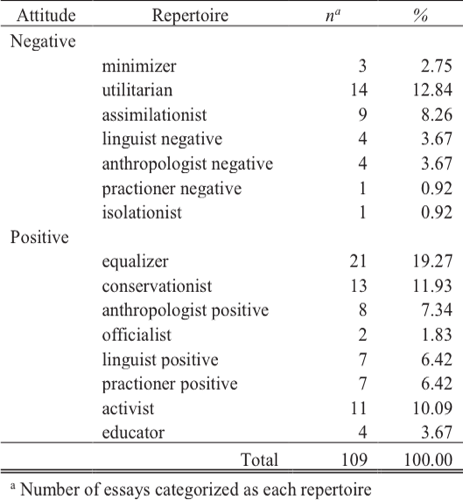
Table 10.
Distribution of Essays by Repertoires
As can be seen from the distribution of the repertoires, negative attitudes toward Limonese English surface in relationship to the use of American and British English in Costa Rican society. Because of the high status of American and British English, Limonese English is classified as non-useful. At the same time, positive attitudes are present in society by those who are trying to elevate Limonese English to the same status of American and British English, and make it a link to the cultural and linguistical heritage of Costa Rica. Preserving it is also seen as a symbol of equality by the speakers of Limonese English.
7. Discussion
To study the attitudes towards these two varieties of English from the perspective of those who speak both, two research questions had to be asked. The first addressed the social perception of the inner circle variety of English in Limón as well as the expanding circle variety of English in the rest of the country to ascertain the attitudes towards these varieties. The second question was whether this social perception resembled the global tendency towards the preference for traditional inner circle varieties (i.e. American or British English).
The results of this study suggest that Limonese English is still regarded as an inferior language by Costa Ricans whereas the use of British and American English is regarded as important for upward mobility and success. However, Limonese English, as can be seen from the generation data on usage places for English, and the fact that about 20% (the largest number) of the essays fall into the equalizer repertoire, is regaining the terrain it once had and is being elevated to the status of an authentic language by its speakers. This may be triggered by the insertion of a lexicalizing variety (i.e. academic English), which benefits the native speakers of English in the region, and seems to be revitalizing the variety of English spoken in Limón. A wider linguistic understanding of the language situation in Limón seems to be growing as a side effect of the introduction of the inner circle varieties for success in the job market. A closer look at the responses to the questions where English is used the most and by whom suggests there is evidence for the proposal of a revitalization of Limonese English. In figures 10 and 11, this propensity by ethnic groups can be observed. Afro-Costa Ricans seem to be using Limonese English in more places and with more people than those reported in previous studies (e.g. Herzfeld, 2004; Winkler, 1999) where it was believed that Limonese English was used strictly at home and for same-race exchanges.
The natural inclination to adopt traditional inner circle varieties for their prestige is present in this context since American and British English enjoy a higher status than Limonese English. Furthermore, they are endorsed by the governmental educationalpolicies.
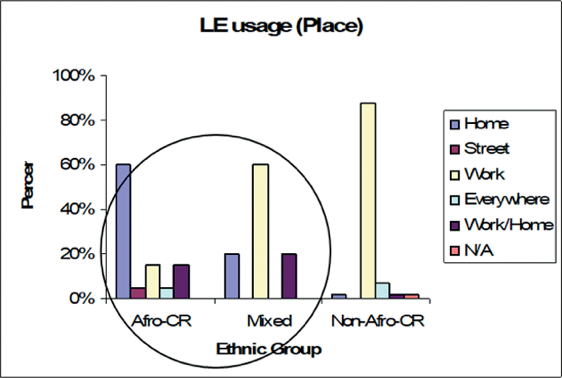
Figure 10.
Places of LE usage by race
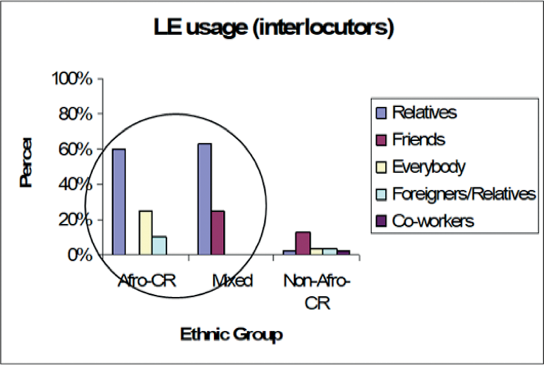
Figure 11.
Interlocutor type of LE usage by race
This study serves as evidence in response to Spence?s (1993) predictions of the future of Limonese English. She postulated two predictions: the total loss of Limonese English and the reverse bilingualism where English takes the place of a second language. Evidence presented here shows that besides reverse bilingualism, a revitalization of Limonese English as a first language is taking place and that people are becoming more aware of the importance of their native tongue.
Furthermore, ethnic group membership does not seem to be a factor that influences language attitudes. However, social factors such as gender, age, education, spoken language, and profession do seem to be strong predictors of negative language attitudes. This may be attributed to the lack of linguistic knowledge that has been prominent in Costa Rica due to monolingual education policies, and the low social status Limonese English acquired after all government-sponsored schooling became Spanish only.
8. Conclusion
The present study was motivated by Ladegaard?s ( 2000) call for the use of eclectic methods, which argue that a positive correlation in the quantitative data, as well as a positive relationship between open-ended responses and sociolinguistic behavior, would provide the ultimate support for the tripartite model; and by Hyrkstedt?s & Kalaja?s (1998) call for a change in the collection of data and its subsequent analysis. It was decided to use an instrument that includes both quantitative data and qualitative discourse responses to written stimuli and methodology, and which includes both quantitative and qualitative data analysis. This eclectic method has proven to be a powerful tool for the understanding of language attitudes at a micro- level (Costa Rica), and it could be extrapolated that its use at the macro-level for the study of language attitudes among other qualitative data would be equally effective.
As pointed out previously in this study, the study of language attitudes is found in two different primary fields of inquiry, social psychology and sociolinguistics. In social psychology, attitudes are studied from the perspective of the importance of perception, which is the foundation of all social constructions, individual and group relationships. Perception reflects the accumulated social knowledge individuals carry with them. An example of these attitudes is when people see dialects as ?better? or ?worse.? This study is an example of how attitudes can be found and quantified by studying the various comments regarding a language that are present in an essay. The results reveal how the perceptions of a society towards its language(s) are sometimes hard to pinpoint. The methodology presented here helps to bring these covert attitudes to light by employing a deeper analysis of participants? essays.
Some of the limitations of the present study are due to the fact that the data collected were written, and participants had a short amount of time to answer. Another limitation is that the sample may not be representative of the population at large. The focus group of the present study was principally prospective and in-service English teachers as well as people from varying professions. However, this sampling serves as a starting point for future studies. Future research should focus on the study of language attitudes found in speech, as well as other types of narratives.
Concerning sociolinguistics, Limonese English seems to be shifting away from its status as a forgotten or limited language to a language whose use may benefit the community both culturally and economically. Culturally, it benefits the community because it may trigger a total revitalization of the English variety found in Limón and its adoption as the language of everyday use alongside Spanish. Economically, it helps because this revitalization of Limonese English and current level of access to the standardized variety through education could help people enter the work force in tourism and other industries like call center management and pharmaceutical manufacturing, which have found a potential source of workers in the region. Hopefully, the results of this work will shed light on the importance of why governments should change and adopt policies that are based on empirical evidence of the linguistic situation of their countries. The gap between research and the real world can be bridged, and erroneous assumptions about languages can be avoided. It is also hoped that this study will serve as a foundation for the construction of such a bridge. Finally, for researchers seeking to study/describe complex linguistic contexts such as the one found in Limón, the present work provides a framework for the understanding of how communities perceive their linguistic situation. Such an understanding leads to the uncovering of covert characteristics of their language that may be hidden behind speakers? attitudes.
References
Aguilar-Sánchez, J. (2005). English in Costa Rica. World Englishes, 24 (2), 161-172.
Battenburg, J. (1997). English versus French: Language Rivalry in Tunisia. World Englishes, 16 (2), 281-290.
Bell, J. (2013). Language attitudes and language revival/survival. Journal of Multilingual & Multicultural Development, 34 (4), 399-410. doi: 10.1080/01434632.2013.794812
Bruthiaux, P. (2003). Squaring the circles: issues in modeling English worldwide. International Journal of Applied Linguistics, 13 (2), 159-178. doi: 10.1111/1473-4192.00042
Bryce-Laporte, R. S. (1962). Social relations and cultural persistence (or change) among Jamaicans in a rural area of Costa Rica. (Doctor of Philosophy). University of Puerto Rico, Puerto Rico.
Cabrera, L., & Ancker, W. (1997). English language education in Costa Rica. Retrieved from http://www.tesol.org/isaffi/affil/profiles/costarica.html (archived)
Chakrani, B., & Huang, J. L. (2014). The work of ideology: examining class, language use, and attitudes among Moroccan university students. International Journal of Bilingual Education & Bilingualism, 17 (1), 1-14. doi: 10.1080/13670050.2012.718319
Cherciov, M. (2013). Investigating the impact of attitude on first language attrition and second language acquisition from a Dynamic Systems Theory perspective. International Journal of Bilingualism, 17 (6), 716-733. doi:10.1177/1367006912454622
Choi, J. K. (2003). Language Attitudes and the Future of Bilingualism: The Case of Paraguay. International Journal of Bilingual Education & Bilingualism, 6 (2), 81-94.
Crezee, I. (2012). Language shift and host society attitudes: Dutch migrants who arrived in New Zealand between 1950 and 1965. International Journal of Bilingualism, 16 (4), 528-540. doi:10.1177/1367006911429523
Dowling, J. A., Ellison, C. G., & Leal, D. L. (2012). Who Doesn?t Value English? Debunking Myths About Mexican Immigrants? Attitudes Toward the English Language*. Social Science Quarterly (Wiley-Blackwell), 93 (2), 356-378. doi:10.1111/j.1540- 6237.2012.00850.x
Edwards, J. (1999). Refining Our Understanding of Language Attitudes. Journal of Language & Social Psychology, 18 (1), 101.
Friedrich, P. (2000). English in Brazil: functions and attitudes. World Englishes, 19 (2), 215.
Garrett, P. (2001). Language attitudes and sociolinguistics. Journal of Sociolinguistics, 5 (4), 626-631. doi:10.1111/1467-9481.00171
González-Riaño, X., Hevia-Artime, I., & Fernández-Costales, A. (2013). Language attitudes of Asturian students in the area of Navia-Eo (Spain). Language & Intercultural Communication, 13 (4), 450-469. doi:10.1080/14708477.2013.785558
Herzfeld, A. (1978). Bilingual Instability as a Result of Government Induced Policies. Retrieved from https://libweb.uwlax.edu/login?url=http://search.ebscohost.com/login.aspx?direct =true&AuthType=ip,uid&db=eric&AN=ED159921&site=ehost-live&scope=site
Herzfeld, A. (1980). Bilingual Instability as a Result of Government Induced Policies. ITL: Review of Applied Linguistics, 48, 3-20.
Herzfeld, A. (2004). Mekaytelyu: la lengua criolla de Limón. San José: Editorial de la Universidad de Costa Rica.
Hyrkstedt, I., & Kalaja, P. (1998). Attitudes toward English and its functions in Finland: A discourse-analytic study. World Englishes, 17 (3), 345.
Infocostarica. (2000). Education in Costa Rica. Retrieved from http://www.infocostarica.com/ education/education.html (archived)
Kachru, B. B. (1984). World Englishes and the teaching of English to non-native speakers, contexts, attitudes, and concerns. TESOL Newsletter, 18, 25-26.
Kachru, B. B. (1985). Standards, codification and sociolinguistic realm: The English language in the outer circle. In R. Quirk & H. G. Widdowson (Eds.). English in the World. (pp. 11-30). Cambridge: Cambridge University Press.
Kachru, B. B. (1990). Native and non-native norms. In B. B. Kachru (Ed.). The Alchemy of English. (pp. 100-114). Urbana, IL: University of Illinois Press.
Kalaja, P. (1997). Language attitudes reconsidered: from cognitive representations to discursive construction. Paper presented at the American Association for Applied Linguistics Annual Conference, Orlando, FL.
Labov, W. (1972a). On the Mechanism of Linguistic Change. In W. Labov (Ed.). Sociolinguistic Patterns. (pp. 167-182). Philadelphia: University of Pennsylvania Press.
Labov, W. (1972b). Sociolinguistic patterns. Philadelphia: University of Pennsylvania Press.
Ladegaard, H. J. (2000). Language attitudes and sociolinguistic behaviour: Exploring attitude- behaviour relations in language. Journal of Sociolinguistics, 4 (2), 214-233.
Lazarus, D. (2002). Universities and Private Language Schools. Retrieved from http://www. fortunecity.com/athena/exercise/2445/id19_m.html (archived)
Meléndez Chaverri, C., & Duncan, Q. (1974). El negro en Costa Rica: antología (2. ed.). San José: Editorial Costa Rica.
Niedzielski, N. A., & Preston, D. R. (2000). Folk Linguistics. Berlin, Germany: Mouton de Gruyter.
Purcell, T. W. (1993). Banana fallout: class, color, and culture among West Indians in Costa Rica. Los Angeles: Center for Afro-American Studies, University of California.
Purnell, T., Idsardi, W., & Baugh, J. (1999). Perceptual and Phonetic Experiments on American English Dialect Identification. Journal of Language and Social Psychology, 18 (1), 10-30. doi: 10.1177/0261927X99018001002
Sallabank, J. (2013). Can majority support save an endangered language? A case study of language attitudes in Guernsey. 34, 332-347. doi: 10.1080/01434632.2013.794808
Simms, E. G. (1990). Un análisis sociolingüístico de las esferas de uso del inglés de Limón en hablantes que residen en San José, Costa Rica y algunas actitudes de los hablantes y de los descendientes de hablantes de inglés de Limón, que no lo hablan, con respecto a esta lengua. (Master?s Thesis), Universidad de Costa Rica, San José, Costa Rica.
Simons, G. F., & Fennig, C. D. (2018a). Costa Rica Languages: Map. In G. F. Simons & C. D. Fennig (Eds.). Ethnologue: Languages of the World. Dallas, Texas: SIL International. Retrieved from https://www.ethnologue.com/country/CR/maps
Simons, G. F., & Fennig, C. D. (2018b). Costa Rica: Languages. In G. F. Simons & C. D. Fennig (Eds.). Ethnologue: Languages of the World. (21 ed.). Dallas, Texas: SIL International. Retrieved from https://www.ethnologue.com/country/CR/languages
Simpson, J. (2013). What?s done and what?s said: language attitudes, public language activities and everyday talk in the Northern Territory of Australia. Journal of Multilingual & Multicultural Development, 34 (4), 383-398. doi: 10.1080/01434632.2013.794811
Spence, M. J. (1993). A Case Study of Language Shift in Progress in Port Limón, Costa Rica. (Doctor of Philosophy), Georgetown University, Washington, D.C. Retrieved from http://gateway.proquest.com/openurl?url_ver=Z39.88-2004&res_dat=xri:pqdiss&rft_ val_fmt=info:ofi/fmt:kev:mtx:dissertation&rft_dat=xri:pqdiss:9410349
Thomason, S. G. (2001). Language contact. Washington, D.C.: Georgetown University Press.
Thumboo, E. (2003). Closed and open attitudes to globalised English: notes on issues. World Englishes, 22 (3), 233-243. doi: 10.1111/1467-971X.00293
Winford, D. (1997). Re-Examining Caribbean English Creole Continua. World Englishes, 16 (2), 233-279.
Winkler, E. G. (1999). Limonese Creole: A Case of Contact-Induced Language Change. (Doctor of Philosophy). Indiana University, Bloomington, IN.
Notes
