Editorial

Esta obra está bajo una Licencia Creative Commons Atribución-NoComercial-CompartirIgual 4.0 Internacional.
Recepción: 04 Noviembre 2021
Aprobación: 02 Marzo 2022
DOI: https://doi.org/10.15765/pnrm.v15i29.3122
Abstract: School practicums constitute a fundamental element in the initial training of future teachers. They are an opportunity to contrast – in a real and practical environment – the knowledge and skills that have been acquired and developed in the framework of their career’s subjects. This study aims to address the transfer of theoretical knowledge to practical knowledge while in the practicum centers (also, internship centers), from the perspective of students enrolled in the program of primary education at Universidad Internacional de Valencia. Their perception of transferability, as well as what type of knowledge and skills are transferred the most to the learning experience during this process will be analyzed through students’ internship reports. Results indicate that students perceive knowledge is indeed transferable, and that contents of psychological and pedagogical subjects are the most commonly transferred while in the practicum at the internship centers.
Keywords: Teacher training, pedagogical practice, knowledge transfer.
INTRODUCTION
In the context of any discipline and, therefore, of any university degree, the practicum (a process that resembles an internship) constitutes the point of union between the educational institution and the reality of work. This context is, therefore, the time and place where university students can put into practice and verify the applicability and transferability of the knowledge and skills associated with the performance of their profession and within the framework of the curriculum. From this perspective, it is a training period of indisputable utility and a key element in students’ professional training. One of its greatest potentials lies in the fact that it is “destined to enrich training by complementing academic learning (theoretical and practical) with experience (also formative, i.e., linked to learning) in workplaces” (Zabalza, 2006, p.314). This approach is based on the complementarity in which practicums create experience in real contexts where students may implement theoretical skills and learning, thus, one could not exist without the other. In teaching curricula, the practicum has traditionally been regarded as an element of the utmost importance (Saiz-Linares & Ceballos-Lopez, 2019; Vaillant & Marcelo, 2021). Consequently, its inclusion is regulated in the structure and contents of university education.
This study is contextualized in the university degree of primary education teaching, regulated by the ECI Ministerial Order 3857/2007, of December 27, which sets forth the requirements for the verification of official university degrees that prepare students to become primary education teachers. It specifies, among other things, competencies that are associated with internships, such as: relationship between theory and practice, acquisition of practical knowledge of the classroom and its daily management, teachers’ participation based on know-how, and practice-based reflection. These approaches will serve as the basis for the development of this study, which will focus on the analysis of the knowledge transfer from theory to practice while in the practicum in the internship centers.
In the case of teaching degrees, its associated ECTS credits usually represent around a quarter of the entire degree at European level (Eurydice, 2013), coinciding with the dedication regulated by ECI Ministerial Order 3857/2007 in our country. Along these lines, the university degree of primary education teaching at Universidad Internacional de Valencia has four internship cycles, with a total of 41 associated ECTS credits, divided as follows:
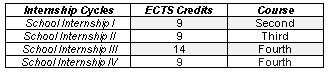
Table 1
Internship Cycles, Associated ECTS Credits and Courses Where they are Integrated
Compiled by the authors, 2021
The internship cycles are divided between the second, third and fourth years of the program. It is not considered appropriate to undertake an internship in the first year because a basic foundation is required prior to having students join the internship center, in order to enable knowledge transfer and skills. This topic has been a source of concern for authors such as Manso and Martin (2014), who state that internship cycles should not be relegated to the end of theoretical training, but that it would be ideal to develop these two elements in a connected and simultaneous way throughout, to facilitate students’ assimilation.
On the other hand, it is important to highlight that the objective of each internship cycle is different, considering the gradual nature of the learning process in the different courses. While School Internship I is oriented towards the observation and knowledge of the school context, School Internship II aims at active participation in teaching tasks. On the other hand, both School Internship III and School Internship IV seek student participation beyond teaching, focusing on project design and didactic programming, respectively.
This planning is the result of the progression of student learning and capacity, not only to analyze contexts and teach, but to plan teaching and learning processes with more robust criteria. All these issues must be contextualized with the rest of the subjects that are part of the curriculum of the university degree of primary education teaching. It is a curriculum consisting of 60 ECTS credits of basic training (10 subjects), 100 ECTS credits of compulsory training (14 subjects), 30 ECTS credits of optional nature (5 subjects), 41 ECTS credits of external internship (4 subjects) and 9 ECTS credits associated with a graduation project (1 subject).
Finally, addressing the phenomenon of knowledge transfer, we must assume that the fact that internships offer the possibility of participating in a professional context based on the knowledge and skills proposed in the curriculum of a given degree, turn this experience into a resource aimed at generating greater integration between theory and practice (Zabalza, 2016).
From this perspective, theory could be considered the formal knowledge that derives from the different subjects that are part of the program. While practice, for its part, could be understood as a set of acts of an applied nature involving, e.g., decision-making and problem solving. It is related to knowledge that has to do with reality and, a priori, knowledge that is more useful, immediate, functional and day-to-day (Saiz and Susinos, 2018). This difference between theory and practice is directly linked to the two spaces where training action occurs, with universities and internship centers being the two contexts where two different a priori types of learning materialize.
Based on this, it can be said that there is some controversy between the way in which students' learning is articulated and if the skills they develop – in one space or another – can be considered independent or complementary elements. Aware that internships are a multidimensional phenomenon where variables such as the figure of the tutor (Colomo & Gabarda, 2019) or the student (Gabarda & Colomo, 2019) cannot be ignored, the focus is on the perception of the latter. Previous research shows, from a theoretical perspective, that the practicum plays a fundamental role in associating initial training (more theoretical and linked to the university) with another that is more practical and related to the internship centers (Aguilar, 2017; Gonzalez et al., 2017; Mena et al., 2019; Tejada et al., 2017). In this case, we cannot ignore that the internship cycles favor the interrelationship between the training and the productive environments, since they put the student in contact with professional reality (Arias et al., 2017). On the other hand, the significance of practical training is undeniable. From this perspective and aligned with the theses of Sepulveda et al. (2017), it is understood that “professional knowledge is constructed with practice, not theory” (p.94). However, a direct relationship between the process at the internship center and a transfer of previous knowledge cannot be anticipated.
In fact, there are a number of factors that can favor or hinder this transfer (Egido & Lopez, 2016; Gairin et al., 2019; Tomàs-Folch & Duran-Belloch, 2017). One of the basic problems is the definition of practicum itself. If there is no alignment between the student's process while at the center and the rest of the curriculum. It could be that none of the agents understand its meaning and, therefore, it will not entail learning and a positive experience for any of them (Zabalza, 2011). Another unquestionable condition for transferability of the results lies in the suitability of the internship center, as well as the attitude and aptitude of its agents. On the one hand, it is essential that those responsible for the institution understand the academic scope of the module and, for this, it is essential that the university is capable of clearly transferring information to the institution through the most appropriate channels. Only this way will schools be able to respond to the proposed training purposes (Zabalza, 2016), communication problems between institutions can be overcome (Colen & Castro, 2017), and adequate mechanisms can be established for the connection between them (Valle & Manso, 2018). A noteworthy figure is the tutor in the center, as it constitutes another crucial element in the student experience. Not only is it essential that they have precise information or that they have the ideal profile (in terms of training and experience), but, due to the idiosyncrasy of their own role, it is the model on which the student will materialize the future profession (Egido & Lopez, 2016; Gonzalez et al., 2017; Villalta & Martinic, 2020), while additionally being a key support figure (Bernardez-Gomez, 2021). In this sense, it is critical for students to have sufficient critical capacity to be able to assess the actions of the tutor with certain criteria, so that they can build their own professional identity (Colomo & Gabarda, 2021).
Several theories have tried to explain the gap between theory and practice (Alvarez, 2015). One of them highlights the lack of clear definition of what the concepts themselves are, which makes it difficult to reach an academic consensus on how to tackle the gap. Likewise, this can be explained by the fact that both types of knowledge have been based and led in different places and by different agents. In this way, “as long as the university continues to be the place where knowledge is acquired and the school the place where said knowledge is applied and practiced, a theoretical-practical articulation will hardly be achieved” (Colen & Castro, 2017, p.71).
Therefore, it is necessary to design and implement strategies that allow us to establish a connection between theory and practice, overcoming their dichotomy (Sepulveda et al., 2017), boosting the student's reflective activity in the real context (Martin et al., 2021) and considering that this confrontation can drive the transformation of the pedagogical practice (Merida-Serrano et al., 2020).
If specific attention is given to teachers in training – precisely the axis of study of this work –, this lack of connection between theory and practice is especially relevant seeing as there are practicing teachers who believe that their initial professional training was inadequate to deal with the complex nature of their work (Bustos, 2021; Prats, 2019). The importance of this aspect is not trivial, on top of the impact of students' beliefs, customs and misunderstandings on internships (Arco et al., 2021; Alvarez, 2015), we must add that an unsuccessful transfer of what has been learned can generate feelings of disappointment, insecurity and meaninglessness (Colen & Castro, 2017). From this perspective, Montero (2018) concluded that, within the framework of the training of future teachers, the gap between theory and practice is evident, and that the divergence between different knowledge, people and contexts that converge in the practicum constitutes one of the main obstacles to the connection between the two. More convincing are the results of the study by Ruiz-Bernardo et al. (2018), where “there is hostility and an averse attitude from students towards the theory learned in the theoretical training courses offered during the career” (p.43), resulting from the disconnection and the uselessness in the internship transfer. However, there are studies that endorse knowledge transfer while at the internship center, especially those linked to the aspects of organization and functioning of educational institutions and classroom management (Arco et al., 2021).
The analysis of these contributions provided insight into the approach of other authors regarding the phenomenon being studied. Subsequently, it can be identified that the main objective of this work is to know the perception of internship students in the university degree of primary education teaching pertaining to the transferability of theoretical knowledge in their internship. This exploration will approach some secondary objectives:
- To analyze the possibilities of transferring theory to practice.
- To analyze what knowledge and skills are transferred the most during internships.
- To identify different perceptions depending on the internship cycles taken and the nature of the subjects.
METHOD
Approach
This study follows a mixed methodology, integrating quantitative and qualitative approaches in order to address the phenomenon being studied in a more holistic way and, therefore, gain greater understanding of the phenomena studied (Hernandez et al., 2014; Sánchez, 2015).
Sample
Non-probability sampling (for convenience) took place among 230 students enrolled in the university degree of primary education teaching at Universidad Internacional de Valencia, in the 2017-2018 academic year. These students completed one of the four internship cycles. In terms of gender, 83.48% (192) were women and 16.52% (38) men, with an average age of 31.42±3.62 years.
Instrument
Information collection will be based on the internship reports that students provided as evidence to pass the subject. This element has already been used in previous research (Colomo & Gabarda, 2019; 2021). In terms of the reports’ segmentation per internship cycles, the analysis was conducted on 28 reports of Internship I (12.2%), 57 reports of Internship II (24.8%), 80 reports of Internship III (34.8%), and 65 reports of Internship IV (28.3%). The reports were made up of four different blocks (Description of the internship center, Student’s activity in the center, Critical reflection on practices, and Self-evaluation). This study used a question that is part of the Critical Reflection on Internships as a foundation, contemplating that reflection allows us to link previous knowledge with lived experience (Sunday, 2018). Specifically, an analysis of the item “Relationship of the tasks performed with the knowledge acquired in university studies” was proposed, considering that it is a suitable element to assess the transferability of theory to practice.
Procedure and Analysis
Content analysis was the selected method, reading and interpreting the internship reports gave meaning to students' reflections regarding transfer between the theory learned during the career and its practical application.
On the other hand, in order to respond to the suggestions of this study and to reinterpret the guidelines of ECI Ministerial Order 3857/2007, the subjects were classified in six blocks depending on their nature to undertake the analyses and quantification: 1) Psychological subjects; 2) Curricular discipline subjects; 3) Subjects for the didactic application of the disciplines; 4) Pedagogical subjects; 5) Socio-educational subjects; and 6) Subjects with special emphasis:
- Psychological subjects are those that go deeper into students’ cognitive, emotional, psychological, motor and social development, as well as its implications in their learning process. This block would include developmental psychology and school education, psychological techniques for conflict resolution in the classroom, social skills and emotional intelligence, and learning difficulties and developmental disorders.
- Subjects of curricular discipline are cover the foundations of the different areas that are part of the curriculum of the primary education stage. These subjects would include Spanish language, mathematics, natural sciences, social sciences, art education, physical education and English I and II.
- Subjects for the didactic application of the disciplines have the objective to provide students with skills for programming and designing didactic proposals for subjects of curricular discipline. Therefore, the subjects of didactics of mathematics, didactics of natural sciences, didactics of social sciences, didactics of art education, didactics of physical education, and CLIL (English as a vehicle language in integrated content and language learning) would be included.
- Pedagogical subjects are intended to train students in basic foundations associated with the teaching function in different stages. This block includes the subjects of general teaching, ICT in education, organization and management of centers and methodology for research and educational innovation.
- Socio-educational subjects are oriented towards the study of students’ personal and social relationships with the environment. This block includes the subjects of family and school, religion, culture and values, and human rights and education in a globalized world.
- Finally, subjects with special emphasis are associated with different specializations and are optional. In this case, they entail foreign language emphases: English, Information and Communication Technologies, music education and Valencian language.
First, a qualitative analysis was conducted on the students' written answers to one of the items that are part of the internship reports. Using interpretative techniques, the objective of this analysis was to extract information that would demonstrate students' perceptions about the knowledge transfer from theory to practice. Subsequently, a quantitative analysis was conducted to the references that the students made of the subjects whose contents they were able to transfer to practice. In this way and with a descriptive approach, it was possible to state the frequency with which students report having translated into practice the approaches of a given subject.
With all this, the approach of the study will make it possible to verify the transfer between theoretical knowledge and its practical application, extrapolating it to any other context and university curriculum program following the proposed procedure.
RESULTS
In line with the two types of methodologies used, the results of the study are presented below. First of all, attention is paid to the interpretation of the students' ideas of the possibilities of transferring knowledge and theoretical skills within the framework of internships at the centers. Subsequently, the frequency with which internship students refer to the different subjects that make up the curriculum is described in reference to their transfer to the internship cycles .
In terms of information analysis and interpretation, it is based on students’ statements about the relationship between the tasks performed in the internship center with the knowledge acquired in university studies. This interpretation will allow us to confirm the likelihood of the existence or not of transfer from theory to practice.
Evidence can be seen about the connection between theory and practice. In line with the theses of Poveda et al. (2020), internships constitute a space where students can identify and apply knowledge and skills developed within the framework of more theoretical training, giving it meaning, utility and everyday life (Saiz & Susinos, 2018):
“Thanks to these practices, I can be more aware of what they teach me at the university, and I consider that they are a fundamental part of the experience to be more effective as a future teacher” (S.3).
“The internship center makes sense of all the learning that seems disconnected and sometimes unproductive, it helps you value everything you have and are studying” (S.35).
“Teaching internships are key in the training of future teachers, since they help connect the theoretical knowledge acquired in the degree with the exercise of teaching” (S.37).
In this sense, internships become the space where professional learning is consolidated (Arias et al., 2017; Tejada et al., 2017), and the experience highlights the nuance that part of professional knowledge is constructed precisely from practice (Sepulveda et al., 2017):
“Finally, it should be said that the internships have allowed me to experience the profession” (S.92).
“The internships have given me a vision of the profession that cannot be perceived while attending classes.” (S.76)
“Internships are necessary and indispensable to relate the knowledge acquired during the career to the daily life of the profession.” (S.112)
On the other hand, as pointed out by Arco et al. (2021) and Alvarez (2015), internship help students challenge their beliefs and misunderstandings about the reality of the educational context:
“This will lead us to face an exercise in introspection, in which we must make our perspective more flexible and adapt it based on what we thought we would feel, in order to begin to reflect on how we feel, how we face daily life and where we want to go.” (S.26)
“Throughout my university years, I have acquired theoretical knowledge, which at first I thought would be of no use, since I would forget much of the knowledge learned.” (S.98)
It is also noteworthy that, as stated by Colen and Castro (2017), students experience positive feelings if they are able to transfer knowledge and relate theory to practice:
“I am very happy to have been able to put into practice what I studied in class.” (S.13)
“Primary education internships have been very enriching, since I have had the opportunity to put into practice the knowledge acquired during undergraduate studies.” (S.183)
However, as Montero (2018) pointed out, students do not always think that knowledge transfer from theory to practice is possible, showing a likely rupture:
“Most of the theoretical subjects in the career have not been useful to me when it comes to my internships.” (S.42)
On other occasions, it is not conceivable that there is no relationship between theory and practice, yet theory is not enough to deal with the concrete situations encountered by students in an internship, as explained by Zabalza (2011):
“There is a long way from theory to practice; in theory there are no problems to solve, but in practice there are.” (S.1)
“I always had the feeling that I lacked knowledge to be able to support my personal opinions.” (S.75)
“In my view, some subjects should focus more on what happens in a classroom, because after my internship experience, I have to say that much of what I have lived cannot be learned in books, articles or seminars.” (S.216)
In accordance with the theses of Egido and Lopez (2016) or Gairin et al., (2019), the conditions that affect the transfer are of various kinds. Sometimes, there are contextual elements, such as the lack of resources in schools or the attitude of the tutor who accompanies the student:
“It's one thing to study and know the theory, but then in the internship it's very difficult, since unfortunately there aren't enough resources.” (S.139)
“I think I have had little room to maneuver to be proactive. My tutor would rather have me observing, even though it was my third internship.” (S.163)
After analyzing the possibilities of transferring knowledge and skills from theory to practice, the following is an explanation of which subjects are transferred to a greater extent by students. In this sense, Figure 1 shows the frequency of references to the different subjects that students take in their internship reports, from higher to lower.
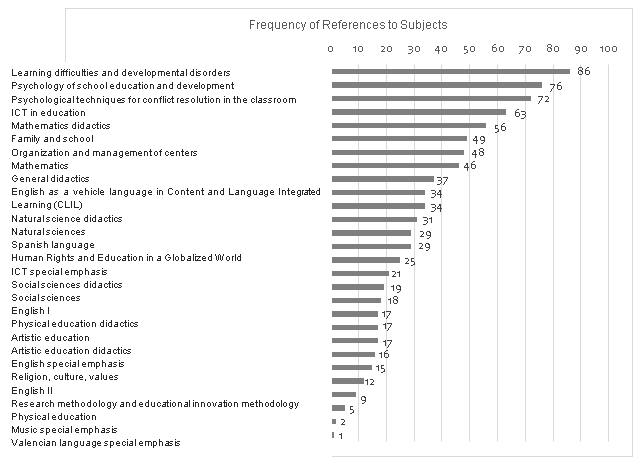
Figure 1
Frequencies of References for the Different Subjects in the Internship Reports
Compiled by the authors, 2021
As can be seen, the subjects that students take most often from theory to practice are learning difficulties and developmental disorders (86 references), developmental and educational psychology (76 references) and psychological techniques for conflict resolution, social skills and emotional intelligence (72 references). Followed by ICT in education and mathematics teaching, with 63 and 56 references, respectively. On the other hand, with a smaller number of references, are the special emphasis in Valencian language (1 reference), the special emphasis in music (2 references), the physical education subject (5 references), research methodology and educational innovation (9 references) and English II (12 references).
Moreover, if we analyze the data according to the students’ internship cycles, we can see that there are no notable differences. Let us recall that the Internship I cycle is proposed in the second year, the Internship II cycle in the third year and Internship III and IV in the fourth year. Tables 2 and 3 show the ten subjects with the highest number of references per internship cycles:
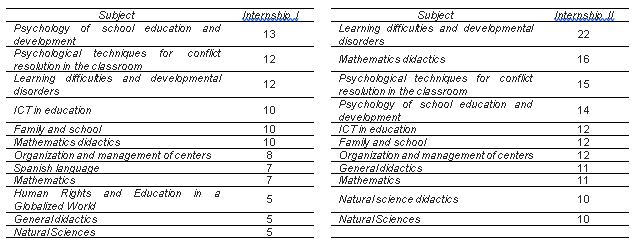
Table 2
Subjects with a Larger Number of References in Internships I and II
Compiled by the authors, 2021
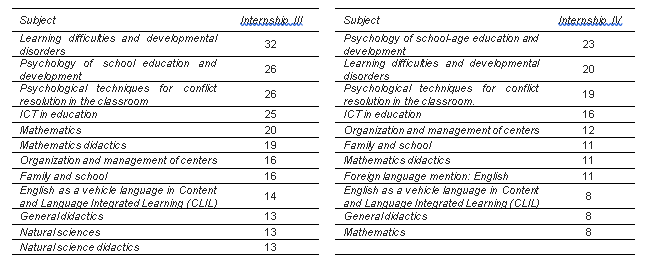
Table 3
Subjects with a Larger Number of References in Internships III and IV
Compiled by the authors, 2021
As can be seen, the four internship cycles have a lot of coincidences in the subjects that have been able to be transferred more frequently, with slight nuances depending on the cycles. While in Internships I, III and IV, the same subjects occupy the first three places, although in different positions (psychology of education and development at school age, psychological techniques for conflict resolution, social skills and emotional intelligence, and learning difficulties and developmental disorders), in Internship II psychology of education and development at school age is replaced by didactics of mathematics.
If we look at the course in which the different subjects are located in the curriculum, it cannot be said that there is a greater applicability than those that are carried out in the internship. An example of this is that, regardless of the course in which the internship cycles are held, the subjects that are transferred to a greater extent are between the first and second year. This aspect also exemplifies that there are eight subjects that are among the ten most referenced in the different internship cycles: psychology of school education and development, psychological techniques for conflict resolution, social skills and emotional intelligence, learning difficulties and developmental disorders, ICT in education, family and school, general didactics, organization and management of centers, mathematics and mathematics teaching.
On the other hand, if we catalog the subjects based on the nature explained above, we can see that students transfer psychological subjects to a greater extent (i.e., psychology of education and development at school age, psychological techniques for conflict resolution, social skills and emotional intelligence, and learning difficulties and developmental disorders), having higher reference frequencies in general and occupying the main positions in the different periods of practices. Secondly, based on the fact that there are eight subjects that are referred to in a greater extent regardless of the internship cycles, it is noteworthy that three of them are psychological in nature (and that obtain the highest scores), and another three are pedagogical in nature (ICT in education, general didactics and organization and management of schools). In relation to the other two, one is for the curricular discipline (mathematics), and the other for the didactic application of the discipline (didactics of mathematics).
DISCUSSION AND CONCLUSION
Based on the results, it can be concluded that students perceive that their time at the internship centers is a bridge between what they have learned at the university and the real context (Zabalza, 2016), favoring the connection between theory and practice (Valle & Manso, 2018) and the real context of professional development (Gonzalez et al., 2017; Sepulveda et al. 2017). Similarly, it is observed that, overall, students are able to transfer knowledge and skills from one space to the other, and that this transfer contributes to greater student satisfaction (Arco et al., 2 021; Zapatero et al., 2021).
Nevertheless, knowledge transfer is not always easy (Montero, 2018), and there are a series of elements that can condition it, whether academic (adaptation of what has been learned), contextual (idiosyncrasy of the centers or tutors) or personal (feelings of insecurity), in accordance with the conclusions of Egido and Lopez (2016), Gairin et al., (2019), and Zabalza (2011).
Additionally, results show that, within the framework of the university degree of primary education teaching at Universidad Internacional de Valencia, students who participate in the internship find greater possibilities of transfer in psychological subjects (focusing on the cognitive, emotional, psychological, motor and social development of students) and pedagogical subjects (associated with the basic foundations of the teaching function); with the lowest taking place in the subjects of curricular discipline and special emphasis. It should also be noted that this happens in all of the internship cycles, so the transfer is not related to the subjects that are taken at a certain time.
Finally, there are still many steps to be taken for students in their internships to achieve meaningful learning, and it is necessary to continue working to eliminate the multiple barriers that prevent knowledge transfer between the university and the internship centers. Consequently, a limitation and future improvement that has been identified is to generate spaces for reflection and debate on the practical applicability of the acquired theoretical foundations, so that students may contrast what they should have learned and in what way with what they actually experienced in their practical context. This analysis would make it possible to design interventions to enhance theoretically-based training processes, as well as the guidance and support of their own identity construction during professional internships.
BIBLIOGRAPHIC REFERENCES
Aguilar, C. (2017). La tertulia pedagógica dialógica en el practicum de la formación inicial de maestras y maestros. Revista Iberoamericana de Educación, 73(2), 9-22.
Álvarez, C. (2015). Teoría frente a práctica educativa: algunos problemas y propuestas de solución. Perfiles Educativos, 37(148), 172-190.
Arco, I., Gairín, J., y & Armengol, C. (2021). El desarrollo de competencias profesionales en el pPracticum de maestros. La visión de sus protagonistas. Espacios, 42(7), 128-144. https://doi.org/10.48082/espacios-a21v42n07p09
Arias, A.R., Cantón, I., y & Baelo, R. (2017). El pPrácticum de las universidades españolas: análisis de las guías docentes. Revista Interuniversitaria de Formación del Profesorado, 88(31), 109-120.
Bernárdez-Gómez, A. (2021). Formación inicial de profesorado, el papel de los tutores de prácticas. Educatio Siglo XXI, 39(2), 419–442. https://doi.org/10.6018/educatio.412891
Bustos, D. (2021). Perceptions of primary education teachers in professional insertion about their initial training: a case study. Perspectiva Educacional, 60(3), 84-109. https://dx.doi.org/10.4151/07189729-vol.60-iss.3-art.1210
Colén, M.T., y & Castro, L. (2017). El desarrollo de la relación teoría y práctica en el gGrado de mMaestro en Educación pPrimaria. Profesorado. Revista de Ccurriculum y formación del profesorado, 21(1), 59-79.
Colomo, E., y & Gabarda, V. (2019). ¿Qué tipo de docentes tutorizan las prácticas de los futuros maestros de primaria? REICE. Revista Iberoamericana sSobre Calidad, Eficacia y Cambio en EducacionEducación, 17(3), 59-78. http://doi.org/10.15366/reice2019.17.3.004
Colomo, E., y & Gabarda, V. (2021). Prácticas escolares y docentes en formación: un análisis axiológico a través de los diarios de prácticas. Profesorado. Revista de Curriculum y formación del profesorado, 25(1), 271-295. https://doi.org/10.30827/profesorado.v25i1.8518
Domingo, A. (2018). El método R5 de pPráctica rReflexiva. Evaluación de su impacto en la formación inicial de maestros. Innoeduca. International Journal of Technology and Educational Innovation, 4(1), 4-13. https://doi.org/10.24310/innoeduca.2018.v4i1.4666
Egido, I., y & López, E. (2016). Condicionantes de la conexión entre la teoría y la práctica en el pPrácticum de mMagisterio: aAlgunas evidencias a partir de TEDS-M. Estudios sobre Educación, 30, 217-237.
Eurydice. (2013). Cifras clave del profesorado y la dirección de centros educativos en Europa. Edición 2013. Informe de Eurydice. Oficina de Publicaciones de la Unión Europea.
Gabarda, V., y & Colomo, E. (2019). La autoevaluación como herramienta de evaluación: percepciones del proceso de aprendizaje de los estudiantes en prácticas del gGrado en Educación pPrimaria. Revista Prácticum, 4(1), 37-54.
Gairín, J., Díaz-Vicario, A., Arco, I., y & Flores, Ó. (2019). Efecto e impacto de las prácticas curriculares de los gGrados de Educación iInfantil y pPrimaria: la perspectiva de estudiantes, tutores y coordinadores. EducacionEducatio Siglo XXI1, 22(2), 17-43. En prensa. https://doi.org/10.5944/educxx1.21311
González, R., Martín, A.M., y& Bodas, E. (2017). Adquisición y desarrollo de competencias docentes en el pPrácticum del Máster de Secundaria: las actividades de aprendizaje y la tutoría. Revista de Humanidades, 31, 153-174.
Hernández, R., Fernández, C., y & Baptista, P. (2014). Metodología de la Investigación. McGrall McGrawHill.
Manso, J., y & Martín, E. (2014). Valoración del mMáster de fFormación de pProfesorado de Educación sSecundaria. Estudio de casos en dos universidades. Revista de educación, 364, 145-169.
Martín, P., García, M. L., y & Mena, J. (2021). El pPrácticum en el gGrado de Maestro/a de Educación iInfantil: análisis de diarios docentes. Revista Complutense de Educación, 33(1), 131-140. https://doi.org/10.5209/rced.73838
Mena, J., Gómez, R., y & García, M. L. (2019). La construcción de conocimiento pedagógico de los profesores en formación durante el prácticum. Revista Electrónica de Investigación Educativa, 21, e27, 1-13. http://10.24320/redie.2019.21.e27.1831
Mérida-Serrano, R., González-Alfaya, M. E., Olivares-García, M. de los Ángeles, Rodríguez-Carrillo, J., y & Muñoz-Moya, M. (2020). El pPrácticum, un eEspacio para la iInvestigación tTransformadora en los cContextos eEducativos iInfantiles. REICE. Revista Iberoamericana sSobre Calidad, Eficacia yY Cambio eEn Educación, 18(2), 17–34. https://doi.org/10.15366/reice2020.18.2.001
Montero, L. (2018). Relaciones entre teoría y práctica en la formación inicial. Percepciones de formadores y estudiantes del Grado de Maestro en Educación primaria. Educatio Siglo XXI, 36(2), 303-330.
Orden ECI 3857. (/2007)., de 27 de diciembre, pPor la que se establecen los requisitos para la verificación de los títulos universitarios oficiales que habiliten para el ejercicio de la profesión de Maestro en Educación Primaria. Boletín Oficial del Estado, núm. 312, de 29 de diciembre de 2007.
Poveda, B.; Barceló, M. L.; Rodríguez, I.; y & López-Gómez, E. (2021). Percepciones y creencias del estudiantado universitario sobre el aprendizaje en la universidad y en el prácticum: un estudio cualitativo. Revista Complutense de Educación, 32(1), 41-53. http://dx.doi.org/10.5209/rced.67953
Prats, E. (2019). La formación inicial del profesorado en España: retos, incertidumbres y horizontes. En Secretaría General Técnica (Ed.). La formación inicial del profesorado en España: análisis de los planes de estudios tras una década desde su implementación (pp. 134-142). Centro de Publicaciones. Ministerio de Educación y Formación Profesional
Ruiz-Bernardo, P., Sánchez-Tarraga, L., y & Mateu-Pérez, R. (2018). La innovación pedagógica de la mano de la investigación-acción para mejorar la calidad de las prácticas externas de los gGrados de Maestro/a en Educación pPrimaria Primaria y Educación iInfantil. Revista Electrónica Interuniversitaria de Formación del Profesorado, 21(1), 33-49.
Sáiz, Á., y & Susinos, T. (2018). El prácticum o cómo aprender a través de la reflexión colaborativa. El caso del problema de Elena. Professorado. Revista de currículum y formación del profesorado, 22(1), 393-411. https://doi.org/10.30827/profesorado.v22i1.9934
Saiz-Linares, A., y & Ceballos-López, N. (2019). El practicum de magisterio a examen: reflexiones de un grupo de estudiantes de la Universidad de Cantabria. Revista iberoamericana de educación superior, 10(27), 136-150. https://doi.org/10.22201/iisue.20072872e.2019.27.344
Sánchez, M.C. (2015). La dicotomía cualitativo-cuantitativo: posibilidades de integración y diseños mixtos. Campo abierto, monográfico, 11-30.
Sepúlveda, M.P., Gallardo, M., Mayorga, M.J., y & Madrid, D. (2017). La evaluación del pPracticum: un proceso clave en la construcción y reconstrucción del pensamiento práctico. Ensayos, Revista de la Facultad de Educación de Albacete, 32(1), 93-110.
Tejada, J., Carvalho, M.L., y & Ruiz, C. (2017). El prácticum en la formación de maestros: percepciones de los protagonistas. Magis, Revista Internacional de Investigación en Educación, 9(19), 91-114. https://doi.org/10.11144/Javeriana.m9-19.pfmp
Tomás-Folch, M., y & Duran-Bellonch, M. (2017). Comprendiendo los factores que afectan la transferencia de la formación permanente del profesorado. Propuestas de mejora. Revista Electrónica Interuniversitaria de Formación del Profesorado, 20(1), 145-157.
Vaillant, D., y & Marcelo, C. (2021). Formación inicial del profesorado: mModelo actual y llaves para el cambio. Reice. Revista Iberoamericana sobre Calidad, Eficacia y Cambio en Educación, 19(4), 55-69. https://doi.org/10.15366/reice2021.19.4.003
Valle, J.M., y & Manso, J. (2018). El prácticum en la formación inicial: aportaciones del modelo 9:20 de competencias docentes. Cuadernos de Pedagogía, 489, 33-40.
Villalta, M. A., y & Martinic, S. (2020). Intercambios comunicativos y práctica pedagógica en el aula de los docentes en formación. Revista Electrónica de Investigación Educativa, 22, e21, 1-16. https://doi.org/10.24320/redie.2020.22.e21.2513
Zabalza, M.A. (2006). El pPracticum y la formación del profesorado: balance y propuesta para las nuevas titulaciones. En J. M. Escudero (Coord.). La Mejora de la educación y la formación del profesorado. Políticas y Prácticas (pp. 309-330). Octaedro.
Zabalza, M.A. (2011). El pPracticum en la formación universitaria: estado de la cuestión. Revista de Educación, 354, 21-43.
Zabalza, M.A. (2016). El pPracticum y las prácticas externas en la formación universitaria. Revista Practicum, 1(1), 1-23.
Zapatero, J.A., Ruiz, G., Avilés, C., y & Miraflores, E. (2021). Universidad y escuela: reflexiones de los futuros maestros de educación física sobre la transferencia teórico-práctica. Revista complutense de educación, 32(3), 383-394. https://doi.org/10.5209/rced.70234
