ABSTRACT:
The processing of coffee beans after harvest relies heavily on drying, which significantly affects the final product quality. Despite its importance, smallholder farmers in developing countries often resort to using patios and sun exposure for drying, exposing the process to numerous uncontrollable variables that may compromise the quality of coffee. Furthermore, coffee farmers typically employ subjective methods to determine moisture content, which can lead to inaccurate measurement results. This study proposes an Internet-of-Things (loT)-based technology for monitoring and analyzing the coffee drying process. By utilizing a portable set of sensors and data analytics, this technology collects real-time data on various parameters of the drying process, including grain moisture and air temperature and humidity. Once registered in the system, users can access and analyze the data using their cell phones. The study employed a three-phase methodology: first, designing and developing an IoT framework to capture and analyze data related to the coffee drying process; second, implementing the IoT system, including software development for data transmission, processing, and visualization; and third, conducting a case study with a female smallholder coffee farmer association in Génova, Quindío, Colombia, to deploy the technology, evaluate its usability, and analyze its impact on the drying process. The results of the case study show that the proposed technology allows users to visualize trends and patterns in the drying process based on previously entered information. This offers valuable insights into the drying process, enabling farmers to make informed decisions and take appropriate action to improve the quality of their coffee beans.
Keywords: Coffee beans, data analytics, dH-200 device, drying process, IoT, real-time monitoring, small farmer coffee producers.
RESUMEN:
La postcosecha de los granos de café depende en gran medida del proceso de secado, el cual afecta la calidad del producto final. A pesar de su papel crucial, los pequeños productores de café en países en desarrollo dependen mayoritariamente de la exposición al sol para el secado, sometiendo el proceso a numerosas variables que son difíciles de controlar y que pueden comprometer la calidad del café. En este artículo, proponemos una tecnología basada en IdC (Internet de las Cosas) para el monitoreo y análisis del proceso de secado del café. Esta tecnología utiliza un conjunto portátil de sensores y análisis de datos para monitorear y recopilar datos en tiempo real sobre varios parámetros del proceso de secado, incluyendo la humedad del grano y la temperatura y humedad del aire. Una vez registrados en el sistema, los usuarios pueden visualizar los datos y su respectivo análisis desde sus teléfonos celulares. Para construir la tecnología, utilizamos una metodología para el desarrollo de sistemas con IdC, que implica la interconexión de dispositivos para la recopilación y el análisis de datos. Para mostrar su uso, realizamos un estudio de caso con una asociación de pequeños agricultores en la región de Génova en Quindío, Colombia. Los resultados del estudio de caso muestran que la tecnología propuesta proporciona información valiosa sobre el proceso de secado, permitiendo a los agricultores tomar decisiones informadas y acciones apropiadas para mejorar la calidad del café.
Palabras clave: Análisis de datos, café, dispositivo Dh-200, internet de las cosas, monitoreo en tiempo real, pequeños productores, proceso de secado.
Carátula del artículo
IOT-BASED TECHNOLOGY FOR THE COFFEE DRYING PROCESS DATA ANALYSIS OF SMALL FARMERS
Tecnología basada en loT para el análisis de datos del proceso de secado de café de pequeños agricultores
 César Acosta-Minoli cminoli@uniquindio.edu.co
Universidad del Quindío, Colombia
Paulo-César Carmona paulocct@uniquindio.edu.co
Universidad del Quindío, Colombia
Mónica Mesa-Mazo mjmesa@uniquindio.edu.co
Universidad del Quindío, Colombia
Juan-Diego Vargas-Gil
Industrias Quantik SAS (Quimbaya-Quindío, Colombia)., Colombia
Juan-Pablo Velásquez jpvelasquez@uniquindio.edu.co
Universidad del Quindío, Colombia
Revista Facultad de Ingeniería, vol. 33, no. 69, e17404, 2024
Universidad Pedagógica y Tecnológica de Colombia
Received: 26 March 2024
Accepted: 17 July 2024
1. INTRODUCTION
Coffee is an essential commodity in the world market because of its high demand, economic value, and cultural value. It is a central part of social rituals and daily life in numerous cultures, with traditional coffee ceremonies and local coffeehouses playing a significant role in community life. Coffee production is a substantial source of livelihood for smallholder farmers in several developing countries. According to the National Federation of Coffee Growers in Colombia, 96% of the coffee producers are smallholder farmers. Approximately 540,000 coffee-producing families have an average farm size of less than 2 ha [1].
Quality is the fundamental pillar of coffee marketing worldwide and is the primary reference for specialty coffees, also known as high-quality or differentiated coffees [2]. The moisture content of coffee is one of the most crucial individual control factors for proper conservation. The moisture content of coffee should be between 10% and 12% to achieve a hygroscopic balance of vapor pressure equivalences between the bean surface and the surrounding air [3], [4].
Coffee farmers worldwide use subjective methods to determine moisture content based on observations of the color and hardness of the beans (green coffee) and by exerting pressure with nails, teeth, or sharp objects, which may lead to inaccurate results. Smallholder farmers often need help with traditional drying methods, such as inconsistent sun exposure, varying climatic conditions, and limited resources, to effectively monitor and control the drying process effectively [5]. These challenges can lead to uneven drying, mold growth, and, ultimately, a decrease in the overall quality of the coffee beans.
Laboratories have used direct methods to measure the moisture content of coffee, including ovens, distillation, infrared radiation, and microwaves [6]. Indirect methods are also used based on the characteristics of materials affected by their moisture content, such as electrical resistance, capacitance, relative humidity, and microwave resonance. Most of the technologies currently in use are based on the dielectric constant of the grain, but their cost exceeds 1,000 USD.
Most of the technologies offered in the market consider large-scale production, and the theories supporting the data analysis that describes the drying process assume laboratory conditions and control variables far from the realities of smallholder coffee farmers [7].
Although the Colombian National Coffee Research Center developed an easy-to-use and low-cost method that allows the measurement of the moisture content of coffee during the solar drying process, this method considers the conservation of dry matter during the process, that is, it assumes the fundamental removal of water, starting from an estimate of initial moisture. No evidence shows that with this technology, users have a tracking record of the drying process [7].
Therefore, practical and innovative technologies are needed to assist small farmers in monitoring and analyzing the drying process [8]. In recent years, the Internet of Things (IoT) has become increasingly important in the agricultural sector, mainly because it enables the precise monitoring of farming environments, thereby increasing efficiency and sustainability [9], [10]. IoT offers a technological solution for gaining deeper insights into agricultural production processes [11]. Furthermore, the IoT-based methodology facilitates data collection and enables advanced analytics [9], opening doors to a deeper understanding of the drying process. As the demand for high-quality coffee continues to increase, particularly in specialty markets [4], the significance of consistent and monitored drying processes has become even more pronounced.
In this study, we propose an IoT-based technology to analyze the coffee drying process of smallholder farmers. Implementing IoT-based technology for monitoring and analyzing the coffee drying process shifts how smallholder farmers approach postharvest processing. With the ability to track crucial parameters in real-time, such as grain moisture, grain temperature, air temperature, and air humidity, farmers have gained valuable insights into the drying process, which was previously inaccessible. This newfound access to data allows for informed decision-making and the opportunity to take proactive measures to improve the quality of the coffee beans [12].
By leveraging data analytics, farmers can identify patterns, correlations, and previously hidden trends, providing a comprehensive understanding of the factors that influence the quality of their coffee beans.
2. METHODS
The following are the three methodological phases [10]: The first phase involved the design and development of the IoT framework. This includes selecting appropriate sensors, controllers, and communication protocols for data capture, storage, processing, and visualization. The second phase focused on the implementation of the IoT systems. Here, we developed a software that allows every component of the IoT technology to be in place. The software can transmit data from the capture device and send them to a repository for cleaning and preparation for analysis, allowing us to offer proper visualization. Finally, in the third phase, we conducted a case study on the association between female smallholder coffee farmers in the municipality of Génova, Quindío, Colombia.
The association is duly registered with government authorities, consisting of 153 coffee-growing families who own land between 1,300 and 2,100m above sea level, located in the Central Mountain Range of Colombia, south of the Department of Quindío. 86% of the terrain is mountainous, mainly comprising hillsides and slopes steeper than 35%. The region has an average temperature of 19.8°C, a minimum temperature of 13.3°C, and a maximum temperature of 33.6°C. The annual precipitation ranges from 2,000 to 2,200 mm [13]. The relative humidity in the region varies between 76% and 81%, with higher levels during the rainy seasons of the year, which are far from ideal conditions for sun-drying. Despite this, this region is recognized for its coffee production activity, which is an integral part of the area's economy and culture. Smallholder farmers in this region cultivate premium-grade coffee beans, which are well-known for their distinctive taste and aroma.
The case study involved collaborating with a group of women from the association to deploy capture data devices in key locations to monitor the relevant variables during drying. It also involved developing and testing the usability of the software so that the interface could match the users' needs and preferences. The case study methodology consisted of six participatory and collaborative meetings among women from associations and technology developers. In the last phase, we also analyzed the data collected from the IoT sensors and evaluated the performance of the system during the coffee drying process.
3. RESULTS
3.1 loT-Based Technology Design
Based on theoretical considerations of the coffee drying process [6], [14], [15], [16], [17], [18], the variables chosen in the time domain to explain the phenomena are the percentage content of moisture in the grain (wet base), temperature of the grain, air temperature, and humidity in the air. Table 1 shows the variables in the time domain and the respective units and ranges.
Table 1
Variables in the time domain describing the coffee-drying process.

The technology design comprises four layers of the IoT systems. We define it as follows [10] with the components shown in Fig. 1: devices for data capture, data collection and transmission, cloud-based analytics, and a mobile app.
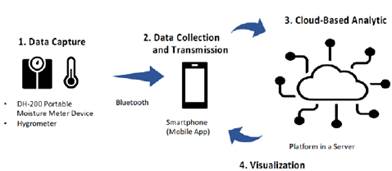 Fig. 1
Schematic of IoT-based technology components for the coffee drying process.
Fig. 1
Schematic of IoT-based technology components for the coffee drying process.
1) Devices for Data Capture. To capture the percentage of grain moisture and grain temperature, we used a DH-200 portable moisture meter device designed, developed, and patented by Quantik Industries. Additionally, we used a digital hygrometer to capture the air temperature and relative humidity.
The portable coffee moisture meter, DH-200, has a practical design, as shown in Fig. 2. It is a low-priced device compared to other devices on the market, and it is intended that coffee producers can acquire and use it easily. The device works and performs consistently, surpassing the validation in a relevant environment using objective tests. It utilizes the fundamental electrical properties of the coffee bean materials. The directly measured variable is the capacitance of the material, which is related to the amount of water in the material. The device was calibrated following the determination of coffee moisture, which was defined as the percentage of the weight of water within the bean using the oven method. The calibration process followed the standard laboratory method or procedure for moisture determination according to the technical standards of NTC 2325 and Resolution 02 of 2016 for green coffee quality.
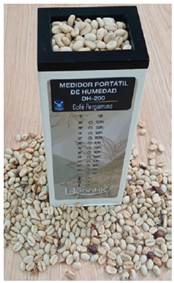 Fig. 2
Portable coffee moisture meter DH-200.
Fig. 2
Portable coffee moisture meter DH-200.
2) Data Collection and Transmission. Farm users must register with an app on their cell phones to collect the data. Once registered, they can set up either a single measurement or create a batch of drying; thus, they can perform several historically stored measurements to create drying curves. To measure, the user must select a 200-gram sample from the coffee batch to be dried and put it into the DH-200, as shown in Fig. 3. The measurements were captured by the application from the DH-200 device via Bluetooth and temporarily stored in the application. Once the cell phone has a connection to the Internet, the data are transmitted to a cloud-based platform using wireless communication protocols where a history of the measurements is stored for each registered user, ensuring seamless and secure data transfer. The app also receives information from the hygrometer to capture the air temperature and humidity data via Bluetooth.
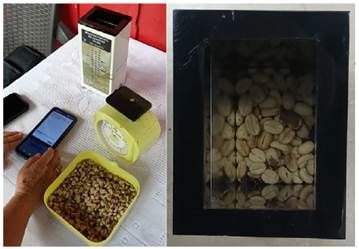 Fig. 3
Sample measurement setup: Users must select a 200-gram sample and place it inside the DH-200. The device transmits the data captured to a cell phone via Bluetooth.
Fig. 3
Sample measurement setup: Users must select a 200-gram sample and place it inside the DH-200. The device transmits the data captured to a cell phone via Bluetooth.
3) Cloud-Based Analytics. The collected data were processed and analyzed with Python programming using a standard data analytics methodology, which includes preparation of data, cleaning of data, and resampling to one-hour lag. We then used descriptive statistics to identify the relevant process behavior. Furthermore, to show the drying process trend, we used techniques related to nonlinear regression applied to a mathematical model [19], [20], [21]. For this drying behavior, the following mathematical model was used, enabling the generation of comprehensive reports and insights into the drying process, including trends and moisture level variations that provide valuable insights into the drying process:
where M: Moisture of the grain in the dry base; Me: Moisture equilibrium depending on air temperature T(t) and air humidity HR(t); Psv: Saturation water vapor pressure; Pv: Partial vapor pressure; m, n, and q are empirical parameters to be adjusted with experimental data; and its time in hours.
4) Visualization. We developed a user-friendly interface and mobile application that provides realtime access to moisture data and the visualization of the results.
3.2 loT-Based Technology Implementation
The implementation of the IoT-based technology relies on a mobile app, which allows for articulating the components, followed by software development protocols for IoT. First, users must create an account in the mobile app by registering their basic information. This account allowed them to record all the measurements. The app takes either an individual measurement or a set of measurements from the drying process. This is referred to as a batch of dried coffee. To record measurements of a batch of dried coffee, the user creates a batch in the app, thus providing information that characterizes it, such as the batch's name, the number of kilograms to dry, the type of bean, and the drying type.
Subsequently, the app displays graphs, descriptive statistics, and trends of their drying processes, allowing the construction of curves that the user can then analyze and make the best decisions regarding the drying process of their coffee. Batch recordings allow farmers to visualize the collected data and their analysis in real-time through their cell phones, empowering them to make informed decisions. This interface also provides graphical representations of the drying process parameters and trends for a straightforward interpretation. From left to right, Fig. 4 presents the main interface of the mobile application, its main menu, measurement modes, and information capture.
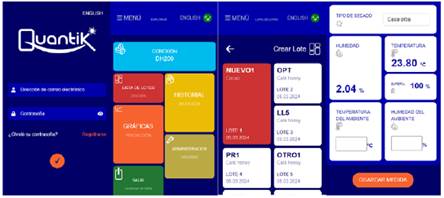 Fig. 4
Mobile app interface of the IoT for analyzing the coffee drying process. From left to right, the main interface, main menu, measurement interface, and measurement recording.
Fig. 4
Mobile app interface of the IoT for analyzing the coffee drying process. From left to right, the main interface, main menu, measurement interface, and measurement recording.
3.3 Case Study
We conducted six participatory and collaborative meetings with a group of women from the association selected according to their interest in attending and completing each activity. These meetings were helpful for feedback and carried out at each stage of development, starting from the conception of the mobile application, its specification, design, analysis, documentation, functionality, error, and usage testing (Fig. 5). Additionally, on-site meetings were held at each coffee farm to support families in using this technology.
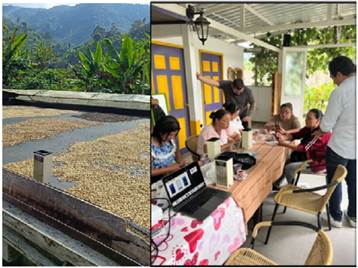 Fig. 5
In the case study, the technology developers met with women from the association to validate the IoT-based technology.
Fig. 5
In the case study, the technology developers met with women from the association to validate the IoT-based technology.
Here, the women from the association had the opportunity to observe for the first time the behavior of the drying process with the obtained data (Fig. 6), which allowed them, in the first instance and at the descriptive level, to understand and analyze the phenomenon of coffee removal due to the times when the temperature drops and the relative humidity of the air increases. Thinking together, they sought strategies for constructing moving roofs, shelters, and marquees to avoid grain exposure to such conditions. The application of this technology in a case study demonstrated its practical effectiveness in the postharvest processing of coffee beans by smallholder farmers. The insights gained from the case study highlight the positive impact of the proposed technology on empowering farmers to improve the quality of their coffee beans and ultimately enhance their livelihoods.
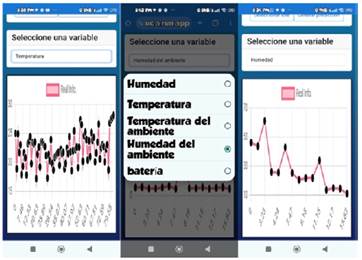 Fig. 6
Mobile app interface of the IoT for analyzing the coffee drying process. From left to right: selection of the plot of temperature, center, interface to select a variable, and selection of the plot Humedad (moisture of the coffee bean).
Fig. 6
Mobile app interface of the IoT for analyzing the coffee drying process. From left to right: selection of the plot of temperature, center, interface to select a variable, and selection of the plot Humedad (moisture of the coffee bean).
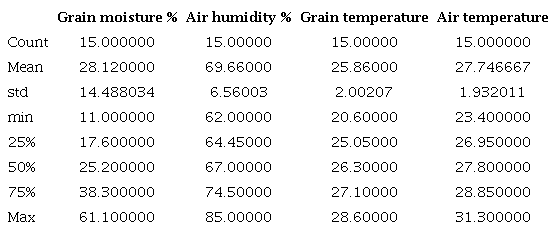
This application allows users to visualize the behavior of the drying process based on previously entered information. From the first measurement, the user takes a batch of coffee, and the application presents a trend based on the mathematical model described in Equation (1). Finally, for each entered measurement, the system plots updates (Fig. 7) and presents a descriptive statistic of the process to the user, as listed in Table 2. Note that the statistical description first establishes the averages, maxima, and minima that can be directly related to water activity and how this can affect grain quality.
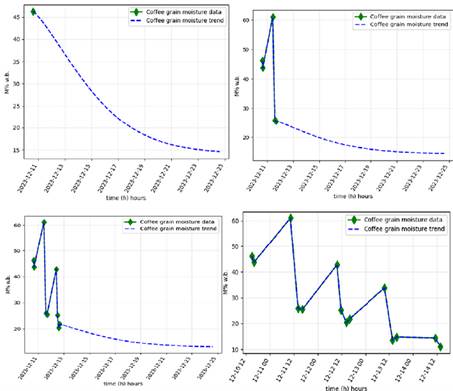 Fig. 7
Plots showing the trend of the coffee drying process as data were inputted into the system. Left-up top: Initial process one measurement: The app offers a trend based on the initial data. Right-up-top: four data measurements. As the data are input, the graphic and trend are updated. Left-down top: Eight data measurements. Right-down top: The process was finished with a moisture measurement of 11%.
Fig. 7
Plots showing the trend of the coffee drying process as data were inputted into the system. Left-up top: Initial process one measurement: The app offers a trend based on the initial data. Right-up-top: four data measurements. As the data are input, the graphic and trend are updated. Left-down top: Eight data measurements. Right-down top: The process was finished with a moisture measurement of 11%.
4. DISCUSSION
In this first use of the technology, the farmers who participated in the case study obtained the first conclusions about the drying process from an analytical point of view, allowing them to propose different strategies for improving the drying process.
Table 2
Descriptive statistics of the drying process.
Real-time data collection and analysis provided valuable insights into drying conditions, leading to informed decision-making and proactive measures to maintain the quality standards demanded by the global coffee industry.
Furthermore, the user-friendly interface and mobile application empowered smallholder farmers to actively monitor and manage the drying process, thereby elevating their capabilities to meet the stringent quality standards of the global coffee market. This technology not only addresses the immediate challenges faced by small farmers but also positions them to compete in specialty coffee markets, contributing to the economic growth of the agricultural sector.
Collaboration with small farmers in Génova, Quindío, Colombia, provided valuable insights into the practical implementation of the IoT-based technology. The positive effect observed in this case study emphasizes the adaptability and effectiveness of this approach in diverse agricultural settings. Smallholder farmers can leverage this technology to enhance the quality of their coffee beans, thereby gaining a competitive advantage in the global market.
Based on the findings and outcomes of this case study, we recommend that small coffee farmers consider integrating IoT-based technologies into their postharvest processes. Through strategic adoption and support, small farmers can harness the transformative potential of this approach, thus paving the way for sustainable and competitive coffee production. Finally, further research on this technology's development and case study consists of studying long-term adoption patterns, cost-benefit analysis, and scalability of such technology.
ACKNOWLEDGMENTS
The authors thank the Extension and Outreach Center at La Universidad del Quindío, Colombia, Quantik Co., and the Association of Coffee Produced by Women in Genova, Quindío, Colombia.
REFERENCES
P. C. Ossani, M. Â. Cirillo, F. M. Borém, D. E. Ribeiro, R. M. Cortez, "Qualidade de cafés especiais: Uma avaliação sensorial feita com consumidores utilizando a técnica MFACT," Revista Ciencia Agronomica, vol. 48, no. 1, pp. 92-100, 2017. https://doi.org/10.5935/1806-6690.20170010
P. Siagian, E. Y. Setyawan, T. Gultom, F. H. Napitupulu, H. Ambarita, "A field survey on coffee beans drying methods of Indonesian small holder farmers," in IOP Conference Series: Materials Science and Engineering, 2017. https://doi.org/10.1088/1757-899X/237/1/012037
C. J. Pimenta, C. L. Angélico, S. M. Chalfoun, "Challengs in coffee quality: Cultural, chemical and microbiological aspects," Ciencia e Agrotecnologia, vol. 42, no. 4, pp. 337-349, Jul-Aug, 2018. https://doi.org/10.1590/1413-70542018424000118
V. M. Berrueta-Soriano, F. Limón Aguirre, "Developing a solar dryer for coffee," LEISA Magazine, pp. 24-25, 2005. Available: https://edepot.wur.nl/91838
C. L. Hii, F. M. Borém, Drying and Roasting of Cocoa and Coffee, Boca Raton: CRC Press Taylor & Francis Group, 2020.
J. M. Jurado-Chaná, E. C. Montoya-Restrepo, C. E. Oliveros-Tascón, J. García-Alzate, "Método para medir el contenido de humedad del café pergamino en el secado sola del café," Cenicafé, vol. 60, no. 2, p. 135, 2009. Available: https://biblioteca.cenicafe.org/handle/10778/188
A. E. Peñuela-Martínez, M. V. Restrepo-Rivera, C. A. Tibaduiza, "Secado solar de café usando diferentes tipos de cubiertas plásticas," Cenicafé, vol. 73, no. 2, e73206, 2022. https://doi.org/10.38141/10778/73206
J.-E. Consuegra-Fontalvo, J. Calderón-Velaides, G.-E. Chanchí-Golondrino, "IoT System for Monitoring and Analysing Physiological Variables in Athletes," Revista Facultad de Ingeniería, vol. 31, no. 61, e14831, 2022. https://doi.org/10.19053/01211129.v31.n61.2022.14831
R. Karunakaran, "Role of non-governmental organization in improving the livelihood of rural community: the case of world vision Ethiopia," Int J Curr Res, vol. 11, no. 07, pp. 5368-5373, 2019. https://doi.org/10.24941/ijcr.35812.07.2019
W. Mühlbauer, J. Müller, Drying atlas. Cambridge, MA, USA: Elsevier, 2020.
H. B. Spencer, "A Mathematical Simulation of Grain Drying," J. agric. Engng Res., vol. 14, no. 3, pp. 226-235, 1969.
E. P. Isquierdo, F. M. Borém, E. T. De Andrade, J. L. G. Corrêa, P. D. De Oliveira, G. E. Alves, "Drying kinetics and quality of natural coffee," Trans ASABE, vol. 56, no. 3, pp. 1003-1010, 2013. https://doi.org/10.13031/trans.56.9794
A. Parra-Coronado, G. Roa-Mejía, C. E. Oliveros-Tascón, "SECAFÉ Parte I: Modelamiento y simulación matemática en el secado mecánico de café pergamino," Revista Brasileira de Engenharia Agrícola e Ambiental, vol. 12, no. 4, pp. 415-427, 2008.
A. Parra-Coronado , G. Roa-Mejía , C. E. Oliveros-Tascón, J. R. Sanz-Uribe, Optimización operacional de secadores mecánicos para café pergamino, Colombia: FNC-Cenicafé, 2017.
Notes
Notes
How to cite: C. Acosta-Minoli, P-C. Carmona, M. Mesa-Mazo, J-D. Vargas-Gil, J-P. Velásquez, "IoT-based Technology for the Coffee Drying Process Data Analysis of Small Farmers",
Revista Facultad de Ingeniería, vol. 33, no. 69, e17404, 2024.
https://doi.org/10.19053/01211129.v33.n69.2024.17404
FUNDING STATEMENT This study was supported by the Ministry of Science and Technology of Colombia (Minciencias), Servicio Nacional de Aprendizaje-SENA, and the Ministry of Environment of Colombia through grant SENAInnova 901, 2021.
ETHICAL COMPLIANCE STATEMENT Ethical considerations were prioritized at all stages of the study. Informed consent was obtained from all community members to ensure their full understanding of the project's objectives, procedures, and potential impacts. Stringent data privacy and security measures were also employed. Cultural sensitivity was paramount throughout with respect to local values, beliefs, and practices.
DATA ACCESS STATEMENT The datasets used and/or analyzed during the current study are available from the corresponding author upon reasonable request.
AUTHORS' CONTRIBUTIONS Juan-Diego Vargas: conceptualization; research; validation. Juan-Pablo Velásquez: data curation; software. Cesar Acosta-Minoli: writing original draft; formal analysis. Paulo Carmona-Tabares: writing review and editing; formal analysis. Mónica Mesa-Mazo: supervision; methodology; validation; project administration.
Author notes
Esta edición se financió con recursos del Patrimonio Autónomo Fondo Nacional de Financiamiento para la Ciencia, la Tecnología y la Innovación, Francisco José de Caldas, Minciencias

