Abstract: New records of Nepticulidae, Gracillariidae, Roeslerstammiidae, Plutellidae, Argyresthiidae, Oecophoridae, Coleophoridae, Momphidae, Brachodidae, Erebidae, and Noctuidae for Spain and Portugal are presented. Stigmella nylandriella (Tengström, 1848), Ectoedemia argyropeza (Zeller, 1839), E. spinosella (Joannis, 1908), Phyllonorycter sorbi (Freyer, 1855), Roeslerstammia erxlebella (Fabricius, 1787), Rhigognostis senilella (Zetterstedt, 1839), Argyresthia aurulentella Stainton, 1849, A. thuriferana (Gibeaux, 1992), A. buvati Gibeaux, 1992, A. reticulata Staudinger, 1877, A. submontana Frey, 1870, Batia internella Jäckh, 1972, Coleophora gryphipennella (Hübner, 1796), and Mompha raschkiella (Zeller, 1839) are new for Spain, Chelis maculosa (Gerning, 1780) and Helotropha leucostigma (Hübner, 1808) are new for Portugal. Stigmella nylandriella, Ectoedemia argyropeza, E. spinosella, Rhigognostis senilella, Argyresthia aurulentella, A. thuriferana, A. buvati, A. reticulata, A. submontana, Batia internella, and Mompha raschkiella are new for the Iberian Peninsula. New province records are given of 54 species (57 new province records in all).
Keywords:InsectaInsecta, Lepidoptera Lepidoptera, Nepticulidae Nepticulidae, Gracillariidae Gracillariidae, Roeslerstammiidae Roeslerstammiidae, Plutellidae Plutellidae, Argyresthiidae Argyresthiidae, Oecophoridae Oecophoridae, Coleophoridae Coleophoridae, Momphidae Momphidae, Brachodidae Brachodidae, Erebidae Erebidae, Noctuidae Noctuidae, new records new records, Iberian Peninsula Iberian Peninsula.
Resumen: Se mencionan nuevos registros de Nepticulidae, Gracillariidae, Roeslerstammiidae, Plutellidae, Argyresthiidae, Oecophoridae, Coleophoridae, Momphidae, Brachodidae, Erebidae y Noctuidae para España y Portugal. Stigmella nylandriella (Tengström, 1848), Ectoedemia argyropeza (Zeller, 1839), E. spinosella (Joannis, 1908), Phyllonorycter sorbi (Freyer, 1855), Roeslerstammia erxlebella (Fabricius, 1787), Rhigognostis senilella (Zetterstedt, 1839), Argyresthia aurulentella Stainton, 1849, A. thuriferana (Gibeaux, 1992), A. buvati Gibeaux, 1992, A. reticulata Staudinger, 1877, A. submontana Frey, 1870, Batia internella Jäckh, 1972, Coleophora gryphipennella (Hübner, 1796) y Mompha raschkiella (Zeller, 1839) son nuevas para España, Chelis maculosa (Gerning, 1780) y Helotropha leucostigma (Hübner, 1808) son nuevas para Portugal. Stigmella nylandriella, Ectoedemia argyropeza, E. spinosella, Rhigognostis senilella, Argyresthia aurulentella, A. thuriferana, A. buvati, A. reticulata, A. submontana, Batia internella y Mompha raschkiella son nuevas en la Península Ibérica. Nuevas citas provinciales para 54 especies (57 nuevas citas provinciales en total).
Palabras clave: Insecta, Lepidoptera, Nepticulidae, Gracillariidae, Roeslerstammiidae, Plutellidae, Argyresthiidae, Oecophoridae, Coleophoridae, Momphidae, Brachodidae, Erebidae, Noctuidae, nuevos registros, Península Ibérica.
New records of Lepidoptera from the Iberian Peninsula from 2017 and 2018 (Insecta: Lepidoptera)
Nuevos registros de Lepidoptera en la Península Ibérica del 2017 y 2018 (Insecta: Lepidoptera)
Sociedad Hispano-Luso-Americana de Lepidopterología
Received: 14/12/2018
Accepted: 26/12/2018
Published: 30/06/2019
The ongoing research on Lepidoptera of the Iberian Peninsula performed by the authors brought some interesting results in 2017 and 2018. The important records are presented in this contribution, supplementing the publications by VAN NIEUKERKEN et al. (2004, 2010), LAŠTUVKA & LAŠTUVKA (2006, 2007, 2009, 2011, 2014a, b, c, 2015, 2017), LAŠTUVKA et al. (2000), CORLEY et al. (2006, 2007, 2009, 2012a, b, 2013, 2016, 2018), CORLEY (2014, 2015a), including summarizing works by VIVES MORENO (1994, 2014) and CORLEY (2015b). The discovery of 11 species new for the Iberian Peninsula, 14 species new for Spain, 2 for Portugal and 54 species new for individual provinces are given here.
The presented records are the results of the authors’ (AL & ZL) two three weeks long visits to the Iberian Peninsula from 10th to 30th June 2017 and from 9th to 30th June 2018. Attention was paid only to northern regions of Spain from Gerona to Asturias and to Trás-os-Montes in Portugal. The moths were mostly collected at light (UV lamp 125 W, fluorescent tubes 8 and 20 W). Some species (specimens) were beaten from their host plants by day, adults of some species were collected on flowers or in stands of host plants, and empty mines or mines with larvae were found in some mining species. The determination was performed by the authors. The mining and other small moths are deposited in the collection of the first, material of Sesiidae in the collection of the second author. Therefore, collectors and the collection are not repeated for the individual species.
ES: Lérida, Valle de Arán, Tredós, 1 ♀, 14-VI-2017.
Species with European distribution, known predominantly from central and northern parts of Europe, occurrence data are missing from the Balkans and some Mediterranean islands (VAN NIEUKERKEN, 2013). Larvae mine on Sorbus aucuparia (Sorbus domestica and Malus) (e.g. LAŠTUVKA & LAŠTUVKA, 1997). New species for Spain and the Iberian Peninsula (Fig. 1, 14).
ES: Lérida, Valle de Arán, Tredós, 1 ♂, 14-VI-2017.
Eurosiberian species, known throughout Europe, with exception of Mediterranean islands (VAN NIEUKERKEN, 2013). Larvae mine on Populus tremula (e.g. LAŠTUVKA & LAŠTUVKA, 1997). New species for Spain and the Iberian Peninsula (Fig. 2, 15).
ES: Soria, Aldehuela de Calatañazor, 1 ♂, 23-VI-2017.
Predominantly central and southern European species, unknown from Scandinavia (VAN NIEUKERKEN, 2013). Larvae mine on various Prunus species (e.g. LAŠTUVKA & LAŠTUVKA, 1997). New species for Spain and the Iberian Peninsula (Fig. 3, 16).
ES: Huesca, Benasque-Cerler, 4 ♂♂, 3 ♀♀, 16-VI-2017, 2 11, 24-VI-2017; Lérida, Valle de Arán,
Tredós, 4 ♂♂, 14-VI-2017.
Western Palearctic (up to Central Asiatic) species, distributed throughout Europe, with exception of southern parts of the Balkans and Mediterranean islands. In the Iberian Peninsula recorded in Portugal: Trás-os-Montes and Beira Alta (CORLEY, 2015b). Larvae usually mine on Sorbus aucuparia, but also other Sorbus species, Cotoneaster, Crataegus, Malus, Mespilus, Prunus padus, and Pyrus are occasional or regular host plants (DE PRINS & DE PRINS, 2018). New species for Spain (Fig. 4, 17).
ES: Huesca, Espés, 1 ♀, 25-VI-2017.
Eurosiberian species, in Europe distributed in western, central and eastern parts, up to southern Scandinavia in the north (KARSHOLT, 2013). In the Iberian Peninsula recorded in Portugal: Minho by CORLEY et al. (2012b). Larvae usually develop on Tilia, but Betula is also mentioned as a host plant (e.g. AGASSIZ, 1996). New species for Spain (Fig. 5).
ES: Huesca, Benasque-Cerler, 1 ♂, 21-VI-2018.
Eurosiberian species, in Europe more common in central and northern parts, in southern regions mostly in mountains (AGASSIZ, 2013). Larvae develop on some Brassicaceae. BARANIAK (2016) considers R. senilella and R. marmorosella to be two distinct species, the first of them occurring in Greenland and Iceland, and the second one is broadly distributed. In such case, the Spanish record would belong to R. marmorosella. But AARVIK et al. (2017) do not confirm this view with regard to the barcoding results and the genitalia morphology. New species for Spain and the Iberian Peninsula (Fig. 6, 18).
ES: Lérida, San Lorenzo de Morunys, Enciens, 1 ♀, 25-VI-2018; beaten from bushes of Juniperus oxycedrus.
Species distributed in northern, western and central Europe, also known from some southern European countries (AGASSIZ, 2013). Larvae mine the needles of Juniperus, the bionomics are described by FRIESE (1969). New species for Spain and the Iberian Peninsula (Fig. 7, 23).
ES: Soria, Aldehuela de Calatañazor, 3 ♂♂, 1 ♀, 18-VI-2017, 1 ♂, 23-VI-2017, 5 ♀♀, 15-VI-2018, 2 ♂♂, 4 ♀, 19-VI-2018; collected at light or beaten from bushes of Juniperus thurifera.
Species described from southern France (Hautes-Alpes) (GIBEAUX, 1992) and still only known from there (AGASSIZ, 2013). Larvae probably mine the shoots of Juniperus thurifera. New species for Spain and the Iberian Peninsula (Fig. 8, 19, 24).
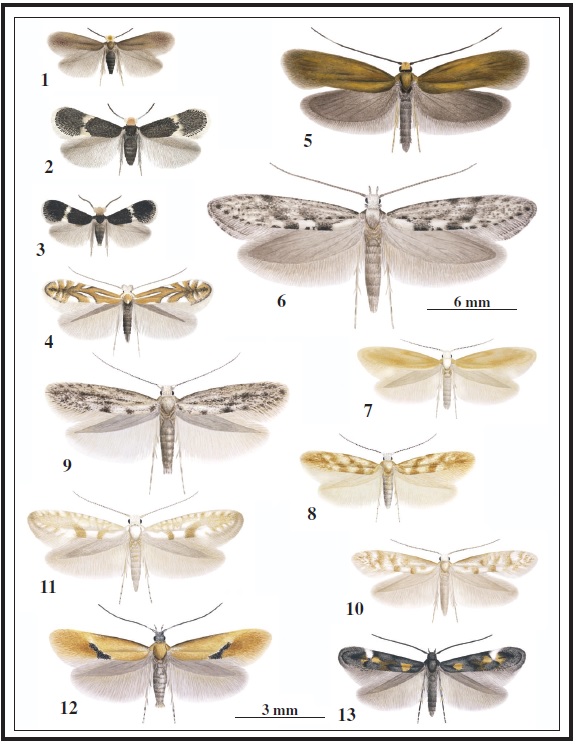
Figs. 1-13.–
1. Stigmella nylandriella (Tgstr.). 2. Ectoedemia argyropeza (Z.). 3. E. spinosella (Joann.). 4. Phyllonorycter sorbi (Frr.). 5. Roeslerstammia erxlebella (F.). 6. Rhigognostis senilella (Zett.). 7. Argyresthia aurulentella Stainton. 8. A. thuriferana Gbx. 9. A. buvati Gbx. 10. A. reticulata Stgr. 11. A. submontana Frey. 12. Batia internella Jäckh. 13. Mompha raschkiella (Z.).
ES: Soria, Aldehuela de Calatañazor, 1 ♀, 15-VI-2018, 1 0, 19-VI-2018; collected at light in the bushes of Juniperus thurifera.
Species described from southern France (Hautes-Alpes) (GIBEAUX, 1992) and still only known from there (AGASSIZ, 2013), similarly to the previous species. Larvae develop on Juniperus, probably on non- prickly species. Argyresthia buvati is very close (conspecific?) to the eastern Mediterranean-SW Asiatic Argyresthiaimpura (Staudinger, 1879). New species for Spain and the Iberian Peninsula (Fig. 9, 25).
ES: Soria, Aldehuela de Calatañazor, 1 ♀, 18-VI-2017, 8 ♂♂, 12 ♀♀, 15-VI-2018, 5 ♂♂, 1 ♀, 19- VI-2018; collected at light or beaten from bushes of Juniperus thurifera.
Species with insufficiently known distribution, recorded in the Netherlands, Belgium, France, Switzerland and one specimen also from the Czech Republic (AGASSIZ, 2013). Larvae mine young shoots and needles of Juniperus spp., apparently both prickly and non-prickly species. New species for Spain and the Iberian Peninsula (Fig. 10, 20, 26).
ES: Huesca, Espés, 1 ♀, 25-VI-2017.
European species, so far known from some northern, western and central European countries (AGASSIZ, 2013). Larvae live in the buds and shoots of Amelanchier and Sorbus aria (FREY, 1870), Sorbus torminalis and Cotoneaster are also given as host plants (LEPIFORUM, 2018). The adults are very similar to A. sorbiella, but their forewings are nearly white and the markings are less distinct. New species for Spain and the Iberian Peninsula (Fig. 11, 27).
ES: Soria, Aldehuela de Calatañazor, 1 ♂, 1 ♀, 23-VI-2017.
Western Palearctic species, distributed throughout Europe (LVOVSKY, 2013), very similar to Batia lunaris (Haworth, 1828). Larvae develop in dead tissues (wood) of shrubs and trees. New species for Spain and the Iberian Peninsula (Fig. 12, 21).
ES: Lérida, Valle de Arán, Tredós, larvae on Rosa sp., 14-VI-2017.
Eurosiberian species, distributed throughout Europe (VAN DER WOLF & BALDIZZONE, 2013). In the Iberian Peninsula recorded in Portugal: Trás-os-Montes (CORLEY et al., 2007). Larvae mine on Rosa and Rubus spp. (EMMET et al., 1996). New species for Spain.
ES: Gerona, Camprodón, Valter 2000, 1 ♂, 27-VI-2018.
Transpalearctic species, widely distributed in Europe with exception of some Balkan countries and Mediterranean islands (KOSTER & SINEV, 2013). Larvae mine on Epilobium angustifolium and E. hirsutum (KOSTER & SINEV, 2003). New species for Spain and the Iberian Peninsula (Fig. 13, 22).
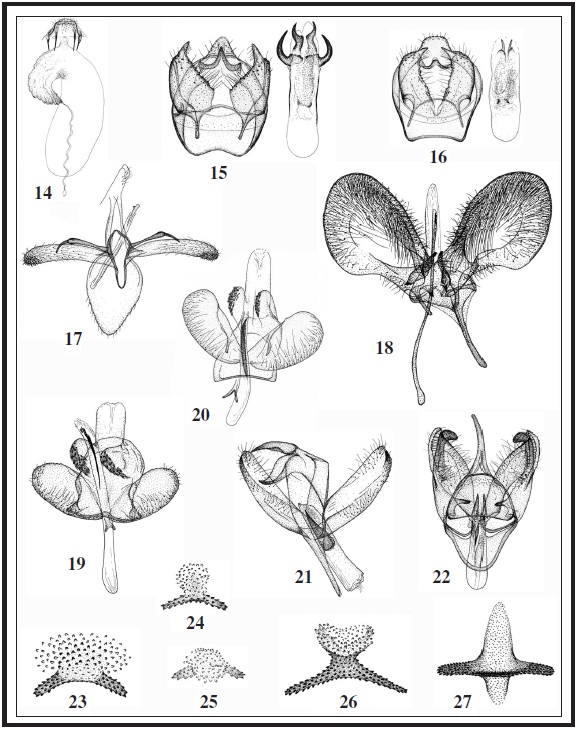
Figs. 14-27.–
Male (15-22) and female (14) genitalia. 14. Stigmella nylandriella (Tgstr.). 15. Ectoedemia argyropeza (Z.). 16. E. spinosella (Joann.). 17. Phyllonorycter sorbi (Frr.). 18. Rhigognostis senilella (Zett.). 19. A. thuriferana Gbx. 20. A. reticulata Stgr. 21. Batia internella Jäckh. 22. Mompha raschkiella (Z.). 23-25. Signum of the female genitalia. 23. Argyresthia aurulentella Stainton. 24. A. thuriferana Gbx. 25. A. buvati Gbx. 26. A. reticulata Stgr. 27. A. submontana Frey.
PT: Trás-os-Montes, Bemposta, 1 ♂, 16-VI-2018.
Transpalearctic species, locally distributed in central and southern parts of Europe (PRZYBYLOWICZ et al., 2013), also recorded in northern regions of the Iberian Peninsula to Galicia (MACIA et al., 2013). Its occurrence in Portugal is undocumented (CORLEY, 2015b). New species for Portugal.
PT: Trás-os-Montes, Bemposta, 1 ex. observed, 19-VI-2017.
Eurosiberian species, distributed throughout northern and central areas of Europe, including the NE part of the Iberian Peninsula (ZILLI et al., 2005). Larvae develop on some hygrophilous plants, e.g. Carex, Juncus, Scirpus, Sparganium, and Iris pseudacorus. The specimen was observed at light near the hygrophilous herbal stands of the river Douro which corresponds to its ecological requirements. New species for Portugal.
The faunistic data on the following Nepticulidae are summarized by VAN NIEUKERKEN et al. (2004), supplemented by LAŠTUVKA & LAŠTUVKA (2008, 2009, 2011, 2014a, b, 2015, 2017), and VAN NIEUKERKEN et al. (2010). Only records of species with less than four province records are individually commented.
ES: Lérida, Valle de Arán, Tredós, 1 ♂, 14-VI-2017.
ES: Gerona, Rocabruna, 1 ♂, 11-VI-2017; Huesca, Espés, 1 ♂, 15-VI-2017.
ES: Soria, Aldehuela de Calatañazor, 2 ♂♂, 19-VI-2018.
ES: Lérida, Valle de Arán, Tredós, 2 ♂♂, 14-VI-2017.
Species with trophic relation to Populus alba and P. tremula, known from the provinces of Málaga and Salamanca (VAN NIEUKERKEN et al., 2004); third Spanish record.
ES: Lérida, Sarroca de Bellera, mines on Prunus spinosa, 26-VI-2017.
ES: Huesca, Saravillo, 1 ♀, 17-VI-2017.
ES: Lérida, Xerallo, 2 ♂♂, 1 ♀, 24-VI-2018.
ES: Gerona, Rocabruna, 2 ♂♂, 1 ♀, 11-VI-2017.
ES: Huesca, Espés, 2 ♂♂, 15-VI-2017; Lérida, San Lorenzo de Morunys, 1 ♂, 27-VI-2017; Soria, Aldehuela de Calatañazor, 5 ♂♂, 1 ♀, 19-VI-2018.
ES: Soria, Aldehuela de Calatañazor, 1 ♂, 19-VI-2018.
ES: Huesca, Espés, 1 ♂, 15-VI-2017.
ES: Huesca, Candasnos, 1 ♂, 12-VI-2018; Lérida, Xerallo, 1 ♂, 24-VI-2018.
ES: Huesca, Benasque-Cerler, 1 ♂, 24-VI-2017.
ES: Lérida, Sarroca de Bellera, mines on Malus, 26-VI-2017.
Known only from the province of Gerona (LAŠTUVKA & LAŠTUVKA, 2008); second Spanish record.
ES: Huesca, Candasnos, 2 ♂♂, 12-VI-2018; PT: Trás-os-Montes, Bemposta, 2 ♂♂, 16-VI-2018.
ES: Huesca, Chía, 1 ♀, 20-VI-2018.
Known so far from the province of Zaragoza (LAŠTUVKA & LAŠTUVKA, 2008); second Spanish record.
ES: Lérida, San Lorenzo de Morunys, 1 ♂, 27-VI-2017.
ES: Soria, Aldehuela de Calatañazor, 3 ♂♂, 15-VI-2018.
ES: Huesca, Chía, 1 ♂, 20-VI-2018.
ES: Gerona, Camprodón, Valter 2000, 1 ♀, 27-VI-2018.
Species with trophic relation to Betula spp., known from the province of Orense (LAŠTUVKA & LAŠTUVKA, 2017); second Spanish record.
ES: Huesca, Benasque-Cerler, 1 ♂, 24-VI-2017.
Species known only from Asturias (LAŠTUVKA & LAŠTUVKA, 2017); second Spanish record.
ES: Huesca, Chía, 1 ♀, 20-VI-2018; Lérida, Valle de Arán, Tredós, 1 ♂, 14-VI-2017.
Species recorded only in the province of Lugo (LAŠTUVKA & LAŠTUVKA, 2017); second and third Spanish records.
The faunistic data and remarks on the following Gracillariidae known in more than three provinces are given by VIVES MORENO (1994) and LAŠTUVKA & LAŠTUVKA (2006, 2007, 2009, 2011, 2014a, b, 2015, 2017).
ES: Huesca, Saravillo, 1 ♂, 17-VI-2017.
ES: Lérida, Port del Comte, 1 ♂, 13-VI-2017.
ES: Huesca, Espés, 1 ♂, 15-VI-2017.
ES: Lérida, Valle de Arán, Tredós, 1 ♂, 14-VI-2017.
Third Spanish record, species so far known from the provinces of Orense and Zamora (LAŠTUVKA & LAŠTUVKA, 2014a, 2015).
ES: Lérida, Valle de Arán, Tredós, 2 ♂♂, 14-VI-2017.
ES: Teruel, Montalbán, 2 ♂♂, 13-VI-2018.
Species recorded in Andalusia by VIVES MORENO (1994); second Spanish record.
ES: León, Viadangos de Arbas, 1 ♂, 22-VI-2017.
ES: Gerona, Camprodón, Valter 2000, 1 ♂, 27-VI-2018.
ES: Oviedo, Alto de la Farrapona, 1 ♀, 21-VI-2017.
ES: Oviedo, Alto de la Farrapona, 3 ♂♂, 1 ♀, 21-VI-2017.
ES: Huesca, Benasque-Cerler, 1 ♂, 1 ♀, 24-VI-2017.
ES: Oviedo, El Puerto de Leitariegos, mines on Betula sp., 21-VI-2017.
ES: Lérida, Sarroca de Bellera, mines on Prunus mahaleb, 26-VI-2017.
ES: León, San Cristobal de Valdueza, 2 ♂♂, 20-VI-2017.
Species known only from the province of Ávila (VIVES MORENO & GASTÓN, 2017); second Spanish record.
ES: Huesca, Chía, 1 ♂, 20-VI-2018.
ES: Gerona, Camprodón, Valter 2000, 1 ♂, 27-VI-2018; Queralbs, 1 ♂, 1 ♀, 13-VI-2017; Rocabruna, 1 ♂, 10-VI-2018; Huesca, Benasque-Cerler, 1 ♂, 7 ♀♀, 21-VI-2018; Lérida, Port del Comte, 3 00, 13-VI-2017, 1 ♂, 25-VI-2018.
ES: Lérida, Valle de Arán, Tredós, 1 ♂, 14-VI-2017.
Second Spanish record from the same province (cf. LAŠTUVKA & LAŠTUVKA, 2015).
ES: Soria, Aldehuela de Calatañazor, 2 ♂♂, 1 ♀, beaten from Juniperus thurifera, 15-VI-2018.
The larva predominantly develops in the shoots of non-prickly Juniperus species, e.g. on Juniperus sabina, J. virginiana or J. chinensis in ornamental greenery, and it is known as invasive species in many parts of Europe. The geographical origin of this species is not well known, the Iberian Peninsula is one of the options, where the autochthonous species Juniperus thurifera, J. phoenicea and J. sabina could be the original hosts.
ES: Huesca, Saravillo, 1 ♀, 17-VI-2017; Lérida, Valle de Arán, Tredós, 1 ♂, 14-VI-2017.
The larva mines needles of Abies spp. For the first time given from the province of Lérida by LAŠTUVKA & LAŠTUVKA (2015); second and third Spanish records.
ES: León, Viadangos de Arbas, 1 ♂, 22-VI-2017.
ES: León, Viadangos de Arbas, 1 ♀, 22-VI-2017; Lérida, Valle de Arán, Tredós, 1 ♀, 14-VI-2017. Both relatively sparsely recorded species of higher cooler locations, with trophic relation to some Brassicaceae (e.g. AGASSIZ, 1996).
ES: Huesca, Espés, 1 ♂, 15-VI-2017.
Species so far known from the province of Barcelona (LAŠTUVKA & LAŠTUVKA, 2015); second Spanish record.
ES: Asturias, Alto de la Farrapona, 3 ♂♂, 5 ♀♀, 18-VI-2018; Lérida, Valle de Arán, Tredós, 2 ♂♂, 1 ♀, 22-VI-2018; Huesca, Benasque-Cerler, 1 ♂, 26-VI-2016; always many other specimens observed around the host plant Chenopodium bonus-henricus.
The faunistic data are summarized and remarks on biology and distribution on the following Sesiidae are given by LAŠTUVKA et al. (2000) and LAŠTUVKA & LAŠTŮUKA (2014c), with additions in LAŠTUVKA & LAŠTUVKA (2015, 2017).
ES: Huesca, Espés, 1 ♂, 15-VI-2017.
ES: Lérida, Valle de Arán, Tredós, exit holes in Betula sp., 14-VI-2017.
ES: Lérida, Valle de Arán, Es Bordes, exit holes in Abies alba, 15-VI-2017.
Second Spanish record from the same province (cf. LAŠTUVKA & LAŠTUVKA, 2015).
ES: Gerona, Sant Juan de las Abadesas, 1 ♂, 27-VI-2017; Soria, Aldehuela de Calatañazor, 1 ♂, 18-VI-2017.
ES: Soria, Aldehuela de Calatañazor, 4 ♂♂, 18-VI-2017, about 50 ex. observ., 23-VI-2017.
ES: Gerona, San Juan de las Abadesas, 2 ♂♂, 2 ♀♀, 28-VI-2017, San Pablo de Seguríes, 1 ♂, 1 ♀, 28-VI-2017.
Additonal records of this species from the province of Gerona (cf. LAŠTUVKA et al., 2000, CERVELLÓ, 2001).
ES: Huesca, Chía, larvae in the roots of Euphorbia cyparissias, 17-VI-2017, 1 ♂, 1 ♀, ex larva VII-2017.
The westernmost record of this species; so far known from the northern parts of the provinces Barcelona, Gerona, Lérida, and Huesca (c.f. GAVALDÁ, 1988, LAŠTUVKA et al., 2000, LAŠTUVKA & LAŠTUVKA, 2017).
PT: Trás-os-Montes, Bemposta, 1 ♂, 16-VI-2018.
Species actually recorded in Alto Alentejo (CORLEY et al., 2016) and Algarve (CORLEY et al., 2018); third Portuguese record.
We are grateful to M. Corley (Faringdon) for important comments and linguistic revision of the manuscript, to Dr. A. Vives (Madrid) for support in obtaining collecting permits for Spain, into the Scientific Project of SHILAP, and for comments on the manuscript and for linguistic revision of the Spanish abstract, to Dr. M. Seguieira (ICNF, Lisboa), and Dr. C. P. Santos (Parque Natural do Douro Internacional) for the permit to collect Lepidoptera in protected areas of Portugal.
*Autor para la correspondencia / Corresponding author. E-mail: last@mendelu.cz
Figs. 1-13.–
1. Stigmella nylandriella (Tgstr.). 2. Ectoedemia argyropeza (Z.). 3. E. spinosella (Joann.). 4. Phyllonorycter sorbi (Frr.). 5. Roeslerstammia erxlebella (F.). 6. Rhigognostis senilella (Zett.). 7. Argyresthia aurulentella Stainton. 8. A. thuriferana Gbx. 9. A. buvati Gbx. 10. A. reticulata Stgr. 11. A. submontana Frey. 12. Batia internella Jäckh. 13. Mompha raschkiella (Z.).
Figs. 14-27.–
Male (15-22) and female (14) genitalia. 14. Stigmella nylandriella (Tgstr.). 15. Ectoedemia argyropeza (Z.). 16. E. spinosella (Joann.). 17. Phyllonorycter sorbi (Frr.). 18. Rhigognostis senilella (Zett.). 19. A. thuriferana Gbx. 20. A. reticulata Stgr. 21. Batia internella Jäckh. 22. Mompha raschkiella (Z.). 23-25. Signum of the female genitalia. 23. Argyresthia aurulentella Stainton. 24. A. thuriferana Gbx. 25. A. buvati Gbx. 26. A. reticulata Stgr. 27. A. submontana Frey.
