2024
52206
09052023
20082023
Abstract: Mud-puddling though very common phenomenon in case of Rhopalocera (especially males) is not so common for Heterocera. The phenomenon was observed during one trapping night at Tippi village in Arunachal Pradesh, India. Here the authors present the first global report of Pyraloidea from India.
Keywords: Insecta, Lepidoptera, Pyraloidea, Arunachal Pradesh, Eastern Himalaya, India.
Resumen: Los charcos de barro, aunque es un fenómeno muy común en el caso de los Lepidoptera (especialmente los machos), no lo es tanto en el de los Heterocera. El fenómeno se observó durante una noche de trampeo en el pueblo de Tippi en Arunachal Pradesh, India. Aquí los autores presentan el primer informe global de Pyraloidea de la India.
Palabras clave: Insecta, Lepidoptera, Pyraloidea, Arunachal Pradesh, Himalaya oriental, India.
Artículos
First Global Report on Mud-puddling by Pyraloidea from India (Insecta: Lepidoptera)
Primer informe global sobre los charcos de barro por los Pyraloidea de la India (Insecta: Lepidoptera)
Received: 09 May 2023
Accepted: 20 August 2023
Published: 30 June 2024
One of the most common behaviour documented in Lepidoptera where adults are attracted towards moist ground, perspiration, tears, excrements or animal carcasses for the purpose of sucking salts and dissolved nutrients (Adler, 1982; Adler & Pearson, 1982; Bänziger, 1973). The males usually display such behaviour as the dissolved nutrients and minerals are necessary for transferring them to their female counterpart as part of nuptial gifts (Drummond, 1984; Smedley & Eisner, 1995, 1996; LaiFook, 1991; Eisner & Meinwald, 1995; Boggs & Gilbert, 1979). Mudpuddling though very common in Rhopalocera, has rarely been reported in case of Heterocera. Previous records include belonging to family Notodontidae (Smedley & Eisner, 1995), Sesiidae (Volponi, 2020) and Noctuidae (Xiao et al. 2010). An Erebidae, Hemiceratoides hieroglyphica (Saalmüller, 1891) from Madagascar was reported by Hilgartner et al. (2007) to suck tears from sleeping bird’s eyes (Newtonia brunneicauda (Newton, 1863) and Copsychus albospecularis (Eydoux & Gervais, 1835)). The current article presents first global report of mud-puddling behaviour by Pyraloidea from India.
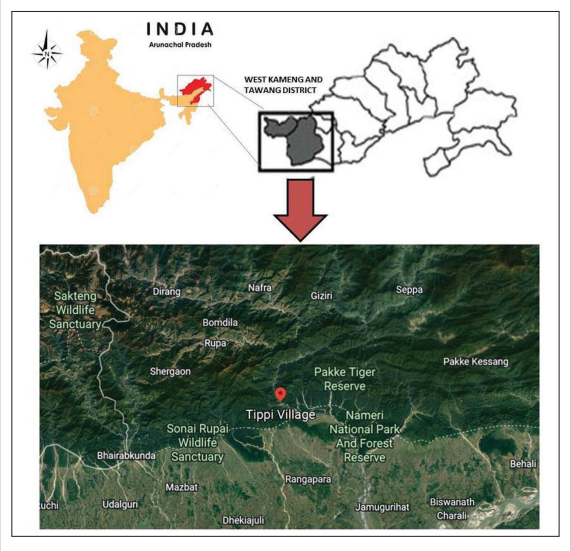
The unique mud-puddling behaviour by Heterocera was observed in Tippi, Arunachal Pradesh, India (Coordinates: Lat. 27.022425, Long. 92.624201; Altitude, 233 m) on 14-IX-2022 during a monthlong field visit for documentation of moth diversity in north-eastern India (Figure 1). Tippi is a small village situated on the west bank of Kameng River, adjoining the Pakke Tiger Reserve on the eastern bank of the river. The area falls under the biogeographic zone of ‘Himalayas’ under the Biogeographic Province of ‘East Himalayas (Zone 2D)’ (Rodgers & Panwar, 1988), characterized by a warm and moist tropical climate.
The behaviour was recorded during the nighttime (18.00 - 21.00 hrs) when the authors were returning from the light-trap site in Tippi, when several Heterocera were found puddling on a muddy patch by the side of motorable road. Moths were also recorded to gather on the freshly splashed mud patches on the vehicle surface and puddling from the same source. The entire event was videographed using mobile camera (Model: Samsung A 20) and all the images used in the article were extracted as JPEG format from the videos recorded in the mobile itself. Classification of Pyraloidea up to their “tribe” category has been followed after Nuss et al. (2003-2023).
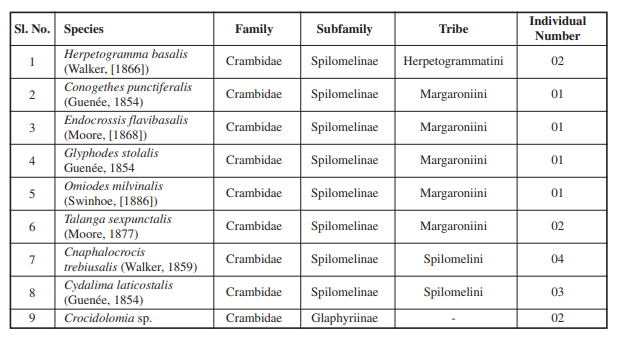
All the Heterocera recorded during the puddling event in Tippi belonged to the family Crambidae under the superfamily Pyraloidea. A total of nine moth species were identified from the event (Table 1), namely Herpetogramma basalis (Walker 1866), Conogethes punctiferalis (Guenée 1854), Endocrossis flavibasalis (Moore 1868), Glyphodes stolalis Guenée 1854, Omiodes milvinalis (Swinhoe 1886), Talanga sexpunctalis (Moore 1877), Cnaphalocrocis trebiusalis Walker 1859, Cydalima laticostalis Guenée 1854, and Crocidolomia sp. Five species belonged to the tribe Margoronini, two to the tribe Spilomelini, and a single species to the tribe Herpetogrammatini - all under the subfamily Spilomelinae. The subfamily Glaphyriinae was represented by a single species, Crocidolomia sp. All species recorded in the present event were carrying out their puddling from the mud substrate. The individual moths were found extending their proboscis, and moving the uncoiled proboscis over the mud surface scattered on the vehicle to puddle for the necessary resources (Figure 2).
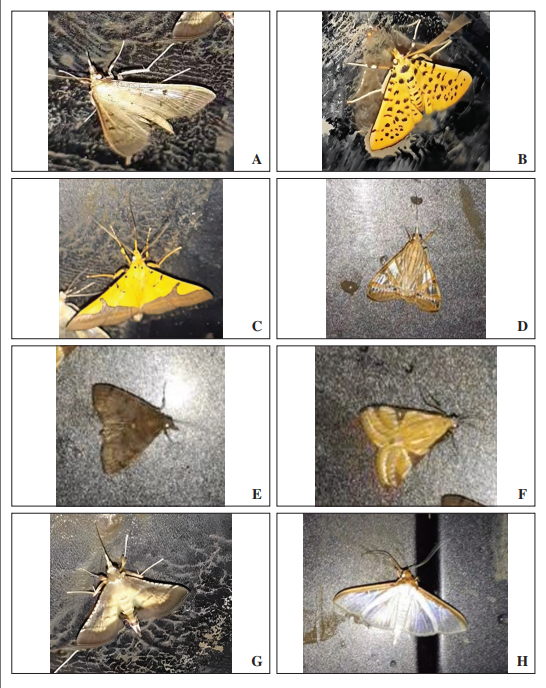
Regarding their positioning of wings during puddling, a species-specific character for moths (Adler, 1982), all crambids were observed with wings spread flat over the substrate, with vigorous shaking of their antennae from side to side and continuously probing their proboscis over the mud patch. In terms of their activity, most individuals were found to remain stationary while feeding from their substrates and even when disturbed by neighbouring individuals for sharing the mud patches, except for Cnaphalocrocis medinalis (Guenée, 1854) and Crocidolomia sp. which showed unrest during the period of observation, with intermittent flights in search of best substrate or disturbed by some other moths. However, Endocrossis flavibasalis immediately extended its proboscis just at the moment of landing on or near the preferred substrate. All individuals seemed unaffected by the light or proximity of the observers.
Pyraloidea show diverse host preferences with unique behavioural tendencies. Their larvae in particular are major pests of important crops like sugarcane, corn, rice etc. and stored products such as seeds and grains (Clausen, 1978; Solis, 1997); with some living concealed in silken webs, within rolled leaves, boring inside stem, root, shoot or galls (Solis, 2007), while some others are scavengers, myrmecophilous and even insectivores (Munroe, 1972; Gumhalter, 2022). The feeding behaviour of adult Pyraloidea is not well-known but can be assumed to effectively feed from an aqueous environment. Bänziger (1973) reported Lacryphagy (feeding on tears and other salt-containing liquids) in Pyraustinae and Spilomelinae.
Taking salts and other nutritional benefits from mud substrate through mudpuddling is commonly reported in Rhopalocera. Alternatively, reports on mudpuddling by Heterocera are very rare may be due to the fact that they are mostly nocturnal and hence not encountered in the wild at night. Moreover, night-flying Lepidoptera avoid the intense competition for essential salt components in soil with dayflying Lepidoptera through such temporal partitioning of resources. The present report on such evidence of nocturnal mudpuddling among some Pyraloidea illustrates the resource utilisation through temporal shift in their feeding behaviour.
* Autor para la correspondencia / Corresponding author: askdar94@gmail.com

