Artículos
Received: 20 March 2024
Accepted: 20 May 2024
Published: 30 June 2024
DOI: https://doi.org/10.57065/shilap.1036
Abstract: The status and systematic position of the taxa of the Neolycaena lunara Zhdanko, 1998 group are discussed. It is shown that N. lunara has large variability in size, shape, and wing pattern parameters even within the same population. The following new synonymy is established: Neolycaena lunara oksanaKorb, 2015, syn. nov., Neolycaena lunara karategina Weidenhoffer, 2000, syn. nov.
Keywords: Lepidoptera, Lycaenidae, morphological features, population level, systematic position, Tajikistan.
Resumen: Se discuten el estatus y la posición sistemática de los taxones del grupo Neolycaena lunara Zhdanko, 1998. Se demuestra que N. lunara presenta una gran variabilidad en los parámetros de tamaño, forma y patrón alar incluso dentro de la misma población. Se establece la siguiente nueva sinonimia: Neolycaena lunara oksana Korb, 2015, syn. nov., Neolycaena lunara karategina Weidenhoffer, 2000, syn. nov.
Palabras clave: Lepidoptera, Lycaenidae, características morfológicas, nivel de población, posición sistemática, Tayikistán.
Introduction
The genus Neolycaena de Nicéville, 1890 consists of two subgenera, Neolycaena S.str. and Rhymnaria Zhdanko, 1983 (Zhdanko, 1998), distributed in the Palearctic (Weidenhoffer et al. 2004). The genus Neolycaena has five species found in Tajikistan: Neolycaena aeto Zhdanko, 1994; Neolycaena tengstroemi (Erschoff, 1874); Neolycaena carbonaria (Grum-Grshimaïlo, 1890); Neolycaena sinensis (Alphéraky, 1881) and Neolycaena lunara Zhdanko, 1998 (Korb & Bolshakov, 2016). The taxon Neolycaena lunara was described by Zhdanko in 1998 from Tajikistan (type locality: Kugiteg ridge, Obikhingou river, Doshtikhasan village, 2000 m). This species is endemic of Central Asia, more precisely, it is known only from the territory of Tajikistan. Later, Korb (2015) described a new subspecies of N. lunara (Neolycaena lunara oksana Korb), from Tajikistan based on the collection of Sedykh collected in 1962 (type locality: Peter the Great Mountain ridge, the valley of the Surkhob river in the vicinity of the Jirgatal village). Tshikalovets (2003) considers N. lunara as a subspecies of N. sinensis; although these taxa are close to each other, there are still differences in wing patterns and genitalia structure. According to Korb & Bolshakov (2016), the taxon N. lunara currently has three subspecies - nominatypical (Obikhingou River Valley); ssp. oksana Korb, 2015 (Peter the Great Mountain ridge) and ssp. karategina Weidenhoffer, 2000 (Gissar), that is, these authors accept the previously described taxon Neolycaena karateginaWeidenhoffer, 2000 as a subspecies of N. lunara.
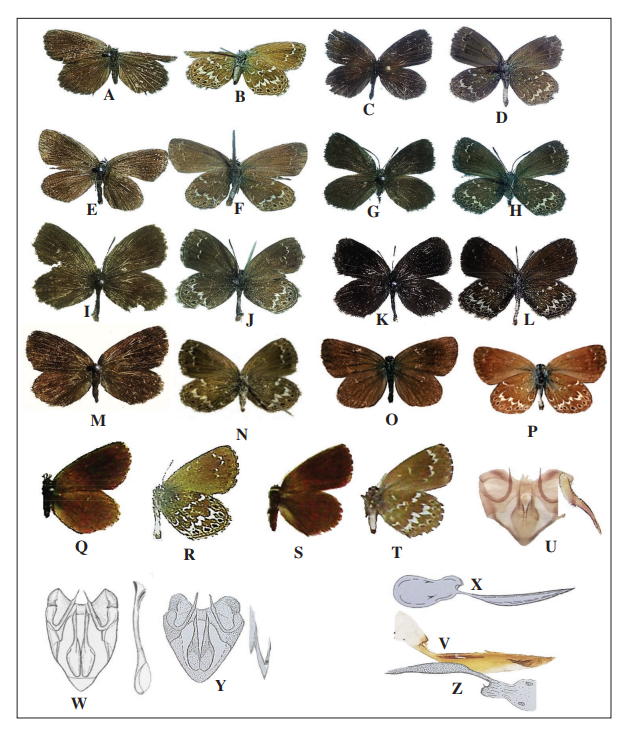
Figure 1.
Imago and genitalia of Neolycaena lynara group. A-B. Female. Peter the Great ridge, Lyakhsh village (by the author). C-D. Male. Hissar ridge, Ramit gorge. E-F. Male. Peter the Great ridge, Hojapulod gorge (by the author). G-H. Male. Peter the Great ridge, Childara gorge (by the author). I-J. Male. Sarsarak ridge (by the author). K-L. Male. M-N. Female, Hazratisho ridge, Anjirak gorge (by the author). O-P. Male. ssp. oksana (by Korb, 2015). Q-R. Male of nominotypic (by Tuzov et al. 2000). S-T. Female ssp. karategina (by Weidenhoffer et al. 2004). U. Male genitalia and V. Female genitalia (by the author). S. Male genitalia and T. Female genitalia of nominotypic (by Zhdanko, 1998). U. Male genitalia and V. Female genitalia (by the author). W. Male genitalia and X. Female genitalia of nominotypic (by Zhdanko, 1998). Y. Male genitalia and Z. Female genitalia of ssp. karategina (by Weidenhoffer et al. 2004).
Representatives of the genus Neolycaena have dark brown wing ground color both dorsally and ventrally, but white and black spots are prominent on the ventral side. The main morphological differences of the current subspecies are as follows: The ssp. oksana fore wing male 12 mm, differs from the nominotypical one by the poorly developed wing pattern in the forewing underside and by poor visible wing pattern elements in hindwing underside (in total they are 1.5-2 times thinner than in the nominotypical subspecies) (see figures O-P); and, the ssp. karategina fore wing male 12-14 mm, both wings narrower, elongated, underside of hind wing white postdiscal band well developed, formed by white bows proximally very faintly bordered with brown and shifted towards outer margin, female somewhat larger, fore wing 13,5-15,5 mm, markings better developed than in males (see figures S-T).
According to the primary descriptions, the main distinguishing features in the structure of the genitals of males N. lunara and N. karategina, the latter, which were later accepted as ssp. karategina, are the following: N. lunara - the valvae are bean-shaped at the base, thin in the distal part with a thickening closer to the distal end, which is pointed and does not go beyond the posterior edge of the tegumen; N. karategina - valva from the broad proximal part gradually narrowed till needle shaped ending.
It is important to note that when studying a series of material of the N. lunara group from different parts of Tajikistan, one can observe variability in the parameters, patterns, as well as the coloring of the wings (see figures A-N). Morphological features characteristic of the existing subspecies of N. lunara can be observed among specimens of the same population, which raises doubts about the validity of the described subspecies. Therefore, our study focuses on studying the morphological features of N. lunara at the population level, the results serve to understand the real position and status of the taxa of the N. lunara group.
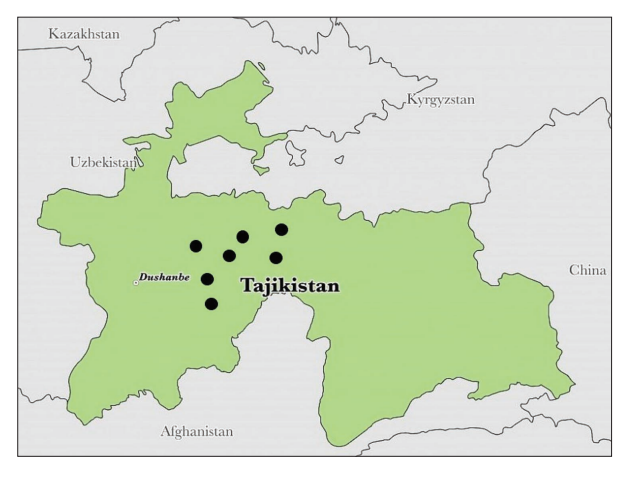
Figure 2.
Distribution of N. lunara in Tajikistan. The black dot indicates the known localities
Material and methods
The material for this paper was the author’s collections in the years 2014, 2022 and 2023 from the Central and Southwestern parts of Tajikistan. The size of the fore wings, the shape of the wings, the coloring, and patterns of the wings in both sides, as well as the structure of the genitalia were studied. In particular, the size of the fore wings was measured from the base of the wings to the tip, the shape of the wings was studied for elongation and roundness, the wing patterns for the degree of its development, and the genitalia were studied for any deviation of its structure. The obtained data on the morphological features of all collected samples were compared with each other, and as a result, any changes or deviations in all listed characteristics could be considered.
Material examined: Peter the Great Mountain ridge, surroundings of the Lyakhsh village, 1 ♂, 2 ♀, 4-VII-2014; Peter the Great Mountain ridge, Hujapulod gorge, 6 ♂, 3 ♀, 12-VII-2014; Peter the Great Mountain ridge, Childara gorge, 10 ♂, 2 ♀, 23-VI-2022; Hazratisho ridge, Anjirak gorge, 3 ♂, 2 ♀, 15- VII-2021, Hazratisho ridge, Anjirak gorge, 18 ♂, 29-VI-2023; Sangloh ridge, 13 ♂, 2 ♀, 5-VI-2023; Hissar ridge, Ramit gorge, 2 ♂, 12-VI-2023 (Figures 3-4).
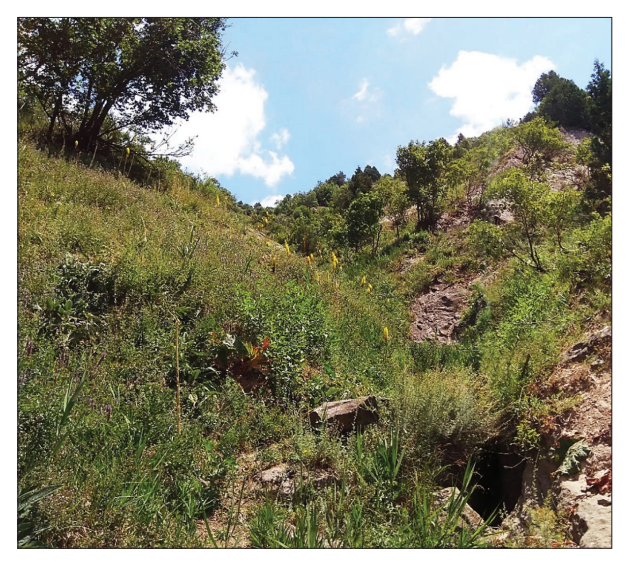
Figure 3.
The habitat of N. lunara in the Anjirak gorge, Hazratisho ridge (by the author).
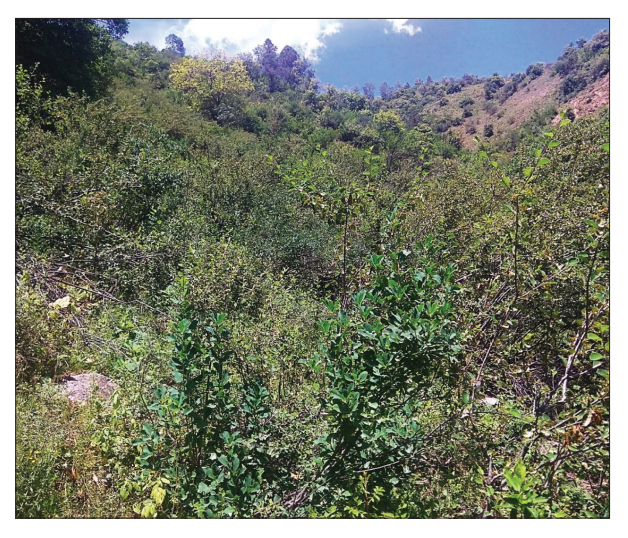
Figure 4.
The habitat of N. lunara in the Childara gorge, Peter the Great Mountain ridge (by the author).
Results and discussion
During the processing and study of the N. lunara group, some differences were found in the size and shape of the wings, as well as in the wing pattern. These changes are as follows: the forewing length of males collected from the Peter the Great Mountain ridge (17 specimens), ranged from 12 mm to 14 mm, but most specimens (10 specimens) had a wing length of 13 mm, and females (7 specimens) had a wing length of 13-16 mm. The population collected from the Sangloh ridge (15 specimens), had males (13 specimens) ranging from 9-11 to 13 mm, while females (2 specimens) had a wing length of 14 mm. The forewing length of specimens from the Hazratisho ridge (23 specimens), was 13-14 mm for males (21 specimens), and 14 mm for females (2 specimens). The two males collected from the Hissar ridge measured from 11-12.3 mm. The color of the upperside of wings is mainly dark brown, monotonous brown, light brown, and the colors of the wings from below are mostly brown and dark brown. The fore and hind wings are oval in shape, but there are specimens with narrow wings, the fringe is spotted, but the white gaps are noticeably thinner than the brown ones. The patterns of the underside of the wings are similar to the nominate subspecies, but with greater variability. In particular, on the underside of the forewing there is the presence or absence of a discal stroke, postdiscal spots are well or less well developed, submarginal black dots are faintly noticeable and sometimes absent, a brownish-gray background from the base is sometimes absent. Also, in some specimens this background has a golden-ochre tint, and in other specimens this tint generally absent. On the underside of the hindwing, the basal grayish - blue plaque in some specimens reaches up to half of the discal cell, and in other specimens it does not enter beyond the basal area. Discal spots are sometimes developed, and in other cases they occur only in the form of two white dots, postdiscal spots are presented in two forms - wider and thinner. Submarginal black dots are rounded in some specimens, and pointed in others, and these dots are sometimes surrounded by white scales, but there are specimens without white scales. In addition, in one specimen from the Hazratisho ridge, the submarginal dots between veins M3- Cu1 and Cu1-Cu2 have insignificant orange-ochre scales on the outside, and this was also noted for two paratypes of the nominotypical subspecies.
When studying the structure of the genitals of both males and females of N. lunara belonging to different populations from Tajikistan, no significant deviations were found in all parameters of the genitals. In particular, there were investigated the shape of the valva, the shape of the vinculum and uncus, the shape, and branches of the gnathos in males, and in females, the shape and size of the ductus, the shape of the antrum, and the structure of the ostium, which fully corresponded to the nominotypical subspecies. It is important to note that the distinctive features peculiar to the genitals of the previously described taxon N. karategina reliably correspond to the genitals of our butterflies and N. lunara, which indicates belonging to the same species.
As can be seen from the figures (U, W, Y and X, V, Z), there are no special differences in the male and female genitals of butterflies, according to which they could be divided into two taxa. According to all parameters, the genitals of N. lunara and ssp. karategina coincide with each other, and they are completely identical, and those small deviations that could be observed when comparing both genitalia are naturally accompanied by the genitalia of many taxa within the same genus. As a rule, sometimes these deviations occur when preparing of the genitals drug. As Korb (2013) notes, genital structures of the same species are depicted in different ways (up to a significant dissimilarity of drawings) and the reason for this is different approaches to research: the use /non-use of pressed drugs, straightening/nonstraightening of individual structures, different orientation of individual structures, etc. Thus, the features of the valva structure mentioned above for the description of N. karategina are not the basis for the description of a new taxon.
According to the above data, the N. lunara shows a large variability in the size and shape of the wings, as well as the wing pattern. These variations can be observed among specimens of the same population. For example, the collected by us from the Ramit gorge, the type locality of the subspecies karategina, fully correspond to the nominative subspecies. Among the species collected in different parts of the Peter the Great Mountain ridge there are specimens that look similar to the nominate, to ssp. karategina and ssp. oksana, and collected from the Hazratisho ridge are characteristic of both the nominative subspecies and the ssp. oksana. From the Sangloh ridge have signs of nominotypicaly and partially ssp. oksana. Thus, the morphological variability of the N. lunara is observed in all its populations in Tajikistan, where it occurs.
In addition, N. lunara are found in similar biotopes at all points of distribution in Tajikistan, that is, this species is confined to slopes with the presence of woody-shrubs and rock outcrops. This is evidenced by literary sources (Zhdakno, 1998), as well as our data. Given the above, only the nominotypical subspecies N. lunara is distributed in Tajikistan and there is no need to divide this species into subspecies, and the previously described subspecies should be considered as synonyms.
It is necessary to conduct such studies on other groups of species in Tajikistan, as there are many problems in the subspecific status of some taxa. To solve these problems, the necessary amount of material for each of these species will be required, collected at different periods of the year and at all points of their distribution in Tajikistan. With such a volume of material, careful study of their morphological features, comparison of individuals of each population with other populations, it is possible to judge the real status of these taxa in the system.
Distribution: Currently, N. lunara is reliably known from the Hazratisho, Vakhsh, Kugitek, Sarsarak ridges and the Peter the Great Mountain ridge. N. lunara probably meets on the Darvaz ridge (Figure 2).
Ecology: It is found at altitudes of 1300-2700 m.a.s.l., depending on the location, the flight is observed from the beginning of June and lasts until the first half of August. Univoltine.
Acknowledgments
The author wishes to thank Dr. Marianne Espeland (Germany) and Dr. Martin Warren (England) for her helpful comments, which have improved earlier drafts of this paper.
References
Korb, S. K. (2013). Butterflies (Lepidoptera: Papilionoformås) of the North Tian-Shan. Part 2. Families Nymphalidae, Riodinidae, Lycaenidae. Tula. [In Russian].
Korb, S. K. (2015). New data concerning the nomenclature, systematics, and distribution of butterflies of Middle Asia (Lepidoptera: Nymphalidae, Lycaenidae). Caucasian Entomological Bulletin, 11(1), 189-193. [In Russian]. https://doi.org/10.23885/1814-3326-2015-11-1-189-193
Korb, S. K., & Bolshakov, L. V. (2016). A systematic catalogue of butterflies of the former Soviet Union (Armenia, Azerbaijan, Belarus, Estonia, Georgia, Kyrgyzstan, Kazakhstan, Latvia, Lituania, Moldova, Russia, Tajikistan, Turkmenistan, Ukraine, Uzbekistan) with special account to their type specimens (Lepidoptera: Hesperioidea, Papilionoidea). Zootaxa, 4160(1), 1-324. https://doi.org/10.11646/zootaxa.4160.1.1 PMid:27615908
Tshikolovets, V. V. (2003). The butterflies of Tajikistan (Lepidoptera, Rhopalocera). Tshikolovets Publications.
Weidenhoffer, Z., Bozano, G. C., & Churkin, S. (2004). Guide to the butterflies of the Palearctic region (Lycaenidae). Part II. Subfamily Theclinae, Tribe Eumaeini (partim). Satyrium, Superflua, Armenia, Neolycaena, Rhymnaria. Omnes Artes.
Zhdanko, A. B. (1998). Review of the blue butterfly species of the nominative subgenus Neolycaena (Lepidoptera, Lycaenidae) with description of two new species from Middle Asia. Zoological Journal, 77(2), 196-201. [In Russian]
