Artículos originales

Esta obra está bajo una Licencia Creative Commons Atribución-CompartirIgual 4.0 Internacional.
Recepción: 14 Septiembre 2018
Aprobación: 05 Noviembre 2018
Resumen:
La legalización de los asuntos globales ha sido considerada positiva en contraste con las condiciones que antecedieron a la segunda Guerra Mundial. No más el interés particular puede imponerse frente al interés común, no más la coerción y la represión, no más las políticas del poder dominando el decision making. Se esperaría que el reconocimiento de un sistema legal de los Derechos Humanos sirviera como garantía del cumplimiento de los derechos en el interior de los Estados. Sin embargo, el objetivo principal de este sistema legal en su generalidad, que es mejorar bienestar de la población, no ha sido alcanzado en su totalidad, ni ha llegado a todos los países y todas las personas como se lo plantea. Este artículo examina dos factores que podrían confirmar esta aseveración. El primero, la posible ambigüedad del sistema a través de la debilidad de los instrumentos y sus instituciones. El segundo, el concepto de legitimidad asociado al lawfare, que permitiría el uso del Derecho Internacional de los Derechos Humanos como estrategia de poder.
En este orden de ideas, este artículo se organiza de la siguiente manera: Primero, realizamos una división por categorías que inicia en una revisión general del sistema internacional de DDHH, las relaciones de actores transnacionales, y presentamos algunos ejemplos de los principales instrumentos y de sus instituciones asociadas. La segunda categoría, discute el concepto de legitimidad asociado al concepto de lawfare, a la luz del Derecho Internacional y de las principales teorías de Cooperación Internacional. Sobre estas nociones teóricas, realizamos un análisis del caso de la tortura en Estados Unidos a partir del año 2000. Finalmente, presentamos unas conclusiones y recomendaciones sobre la estructura del sistema y su aplicación en el contexto internacional.
Palabras clave: Derechos Humanos, cooperación internacional, tortura, poder político, normativa.
Abstract:
The legalization of global affairs has been considered positive, in contrast to the conditions preceding the Second World War. No longer could individual interests be imposed against the common interest, no longer was there coercion and repression, no longer was decision making dominated by power politics. It would be expected that the recognition of a Human Rights legal system would serve as a guarantee for the fulfillment of the rights within States. The main objective of this legal system in its generality, which is to improve the well-being of the population, has not been reached in its entirety, nor has it reached all countries and all people as it is posed. Hence, this article examines two factors that could confirm this assertion. The first is the system’s possible ambiguity through the weakness of the instruments and their institutions. The second is the concept of legitimacy associated with lawfare, which would allow the use of International Human Rights Law as a power strategy.
In this order of ideas, this article is organized as follows: first, we carry out a categorical division that begins with a general review of the international human rights system and the relationships of transnational actors, and we then present various examples of the primary instruments and their associated institutions. The second category discusses the concept of legitimacy associated with the idea of lawfare, in light of International Law and the main theories of International Cooperation. Based on these theoretical ideas, we conducted an analysis of the cases of torture in the United States since the year 2000. Finally, we present various conclusions and recommendations regarding the system’s structure and application in the international context.
Keywords: Human Rights, international cooperation, torture, political power, norm.
INTRODUCTION
The idea that Human Rights are not limited by borders, and that the international community is obliged to protect and guarantee them, is increasingly accepted. The end of the Cold War reaffirmed the struggle begun in 1945, and today neither states nor individuals who violate human rights are exempted from prosecution. This does not mean that the world is free from acts of barbarism and that we do not continue to witness systematic violations; nor, even, that we are receiving optimal responses from the rights protection system through existing institutions. However, the very existence of a system that seeks to impose restrictions on the absolute freedom of governments to systematically violate human rights represents a substantial step towards their strengthening.
The Universal Declaration of Human Rights is the cornerstone of the International Law of Human Rights (IL-HR). Adopted in 1948, it is the document that inspires an entire set of treaties which has gradually come to specialize in specific issues, and it continues to be the main reference point in regards to the recognition of basic freedoms and human dignity. The commitment acquired by the States with this declaration was transferred to the field of law, materializing in the system of norms and principles contained in treaties, related instruments and international custom, as well as in domestic law. All this legal material reveals a growing tendency towards the strengthening of systems for human rights protection throughout the world. The Declaration, which is an exposition of principles rather than a binding legal instrument, has a social value that goes beyond the purely legalistic. Its principles have been inserted into the ideas of international political actors, influencing their actions and decisions (Risse, Roop and Sikkink, 2007). Following its appearance, the development and construction of universal human rights norms continued, accompanied by the creation of more national and international institutions (Forsythe, 2006).
In countries such as Yugoslavia and Rwanda, where international criminal tribunals were created with the authorization of the UN Security Council, close interaction was seen between national and international actors in search of justice in the face of serious human rights violations. These events brought international standards to cases of war crimes, crimes against humanity and acts of genocide. Along the same lines, under the principles of human rights, the International Criminal Court was created (Forsythe, 2006).
Undoubtedly, these facts envisage a growing commitment by states to take measures against those responsible for massive violations of the rights enshrined in international human rights treaties. The reason for this has been the situations of repression and abuses committed in a number of countries, where victims found neither responses nor resources to obtain justice and truth within their countries.
IL-HR is delimited through the set of obligations that the States commit to complying with. The obligations acquired by States are divided into three categories: to respect, protect and promote human rights. Respect implies that States must refrain from restricting rights or interfering in their practice. Protection requires States to protect individuals from violations of their rights, and promotion implies that States adopt positive measures for the exercise of fundamental rights. The adoption of commitments at the international level extends to the domestic sphere, in which states must seek to align their systems in a manner consistent with their international commitments.
1. UNIVERSAL DECLARATION OF HUMAN RIGHTS
The internationalization of human rights arises from the establishment of the United Nations Organization and its Charter, which marks a milestone in the development of modern international law. Despite this, after the creation of the UN, conflicts and human rights violations of all types have occurred. Given this situation, Thomas Risse and Kathryn Sikkink clarify that “enduring implementation of human rights norms requires political systems to establish the rule of law” (Risse, Roop and Sikkink, 2007, p. 3). Indeed, from a constructivist perspective, the identities created around what is understood as human rights have been the focus of an important international consensus. The global understanding of human rights has linked the different local, national and global actors, who have shared the principles for norms and regimes created in this branch of the law. In fact, “even if human rights are thought to be inalienable, a moral attribute of persons that public authorities should not contravene, rights still have to be identified - that is, constructed - by human beings, and codified in the legal system” (Donnelly, 1998 cited in Forsythe, 2006, p. 3). It has thus been necessary for state officials, social activists, and even victims, to advocate the creation of these standards nationally and internationally. As mentioned above, the Universal Declaration of Human Rights is the basic document giving rise to the development of instruments that today make up the system. There are nine instruments that constitute the fundamental structure of the universal human rights system. Their common characteristic is the call made to the States to respect fundamental rights and incorporate the necessary protection measures into their domestic systems. Additionally, these instruments have developed protocols that add rights and obligations to those initially adopted. These are:
1. International Convention on the Elimination of All Forms of Racial Discrimination CERD
2. International Covenant on Civil and Political Rights ICCPR
3. International Covenant on Economic, Social and Cultural Rights ICESCR
4. International Convention on the Elimination of All Forms of Discrimination Against Women CETFDCM
5. Convention against Torture and Other Cruel, Inhuman or Degrading Treatment or Punishment UNCAT
6. The Convention on the Rights of the Child CRC
7. International Convention on the Protection of the Rights of All Migrant Workers and their Families CTM
8. International Convention for the Protection of All Persons from Enforced Disappearances ICPPED.
9. International Convention on the Rights of Persons with Disabilities CRPD
It is easy to determine each instruments’ scope by its name. The ICCPR constitutes the basis for the rights promulgated in liberal democracies. It includes the right to free expression, freedom of worship, the right to association, and prohibits arbitrary detention and investigation without a cause, among others. The ICESCR contains a series of rights, mainly economic in nature, which include the right to work, the right to a fair wage, the right to vacations, the right to education, the right to health and the right to a dignified retirement. The CETFDCM establishes gender equality in all areas of action. The UNCAT prohibits torture and all other treatments practiced, especially in times of conflict. The CRC requires governments to guarantee children’s rights to not be separated from their families, safeguarding their integrity against any abuse and guaranteeing their right to free expression, among other rights. The CTM extends the rights of the ICCPR to migrant workers. The International Convention for the Protection of All Persons from Enforced Disappearance seeks to protect persons who are detained and disappeared by governments in the margins of legality. The CRPD categorically prohibits discrimination against persons with disabilities and requires States to implement the necessary measures in the workplace and civic spheres. The current status of international treaty ratification shows a generally encouraging picture regarding the international community’s acceptance of treaties on human rights issues, as shown in the following table:
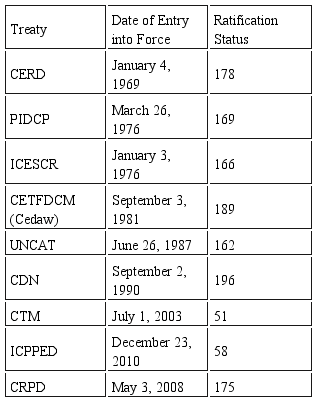
The International Convention on the Elimination of All Forms of Racial Discrimination CERD entered into force on January 4, 1969. Its current status is 178 State parties. The International Covenant on Civil and Political Rights ICCPR entered into force on March 26, 1976, and has 169 State parties. The International Covenant on Economic, Social and Cultural Rights PIDESC entered into force on January 3, 1976 and has 166 State parties. The International Convention on the Elimination of All Forms of Discrimination against Women CETFDCM entered into force on September 3, 1981 and has 189 State parties. The Convention against Torture and Other Cruel, Inhuman or Degrading Treatment or Punishment UNCAT entered into force on June 26, 1987 and has 162 State parties. The Convention on the Rights of the Child (CRC) came into force on September 2, 1990 and has 196 State parties. The International Convention on the Protection of the Rights of All Migrant Workers and their Families CTM entered into force on July 1, 2003 and has 51 State parties. The International Convention for the Protection of All Persons from Enforced Disappearance entered into force on December 23, 2010 and has 58 State parties. Finally, the International Convention on the Rights of Persons with Disabilities CRPD came into force on May 3, 2008 and has 175 State parties. (UN Treaty collection, s.f.))
In general terms, modern societies and developed States have included the guarantee of human rights in their public policies. They do not necessarily elevate them to the constitutional category, but they do exist within public policy. The internationalization of norms is thus not enough. Their internalization within countries is also necessary. The process by which these international norms are internalized and implemented at the domestic level is understood as a “socialization process” (Risse, Roop and Sikkink, 2007). There are three types of mechanisms to achieve this and make these standards lasting and effective. Instrumental adaptation and strategic bargaining, both internal and external, through which is negotiated internationally, and internal opposition is appeased. In this stage, even a merely discursive use can be provided in favor of human rights. In a second moment there is processes of moral consciousness-raising, which emphasizes argumentation, dialogue and persuasion. These communicative behaviors focus on an exchange of information through verbal utterances, or discourses, meaning the validity of human rights norms to clarify the actions that have been taken (Risse, Roop and Sikkink, 2007). Finally, practice of the domestic institutionalization and habitualization according to that mandated by international regulations begins at the domestic level, independent of individual beliefs regarding its validity.
This phenomenon is related to the international regimes approach by Kathryn Sikkink and Martha Finnemore regarding the “norm cascades”. For them, international or regional standards establish standards for the proper behavior of states (Finnemore and Sikkink, 1998). Thus, through the study of human rights principles, they explain that the norms have a “life cycle” which emerge in a first stage, are socialized in a second, and are internalized in a third. In the second stage is where the cascade occurs, because the norms “fall” to society in general or to the states. Whether due to social pressure, the desire to improve internal or external legitimacy, or rulers’ desire to boost their self-esteem, the “norm cascade” is facilitated (Finnemore and Sikkink, 1998). Rules are subsequently internalized and applied, guaranteeing the rights they defend.
An example of the “norm cascade,” developed by Kathryn Sikkink, is the “cascade of justice”, which corresponds to “a rapid, and dramatic shift in the legitimacy of the norms of individual criminal accountability for human rights violations and an increase in actions (like prosecutions) on behalf of those norms” (Sikkink, 2013, p. 7). While this does not mean that true justice occurs, it ensures that the norm has a new force and legitimacy, because of the fact that it has become common to prosecute state officials involved in serious human rights violations (Sikkink, 2013). The result of these actions, and their effectiveness -which in many countries has been strongly questioned- remains to be evaluated.
Despite the mutual construction of international commitments and state obligations, there are still several limitations in the implementation and enforcement of human rights norms. The norms system for States with authoritarian regimes, poor States and developing States, does represent certain impositions from the international level, which, added to the obvious limitations of a social and economic nature, prevent the guarantee of rights in an effective, indivisible and egalitarian manner.
a. Instruments
With regard to the possible ambiguity that accompanies these instruments in their construction, we will analyze some articles that, by way of example, will serve as an indicator of this presumption.
International Covenant on Civil and Political Rights
Article 19 of the ICCPR regarding the Right of Free Expression establishes:
Article 19
1. No one can be harrassed for their opinions.
2. Everyone has the right to freedom of expression; this right includes the freedom to seek, receive and disseminate information and ideas of all kinds, regardless of borders, be it orally, in writing or in printed or artistic form, or by any other procedure of the person’s choice.
3. The exercise of the right provided for in paragraph 2 of this article entails special duties and responsibilities. Accordingly, it may be subject to certain restrictions, which must, however, be expressly set forth by law, and be necessary to:
a) Ensure respect for the rights and reputation of others;
b) The protection of national security, public order and public health or morals.
States, in the domestic sphere, have found space to protect their exceptions, principally in number 3. These restrictions can take the form of fraudulent, defamatory, obscene and even dangerous messages, according to the agent’s point of view, being constituted as extremely broad frameworks giving the State complete freedom for interpretation as it sees fit. Paragraph b is broad enough for States to determine what is considered a threat to national security. In this way, said right is limited to domestic consideration, is vague and imprecise, and does not grant facilities to limit the space for interpretations.
International Covenant on Economic, Social and Cultural Rights
Along the same lines, we will review the Right to Work contained in the ICESCR:
Article 6
1. The State Parties to this Covenant recognize the right to work, which includes every person’s right to have the opportunity to earn a living through freely chosen or accepted work, and shall take appropriate measures to guarantee this right.
2. Among the measures to be adopted by each of the State Parties to this Covenant in order to achieve full effectiveness of this right will be technical and vocational guidance and training, the elaboration of programs, standards and techniques aimed at achieving on-going economic, social and cultural development and full and productive occupation, in conditions guaranteeing the fundamental political and economic freedoms of the human person.
Article 7
The State Parties to this Covenant recognize the right of all to the enjoyment of just and satisfactory working conditions, which ensure in particular:
a) A remuneration that provides all workers, at minimum:
i) An equal and equitable salary for work of equal value, without distinctions of any kind; in particular, women should be guaranteed working conditions not inferior to those of men, with equal pay for equal work;
ii) Dignified iving conditions worthy for workers and their families in accordance with the provisions of this Covenant;
b) Safety and hygiene at work;
c) Equal opportunity for all to be promoted, within their work, to the category corresponding to them, with no considerations other than time of service and ability;
d) Rest, enjoyment of free time, reasonable limitation of work hours and periodic paid holidays, as well as the remuneration of holidays.
General questioning of these instruments includes, for example: How is the determination of what is considered a fair wage made? What is a decent life? What is reasonable in regards to what constitutes a working day? The achievement of full employment, rather than a human rights goal, is an economic development goal that guarantees optimal social conditions; even so, unemployment is a modern condition common to both developing and developed countries. In another very important area, even when there are advances in terms of labor rights and economic development in a country - have women achieved the same benefits as men? Throughout the world, it is known that women are historically behind in terms of job opportunities and wages when compared to men. So, are we facing a systematic violation of rights or it is needed an articulation with development and mainstreaming of gender approach?
Article 2 of this convention establishes that:
1. Each of the State Parties to this Covenant will adopt measures, both separately and through international assistance and cooperation, in particular economic and technical, to the maximum extent of the resources at its disposal, to progressively achieve, by all appropriate means, including, in particular, the adoption of legislative measures, the full effectiveness of the rights recognized herein.
2. The State Parties to this Covenant will guarantee the exercise of the rights enunciated therein, without discrimination on grounds of race, color, sex, language, religion, political or other opinion, national or social origin, economic position, birth or any other social condition.
3. Developing countries, with due regard to human rights and their national economy, will be able to determine to what extent they will guarantee the economic rights recognized in this Covenant to persons who are not their nationals.
In this sense, developing countries have the legal capacity to postpone the offer of these guarantees of rights until they have achieved more optimal economic conditions. What then is the margin that makes it possible to clearly establish the optimum?
International Convention on the Rights of the Child
In the case of the CRC (1989), Article 19 provides that “States adopt the administrative, social, and educational legislative measures necessary to protect the child against any form of physical or mental harm or abuse, neglect or negligent treatment, mistreatment or exploitation, including sexual abuse, while the child is in the custody of the parents, a guardian, or any other person who has them under their care.”
Questions arise again regarding the crucial aspects defined by the treaty itself, such as the qualification of what is necessary and what is negligent. What is the scope? Does this impose a duty of due diligence on States? What system of international responsibility is established? The foregoing does not seek to underestimate the plural and diverse nature of International Law. The law is based on the fundamental principle of respect for state sovereignty, which, translated, means that the expectations held regarding human rights treaties do not exceed that legally possible. However, there are gaps due to a failure to establish clear behavior guidelines that limit the legal valuation of responsibility.
Under the Law of Treaties, these instruments allow reservations, letters of understanding and unilateral declarations. This without doubt limits and changes the nature of the obligations contained in the treaty. For example, in relation to the CRC (1989) that in its Article 37 (c) establishes:
“Every child deprived of liberty is treated with humanity and the respect that the inherent dignity of the human person deserves, and in a way that takes into account the needs of persons of that age. In particular, every child deprived of liberty shall be separated from adults, unless it is considered contrary to the child’s best interests, and shall have the right to maintain contact with his/her family through correspondence and visits, except in exceptional circumstances,”
In this regard, countries such as Great Britain, Switzerland, the Netherlands and Australia have stated that this will be applied so long as they find the possibilities to do so. Thus, the reservation presented by Australia reads:
Australia accepts the general principles of article 37. In relation to the second sentence of paragraph (c), the obligation to separate children from adults in prison is accepted only to the extent that such imprisonment is considered by the responsible authorities to be feasible and consistent with the obligation that children be able to maintain contact with their families, having regard to the geography and demography of Australia. Australia, therefore, ratifies the Convention to the extent that it is unable to comply with the obligation imposed by article 37 (c). (Convención contra la Tortura y Otros Tratos o Penas Crueles, Inhumanos o Degradantes, 1984)
Similarly, with regard to countries governed by Islamic law, everything established in the international sphere must be reviewed under this filter, as denoted by the reservation presented by the Kingdom of Saudi Arabia regarding the Convention, in relation to the prohibition of all forms of racial discrimination: “The Government of Saudi Arabia declares that it will implement the provisions [of the above Convention], providing these do not conflict with the precepts of the Islamic Shariah.”
The following is an illustrative table of the reservations registered, to date, for the aforementioned instruments:

b. Institutions
The main institutions responsible for ensuring compliance with human rights accompany the nine main treaties mentioned above. Thus, each of the treaties and their additional protocols has its own Human Rights Committee. In total there are ten committees (since the Convention on Torture UNCAT has two, a committee and a subcommittee) comprised of members who are nationals of the States party to the treaties. They are elected by secret ballot and their main function is to offer guidance for the interpretation of the treaties, and review the periodic reports issued by the States. These committees can obtain jurisdiction over a country only if that country ratifies the additional protocol to the treaty in question. The committees have the authority to make observations on the reports, and seven of them can receive petitions from natural persons who consider that their rights have been violated by the State under the terms of the treaty. The committees do not judge these petitions, but they do require states to respond to complaints and facilitate mediation. These are:
1. International Human Rights Committee (CCPR)
2. International Committee on Economic, Social and Cultural Rights (CESCR)
3. Committee for the Elimination of Racial Discrimination (CERD)
4. Committee for the Elimination of Discrimination Against Women (CEDAW)
5. Committee Against Torture (CAT)
6. Subcommittee for the Prevention of Torture (SPT)
7. Committee for the Rights of the Child (CRC)
8. Committee for the Rights of Migrants (CMW)
9. Committee for the Rights of Persons with Disabilities (CRPD)
10. Committee on Enforced Disappearances (CED)
These committees have been characterized as weak, since their reports have a high non-binding content whose messages, which they can hardly be ignored by the States, do not lead to concrete action. They identify general situations, but their suggestions become superfluous when establishing how problems should be addressed.
Messages such as “continue strenghtening legal and institutional mechanisms aimed at combating discrimination”, “Ensure that adequate resources are afforded to public health services”, “Examine the extent to which human rights education is available in schools”, are only examples of the fragility of the recommendations and denote the absence of adequate follow-up mechanisms.
This is what causes States to pay little attention to the recommendations on the matter issued by these entities. As of 2011, only 16% of States had submitted their annual reports on time, 20% had never submitted a report in regards to the Covenant of Economic, Social and Cultural Rights, the Covenant on Civil and Political Rights, or the Convention for the Elimination of Torture (Posner, 2014). It is evident that the number of committees is limited to the scope they intend; in addition, the jurisdiction overlaps between committees, their resources are limited, and this causes their effectiveness to be limited. The reality is that their achievements are directly dependent on the state’s will, and their scope is limited to the cooperation received from the state. The committees’ function is clearly conciliatory. They have no judicial competence and thus their authority falls on the moral plane. Thus, the protection system offered to victims of rights violations is likewise not very effective. Through 2016, the Human Rights Committee associated with the Covenant of Civil and Political Rights had received 2756 requests. A violation was determined for 975 of these cases and a satisfactory response was obtained from the State for 67 of them.
Above these committees is the UN Human Rights Committee, which has the authority to monitor compliance with all the aforementioned instruments. Similarly, the UN has the Office of the High Commissioner for Human Rights, which serves as the organization’s official voice on the matter. The difference between this and other committees is that this body does not respond to any special treaty; rather, its monitoring is widespread, and its members are the States. This Committee succeeds the UN Human Rights Commission, whose fundamental task was to prepare the text of the Universal Declaration of Human Rights.
Compliance with the decisions of the Inter-American Court of Human Rights is mandatory for member states. These decisions are final and not subject to appeal. (Art. 67-28, American Convention on Human Rights, 1948). For this reason, States must comply through clear and effective internal regulations that benefit victims.
In most of the countries of the region, the National Constitutions and their legislations establish the procedures to comply with international regulations. The judgments and dispositions of the Court are usually fulfilled, however, there have been cases in which the countries do not apply the decisions directly. In countries like Mexico, there are federal governments with their own jurisdictions, which usually represent a threat to compliance. In Ecuador and Colombia, there are cases where compliance has been limited or partial. The same has happened with the United States that has not complied with some decisions of the Court, either by opposition of its Supreme Court of Justice or State Courts.
The Court informs the General Assembly of the OAS about compliance with the judgments. In cases where there isn´t full compliance with the verdicts, the coercive mechanisms are very slight since the Court cannot expel those States that do not comply with the resolutions. The Court and the Inter-American Commission on Human Rights can observe and monitor cases of violations and compliance with judgments, in order to generate international pressure that will have a negative impact on the prestige of the country in terms of compliance with international standards.
In relation to the United Nations Human Right´s Bodies, the consequences of non-compliance with resolutions or recommendations often has the same difficulties. Countries might not comply with the UN recommendations on human rights and since there is no legal obligation, only matters of international pressure and prestige remain as moral sanctions. However, there is a fundamental difference with cases that are raised to the UN Security Council, because this organ is the only one within the United Nations system that can decided an armed intervention. This is provided in Chapter VII of the Charter in case of threats to peace.
2. THE LEGITIMACY ASSOCIATED WITH LAWFARE
There are many rights that lie outside of the treaties but which have gained traction to the extent that the international dynamic has begun to recognize their relevance; one example is the Right to Development, which emerged within the United Nations. The Declaration on the Right to Development (1986) establishes in its Article 1: “The right to development is an inalienable human right by virtue of which every human being and all peoples are entitled to participate in an economic, social, cultural and political development in which all human rights and fundamental freedoms can be fully realized, to contribute to that development and to enjoy it.” It is a human right and it has both an individual and a collective focus, it links both the national and the international scopes, as it operates in both dimensions, and makes the entire conglomerate responsible for respecting, contributing to and enjoying it. The growing recognition of the Right to Development has led to multiple inclusions within Hard Law, such as the Inter-American Convention on Human Rights 1948 in its Article 26, the African Charter of Human Rights and Persons of 1981 Article 22, the Arab Charter of Human Rights of 2004, Article 37 and the ASEAN of 2012, among other instruments.
Soft Law has been an expeditious way to address many issues in the area of Human Rights. It is a source of unconventional written law that is characterized by being non-binding, but highly effective. Bearing in mind that the international community is a system that contemplates a multiplicity of relations in the political, economic, social, cultural and legal spheres, the conglomerate of international norms is so rich that it allows for the coexistence of different relationship forms on the legal plane, and not all disputes are resolved before judicial bodies. This implies recognizing the existence of a broad and diverse norm that extends to human rights and that does not necessarily have to be binding in order to fulfill its purposes. Rights such as the Right to Development are contained in Soft Law instruments, but their legal relevance is undebatable. It has been included in the two major frameworks of international action, such as the Millennium Development Goals and the 2030 Agenda for Sustainable Development, which become guides for State’s local development plans, which, ultimately, is public policy. The recognition of Soft Law in the International Law of Human Rights allows for adaptation to the changing and spontaneous dynamics of international interrelation. In addition, it is necessary to remember that this does not oppose the Hard Law, nor does it substitute, precede or complement it in terms of Del Toro Huerta (2006). Soft law’s flexibility adapts the law to the new mechanisms of normative formation, through the inclusion of new actors that had been outside the legislative creation processes. We consider that a law conceived from Soft Law can be transferred to the field of that which binding; not as a condition necessary for its fulfillment, but because of its increased observance.
The dynamics of international interaction have shown that compliance with international obligations is not linked to the existence of sanctions. Previously, it was shown that the possibility of presenting reservations and unilateral declarations to treaties can considerably reduce the influence of the international judicial system, and has a direct impact on the system of international State responsibility; thus, despite the existence of a binding system, given the great variety of legal possibilities had by States, enforceability from law always be diminished.
The debate regarding State’s cooperative behavior, and their compliance with international norms, has a long history and is important to understand the attachment, or lack thereof, to human rights in their strict compliance. In this regard, the neoliberal institutionalist theory and the constructivist social approach allow an effective approach to the events of this century, in which times of change have can be seen. Neoliberalism has disputed with neorealism the reading of cooperative relations in an anarchic system, in which the hegemony of certain states has never been lacking. On the other hand, the incorporation of broader theories, such as those of international regimes and constructivists, have been able to respond to the emergence of new actors, mechanisms and conditions in the arena of International Cooperation (IC).
Neoliberalism is a response to the neorealist current that since the sixties, with authors like Waltz and Carr, has explained international relations and cooperation. It focuses on the structure of the anarchic international system (understood as the absence of a global government) and determines that IC is not possible and that this type of relationship, or its institutions, will always be defined by power and by the individual interests of the states. This current does not account for several ridges in the international system and its change processes over the years, as is the case of adherence to human rights standards.
Given this theoretical limitation, different approaches appear with other proposals for the analysis of IC, showing that a single conception is not sufficient to explain power in international politics. The same definition of power in regards to issues such as the emerging social structures that are formed at the global level, depending on the context and object of study, is relative to the neo-realist perspective (Barnett and Duvall, 2005). In neoliberalism, IC is considered as a constant interaction between the states and other actors, which can regulate the obstacles posed by the neorealists (Axelrod and Koehane, 1985). Indeed, for the neoliberals, cooperation coexists with anarchy and this has been seen in practice. Reward structures (game theory) systematically explain the cooperation between actors that, based on their interests and logical reasoning, choose to cooperate. The future’s shadow and the iteration of interactions is also the feature of a system that will allow for cooperation. Additionally, the number of actors interrelating provides incentives and possibilities to IC (Axelrod and Koehane, 1985).
The presence and participation of an international leader is considered by neoliberalism, accepting that this allows for the emergence of IC and international regimes (Keohane, 1984). Transfer this is how the current IC and Human Rights system was created following the Second World War, led by the winning countries and more specifically, by the United States. However, this same system, following the Cold War and certain global economic and humanitarian crises, has led to much more stable multilateral relations, where IC has been maintained beyond the interests or principles of a single country. Therefore, IC is possible without a hegemon to lead it and international regimes to facilitate it (Keohane, 1984). For this, it is key that there are significant common interests, which does not necessarily mean that there is harmony among the actors that cooperate. On the contrary, it must be considered that the actors reach conformity through negotiation processes for problematic issues. That is why “cooperation occurs when actors adjust their behaviors to the current or anticipated preferences of others, through a process of political coordination” (Keohane, 1984, p. 51).
In this way, international institutions explain the practices and expectations of actors in IC relations. Cooperation or discord affects the beliefs, rules and practices that form the framework for future actions. Likewise, each action must be interpreted within a context that has cognitive consequences and institutional residues (Keohane, 1984). In this way, international regimes, such as those of human rights, make sense, since they make it possible to distinguish IC patterns. International regimes are defined as a set of principles, norms, rules and decision-making procedures, implicit or explicit, around which the expectations of the actors converge, in a determined area of international relations” (Krasner, 1983, p. 2). Within this definition, the principles and norms have a broad scope, determined by the problem areas faced by governments and which they consider to be so closely linked that they must be attended to jointly. The problem areas are those addressed within common negotiations by coordinated bureaucracies, as opposed to problems that are faced separately and without coordination (Keohane, 1984). These will depend on the actors’ perception and their behavior rather than on the inherent qualities of the topics, such that their limits will change over time.
With this reflection, Keohane introduces a relativism of problem areas and the norms that will be created depending on perceptions and behaviors. In addition, the author goes further, stating that the regimes may affect the interests of the states, taking into account the elasticity and subjectivity of the idea of self-interest. Likewise, regimes can affect actors’ expectations and values. All this is possible despite the selfish and individual interests of the states.
In the context of recent decades, with a growing interdependence of international actors, international regimes have greater importance and utility for governments in the search to solve common problems without being governed by a hierarchical control system. Additionally, regimes show patterns of cooperative actions beyond isolated events, allowing for analysis of the continuity and changes in global policies. Regarding the appearance of international institutions, such as those of the UN and of Human Rights, several neo-realist authors observe that, when there is a conflict between operations and national interests, national interests will always prevail. However, from the neoliberal viewpoint, the formation of these interests and the way in which institutions affect the definition of states’ interests is key. The rational calculations of selfish and individual interests are explained by the iteration of international relations and the wide network of problems and regimes in which states interact. In this regard, regimes and institutions such as the UN and the mandates of their specialized agencies hold an indisputable role in international politics.
For its part, constructivism considers the formation of interests and identities; but beyond a rationalism centered on the anarchic structure and based on self-interests, principally of the states. For this current, institutions share a cognitive and intersubjective conception of the process, in which the actors’ interests and identities are endogenous to their interaction, and not given by an exogenous structure. This is how international institutions can transform states’ identities and interests. Within this conception, the current system of self-help centered on one’s own interests is not caused by an anarchic structure, but rather is due to a process that led to that structure (Wendt, 1992). Alexander Wendt argues that anarchy is what states make of it, since interest in security is not a characteristic of anarchy. Self-help and competitive power policies can be caused by processes of interaction between states, where anarchy has only a permissive role; that is, there can be different types of anarchies according to the collective meanings that constitute the structures organizing our actions (Wendt, 1992).
Behind the interests are identities that depend on a specific context. From this perspective, institutions are a set of identities and interests, with norms and rules that are normally codified formally. The main virtue is that of being cognitive entities that do not exist separate from the actors’ ideas regarding the functioning of the world. As collective knowledge, they exist beyond the individuals comprising them at a given moment, and are mutually constitutive. From this approach, institutionalization is a process of internationalization of new identities and interests, and socialization is a cognitive process. Both processes are more than just types of behavior and their affectations.
Within this framework, states’ importance has diminished in the face of new social movements, multinational corporations, transnational networks and intergovernmental organizations. The identities and interests of the states are dependent and can be transformed collectively, within a context of anarchy, by many individual, domestic, systemic or transnational factors (Wendt, 1992).
Constructivism complements the harshest and broadest theories of neoliberalism, explaining phenomena such as the influence of epistemic communities, transnational social groups and international organizations. The latter bring together states and have led them to international commitments and IC agreements, which for several years have collaborated in the construction of their development policies and in attention to important, cross-border problematic issues. International IC can be explained, to a large extent, by its regimes and institutions, which reflect and affect global policies and the interests and identities of its actors. The efforts of institutionalist neoliberals to explain the emergence and growth of IC have been profound. There are other principles that have not been questioned, and rather have been ratified, but with a different approach. Therefore, it explains Staes’ behavior in situations of cooperation according to the expectations and agreements of the international group.
Within this scope, it is not possible to establish that fulfillment of International Law is due to the fear of punishment by the international community, but rather, that there are other underlying factors that make the law work. The traditional understanding of the concept of legitimacy in social sciences suggests that a legitimate rule should produce greater compliance on the part of the subjects because it would create natural motivation. This is based on the fact that a rule that enjoys legitimacy is presumed to reflect the common interests of the States, and if these interests in turn represent the stable and secure international society intended, then observance of the law would not be in the norm, precisely, but in the value of reciprocity as a foundational principle of International Law, which compels States to behave in the way they expect their peers to behave. (Zemaneck, 1997)
If the previous reflection is positive, then the prohibition of torture should not represent a threat to IL-HR, since it is a rule enjoying universal acceptance.
We will examine the prohibition of torture in relation to the behavior of the United States in order to analyze the relationship between international law, politics, state behavior and legitimacy. Using torture as a case study facilitates the reflection, given that its prohibition has a legal basis in treaty law, in custom and in jus cogens with the effect that no State has the option of conceiving said practice as legal.
The Universal Declaration of Human Rights in its Article 5 states that: “No one shall be subjected to torture or to cruel, inhuman or degrading treatment or punishment.” The International Covenant on Civil and Political Rights likewise enshrines it, in the same terms.
The Convention against Torture and Other Cruel, Inhuman or Degrading Treatment or Punishment UNCAT, of 1984, and the 1949 Geneva Conventions are the basic instruments for the prohibition of torture. UNCAT defines it as:
Any act by which a person is intentionally inflicted with severe pain or suffering, whether physical or mental, in order to obtain from the person or a third party information or a confession, punish the person for an act he or she has committed, or which it is suspected that he or she has committed, or to intimidate or coerce that person or others, or for any reason based on any type of discrimination, when such pain or suffering is inflicted by a public official or another person in the exercise of public functions, at the instigation of that person, or with their consent or acquiescence. Pain or suffering resulting only from legitimate sanctions, or that are inherent or incidental to them, will not be considered torture. (UNCAT, 1984)
The Geneva Convention (1949) in its common Article 3 states:
In the event of an armed conflict that is not of an international nature and that arises in the territory of one of the High Contracting Parties, each of the Parties to the conflict shall have the obligation to apply, as a minimum, the following provisions:
1) Persons not directly participating in hostilities, including members of the armed forces who have laid down their arms and persons put out of action due to illness, injury, detention or any other cause, shall be, in all circumstances, treated with humanity, without any distinction of an unfavorable nature based on race, color, religion or belief, sex, birth or fortune or any other analogous criteria. In this regard, at any time and place, as regards the abovementioned persons, the following are prohibited:
a) attacks against life and bodily integrity, especially homicide in all its forms, mutilation, cruel treatment, torture and torture;
b) the taking of hostages;
c) attempts against personal dignity, especially humiliating and degrading treatment;
d) sentences handed down and executions without previous judgment before a legitimately constituted court, with judicial guarantees recognized as indispensable by civilized peoples.
2) The wounded and sick will be gathered and assisted.
In the United States, the War Crimes Act of 1996 turns serious violations of the Geneva Convention into federal crimes. However, in US criminal law, the term Torture only applies to acts committed abroad, while the majority of the behavior described by UNCAT is included in Amendment 8 of the Constitution. That is to say that, within US law, official acts enter the framework of the constitutional prohibition of “cruel and unusual punishments” and the acts of individuals are classified within the criminal law that describes homicide and other legal types (Hurd, 2017).
With regard to the legitimacy they enjoy, both treaties are among the most ratified: the Geneva Convention has 194 signatories and the UNCAT 162. So, what does it mean for IDHR that a norm considered so legitimate be violated? In 2005, Bush explicitly stated that the United States does not torture. He added: “there’s an enemy that lurks and plots and plans to hurt America again. And so, you bet we wiil aggressively pursue them. But we will do so under the law” (Bush, 2005). This is a perfect example of how States demonstrate alignment with the law and how their behavior is framed within the limits of legality.
The Bush administration used the prohibition of torture as an explanation of their behavior in order to justify their actions in light of that prohibition. That is, the conduct of the country was anything but that described by UNCAT. While experts can discuss the absence of legal bases to justify it, they were significant in the politics of legitimacy. The arguments were:
• Prisoners in US custody did not qualify for the anti-torture regime because they belonged to “the war against terrorism” and therefore they did not enjoy the protection of the Geneva Convention. The conflict with Al Qaeda was outside the Convention’s perimeter because it was neither state nor internal. The fighters that were captured did not have a militia organization and therefore they were not protected by the ius in bellum.
• Interrogation practices such as waterboarding were not framed within the UNCAT classification. This was based on the fact that the content of the definition of torture was limited to acts producing pain equivalent to that which accompanies severe physical harm, physical incapacity or even death. Additionally, the US established that in order for torture to be configured, the agent must have the intent to inflict harm or suffering, which is entirely different from wishing to extract information.
• The US Constitution allows the president to exceed the limits of international law in extreme conditions such as the war against terrorism. Therefore, when the president exercises the role of commander in chief of the armed forces, his actions are discretionary, as well as that of his agents.
American practice challenges the traditional conviction that noncompliance with the law is the product of a lack of legitimacy. This is how the concern arises as to whether the fact that there is an extensive and repeated practice of torture mechanisms, despite the existence of a system of rules prohibiting it, is evidence that these rules are not legitimate. But perhaps we are seeing another possible reason: that rules such as those prohibiting torture gain power when considered legitimate, even if that power does not translate into greater compliance.
This is how legitimacy allows law to be used as a useful resource to define state practice, and this right is precisely the discursive material under which States are protected and with which they obtain political legitimacy. That is to say, the non-observance of a norm can coexist with its legitimacy, without altering the concept of legitimacy.
In this sense, the relationship between International Law, IDHR, politics, state behavior and legitimacy is reduced to a matter of interpretation of the norms and the State’s ability to justify its behavior within the legal parameters. However, this need for justification in turn reflects the dependence of States, and maintains the prevailing Rule of Law.
Beyond the realistic theories of International Relations that places International Law and ILHR as a system subordinated to power and selfish interests or, like the liberal framework, which is more optimistic and trusts that the international legal system in effect imposes limits on the state’s behavior, it is evident that ILHR ends up being a social practice that facilitates political justifications. It is as empowering as it is restrictive, because when a State chooses to be bound by an international instrument it does so voluntarily, and likewise, when it is bound, it has a broad scope to interpret the norm in such a way that it can advance achievement of its own objectives. This could be proven through the relationship between the rules prohibiting torture and US practices since the year 2000.
IL-HR is a permissive and at the same time limiting system, and its relation to power is far more complex than what we assume on a daily basis because governments frequently ignore, violate and redefine their international obligations. Powerful states thus have more opportunities to assume the costs of not complying with ILHR than weak states, as demonstrated by the US invasion of Iraq in 2003. Moreover, when strong states violate legal provisions, their actions can even be taken as evidence of a change in the rules.
The international system goes through a series of post-globalization changes that present economic, environmental, social and political limits to the system. On this last level, Sanahuja states that we are going through “problems of representativeness, legitimacy and effectiveness of postwar multilateralism” (Sanahuja, 2017). An “emerging normative challenge” and a response from the domestic to the liberal international order are proposed; this could pose an additional challenge to the difficulties already described, given that the international human rights system fails to establish itself as a strong and independent system and would end up, in this scenario, entering the declining sphere of liberal multilateralism.
CONCLUSIONS
It is clear that human rights instruments are not determinative when adjudicating responsibilities due to the lack of effectiveness of the system. The Hard Law represented in the Law of Treaties allows States to present the exceptions that they consider necessary to ratify the treaties. This possibility modifies the relations of responsibility in the treaty framework. Perhaps the necessary modification should be directed to the fact that as a general rule human rights treaties do not admit reservations, or, at least, they considerably limit them. This could have repercussions on a system of responsibility for human rights violations that is much more secure, legally speaking.
In the current system, a clear rule does not necessarily translate into a clear obligation, and a clear obligation does not mean that there is a consensus on the meaning of compliance with that obligation. The principal treaties regarding human rights are ambiguous and leave a very wide space for interpretations. The provisions contained in human rights instruments must be sufficiently specific, clear, and transparent, so as to reduce the space for interpretation by the State. The IC system and the international regimens of human rights require clearer rules and, more effective sanctions for all the actors involved.
In this regard, enforcement mechanisms for ILHR must be stricter, have adequate follow-up mechanisms and greater financial resources. The possibility that States do not accept the mechanisms for judicial settlement established by the treaties reduces to a minimum their level of commitment when facing a complaint for alleged human rights violations. The commissions in charge of ensuring compliance with the treaties must have judicial or pre-judicial authority -such as the IACHR- that allows them to adjudicate responsibilities and go far beyond the languor of the recommendations.
On the other hand, the inability of the system to guarantee all rights in its entirety must be recognized. If we start from the idea that ILHR’s main objective is the protection of people through the guarantee of their freedoms, we must consider that, even with the best efforts, achieving the realization of economic and social rights is not an exclusive possibility for an efficient legal system. It is a social and political responsibility that punishes the poorest countries, in particular. The political and civil rights established in the consciousness of the liberal democracies basically require democratic governments willing to guarantee them. However, the challenges represented by the fulfillment of economic and social rights are dependent on other variables that escape the law.
This does not mean that the international and internal norms of the countries can leave aside some or other rights. Just as the norms of ILHR´s must be articulated in order to comply with its universal and indivisible principles, institutions and monitoring mechanisms must also do the same until they land in society, in communities and in all people. The recognition must be profound with respect to those countries and people where protection or well-being is not coming, and the fulfillment and exercise of rights is a distant reality. Obviously, solid normative bodies will not be enough, but integral domestic policies are necessary, with effective and efficient institutions and governments.
The legal weaknesses should not be confused with political weaknesses. There are flaws in the legal system, but the main responsibility falls within the scope of state and international political will. Law as a medium needs a political project to support it and IL-HR is a political project of the international society. If IL-HR were above policy, it would be much easier to distinguish between the legality and illegality of foreign policy options. This makes it possible to understand the close relationship between the power and policies of IL-HR. The law is not a system of rules outside state power; instead, it is a social practice in which States participate and use the law to work towards their own interests.
REFERENCES
Axelrod, R. and Keohane, R. O. (1985). Achieving cooperation under anarchy: Strategies and institutions. World politics, 38, p. 1.
Barnett, M. and Raymond Duvall. (2005). Power in International Politics. International Organization, 59(1)
Buergenthal, T. (1997). The normative and institutional evolution of international human rights. Human Rights Quarterly, 19(4)
Cassel, D. (2001). Does international human rights law make a difference? Chicago Journal of International Law, 2(1), pp. 121-135. Available at: https://search.proquest.com/docview/237215195?accountid=13357
Cielo, C. (2018). Corte IDH: Siete preguntas para entender la audiencia del 2 de febrero. Instituto de la Democracia y Derechos Humanos de Perú. Available at: http://idehpucp.pucp.edu.pe/notasinformativas/indulto-ante-la-corte-idh-siete-preguntas-entender-laaudiencia-del-2-febrero/
Del Toro Huerta, M.I. (2006). El fenómeno del Soft Law y las nuevas perspectivas del Derecho Internacional. Anuario mexicano de Derecho Internacional, VI.
Finnemore, M. (1996). Norms, culture, and world politics: insights from sociology´s institutionalism. International Organization, 52.
Finnemore, M. and Sikkink K. (1998). International Norm Dynamics and Political Change. International Organization, 52
Forsythe, D. (1984). Derechos humanos y política mundial. Buenos Aires: Universitaria.
Forsythe, D. (2006). Human rights in international relations. Cambridge: Cambridge University Press.
Bush, G. W. (2005). News conference. Panama City, November 7.
Huneeus, A. (2011). Courts Resisting Courts: Lessons from the Inter-American Court’s Struggle to Enforce Human Rights. Cornell International Law Journal, 44
Hurd, I. (2017). How to do things with International Law. Princeton.
Keohane, R.O. (1984). Cooperation and International Regimes. After hegemony: Cooperation and discord in the world political economy. Princeton University Press
Krasner, S. (1983). Structural causes and regime consequences: Regimes as Intervening Variables. International Law and International Relations.
Naciones Unidas (2012). Indicadores de Derechos Humanos: Guía para la medición y la aplicación. Available at: http://www.ohchr.org/ Documents/Publications/Human_rights_indicators_sp.pdf
Posner, E. (2014). The twilight of human rights. Oxford University Press.
Risse, T., Roop, S. and Sikkink, K. (2007). The power of Human Rigths: International Norms and Domestic Change. Cambridge University Press. Nueva York – Estados Unidos.
Sanahuja, J.A. (2017). Crisis de globalización y hegemonía en cuestión: un escenario de cambio estructural para Cuba y Latinoamérica y el Caribe. Pensamiento propio, 22 (45).
Salgado, E. (2012). La probable inejecución de las sentencias de la Corte Interamericana de Derechos Humanos. Cuestiones Constitucionales, (26).
Scott, S. (2017). International Law in World Politics, an introduction. Lynne Rienner publishers.
Sen, A. (2004). Elements of a theory of human rights. Philosophy & Public Affairs, 32(4)
Sen, A. (2012). The Global Reach of Human Rights. Journal of Applied Philosophy, 29.
Sikkink, K. (1998). Transitional Politics, International Relations Theory, and Human Rights. Political Science and Politics, 31(3)
Sikkink, K. (2013). The Justice Cascade: Human Rights Prosecutions and Change in World Politics, Retrieved from: https://bc.sas.upenn. edu/system/files/Sikkink_04.08.10.pdf
War Crimes Act (1996) Available at: https://www.dni.gov/index.php/ic-legal-reference-book/war-crimes-act-of-1996
Wendt, A. (1992). Anarchy is what states make of it: the social construction of power politics. International organization 46(2).
Zemanek, K. (1997). The Legal Foundations of the International System, General Course on Public International Law. Recueil des cours, (V), p. 266
LEGAL DOCUMENTS
Convención contra la Tortura y Otros Tratos o Penas Crueles, Inhumanos o Degradantes. (1984). Resolución 39/46, de 10 de diciembre de 1984. Available at: https://www.ohchr.org/sp/professionalinterest/pages/cat.aspx
Comité Internacional de la Cruz Roja. (1949). Convención de Ginebra. Available at: https://www.icrc.org/es/guerra-y-derecho/ tratados-de-dih-y-el-dih-consuetudinario/convenios-de-ginebra?gcli d=CjwKCAjwoMPcBRAWEiwAiAqZh8XD4jycjMWIiGTn1f1zIECom Y7hchV9t2oe2I_Bp84QT7ZyTXtMFhoClHsQAvD_BwE
Convención internacional para la protección de todas las personas contra las desapariciones forzadas. (1992). Resolución 47/133, de 18 de diciembre de 1992. Available at: https://www.ohchr.org/sp/ professionalinterest/pages/conventionced.aspx
Convención Internacional sobre la Eliminación de todas las Formas de Discriminación Racial. (1965). Resolución 2106 A (XX), de 21 de diciembre de 1965. Available at: https://www.ohchr.org/sp/professionalinterest/pages/cerd.aspx
Convención internacional sobre la Eliminación de todas las formas de discriminación contra la mujer. (1979). Resolución 34/180, de 18 de diciembre de 1979. Available at: https://www.ohchr.org/sp/ professionalinterest/pages/cedaw.aspx
Convención Internacional sobre la Protección de los Derechos de Todos los Trabajadores Migratorios y de sus Familiares. (1990). Resolución 45/158, de 18 de diciembre de 1990. Available at: https://www.ohchr. org/sp/professionalinterest/pages/cmw.aspx
Convención Internacional sobre los Derechos de las Personas con Discapacidad. (2008). [A/RES/61/106]. Available at: http://www.un.org/ spanish/disabilities/default.asp?id=617
Convención sobre los Derechos Del Niño. (1989). Resolución 44/25, de 20 de noviembre de 1989. Available at: https://www.ohchr.org/sp/ professionalinterest/pages/crc.aspx
Declaración sobre el Derecho al Desarrollo. (1986). Resolución 41/128, de 4 de diciembre de 1986. Available at: https://www.ohchr.org/sp/ professionalinterest/pages/righttodevelopment.aspx
Declaración Universal de los Derechos Humanos. (1948). Resolución 217 A (III), de 10 de diciembre de 1948. Available at: https://www.ohchr. org/EN/UDHR/Documents/UDHR_Translations/spn.pdf
Pacto Internacional de Derechos Civiles y Políticos. (1966). Resolución 2200 A (XXI), de 16 de diciembre de 1966. Available at: https://www. ohchr.org/sp/professionalinterest/pages/ccpr.aspx
Linkography
United Nations Treaty Collection Available at: https://treaties. un.org
United Nations Human Rights Office of the High Comissioner. Available at: http://tbinternet.ohchr.org/_layouts/ TreatyBodyExternal/FollowUp.aspx?Treaty=CCPR&Lang=en
United Nations Human Rights Office of the High Comissioner. Available at: http://www.ohchr.org/EN/HRBodies/Pages/HumanRightsBodies.aspx
Notas de autor
Correo electrónico: itellez783@puce.edu.ec
Correo electrónico: socsebasyerovi@gmail.com
Enlace alternativo
http://www.revistarfjpuce.edu.ec/index.php/rfj/article/view/106/74 (pdf)
http://www.revistarfjpuce.edu.ec/index.php/rfj/article/view/106/92 (html)
