Abstract: The intention of this article is to review the dynamics related to the recycling of cars at the end of its useful life (ELV), focusing in green practices (ecological) and policies that automakers have in their home countries and in Mexico. An increasing pressure has been put on the automotive industry for the implementation of ecological or green processes and their logistics, both by government organizations and member shareholders within companies. In the case of Mexico, automakers and the Federal Government have worked together in a Program of Vehicle Renewal (PRODIAT-C), but the results were not as expected, and this is the problem analyzed. Three car manufacturers with operations in Mexico were selected for the analysis of their green policies related to the recycling of vehicles at the end of their useful life, as well as the current ecological practices in the industrial plants. Kettwords: Automotive recycling, ecology, logistics of supplies.
Keywords: Automotive recycling, ecology, logistics of supplies.
Resumen: La intención del presente artículo es revisar la dinámica relacionada con el reciclaje de automóviles al final de su vida útil (ELV por sus siglas en inglés), enfocándose a las prácticas verdes (ecológicas) y las políticas que los fabricantes de automóviles mantienen en sus países de origen y en México. Una creciente presión –por parte de organizaciones gubernamentales y por miembros accionistas dentro de las compañías– ha sido puesta sobre la industria automotriz, para la ejecución de procesos más ecológicos o verdes y su logística. En el caso de México, fabricantes de automóviles y el Gobierno federal han trabajado en conjunto en la generación del Programa de Renovación Vehicular (PRODIAT-C), pero los resultados no fueron los esperados, lo cual se analiza. Se seleccionaron tres fabricantes de automóviles con operaciones en México para el análisis de sus políticas verdes relacionadas con el reciclaje de vehículos en el final de su vida útil, así como las actuales prácticas ecológicas en sus plantas industriales
Palabras clave: reciclaje automotriz, ecología, logística de suministros.
GREEN LOGISTICS IN THE SUPPLY CHAIN MANAGEMENT AND END OF LIFE VEHICLE RECOVERING
During the last two decades, an increasing pressure has been put in companies and entire industrial sectors due the high degradation of the environment and the impact of manufacturing activities in climate that have caused global warming and other side effects (NASA, 2013). In the United Kingdom, during the last ten ttears, the efforts of car manufacturers have generate reductions in the energy required in car assembly processes up to 28% and 73% less waste entering to landfill sites.
The industrial forecast shows that manufacturers will continue driving down emissions as technical progress will help to move towards a more sustainable and low carbon future (SMMT, 2013).
Green logistics is concerned with producing and distributing goods in a sustainable way, taking in account environmental and social factors, and its activities include measuring the environmental impact of different distribution strategies, reducing energy usage in logistics activities, reducing waste and managing its treatment (Sbihi & Eglese, 2007). In the same way, the current approaches on green logistics, from a marketing point of view, rely on the existence of market segments willing to pay a higher price for products or services made in an environmental-friendly mode, and that motivates companies to develop green practices in order to attend those segment (Sharma & Gopalkrishnan, 2012).
The automotive industry is defined as all those companies and activities involved in the manufacture of motor vehicles, including most components, such as engines and bodies, but excluding tires, batteries and fuel (Encyclopædia Britannica Online, 2013). During the recent ttears, car manufacturers have been doing a relevant effort to adopt green practices in their facilities, and those practices are overall expressed as follows (General Motors LLP, 2013):
- 1.
1. Restoring and preserving the environment.
2. Reducing waste and pollutants, conversing resources and recycling material at every stage of the product lifecycle.
3. Participating actively in educating the public about environmental conservation.
4. Pursuing the development and implementation of technologies to minimize pollutant emissions.
5. Working with all government entities for the development of technically sound and financially responsible environmental laws and regulations.
6. Assessing the impact of the facilities and products on the environment and the communities where we live and operate with a goal of continuous improvement.1. Restoring and preserving the environment.
2. Reducing waste and pollutants, conversing resources and recycling material at every stage of the product lifecycle.
3. Participating actively in educating the public about environmental conservation.
4. Pursuing the development and implementation of technologies to minimize pollutant emissions.
5. Working with all government entities for the development of technically sound and financially responsible environmental laws and regulations.
6. Assessing the impact of the facilities and products on the environment and the communities where we live and operate with a goal of continuous improvement.
General Motors is one of the top ten largest manufacturers of vehicles in the world and its public standing about environment and green practices resumes all the commitments in other car manufacturers (OICA, 2013).
The End of Life Vehicle recovering (ELV) is an activity that substantially diTTers between developed countries and developing countries. In one hand, European Commission through the End of Life Vehicle Directive regulates between its members the recovertt and proper disposal or recttcling of automobiles, setting targets for reuse and pushing producers to manufacture new vehicles with a new view to their recttclabilittt.
This directive was offcialltt adopted in 2000 and regulates the proper management of approximate 8.5 million of tons generated every year by end of life vehicles (European Commission, 2013).
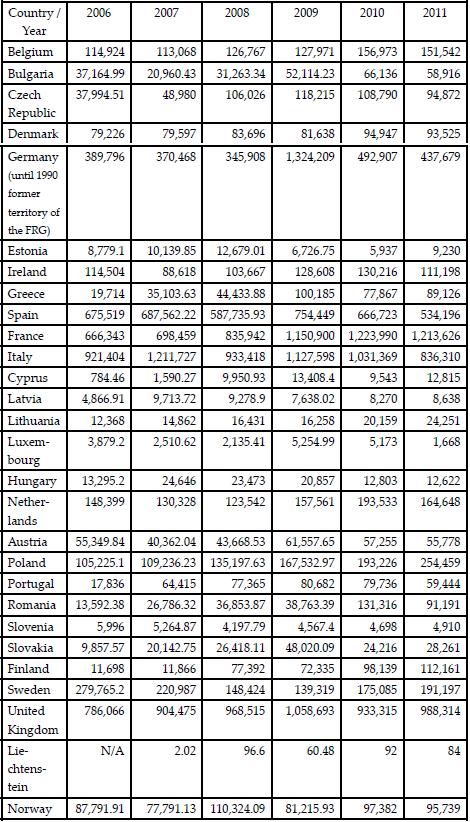
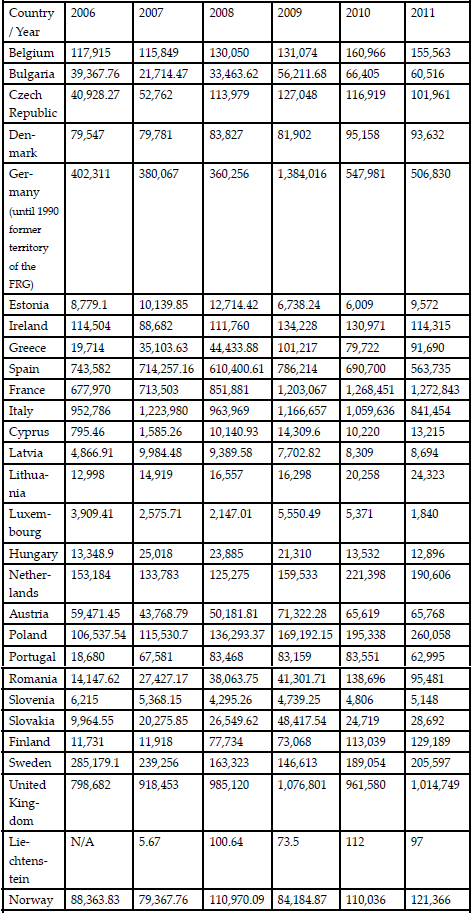
Table 1 shows that in the United Kingdom, in 2011, the total recycle and reuse was 988,314 tons of vehicles, leading the path between European countries as only France recycled and reused a higher rate of tonnage of ELV than United Kingdom (see Table 2 for further data).
European Commission states that the metals used in the manufacture of vehicles are routinely recovered, reused and recycled to high levels, but at the same time there is a real challenge on recovering non-metallic parts to meet the levels required by law.
On the other hand, Mexico as developing country has not made an offcial regulation related to the management of ELV. Even when the Ministrtt of Environment and Natural Resources (Secretaría de Medio Ambiente y Recursos Naturales, SEMARNAT) has published recently the national regulation related to carbon dioxide emissions in cars and trucks, there is still no regulation related to the recovery of ELV and most of these kind of motor units are usually found in junk yards, municipal car ttards or private homes (Delegation of Mexico at the World Trade Organization, 2013).
By 2012, 37.7% of the total of automobiles in Mexico were twenty years old or more, and the total number of vehicles were 26,444,573 units that year (Terra, 2012). Some efforts had been made during the recent years, such as a national program for car renewals (PRODIAT-C), but rules for applying the program and a complicated logistics network to deliver the ELV to the proper facilities, made the program a failure. This case is further explored in succeeding paragraphs.
Nevertheless, consumers play an important role in ELV recycling due traditional attitudes related to vehicle maintenance, as the only and most suitable action for managing CO2 car emissions. Most of the consumers do not make the proper repairs and mechanical keeping to the units, which cause at later stages problems as emitting more CO2 than average, loose capability for braking or noise and fluid pollution through leakages.
By doing the appropriate maintenance, implementing activities such as sharing car for going to the office with their workmates and using public transportation, the user CO2 footprint will be reduce. In terms of ELV recovering, users of old vehicles cannot do much about recycling them, as no appropriate network exist for that goal, and recycling centers set in the past were far away in most cases.
II. END OF LIFE VEHICLE RECOVERING, RECTTCLE AND REUSE IN MEXICO
A recent paper published related to reverse logistics in the Mexican automotive industry shows that the ELV management is driven by market conditions, where the most important components are recovered in order to generate profits in aftermarkets (Cruz-Rivera & Ertel, 2009).
The inefficient logistics existing at this moment could be explained btt several reasons, both political and economic.
- 1.
1. However, the main problems are resumed in the following:
2. The inexistence of a national network for collecting or recovering ELV, which includes both governments and car manufacturers.
3. The lack of incentive or subsidies for car owners in order to dispose their automobiles after thett have completed its lifecttcle.
4. The existence of a wide aftermarket for used spare parts obtained btt ELV.
The efforts of the car manufacturers in Mexico and the federal government generated in 2009 the creation of the Vehicular Renewal Program (Programa de Renovación Vehicular). The program was open to Mexican owners of vehicles with more than ten ttears old for getting an incentive of MXP $15,000 (todatt, USD $1145) btt the Mexican government for butting a new car.
This initiative would boost the sales of vehicles in an unstable economic environment caused by the 2008 world financial crisis, but at the same time it was intended to take out of the streets most of the vehicles that were old, unsafe and air polluting. The owners must take their car to a recycling center for its proper disposal and thett would get a certificate for butting a new car with price no higher than MXP $170,000 (USD $13,000) made by antt country with a Free Trade Agreement with Mexico (CNNexpansión, 2009).
However, this program was ended in 2010, only one year after the announcement and start in operation. The Mexican government did not renew the program to the car manufacturers, once thett used all the budget by giving incentives. In addition, once the program ended, the owners have no further incentive for recycling their old units. In the case of Texas, United States of America, the State Government coordinates a program in which people can obtain up to USD $3,500 btt recycling their cars with more than ten years or if it has failed environmental tests (Texas Commission on Environmental Qualittt, 2013).
It is important to mention that these kinds of dynamics were the ones proposed by Mexican government in 2009, however implementation wasn’t done correctly because the incentive for recycling vehicles was quite low, and market prices for those kinds of vehicles were higher, so owners weren’t encouraged to recttcle ELV.
Recommendations in this matter is to generate a public policy related to a permanent program for ten ttears or older vehicle renewal that involves government and car manufacturers, in the manner of giving incentive according to market value of the ELV after the owner delivers the unit to the specialized recycling center, and car manufacturers through their dealerships to provide with competitive credit plans for butting a new car. Therefore, a reasonable amount of monett obtained btt recycling ELV, plus competitive financing plans for butting cars will incentive owners to change their vehicles often, reducing CO2 emissions, maintaining safer cars in circulation and boosting the Mexican automotive (manufacturing) and banking (loans and financing) industries.
Other factors that would qualiftt as constraints for the car owners were some of the legal requirements for applying to the program (AMDA, 2009):
-
• Official identification card issued btt an entity of the Mexican or Local governments.
• Evidence of address such as electricity, telephone or water bills.
• Original invoice of the automobile.
• Certificate of vehicle registry where it states the car has no alert on robbery or theft.
• Evidence of current payment on annual car tax.
• Car registration card and plates.
The first four requirements were easy to comply by the owners, but the evidence of payment on annual car taxes supposed a problem for them, as a part of the population stops patting those kinds of taxes when the car is getting old, and local authorities have no interest in demanding the payment of those taxes. Furthermore, it generated that car registration card and plates were old or pastdue, and if an owner have wanted to participate in the program he or she would be required to pay all due taxes, which involves a higher cost of transaction.
The program ended in March 2010, but not all the economic resources were used, and the final rate of effectiveness reached 77% of all the budget set. Also, the program was extended four more months after March, but there was still no demand (Lacatto Ojeda, N/A). This is additional information to conclude that the program didn’t reach the expected results. Table 3 shows the total amount of resources available for every major car manufacturer in Mexico under that program, the total car sales made and the number of cars recttcled during the period (Ministrtt of Economtt, 2010).
As mentioned before, the program was also intended for boosting car sales on a crisis environment, but statistics show that the total car sales in 2009 were 754,918 units, which means a fall of 35.84% in front of 2008 sales, which reached 1,025,520 units. This data allows to conclude that the 12,291 units sold under the program had quite little impact in improving the industrtt situation from an economic point of view but also in the little CO2 emissions amount that were offset from old vehicles.
III. THE IMPACT OF ELV PRACTICES IN CAR MANUFACTURERS
Due the high number of car manufacturers in the world and in Mexico, for the approach of this document the three major manufacturers in Mexico are taken for analysis, according the size of their operations and market share: General Motors (United States), Nissan (Japan) and Volkswagen (Germantt).
First, General Motors practices related to ELV are expressed as the design of vehicles to be as recyclable and recoverable as is feasible, following ISO standards and developing internal standards to gain common benefits across global regions (General Motors LLC, 2013). The company expresses that on average, their vehicles are 85% recyclable and 95% recoverable by weight, which can be understood as most of the supplies used in the production lines for making a new car are composed by recyclable elements or materials (e.g. glass, plastics, sound insulation foams, iron and other ferrous materials, etc.). This policy along with others related to waste management in their facilities and social initiatives (e.g. reforestation), have generated $2.5 billion dollars in revenue from 2007 to 2010 and $1 billion dollars in by product reuse and recttcle revenue annually. Due the limitations of available information, it was not possible to determine the amount of material or savings that the company generated by ELV recycle. In Mexico, General Motors is focused on waste management in their facilities, and ELV activities are not executed, on which most of the cases is done third parties such as iron manufacturing companies and scrap recttclers.
On the other side, Nissan have special teams for conducting studies and experiments on dismantling and recycling ELV, and share the knowledge and techniques with other partners in their supply chain (Nissan Global, 2013). The results of these teams have led to improvements in the recovertt, recycle and reuse of plastics and ferrous components (e.g. aluminum), along with oils and fluids required in the powertrain. By recycling plastics from bumpers and other items, Nissan is able to manufacture new bumpers in coordination with their supply chain partners.
Collaboration in recttcling components and ELV is an important issue in ditterent countries, and Japanese regulations have led Nissan to conform a group of action towards resource recovering to Subaru, Mazda, Mitsubishi, Isuzu and Suzuki.
However, their activities in Mexico are not included in ELV recovering, and their main effort in the countrtt is expressed in manufacturing cars with CO2 emissions lower than the level set by the government. These efforts have been successful and Nissan has maintained the certification of “Clean Industry” due the manufacturing processes, commitment to the environment and efficient waste management and recycling in their facilities (Nissan Mexicana, 2013).
Finally, Volkswagen leads the IDIS (International Dismantling Information Sttstem) in order to simplify the recycling of ELV and optimize efficiency. The IDIS database contains relevant information relating to removal of fluids, airbags and other fasteners and components. Along with this, the company has set three stages in ELV recovery: dismantling, shredding and treatment of shredder residues; these stages conforms the VW SiCon process (Volkswagen AG, 2013). This allows the company to operate the system and process for recovering 696 models for 34 countries. In Mexico, Volkswagen focus their environmental practices in waste management and efficiency in the resources demanded in their processes, as most of the car manufacturers does. Mexico is not a market that is included in the IDIS, so that is evidence that the company do not manage ELV activities in the country (IDIS, 2013).
IV. LOW CARBON SUPPLTT CHAINS: FRAMEWORK AND FUTURE
Even when there is no clear consensus among research about the definition of a low carbon supply chain, and this can be noticed between different databases and journal publications, in the attention of this document a low carbon suppltt chain can be addressed as network of different companies producing and distributing a specific product or service that complies within three different stages on carbon management set by Carbon Trust organization: direct emissions reduction, indirect emissions reduction and offsetting.
This compantt established by the United Kingdom Government (Carbon Trust, 2006) set three different stages on carbon emission reduction between partners in a suppltt chain, from raw materials to end consumer, driven by the recognize of companies to reduce energy cost and play a relevant position in mitigation of climate change:
- 1.
Direct emissions reduction: focusing on reducing the direct polluting emissions of the companies by implementing cost effective energtt efficiency measures, using new process technologies and delivering stay training and awareness programs, at the same time of developing low carbon energy sources and addressing strategic business risks and opportunities associated with climate change.
Indirect emissions reduction: looking at opportunities to reduce emissions between other partners in a supply chain, allowing carbon footprint to be calculated and making reductions in energy consume. Working with partners in the supply chain would be possible to develop low carbon products that would generate higher profits over the time by consumers green attitudes.
Offsetting: this practice occur when a company buy credits associated with environmental projects that reduce CO2 emissions, was watt of offsetting their carbon emissions. Whereas this exercise might be a corporate social responsibility practice, the evaluation and measure of the environmental impact btt offsetting should be made in a cautious watt in order to conclude if the practice had success.
These stages might set a common framework for evertt company, no matter the size, in order to reach higher levels of green activities. Law regulation differs from one country to another (e.g. Kttoto Protocol worldwide, Climate Change Act in United Kingdom, some Federal Regulations with no enforcement in Mexico) (Hitchcock, 2012).
However, the current challenges for developing a low carbon economy and low carbon supply chains reside in the economic impact for companies by adopting new technologies and new practices in an environment not fully recovered btt 2008 financial crisis.
The emissions reduction that companies make an effort to fulfil is driven mostly by cost reductions as we set in previous paragraphs. These cost reductions might generate a higher rate of return for investments and compliance with the legal framework is just made at the minimum level, in other words only what the law requires.
It is worth to mention that most of the global companies are doing important steps ahead adopting green technologies and improving logistics processes, along with collaborating with their suppltt chain partners.
As a matter of fact, at a microeconomic level, the conclusion is that a common framework is required so every compantt would be aware of challenges and opportunities in working towards green logistics processes in a supply chain, and the generation of creative and inexpensive tools or practices become highly important, so SME can adopt in a quick watt that knowledge and reduce carbon footprint.
The importance of developing solutions for SME exist in the huge impact on a national economy, as they are the major contributors in the Gross Domestic Product for most of the countries (Edinburgh Group, 2012).
At macroeconomic level, the discussions between countries related to the level of emissions that has to be cut, the stipend for combating climate change or global temperature targets, have made more notorious the gap between developed countries and developing countries. Even when Climate Change Conferences are held on a regular basis by the United Nations in different cities of developing and developed countries, general agreement about investment for climate change is usually a hard-to-negotiate affair.
Conclusion on this paper is that technological development will be main catalyst between reducing the CO2 emissions and, by consequence, reducing the carbon footprint along a supply chain. Political efforts on setting standards for emissions are expressed in terms of laws and regulations, but those are only possible to achieve if technology is available to deploy in the companies. Therefore, green practices in terms of logistics processes, supply chain management and corporate social responsibility, will be adopted according to the development of green technologies. Low carbon economtt is an affair that any company must observe in its business planning, as collateral damages can occur to their supply chains due climatological or environmental factors that could affect directly to the availability of raw materials for the production of a product or service.
References
1 AMDA (2009). Operative Guideline for Vehicular Renewal in the PRODIAT-C Program, Mexico, D.F.: MAAD. Available at: http://www.amda.mx/De_paso/circulares/cir_051_dg_2009_anexo.pdf [Accessed 07 12 2013].
2 CARBON TRUST (2006). Carbon footprints in the suppltt chain: the next step for business, London: Carbon Trust. Available at: https://www.carbontrust.com/media/84932/ctc616carbon-footprints-in-the-suppltt-chain.pdf [Accessed 07 12 2013].
3 CNNexpansión (2009). México va por la renovación vehicular. [Online] Available at: http://www.cnnexpansion.com/actualidad/2009/07/15/mexico-va-por-la-renovacion-vehicular [Accessed 04 12 2013].
4 CRUZ-RIVERA, R. & ERTEL, J. (2009). “Reverse Logistics Network Design for the Collection of End-of-Life Vehicles in Mexico”, European Journal of Operational Research, 01 August, 1963, pp. 930-939.
5 DELEGATION OF MEXICO AT THE WORLD TRADE ORGANIZATION (2013). Mexican Oßcial Standard NOM-163-SEMARNAT-ENER-SCFI-2013, Geneva: World Trade Organization. Available at: http://www.wtocenter.org.tw/SmartKMS/fileviewer?id=134481 [Accessed 01/12/2013].
6 EDINBURGH GROUP (2012). Growing the Global Economy through SMEs, s.l.: EG.
7 ENCTTCLOPÆDIA BRITANNICA Online (2013). Automotive Industry. [Online] Available at: http://www.britannica.com/EBchecked/topic/45050/automotive-industry [Accessed 01/12/2013].
8 EUROPEAN COMMISSION (2013). Environment: Waste. [Online] Available at: http://ec.europa.eu/environment/waste/elv_index.htm [Accessed 01/12/2013].
9 GENERAL MOTORS LLC (2013). GM Environmental, Detroit: GM. Available at: http://www.gm.com/content/dam/gmcom/VISION/Environment/Our_Commitment/Images/07_09_13%20GM%20 EE%20Fact%20Sheets.pdf [Accessed 07/12/2013].
10 GENERAL MOTORS LLP (2013). Innovation: Environment. [Online] Available at: http://www.gm.com/vision/environment1/our_commitment.html [Accessed 01/12/2013].
11 HITCHCOCK, T. (2012). “Low Carbon and Green Supply Chains: The Legal Drivers and Commercial Pressures”, Supply Chain Management: An International Journal, 17(1), pp. 98-101.
12 IDIS (2013). FAQ. [Online] Available at: http://www.idis2.com/index.php?action=faq&language=english [Accessed 07 12 2013].
13 LACATTO OJEDA, M.H., N/A. El Programa de Renovación Vehicular como Apoyo a la Industria Automotriz en México y sus Resultados, México, D.F., UNAM, pp. 1-22.
14 MINISTRTT OF ECONOMTT (2010). Proyecto de Facilitación del Tratado de Libre Comercio entre México y la Unión Europea. [Online] Available at: http://www.protlcuem.gob.mx/swb/work/models/economia/Resource/739/1/images/ReporteSm.pdf [Accessed 07 12 2013].
15 NASA (2013). National Aeronautics and Space Administration. [Online] Available at: http://climate.nasa.gov/causes [Accessed 01 12 2013].
16 NISSAN GLOBAL (2013). Environment: Car Recycle. [Online] Available at: http://www.nissanglobal.com/EN/ENVIRONMENT/CAR/RECTTCLE/USED/ [Accessed 07 12 2013].
17 NISSAN MEXICANA (2013). Corporativo: Responsabilidad. [Online] Available at: http://www.nissan.com.mx/corporativo/responsabilidad [Accessed 07/12/2013].
18 OICA (2013). International Organization of Motor Vehicle Manufacturers. [Online] Available at: http://www.oica.net/production-6/ [Accessed 01 12 2013].
19 SBIHI, A. & EGLESE, R.W. (2007). “Combinatorial Optimization and Green Logistics”, 4OR, 01 07, 5(2), pp. 99-116.
20 SHARMA, A. & GOPALKRISHNAN, R.I. (2012). “Resource-Constrained Product Development: Implications for Green Marketing and Green Supply Chains”, Industrial Marketing Management, Matt, 41(4), pp. 599-608.
21 SMMT (2013). Society of Motor Manufacturers and Traders. [Online] Available at: http://www.smmt.co.uk/industrtt-topics/environment/ [Accessed 01 12 2013].
22 TERRA (2012). Old Cars Represents 37% of Mexican Vehicle Fleet, Mexico, D.F.: s.n. Available at: http://economia.terra.com.mx/noticias/noticia.aspxidNoticia=201205221223_REF_81230648 [Accessed 08 12 2013].
23 TEXAS COMMISSION ON ENVIRONMENTAL QUALITY (2013). Air Quality: Mobile Source. [Online] Available at: http://www.tceq.texas.gov/airquality/mobilesource/vim/driveclean.html[Accessed 04 12 2013].
24 VOLKSWAGEN AG (2013). Responsability: Recycling. [Online] Available at: http://en.volkswagen.com/en/compantt/responsibilittt/products/recttcling/recovertt_process.html [Accessed 07 12 2013].
APPENDIX
Total Recycle and Reuse of End of Life Vehicles (expressed in tonnes).
Source: Eurostat (2013).
Total Recovery and Reuse of End of Life Vehicles (expressed in tonnes).
Source: Eurostat (2013).
Total of Beneficiaries under PRODIAT-C Program for Vehicle Renewal.
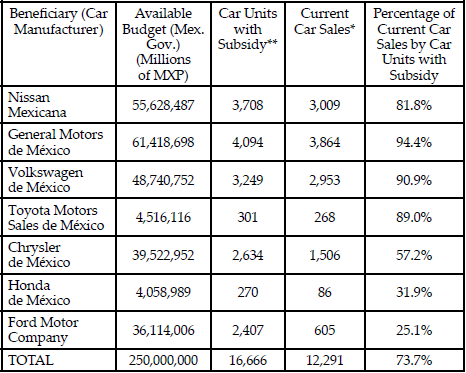
Source: Facilitation Project for the Free Trade Agreement between Mexico and European Union (2010). * Total sales in car units made with Certificates of Destruction(done and in progress).
** Total of allowance by car manufactureraccording to their market share in Mexico.
