Research articles
Received: 12 May 2021
Accepted: 22 April 2022
Published: 30 June 2022
DOI: https://doi.org/10.19052/eq.vol1.iss39.1
Abstract:
This research aimed to suggest an assessment of sustainability in livestock systems in the Colombian Amazonian Piedmont. The variables benefit-cost ratio (BCR) of the production systems and the carbon stored (CS ) in the aerial biomass (Ba ) of trees in pastures were used to construct the sustainability indicator. The percentage of productive soil and the number of heads of cattle were used as inputs. The sample consisted of 37 farms. The indicator was obtained with the non-parametric Data Envelopment Analysis method. The results showed that 8% of the production systems were on the sustainability threshold, and the remaining 92% had the potential for improvement, specifically through increased BCR, efficient use of productive land, and increased carrying capacity. It was concluded that the sustainable farms had an average BCR of 2.3 and registered an average CS in Ba of 2.14 t·ha-1 , using 13.6% of the extension of the farm as productive soil.
JEL Classification: C61, D22, Q56
Keywords: Sustainability indicator, ecosystem services valuation, carbon storage, data envelopment analysis.
Resumen: Esta investigación tuvo por objetivo proponer una valoración de la sostenibilidad de los sistemas ganaderos del piedemonte amazónico colombiano. Para construir el indicador de sostenibilidad se usaron las variables razón beneficio costo (RBC) de los sistemas productivos y el carbono almacenado (CA ) en la biomasa aérea (Ba ) de árboles en pasturas. El porcentaje de suelo productivo de la finca y el número de cabezas de ganado se utilizaron como insumos. La muestra fue de 37 fincas. El indicador se obtuvo mediante el uso del método no paramétrico Análisis de la Envolvente de Datos. Los resultados mostraron que el 8 % de los sistemas productivos estaban en la frontera de la sostenibilidad y el 92 % restante tenían un potencial de mejora, específicamente en aumentos en la RBC, el uso eficiente del suelo productivo y el aumento en la capacidad de carga. Se concluyó que las fincas sostenibles tuvieron una RBC promedio de 2,3 y registraron un promedio de CA en Ba de 2,14 t·ha-1 , empleando un 13,6 % de la extensión de la finca como suelo productivo.
Palabras clave: Indicador de sostenibilidad, valoración de servicios ecosistémicos, almacenamiento de carbono, análisis de envolvente de datos.
Introduction
Population growth and current forms of production and consumption have generated the environmental crisis that resulted in climate change, loss of biodiversity, and overexploitation of natural and environmental resources (Constanza et al., 2017). In response, the focus on sustainability emerged as a development criterion by which the productive or consumption units guarantee the satisfaction of human needs in the socioeconomic and environmental aspects, based on the conservation of natural capital and the ecosystem balance (World Commission on Environment and Development [WCED], 1987). Current world policy has focused on these aspects to raise the so-called sustainable development goals -SDG- (Naciones Unidas, 2018).
For this reason, the assessment of sustainability in different sectors and contexts is a tool for the construction of environmental policy, in accordance with potential improvements for production units, and constitutes a baseline to strengthen communities with programs oriented towards sustainable development (Quiroga, 2007).
The Amazon is a strategic ecosystem that has been gradually reduced as a result of both colonization and the agricultural expansion to implement inefficient production systems, which fragment forests and, therefore, the ecosystem services that they sustain (Phillips et al., 2016). After the oil industry and its derivatives that emit about 85% of the Greenhouse Gases (GHG), the agricultural sector is responsible for emitting between 14 to 18% of the GHG, in essence methane (CH4), dioxide carbon (CO2), and nitrous oxide (N2O), and this is primarily attributed to the enteric fermentation of cattle (Ritten, Bastian, & Rashford, 2012).This environmental problem has been persistent, due to the economic representativeness of the agricultural sector in the regional economy, and it has result in high environmental costs (Brown et al., 2005; Gerber et al., 2013).
From this point of view, the rural production systems in the Amazon should be evaluated for changes in soil use and coverage, not only in terms of its financial profitability, but also for the achievement of its socio-economic goals, improvements in settler quality of life and social welfare, and environmental impacts generated, in order to decide if it should evolve with a focus on sustainability (Peña-Venegas & Cardona-Vanegas, 2010).
Theoretical references
Evaluating the sustainability of Latin America has mainly involved the construction of indicators developed by the Economic Commission for Latin America and the Caribbean -ECLAC-, the Inter-American Development Bank -BID- and the World Bank -BM-, among others (Pardo-Rozo & Sanjinés-Tudela, 2014). For the agricultural sector, indicators of biodiversity, deforestation, species depletion, carbon footprint, water footprint, quality of life, poverty, human development, environmental impact, and other forms of sustainability measurement have been developed. These include the Framework for the Assessment of Natural Resource Management Systems incorporating Sustainability Indicators (MESMIS), capital and life analysis (Sepúlveda et al., 2005; Schuschny & Soto de la Rosa, 2009). However, these indicators are partial, while the assessment of sustainability demands an integral indicator that consolidates socioeconomic and environmental dimensions (Muñoz, 2007; Cecchini et al., 2018; Heidari et al., 2021).
In the Colombian Amazon, studies have been carried out to diagnose and monitor environmental problems, as well as to seek alternatives for agricultural development that are more environmentally viable (Ramírez et al., 2004; Ramírez et al., 2013; Instituto Amazónico de Investigaciones Científicas SINCHI, 2015). However, it is important to evaluate the sustainability of the farm systems and understand the potential for improvement in the Colombian Amazonian piedmont.
Valorization of sustainability is a crucial process for measuring the effectiveness of local administrations and sectoral policies for rural development, aiming to protect and conserve indispensable resources with strategies developed in Colombia to mitigate and adapt to climate change (Álvarez et al., 2013). Such methods must integrate the potential of ecosystem services (Balvanera et al., 2017), which can add value to the land and strengthen production processes (Millennium Ecosystem Assessment, 2005; Ruíz & Bello, 2014; Toledo et al., 2018).
Methods
The study was developed in the towns of Belén de los Andaquíes (1º 24'59’’ N, 75º52’22’’W) in the Amazon piedmont of the state of Caquetá (Colombia) (Figure 1). The topography of the sector is undulated with altitudes between 250-530 m (Sistema de Información Ambiental Territorial - Amazonia Colombiana [SIAT-AC], 2018). The climate is characterized by presenting, on average, 3758 mm of annual precipitation, 25.8ºC of average temperature, and 4.3 h·day-1 of sun light (Instituto de Hidrología, Meteorología y Estudios Ambientales, 2020).
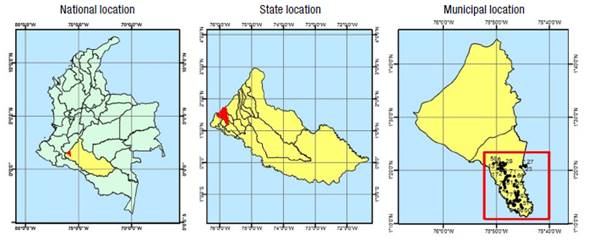
Figure 1
Production units of the mine in Belén de los Andaquíes, Caquetá, Colombia
Source: own work
Of the 297 properties in the area, 37 were randomly selected , considering the proportion of farm operation and size (Hernández et al., 2014). These agricultural systems of the Amazonian piedmont had the following characteristics: i) areas with traditional livestock, agricultural, and forestry practices, ii) areas with presence of traditional systems but updated with policies for transition to sustainable systems and the promotion of ecotourism, iii) areas with locations connecting spaces between national and municipal natural parks, iv) area with water and biodiversity richness, and v) area with potential for the establishment of economic incentive compensation systems for ecosystem services (Ramírez et al., 2012; Ramírez et al., 2013).
The primary information was collected directly from the producers, through a structured survey with questions about socioeconomic and environmental aspects. The variables to estimate the sustainability indicator were the benefit-cost ratio (BCR) of the production systems, the carbon stored (CS ) in the aerial biomass (Ba ) of trees in pastures, the percentage of productive farm soil, and the number of heads of cattle.
Valorization of sustainability considers the Benefit Cost Ratio (BCR) as a socioeconomic variable because of the financial viability of all the production activities that are carried out on the farm. This data demands the construction of cash flows for each production unit, which incorporate both the dynamics of the income and costs reported by the producer (according to market prices) and the quantity of products versus the costs of production factors (labor, land, and capital). The benefit-cost ratio was calculated from the quotient between the net present value of the incomes and the net present value of the costs (Castro-Rodríguez et al., 2008). The opportunity interest rate (OIR) used to discount cash flow was 12 % for social projects (DNP, 2018). It was compared to the Internal Return Rate (IRR), another financial criterion for decision-making (Castro-Rodríguez et al., 2008).
The CS was used as a variable of the environmental dimension of sustainability. The CS is a strategic ecosystem service in mitigation and adaptation to climate change. The carbon stored data were taken from the study by Pardo-Rozo et al. (2021). This study established temporal sampling plots of 500 m2 in pastures with trees on each farm. In total, there were 40 plots (2 ha). Then, all trees with a trunk diameter at breast height (dbh) > 10 cm, located in the plots, were measured. The stored carbon (CS ) per hectare was estimated based on the model (Equation 1) of IPCC (2006). An estimate of the aerial biomass (Ba ) was performed using an allometric model (Equation 2) and wood density value (ρ) for tropical forests, of 0.6 g·cm-3 (Álvarez et al., 2012).
The CO2 carbon equivalent (CO2 eq ) was estimated according to the model (Equation 3) suggested by IPCC (2006).
With the above data, the sustainability indicator was estimated using the data envelopment analysis (Data Envelopment Analysis -DEA-), a resource for linear programming to build a synthetic indicator from partial data (Coll & Blasco, 2006; Quiroga, 2007). This approach is used to integrate variables of different sustainability dimensions to determine if the farms have been able to maximize the benefits in economic, social, and environmental terms with the lowest number of inputs (García-Cornejo et al., 2020; Nandy et al., 2021).
The sustainability indicators are calculated using the Frontier Analyst program, which sets efficiency rates between 0 and 1 for each property. Farms that obtained a score equal to one (1) were considered sustainable (efficient) because they present an optimal relationship between products (socioeconomic and environmental variables) and inputs (percentage of productive income from cattle and cattle heads). Farms with less than one (1) score are considered unsustainable (inefficient). For sustainable livestock farms, a border was built to define each farm’s improvement potential with respect to the different sustainability variables. The potential for improvement is associated with reduced inputs and increased products that farms, with a score below 1 must obtain to be considered sustainable. This information allowed for comparing farms and elucidating policies and programs aimed at sustainability.
The mathematical model was aimed at maximizing a product (U) and simultaneously minimizing inputs (V) to build a scenario that allowed each observation unit to be compared against its optimal potential. It was started from N farms that used a certain number of inputs (I) to produce products (P) in a certain period (t). Matrices X of inputs (of order I x 1) and matrix Y of products (of order P x 1) were taken for the i-th farm, and both were confirmed by the data observed from the agricultural farms, assuming constant returns for scale. The BCR and CS were used as outputs, while the percentage of productive farm soil and the number of heads of cattle were used as inputs. The technical efficiency of a given farm was estimated using the following linear programming expression:
Objective function: Max U,V (Xi, Yi)
Subject to the restrictions: VXi = 1
UYi - VXi ≤ 0
And: i = 1,2, … N
U, V ≥ 0.
where, U is a vector of P x 1 optimal products to be found (the weight of the output), V is a vector of I x 1 that represents the optimal combination of inputs to be found (the weight of the input), Xi represents the inputs of the i-th evaluated farm, Yi represents the products of the i-th evaluated farm, and N is the number of decision-making units (DMU), in this case, 40 farms. This DEA approach corresponds to a product-oriented model. However, the input-oriented model was also explored. The existence of constant returns at scale (CRS model) and variable returns at scale (VRS) were considered. Thus, the output-oriented efficiency ratio is measured between CP/CD, and in the input-oriented approach, it is constructed between the AB/AP ratio (Figure 2).
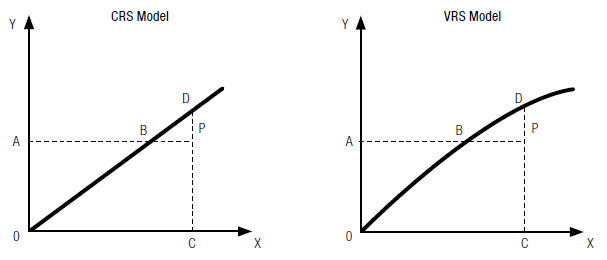
Figure 2
Product-oriented (CP / CD) and input-oriented (AB / AP) technical efficiency representations with constant returns (CRS model) and variable returns at scale (VRS model)
Source: adapted from Gamarra (2004)
Scale efficiency (SE) was obtained from the quotient between the model’s score with constant returns θCRS and the model with variable returns θVRS (in each orientation). SE is used to identify which DMUs were operating on an optimal scale. The analyses were carried out with the VRS models (Coll & Blasco, 2006). One of the advantages of this linear programming method is that it allows for treating and involving many variables of different nature (economic, social, and environmental), which are measurable in different units (some monetary and others in quantities) with values that can be continuous or discreet.
Additionally, the method allows for identifying the distance between the score calculated for each farm and the optimal sustainable score. That is, it identifies the potential improvements, the values that define how many resources (products or inputs) must be increased or decreased to reach the efficiency threshold (or, sustainability threshold in this case).
Results
Socio-economic aspects of producers in livestock systems
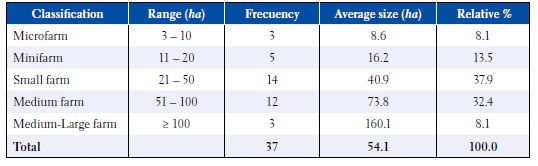
The farm size under study was 2000 ha (100%), with 1506.5 ha (75.3%) used as pasture for livestock. The farms under study were mainly small and medium-sized (Table 1), had an average extension of 54.1 ha with a minimum of 8 ha and a maximum of 178 ha, and were between 5 and 60 km from the municipal seat of Belén de Los Andaquíes (Colombia). The 37 farms under study were inhabited by a total of 140 people, representing 3.3% of the municipal rural population, and 89% were male. Households were made up of four people, on average, with a maximum of seven, and there was an average of two children per household. 80% of the producers were between the ages of 21 and 60. 33% of the producers did not have any education diploma; 26% did not finish primary school, but they know how to read and write; 7% did not carry out any study; 65% had educational qualifications, and only 2% are professionals.
According to land tenure, 87% of those surveyed were owners, 10% were on a lease, and 3% lived on the properties as family homes. 95% of the heads of the household were active on their farms, and 5% were pensioners. The average monthly income of the families was COP 732,000 (USD 216.3), observing a minimum of COP 100,000 (USD 29.5) and a maximum of COP 3,000,000 (USD 886.5). The average monthly expenditures per household (in aspects related to food, health, transportation, education, clothing, and unforeseen events) was COP 673,200 (USD 198.9), noting a minimum of COP 185,000 (USD 54.7) and a maximum of COP 4,650,000 (USD 1,374).
38% of the farms were subsistence economies because their profits were zero or they reported annual losses, presenting an RBC between 0-1. 22% were simple economies, characterized by few possibilities for capital accumulation or technological investment (their profits were positive, with RBC> 1, but without a culture of saving or investment to expand production). 40% were characterized as capital accumulation economies that generated RBC > 3 and had a culture of savings and investment. 85% of the farms employed family labor, while only 15% employed external labor. 82% of the farms were considered family production systems, and the remaining 18% were semi-commercial production systems.
Classification of the farms under study according to their size
Source: own work.
Financial and economic aspects of production systems
90% of the farms had milk production systems, and 10% were dual-purpose (meat and milk). Regarding the minority, 26.6% of the farms reported pig farming activities, 30% reported poultry meat, and 35% produced field and barn eggs, while only 2% of the producers developed aquaculture activities. The most profitable production systems were, in decreasing order: dairy farming, rubber production (Hevea brasiliensis Muell Arg.), palm oil (Elaeis guineensis Jacq.), and cocoa (Theobroma cacao L.). The latter barely managed to reach the social discount rate (SDR) for the rural sector (12%), which means that the producer decides whether to reinvest the money in agricultural activity or to instead put it into the financial system (Table 2).
Profitability indicators for rural production systems in the Caquetá Amazon piedmont considering the main economic activities

BCR: benefit-cost ratio; IRR: annual effective internal rate of return Source: own work.
According to the main economic activity, 36% of the production systems under study were agroforestry; 29% were purely livestock systems (bovine livestock with minor bird and swine species); 16% were combined agricultural units (cattle and crops); 10% were bovine livestock systems, and 9% were forest systems.
Environmental Aspects
Among the environmental aspects, the abundance of superficial and underground water resourcesoth stood out (Alcaldía de Belén de Los Andaquíes, 2020). 20% of the farms had access to water bodies, such as streams and wetlands, and 78% had creeks and streams on the properties. 83.5% of the production units were supplied from underground water sources through the construction of reservoirs. 54% of the producers stated that they had permanent water availability during dry periods. 24% considered the supply at a medium level in these periods, and the remaining 22% considered the level of water availability in dry periods low, which could affect their agricultural production activities, but not their domestic ones. With the results of the sampling plots (Table 3), the aerial biomass immersed in the 2000 ha of existing pastures was estimated at 15,600 t CS and 57,200 t CO2 .
Dasometric measurements of trees in pastures and estimates based on data collected in temporary sample plots in the Amazonian piedmont of Caquetá
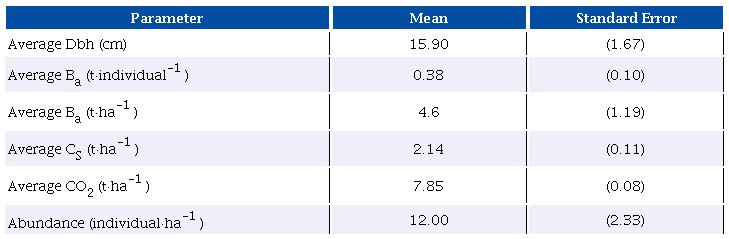
Dbh = diameter at breast height; Ba = Aerial Biomass; CS = Sequestered Carbon Source: own work.
Input-oriented model with constant returns at scale (CRS)
The challenge was to minimize the inputs (head of cattle as a percentage of production area) to produce a given level of products (CS in Ba and BCR), given the assumption of constant returns at scale. The result will be the same as the primary problem of maximizing outputs at a certain level of inputs with constant returns to scale. The distribution of the inefficiency (non-sustainability) scores was mostly concentrated between 0 and 30 (Figure 3), and only 3 efficient or sustainable farms were found (8.1%).
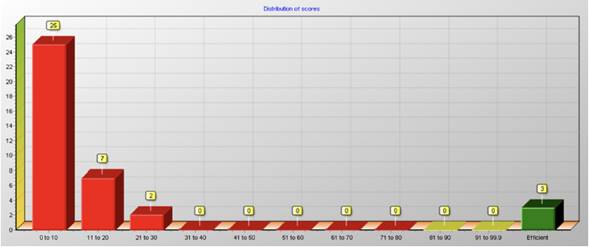
Figure 3
Distribution of model inefficiency scores with constant yields oriented to inputs (CRS input) for the properties under study in the Amazon piedmont (Caquetá, Colombia)
Source: author own elaboration using Frontier Analyst software
Input-oriented model with variable returns at scale (VRS)
The challenge was to minimize the inputs to sustain a given level of outputs. The distribution of the inefficiency (non-sustainability) scores was concentrated between 3 and 40 (Figure 4), and only showed 4 efficient farms (11%).
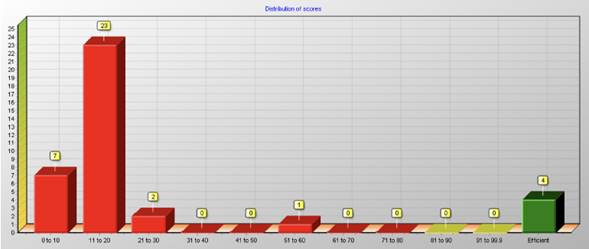
Figure 4
Distribution of input-oriented model inefficiency scores with variable returns to scale (VRS input) for the properties under study in the Amazonian piedmont (Caquetá, Colombia)
Source: author own elaboration using Frontier Analyst software
Scale Efficiency (SE)
With the sustainability scores of the previous models, the SE was calculated from the quotient between the model’s score with constant returns and the model with variable returns in each orientation (Table 4). The sustainable farms (with SE = 1) presented an average BCR of 2.3, an average CS of 3.64 t·ha-1 , and only 13.6% of its extension as a production area. These output values for the sustainable farms were higher than the average output of the sampled group’s total farms. Likewise, the average values of sustainable farm inputs were lower than those of unsustainable farms.
Descriptive statistics of sustainability scores for input-oriented models (under constant and variable returns to scale) and efficiency at scale for farms in the Amazonian piedmont
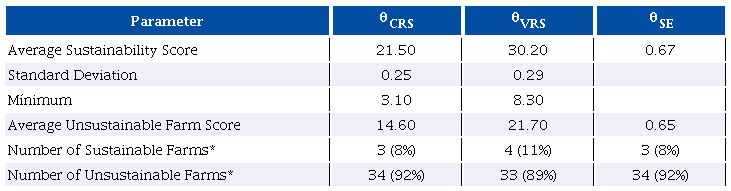
θCRS: scoring efficiency at scale with constant returns. θVRS: efficiency score at scale with variable returns. SE: Scale efficiency. *: those farms whose efficiency score was equal to 1 were considered sustainable, while the others had potential for improvement towards sustainability Source: own work.
The sustainable farms had areas between 40-60 ha (small farms) with forest cover and were located at an average altitude of 260 meters above sea level. The predominant production activity in 58% of these farms was dairy farming with minor species (pigs and chickens), while 28% were rubber forest systems, and the remaining 14% were agroforestry systems. 100% were farms with their own land tenure and were managed by family systems. The average annual profit of these farms was COP $17.65 million (USD 5,215.4) with a minimum of COP 10,650,000 (USD 3,146.9) and a maximum of COP 25,300,000 (USD 7475.9). The three sustainable farms defined the data envelopment analysis (sustainability threshold) and marked the difference between the different dimension attributes that defined sustainability (social, economic, and environmental aspects) (Figure 5).
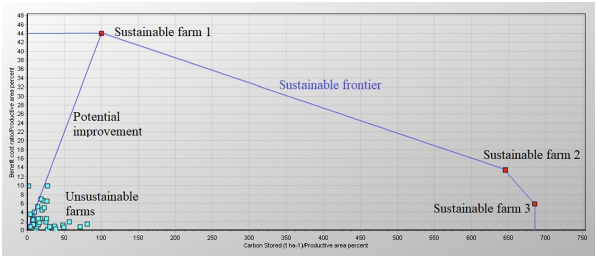
Figure 5
Threshold of sustainability in the input-oriented model with constant returns at scale (Benefit Cost Ratio: CBR, Carbon Stored CS)
Source: author own elaboration using Frontier Analyst software
Potential improvements for unsustainable farms
The present values for production area represented 86% of the total extension of unsustainable farms, where the negative sign for the improvements (%) indicates an underutilization of this resource (Table 5). Similarly, the production unit must increase its profitability, and the tree capacity to serve as carbon sinks can be improved.
Potential improvements in the farms under study in the Amazon piedmont (Caquetá, Colombia)

*: CRS = Input-oriented model with constant returns at scale. **: VRS = Input-oriented model with variable returns at scale. Source: own work.
Sustainable farms use less land and obtain both higher production and better BCR. Thus, they are more efficient in managing their resources and show that this is possible without impairing the capacity of carbon sequestration service that is stored in trees.
Discussion
The results found in this research were consistent with those reported by Zúñiga-González et al. (2015), who evaluated productivity using the DEA in dual-purpose agricultural systems of 17 Latin American countries, including countries in the Amazon basin (Bolivia, Brazil, Colombia, Ecuador, and Peru). The authors concluded that livestock is one of the activities with the highest GHG emissions, mainly methane gas (CH4), produced from bovine enteric fermentation processes. Likewise, they highlighted the importance of forested farm areas in the reported technical and environmental efficiency scores. They concluded that the valorization of loss or gain of Ba and CS helps to promote action to face climate change by reducing of greenhouse emissions and preserving carbon sinks.
In Colombia, Gamarra (2004) evaluated the efficiency of livestock and obtained an average score of 60, a value higher than that obtained in the present investigation, yet, this value was calculated without considering environmental factors. However, the sustainability assessments by Calderón-Cuartas & Flórez-Yepes (2015) and Figueroa-Lucero (2016) found that, similar to this study, sustainability depends on variables of a social, economic, and environmental nature. Conservation of ecosystem services and the financial profitability of livestock are productivity factors that play a fundamental role in the sustainability of Colombian agricultural farms. Although forests are major carbon sinks (Amézquita et al., 2008), the CS ecosystem service can be enhanced in pastures (Ritten et al., 2012) due to the magnitude of the areas used for grazing.
Local milk production (4 L·cow-1·día-1 ) is considered low compared to the regional average (4.6 L·cow-1·día-1 ) and the national average in specialized dairy (5.6 L·cow-1·día-1 ) (Torrijos & Eslava, 2018) evidenced in the study area highlights the need to generate specific adaptations of the production systems to the edaphic, topographic, hydrological, and climatic conditions of the Amazon piedmont landscape. These would help increase production and reduce the impacts on ecosystem services to protect biodiversity in endangered forests and rural soils, as Liebig et al. (2017) proposed.
The tree density in pastures found in this study (12 trees·ha-1) is within the range of 2-20 trees·ha-1 found by Trujillo et al. (2012) and close to the 17 trees·ha-1 reported by Rojas-Vargas et al. (2019) for traditional pastures of the Colombian Amazonian landscape. Likewise, the results for the ecosystem service associated with trees in pastures found in the present study were consistent with the reports by Rojas-Vargas et al. (2019) and Calderón et al. (2016) for pastures in the Caqueteña Amazon (Colombia).
The low profitability of the average livestock farms in the Amazon piedmont (compared to the national average) and the low establishment of trees in pastures (which represent low levels of carbon stored in aerial biomass) resulted in high inefficiency. The sustainability indicator found from the integration of the economic and environmental technical efficiency index showed the predominance of unsustainable agricultural systems in the area (92% of the farms).
The above resulted in potential improvements related to the use of productive land, increased carbon storage capacity in aerial biomass in pastures, and increased profitability. In this regard, Trujillo et al. (2012) and Gutiérrez et al. (2012) argue that pastures are areas in which one of the strategies can be implemented to mitigate the impacts of livestock systems productivity. The so-called trees scattered in pastures help to increase milk production because the shade, foraging provisions, and fruits improve the animals’ thermal comfort and reduce heat stress. These factors increase feed consumption and reduce the animal’s energy expenditure while contributing to the storage of carbon.
In addition, Fajardo & Facundo-Vargas (2014) demonstrated that farms in the Amazonian landscape with sustainable production systems (SPS) -such as agroforestry arrangements- are more profitable than traditional systems. Furthermore, they stated that the transition to SPS per hectare requires higher investment and costs in the first two years but is recoverable in the third year. This demonstrates that agroforestry systems are competitive and had comparative advantages with traditional systems. Other authors, such as Grassauer et al. (2021), mention eco-efficiency as an approach to managing livestock systems, a concept that takes up variables related to the concept of sustainability.
In this sense, pastures present an opportunity for adaptation toward sustainable systems by stablishing scattered trees in pastures (Álvarez et al., 2013). These can potentially be used on unsustainable farms in the Colombian Amazon piedmont to improve their SE (Pardo-Rozo et al., 2020). These strategies must be accompanied by efficient business management in the field, which maximizes the economic benefits for producers and preserves the balance of the ecosystems that intervene in the production processes (Soussana et al., 2010).
Another factor to consider that strengthens sectoral sustainability is the social context. The area under study presents limitations to development caused by the levels of poverty evidenced by low education, low production technology, and, therefore, low productivity and profitability (Pardo-Rozo et al., 2019). These effects suggest fewer possibilities for transitioning from current productive units to commercial levels. Such a transition would require production diversification, a change in the mentality of producers toward the incorporation of environmentally friendly productive alternatives (Pardo-Rozo et al., 2020), and the establishment of a policy toward the sustainable development of the rural sector. These factors could promote the comparative advantages of the Colombian Amazon piedmont in terms of natural resources, ecosystem services, biodiversity, and food security (Van Riper et al., 2017).
The sustainability of the rural economy in the Colombian Amazon piedmont can be improved if respect for ecosystem services is enhanced, and these methods are incorporated into the estimation of the production profitability. This proposal for an industry sustainability assessment can serve as the basis for developing an environmental policy that contributes to mitigating climate change from the Colombian Amazon.
Conclusions
Sustainability is a multidimensional concept that involves socioeconomic and environmental variables. The research integrated variables from each dimension of sustainability to evaluate agricultural systems in the Amazonian piedmont. The sustainability indicator calculated using the DEA optimized the relationship between the benefit-cost ratio, the carbon storage in aerial biomass in pastures, and the capacity of the livestock production areas of each farm. 8% of the sustainable farms are agroforestry systems, which combine livestock activity with rubber and palm forestry production. These operations demonstrate that economic growth is possible while conserving environmental resources. 92% of the livestock systems were not sustainable because these production units can still improve the carrying capacity, milk productivity, and profitability, as well as improve their function as carbon sinks by using pasture trees. Because forests only occupy 9% and pastures represent more than 80% of rural production soil use, the establishment or conversion towards sustainable production systems is viable (such as agroforestry systems, living fences, and pastures with trees, among others). Sustainability is a principle, a guiding criterion, capable of being materialized, valued, and evidenced in the farming sector in vulnerable landscape areas like the Amazonian piedmont.
References
Alcaldía de Belén de Los Andaquíes. (junio, 2020). Plan de Desarrollo: Belén Sigue avanzando 2020-2023. https://belendelosandaquiescaqueta.micolombiadigital.gov.co/sites/belendelosandaquiescaqueta/content/files/000406/20277_pdmbelen-sigue-avanzando-20202023-vfinal.pdf
Álvarez, E., Duque, A., Saldarriaga, J., Cabrera, K., de las Salas, G., del Valle, I., Lema, A., Moreno, F., Orrego, S., & Rodríguez, L. (2012). Tree above-ground biomass allometries for carbon stocks estimation in the natural forest of Colombia. Forest Ecology and Management, 267, 297-308. https://doi.org/10.1016/j.foreco.2011.12.013
Álvarez, F., Ocaña, H., Orjuela, J., & Suárez, J. C. (2013). Árboles dispersos en potreros en fincas ganaderas del piedemonte amazónico. Universidad de la Amazonía.
Amézquita, M., Amézquita, E., Casasola, F., Ramírez, B., Giraldo, H., Gómez, M., Llanderal, T., Velásquez, J. & Ibrahim, M. A. (2008). Chapter 3. C Stock and sequestration. In L. t’Mannetje, M. C. Amézquita, P. Buurman, & M. A. Ibrahim (Eds.), Carbon sequestration in tropical grassland ecosystems (pp. 49-67). Wageningen Academic Publishers.
Balvanera, P., Quijas, S., Karp, D.S., Ash, N., Bennett, E. M., Boumans, R., Brown, C., Chan, K., Chaplin-Krammer, R., Halpern, B., Honey-Rosés, J. H., Kim, CH. K., Martinez-Harms, M. J., Mooney, H., Mwampamba, T., Nel, J., Polasky, S., Reyers, B., Roman, J., Turner, W., Scholes, R. J., Tallis, H., Thonicke, K., Villa, F., Walpole, M., & Walz, A. (2017). Ecosystem Services. In M. Walters & R. J. Scholes (Eds.), The GEO Handbook on Biodiversity Observation Networks (pp. 39-78). Springer. https://doi.org/10.1007/978-3-319-27288-7_3
Brown, J., Koeppe M., Coles B., & Price, P. (2005). Soybean Production and Conversion of Tropical Forest in the Brazilian Amazon: The Case of Vilhena, Rondônia. Ambio A Journal of the Human Environment, 34(6), 462-469. https://doi.org/10.1579/0044-7447-34.6.462
Calderón, V., Suárez, J., Rico, A., Ángel, Y., & Rojas, L. (2016). Análisis de rentabilidad de diferentes sistemas productivos para la Amazonía Colombiana. Universidad de la Amazonia.
Calderón-Cuartas, P. A., & Flórez-Yepes, G. Y. (2015). Valoración y análisis de indicadores de sostenibilidad en seis unidades de producción agropecuaria de la cuenca media del río Chinchiná. Revista Luna Azul, (41), 77-88. https://doi.org/10.17151/luaz.2015.41.5
Castro-Rodríguez, R., Rosales-Álvarez, R. A., & Rahal G., A. (2008). Metodologías de preparación y evaluación de proyectos de inversión pública: con ayuda de planillas parametrizadas. Universidad de los Andes. http://hdl.handle.net/1992/26227
Cecchini, L., Venanzi, S., Pierri, A., & Chiorri, M. (2018). Environmental efficiency analysis and estimation of CO2 abatement costs in dairy cattle farms in Umbria (Italy): A SBM-DEA model with undesirable output. Journal of Cleaner Production, 197, 895-907. https://doi.org/10.1016/j.jclepro.2018.06.165
Coll, V., & Blasco, O. (2006). Evaluación de la eficiencia mediante análisis de la envolvente de datos. Introducción a los modelos. Universidad de Valencia. https://www.uv.es/vcoll/libros/2006_evaluacion_eficiencia_DEA.pdf
Constanza, R., de Groot, R., Braat, L., Kubiszewski, I., Fioramonti, L., Sutton, P., Farber, S., & Grasso, M. (2017). Twenty years of ecosystem service: how far have we come and how far do we still need to go? Ecosystem Services, 28, 1-16. https://doi.org/10.1016/j.ecoser.2017.09.008
Fajardo, G., & Facundo-Vargas, M. (2014). Costos de conversión en los procesos de producción de ganadería tradicional al sistema silvopastoril en fincas ganaderas del municipio de Florencia, Morelia y Belén de los Andaquíes del departamento del Caquetá. Revista FACCEA, 4(1), 1-11. https://doi.org/10.47847/faccea.v4n1a1
Figueroa-Lucero, O. A. (2016). Evaluación de la sostenibilidad de los sistemas de producción de café en fincas-hogar del sector San José, municipio de Linares-Nariño. Tendencias, 17(2), 111-125. https://doi.org/10.22267/rtend.161702.6
Gamarra, J. (2004). Eficiencia técnica relativa de la ganadería de doble propósito en la Costa Caribe (Documentos de trabajo sobre economía regional n.º 53). Banco de la República. https://www.banrep.gov.co/sites/default/files/publicaciones/archivos/DTSER-53.pdf https://doi.org/10.32468/dtseru.53
García-Cornejo, B., Pérez-Méndez, J. A., Roibás, D., & Wall, A. (2020). Efficiency and Sustainability in Farm Diversification Initiatives in Northern Spain. Sustainability, 12(10), 3983. https://doi.org/10.3390/su12103983
Gerber, P. J., Steinfeld, H., Henderson, B., Mottt, A., Opio, C., Dijkman, J., Falcucci, A., & Tempio, G. (2013). Enfrentando el cambio climático a través de la ganadería. Una evaluación global de las emisiones y oportunidades de mitigación. FAO. https://www.fao.org/3/i3437s/i3437s.pdf
Gutiérrez, G., Suarez, J., Álvarez, F., & Orjuela, J. (2012). Arboles dispersos en potreros y conectividad estructural en el paisaje de fincas ganaderas en la Amazonía colombiana. Revista Ingenierías & Amazonia, 5(1), 30-41. Recuperado de https://www.uniamazonia.edu.co/revistas/index.php/ingenierias-y-amazonia/article/view/98
Grassauer, F., Herndl, M., Nemecek, T., Guggenberger, T., Fritz, C., Steinwidder, A., & Zollitsch, W. (2021). Eco-efficiency of farms considering multiple functions of agriculture: Concept and results from Austrian farms. Journal of Cleaner Production , 297, 126662. https://doi.org/10.1016/j.jclepro.2021.126662
Hernández, R., Fernández, C., & Baptista, L. (2014). Metodología de la Investigación. McGraw Hill Education.
Heidari, M. D., Turner, I., Ardestani-Jaafari, A., & Pelletier, N. (2021). Operations research for environmental assessment of crop-livestock production systems. Agricultural Systems, 193, 103208. https://doi.org/10.1016/j.agsy.2021.103208
Instituto Amazónico de Investigaciones Científicas. (2015). Línea base para el monitoreo de la sostenibilidad de los sistemas productivos agropecuarios en el departamento de Caquetá. Ministerio de Ambiente y Desarrollo Sostenible, Instituto Amazónico de Investigaciones Científicas SINCHI.
Instituto de Hidrología, Meteorología y Estudios Ambientales (2020). Tiempo y clima. http://www.ideam.gov.co/web/tiempo-y-clima/
IPCC National Greenhouse Gas Inventories Programme. (2006). IPCC Guidelines for National Greenhouse Gas Inventories. Institute for Global Environmental Strategies (IGES).
Liebig, M., Herrick, J., Archer, D., Dobrowolski, J., Duiker, S., Franzluebbers, A., Hendrickson, J., Mitchell, R., Mohamed, A., Russell, J., & T. Strickland, C. (2017). Aligning land use with land potential: the role of integrated agriculture. Agricultural and Environmental Letters, 2, 170007. https://doi.org/10.2134/ael2017.03.0007
Millennium Ecosystem Assessment. (2005). Ecosystems and human well-being. A framework for assessment. Island Press.
Muñoz, J. (2007). Contribución a la sostenibilidad de los núcleos familiares asentados en fincas del piedemonte amazónico colombiano [Tesis doctoral]. Universidad Agraria de la Habana.
Naciones Unidas. (2018). La Agenda 2030 y los Objetivos de Desarrollo Sostenible: una oportunidad para América Latina y el Caribe. https://repositorio.cepal.org/bitstream/handle/11362/40155/24/S1801141_es.pdf
Nandy, A., Singh, P. K., & Singh, A. K. (2021). Systematic Review and Meta-regression Analysis of Technical Efficiency of Agricultural Production Systems. Global Business Review, 22(2), 396-421. https://doi.org/10.1177/0972150918811719
Pardo-Rozo, Y., & Sanjinés-Tudela, G. (2014). Valoración Económica de servicios ambientales en sistemas agroforestales en América Latina. FACCEA, 4(2), 141-150. https://www.udla.edu.co/revistas/index.php/faccea/article/view/349/360 https://doi.org/10.47847/faccea.v4n2a2
Pardo-Rozo, Y., Peña-Torres, P. & Orjuela-Cháves, J. (2019). Valoración de servicios ecosistémicos en sistemas productivos de Belén de los Andaquíes, Caquetá. Universidad de la Amazonia.
Pardo-Rozo, Y. Y., Muñoz-Ramos, J., & Velásquez-Restrepo, J. E. (2020). Tipificación de sistemas agropecuarios en el piedemonte amazónico colombiano. Revista Espacios, 41(47) 213-228. https://doi:10.48082/espacios-a20v41n47
Pardo-Rozo, Y.Y., Andrade-Castañeda, H. J., Muñoz-Ramos, J., & Velásquez-Restrepo, J. E. (2021). Carbon capture in three land use systems in the Colombian Amazonia.Revista de Ciencias Agrícolas,38(2), 111-123. https://doi.org/10.22267/rcia.213802.160
Peña-Venegas, C., & Cardona-Vanegas, G. (2010). Dinámica de los suelos amazónicos: procesos de degradación y alternativas para su recuperación. Ministerio de Ambiente y Desarrollo Sostenible, Instituto Amazónico de Investigaciones Científicas SINCHI. https://www.sinchi.org.co/files/publicaciones/publicaciones/pdf/librosuelosweb.pdf
Phillips, J., Duque, A., Scott, C., Wayson, C., Galindo, G., Cabrera, E., Chave, J., Peña, M., Álvarez, E., Cárdenas, D., Duivenvoorden, J., Hildebrand, P., Stevenson, P., Ramírez, S., & Yepes, A. (2016). Live aboveground carbon stocks in natural forests of Colombia. Forest Ecology and Management . 374, 119-128. https://doi.org/10.1016/j.foreco.2016.05.009
Quiroga, R. (diciembre, 2007). Indicadores ambientales y de desarrollo sostenible: avances y perspectivas para América Latina y el Caribe (Manuales 55). Naciones Unidas. http://hdl.handle.net/11362/5498
Ramírez, B., Estrada, C. A., Rodríguez, G., Muñoz, J., & Guayara, Á. (2004). Aporte al conocimiento y sostenibilidad de la Amazonia colombiana. Feriva Editores.
Ramírez, B., Lavelle, P., Orjuela, J., & Villanueva, O. (2012). Caracterización de fincas ganaderas y adopción de sistemas agroforestales como propuesta de manejo de suelos en Caquetá, Colombia. Revista Colombiana de Ciencias Pecuarias, 25(3), 391-401. https://revistas.udea.edu.co/index.php/rccp/article/view/324782
Ramírez, J., Libreros, H., & Suárez, J. (2013). Caracterización de los sistemas productivos y percepción de los agricultores sobre agroforestería: caso conformación red silvopastoril. Ingenierías & Amazonia, 6(2), 99-106.
Ritten, J., Bastian, C., & Rashford, B. (2012). Profitability of carbon sequestration in Western Rangelands of the United States. Rangeland Ecology & Management, 65(4), 340-350. https://doi.org/10.2111/REM-D-10-00191.1
Rojas-Vargas, E. P., Silva-Agudelo, E. D., Guillén-Motta, A. Y., Motta-Delgado, P. A., & Herrera-Valencia, W. (2019). Carbono almacenado por estrato arbóreo en sistemas ganaderos y naturales del municipio de Albania, Caquetá, Colombia. Revista Ciencia y Agricultura, 16(3), 35-46. https://doi.org/10.19053/01228420.v16.n3.2019.9515
Ruiz, C. A., & Bello, L.C. (2014). ¿El valor de algunos servicios ecosistémicos en los Andes colombianos? Transferencia de beneficios por meta análisis. Universitas Scientiarum, 19(3), 301-322. https://doi.org/10.11144/Javeriana.SC19-3.vase
Schuschny, A., & Soto de la Rosa, H. (2009). Guía metodológica: Diseño de indicadores compuestos de desarrollo sostenible. Naciones Unidas. http://hdl.handle.net/11362/3661
Sepúlveda, S., Chavarría-Miranda, H., & Rojas, P. (2005). Metodología para estimar el nivel de desarrollo sostenible en territorios (El Biograma). Instituto Interamericano de Cooperación para la Agricultura. https://repositorio.iica.int/handle/11324/7385
Sistema de Información Ambiental Territorial - Amazonia Colombiana. (2018). Información de referencia: datos básicos de la Amazonia Colombiana. Instituto de Investigaciones Científicas SINCHI.
Toledo, D., Briceño, T., & Ospina, G. (2018). Ecosystem service valuation framework applied to a legal case in the Anchicaya region of Colombia. Ecosystem Services , 29, 352-359. https://doi.org/10.1016/j.ecoser.2017.02.022
Trujillo, L., Cuellar, Y., Huaca, D., Velásquez, J., & Suárez, J. (2012). Caracterización de árboles dispersos en potreros y su efecto en la cobertura herbácea en pasturas del piedemonte amazónico colombiano. Momentos de Ciencia, 9(1), 50-58. http://www.udla.edu.co/revistas/index.php/momentos-de-ciencia/article/view/227
Van Riper, C. J., Landon, A. C., Kidd, S., Bitterman, P., Fitzgerald, L. A., Granek, E. F., Ibarra, S., Iwaniec, D., Raymond, C. M. & Toledo, D. (2017). Incorporating sociocultural phenomena into ecosystem service valuation: the importance of critical pluralism. BioScience, 67(3), 233-244. https://doi.org/10.1093/biosci/biw170
World Commission on Environment and Development. (1987). Our common future. The Brundtland Report. Oxford University Press. https://sustainabledevelopment.un.org/content/documents/5987our-common-future.pdf
Zúniga-González, C. A., Blanco-Roa, N. E., Berrios, R., Martínez-Avedaño, J., & Navas-Calderón, J. (2015). Green economies impact with methane reduction in livestock production systems on Latin America. Universitas (LEON), 6(1), 30-48. https://doi.org/10.22004/ag.econ.232905
Notes
